

You deposited stablecoins because you wanted something calmer than trading, but the search for yield can turn into a second job. One week, a lending market looks attractive. The next, an incentive program changes, a liquidity pool becomes harder to exit, or a new vault advertises a higher rate. Soon you're comparing dashboards, claiming rewards, swapping tokens, and paying fees just to keep your capital productive.
A DeFi yield optimizer is designed to handle that routing problem. It can pool deposits, monitor on-chain opportunities, move capital between approved strategies, harvest rewards, and compound returns. But automation doesn't make yield safe, and a higher advertised APY doesn't automatically mean a better outcome.
The useful question is simpler: how much yield will you realistically keep after fees, slippage, operational costs, and risk? That's the lens for evaluating the category.
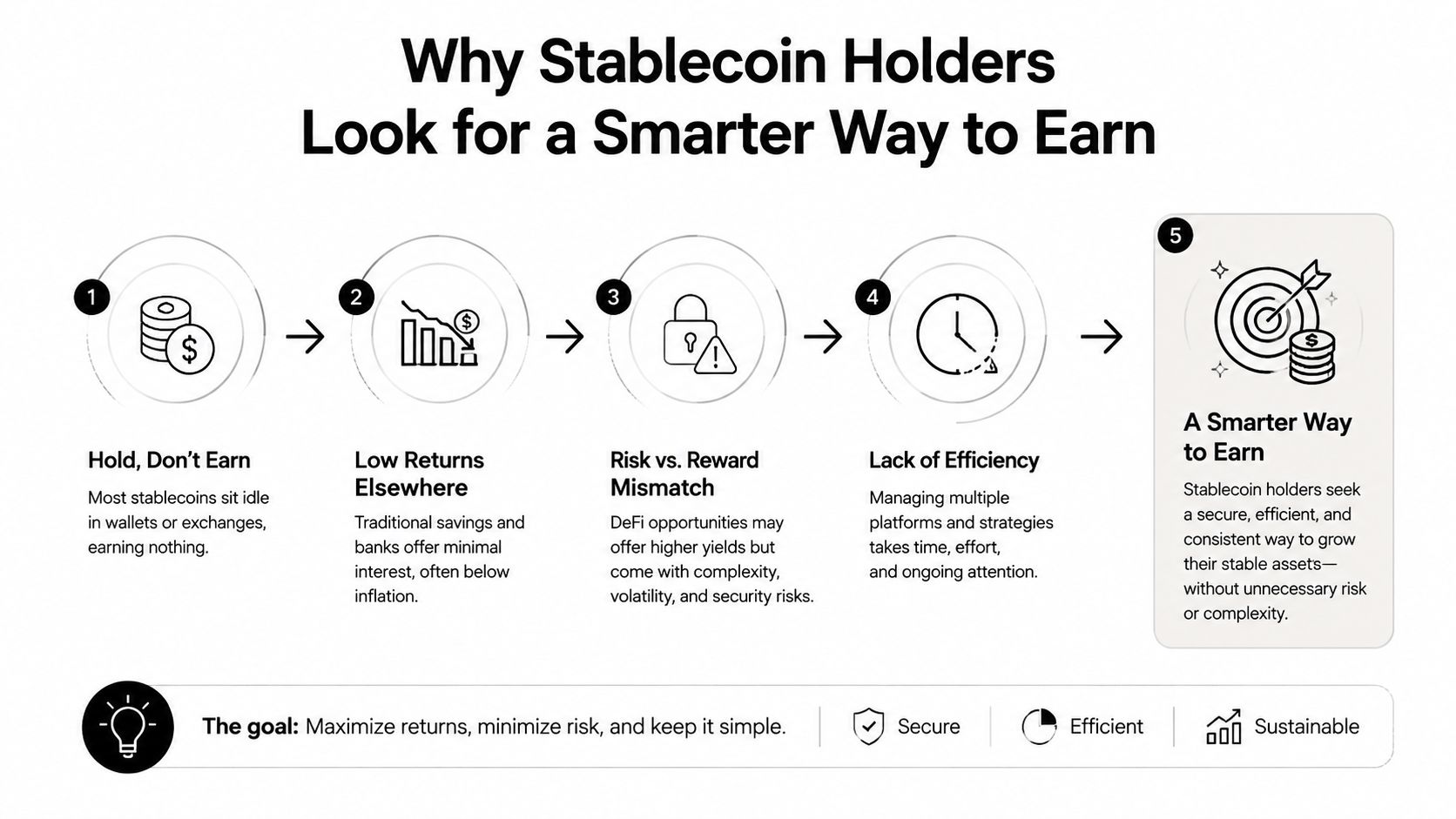
Why Stablecoin Holders Look for a Smarter Way to Earn
A stablecoin holder who found a respectable lending rate six months ago may now face a different menu: another market advertises a higher figure, a Pendle market offers different exposure, and an auto-compounding vault promises less manual work. Keeping up can become a weekly migration routine. You approve a contract, withdraw from the old venue, deposit elsewhere, claim rewards, swap them back into stablecoins, and repeat when rankings change.
The challenge is fragmentation. Yield information spans lending markets, liquidity pools, vaults, and staking contracts across thousands of pools, hundreds of protocols, and multiple chains, as described in DefiLlama's coverage of yield aggregation rankings. Comparing a few choices is manageable. Tracking every rate, incentive, liquidity condition, and transaction cost at the same time is much harder.
Stablecoins are a natural starting point for automation because their balances are designed to remain relatively stable in nominal terms. Holders generally seek income rather than profit from directional price movement. Stablecoin lending can also avoid the classic price-divergence problem found in many volatile-asset liquidity pairs.
The risks remain. Depegs, smart-contract failures, liquidity shortages, oracle problems, and shifts in borrowing demand can all affect the position.
The hidden cost of manual routing
Manual management carries costs that an APY figure may not show:
Time cost: Research new venues, read strategy documentation, and monitor changes.
Transaction cost: Withdrawals, approvals, deposits, swaps, and reward claims consume gas.
Timing cost: A rate can fall before the migration is complete.
Behavioral cost: Frequent switching can favor the most attractive headline over the most durable return.
A yield optimizer functions as a routing layer between your deposit and changing DeFi venues. It can rebalance under defined conditions, combine several activities, and compound rewards without requiring you to submit every transaction yourself. The point is not to chase the highest displayed APY. It is to route capital toward the best risk-adjusted net yield, meaning the return you realistically keep after fees, slippage, operating costs, and losses.
Practical rule: Treat an optimizer as an execution system, not a magic APY machine.
The category emerged during DeFi's 2020 growth cycle. Researchers recorded total value locked in DeFi at about $600 million in March 2020, while early aggregators quickly accumulated substantial pools. A later academic survey recorded roughly $550 million in combined TVL for Idle, Harvest, and Pickle Finance, while Vesper Finance had reached about $1 billion locked, according to the academic survey of yield aggregators. Since then, the category has expanded from single-chain vaults into broader capital-allocation systems.
What a DeFi Yield Optimizer Actually Does
Start with the broadest idea: a yield aggregator pools deposits and applies a strategy on behalf of depositors. Rather than asking each user to interact directly with several lending markets or liquidity pools, the aggregator uses contracts to account for deposits, deploy capital, collect returns, and represent each user's proportional share.
The user-facing component is usually called a vault. You approve the vault to use your asset, deposit funds, and receive a share that reflects your portion of the pooled position. The vault doesn't necessarily decide every investment action itself. That work often belongs to a separate strategy contract.
Think of a restaurant. The vault is the menu and billing system. It accepts your order, records your share, and handles the account. The strategy contract is the chef. It decides which ingredients to use, when to change the recipe, and how to combine the underlying protocols. Those protocols are the ingredient suppliers, such as lending markets, decentralized exchanges, staking systems, or incentive gauges.
The deposit-to-withdrawal loop
A typical cycle looks like this:
Deposit: You send stablecoins or another supported asset to the vault.
Deployment: The strategy contract supplies, stakes, lends, or provides liquidity according to its rules.
Accrual: Interest, trading fees, or incentive tokens accumulate.
Harvesting: The strategy claims eligible rewards and may swap them into the vault's underlying asset.
Compounding: The proceeds are redeployed, increasing the value represented by each vault share.
Withdrawal: You redeem shares and receive your proportional amount, subject to the strategy's liquidity and exit conditions.
Some vaults use a single strategy, such as supplying assets to one lending market. Others behave more like routers, distributing capital among multiple venues. Academic work describes this broader function as strategy selection and capital reallocation, with results depending on movement across fragmented markets and fee-aware execution, as discussed in recent research on automated yield strategies.
The word optimizer describes the automation and routing layer. It does not promise that the selected strategy will outperform every alternative, or that the system will avoid losses. A vault can automate a poor decision just as efficiently as a good one.
For a more technical overview of the contract architecture, see this guide to yield optimization protocol design.

Core Strategies That Power Yield Vaults
Yield vaults usually combine a few repeatable strategy families. The useful question is not only the advertised return. Ask which economic activity creates it, which assumptions support it, and what can go wrong while capital is deployed. A vault is better understood as a routing system than an APY scoreboard. Its automation matters when it directs funds toward risk-adjusted net yield, meaning the return left after fees, slippage, losses, and the operational cost of switching venues.
Lending strategies
A lending vault supplies stablecoins to money markets such as Aave, Compound, Morpho, or Silo. The user earns supply interest, while the vault may collect incentives and reinvest them. The cash-flow source is relatively direct: borrowers pay for access to liquidity.
Rates respond to utilization. If supplier deposits grow while borrowing demand stays unchanged, the rate can fall. A routing process should therefore examine liquidity, utilization, protocol parameters, withdrawal conditions, and the cost of moving funds, rather than follow the highest displayed APY.
Liquidity provision
A liquidity strategy deposits assets into a pool on Curve, Balancer, or Uniswap. Stable-to-stable and correlated-asset pools can reduce directional exposure compared with volatile pairs, yet they still carry depeg and pool-composition risk. Trading fees and incentives may be harvested and compounded automatically.
The main exposure is broader than classic impermanent loss. If one stablecoin diverges, the pool can leave the provider holding more of the asset the market trusts less. The stablecoin yield strategy guide offers a useful framework for separating pool fees from incentive-driven returns.
Compounding and looping
An auto-compounder claims reward tokens, swaps them into the underlying asset, and deposits the proceeds again. More advanced systems can use compounding loops, where collateral and debt positions are adjusted together. This arrangement increases sensitivity to rate changes, liquidation conditions, collateral value, and transaction execution.
Automation can reduce repeated manual work, but it cannot remove the underlying exposure. A failed transaction, stale price, or sudden rate move can still reduce the net yield the user keeps.
Basis, structured, and Pendle-style strategies
Structured strategies may tokenize future yield, separate fixed and variable components, or use basis and options exposures. They can provide a clearer maturity or payout structure, while introducing duration, market, counterparty, and liquidity constraints. The yield source and the exit terms need to be read together.
Strategy Family | Mechanic | Typical Stablecoin APY Range | Primary Risk |
|---|---|---|---|
Lending | Supply assets to a money market and compound interest or incentives | Not fixed, and regime-dependent | Smart-contract, utilization, and rate risk |
Liquidity provision | Provide liquidity and collect trading fees plus incentives | Not fixed, and dependent on pool conditions | Depeg, liquidity, and composition risk |
Compounding or looping | Reinvest rewards, sometimes with collateralized borrowing | Not fixed, with amplified sensitivity to rate changes | Liquidation, rate, and execution risk |
Basis or structured | Tokenize, hedge, or reshape future yield exposure | Not fixed, and dependent on structure and maturity | Duration, counterparty, and liquidity risk |
Independent market analysis describes stablecoin yield as regime-dependent. Conservative lending strategies generally cluster around mid-single-digit APY, while higher returns usually require basis trades, borrowed funds, or liquidity risk. In one low-yield regime, average TVL-weighted stablecoin APR fell to 5.8%, while time-locked or structured products reached about 12.4%, according to Galaxy's on-chain yield analysis.
The underwriter's takeaway is simple: the higher number usually has a job. It may compensate you for lockup, capital use, depeg exposure, thin liquidity, or temporary emissions. A routing decision is sound only when that compensation still outweighs the risks and costs.
Popular Optimizer Designs Worth Knowing
Different protocols optimize different steps in the routing problem. Comparing them by headline APY alone can hide what the automation changes, the risks it adds, and how much of the return remains after fees and execution costs.
Protocol | What It Optimizes | Primary Chain | Core Mechanism | Best-Fit User |
|---|---|---|---|---|
Yearn | Automated vault strategy execution and compounding | Ethereum-centered, with multichain activity | Vaults route and compound deposits through selected strategies | Users who want established vault-style automation |
Beefy | Reward harvesting across many networks | Multichain | Auto-compounding vaults reinvest farming rewards | Users prioritizing broad chain and vault coverage |
Convex | Curve-related liquidity incentives | Ethereum-centered | Layers boosted Curve rewards onto eligible liquidity exposure | Users already comfortable with Curve-linked positions |
Pendle | Separation of principal and yield streams | Multichain | Splits yield exposure into distinct tokenized components | Users who understand maturity and fixed or variable yield |
Morpho Blue | Matching between lenders and borrowers | Ethereum and other supported deployments | Permissionless lending markets with defined parameters | Users seeking lending-market flexibility and direct rate exposure |
Yearn is often treated as the classic vault aggregator. Its strategies deploy capital, harvest returns, and compound them according to their configured rules. Historical snapshots have placed its TVL at roughly $9.98 million in one period and about $184.78 million in another, with activity spread across seven chains, according to the DeFi data source's Yearn overview. These figures are changing snapshots, not a promised level of capital or performance.
Beefy concentrates on the repeated work of harvesting and compounding across networks. That breadth can reduce manual routing for a user, though each extra chain, bridge, and underlying protocol creates another dependency. The resulting APY matters only after those costs and risks are considered.
Convex is not a general stablecoin vault. It acts as an incentive layer around Curve-related liquidity. Pendle reshapes yield by separating principal exposure from future yield, making maturity, exit liquidity, and the chosen component central to the decision. Morpho Blue focuses on defined lending markets and matching rather than placing every deposit into one shared pool.
These designs fit different routing needs. A careful comparison asks, what exactly is being optimized? It may be compounding frequency, incentive access, lending efficiency, maturity selection, chain coverage, or allocation across venues. The best route is the one that leaves the strongest risk-adjusted net yield in the user's wallet, not necessarily the one displaying the highest gross rate.
The Risk Layer Most Yield Charts Hide
An APY chart shows a rate. It rarely shows the complete path your money takes to earn that rate.
Six exposures to identify
Smart-contract risk: A bug in the vault, strategy, or underlying protocol can impair or drain funds. Audits reduce uncertainty, but they don't eliminate technical risk.
Oracle risk: A manipulated or stale price feed can trigger bad liquidations, misvalue collateral, or distort a liquidity strategy.
Bridge risk: Moving assets across chains introduces an additional dependency beyond the optimizer and its underlying venues.
Governance risk: Token votes, multisignature actions, or upgrade permissions can change fees, parameters, supported assets, or strategy behavior.
Liquidity risk: A position may show an attractive return while the practical exit is delayed, queued, or expensive during stress.
Stablecoin depeg risk: A temporary deviation can change the composition and value of a supposedly conservative position.
Recent coverage also illustrates that protocol events can produce material losses. One reported 2026 incident involved nearly $4 million in losses, as described by coverage of the DeFi protocol event. The lesson isn't that every optimizer is equally exposed. It's that the wrapper doesn't erase the dependencies beneath it.

Automation changes the timing of decisions. It can react faster than a person when a rate falls, a pool becomes illiquid, or a strategy reaches a predefined threshold. That speed can help, but it can also amplify a flawed rule, an inaccurate oracle, or a temporary market signal.
The system may move funds into a new venue before a human has finished reviewing it. Rapid strategy churn can also create repeated transaction costs and increase exposure to composability failures. During a stressed market, liveness risk may matter as much as a headline exploit because users may be unable to withdraw, rebalance, or execute an emergency action when timing matters.
Automation removes repetitive execution. It doesn't remove judgment about which contracts, assets, and dependencies deserve your capital.
A practical risk review should map the entire chain of custody, from wallet approval to vault contract, strategy contract, underlying protocol, price feed, bridge, and withdrawal route. The on-chain risk management guide offers a framework for making that dependency map explicit.
How to Read Yield Like an Underwriter
An underwriter doesn't start with the largest number on a dashboard. They ask what supports it, how long it may last, and what could reduce or reverse it.
Start with the number you can actually keep
Begin with gross APY. Then subtract the costs that affect realized results:
Protocol fees: Performance, management, withdrawal, or other stated charges.
Harvest costs: Gas and execution costs associated with claiming and reinvesting rewards.
Reward conversion: The spread and slippage involved in swapping incentive tokens into the deposit asset.
Exit costs: Slippage, queue delays, lockups, or penalties that make withdrawal less efficient.
A yield report on stablecoins described a typical APY band of 2% to 6%, with sustainable returns often clustering near money-market ranges. The same coverage notes that double-digit rates commonly reflect incentives, stress, or smaller and riskier pools, as discussed in recent stablecoin yield analysis. When a vault's headline rate compresses toward the supply rate of a major lending market, much of its extra return may already be gone.
Ask five uncomfortable questions
What did the audits review? Check the date, severity of findings, scope, and whether the current strategy matches the audited code.
What is happening to TVL? Rising capital can indicate adoption, but it can also make a rate less attractive by changing utilization. Falling capital can reduce concentration, or signal withdrawals.
How do I exit? Identify whether withdrawals are instant, queued, dependent on underlying liquidity, or subject to a pause.
Where do incentives come from? Revenue from borrowers, traders, or protocol fees has a different durability profile from emissions that may end.
What happens during a failure? Read the emergency controls, upgrade permissions, oracle dependencies, and loss-socialization terms.
Underwriter's rule: If you can't explain where every basis point comes from, you don't yet own the yield.
Choosing the Right Setup for Your Goals
The right setup depends on how much oversight you want, which risks you can tolerate, and whether you need immediate access to your funds.
Manual routing suits users who can evaluate lending markets, liquidity pools, reward schedules, contract permissions, and withdrawal mechanics. You get direct control, but you also carry the research burden and must decide when moving funds is worth the transaction cost.
Vault platforms suit users who prefer a standardized interface and an established strategy wrapper. They can reduce repetitive work, but you still need to inspect the vault's assets, underlying protocols, fees, audit coverage, share accounting, and exit path. A familiar interface shouldn't be mistaken for a lower-risk contract.
AI-driven allocation, including a platform such as Yield Seeker, can suit stablecoin holders who want ongoing opportunity screening and automated allocation on Base. Its stated product design supports deposits from $10 USDC, with funds remaining accessible and no lockups or withdrawal fees, as described by the publisher. Those product details should still be checked against the current terms before depositing, just as you would verify a vault's controls and fees.
Start with the job your capital needs to do:
Capital preservation: Prefer simpler assets, transparent strategies, strong liquidity, and limited protocol concentration.
Stablecoin income: Compare lending, liquidity, and structured routes by realized net yield rather than gross APY.
Higher returns: Accept that amplifying positions, incentives, basis exposure, lockups, and thinner liquidity may become part of the trade.
Minimal oversight: Choose automation only when the system explains allocation decisions, applies concentration limits, and provides a clear exit route.
Before committing, verify minimum deposits, supported wallets, chain compatibility, gas requirements, withdrawal timing, and behavior during depegs or oracle failures. Start with a small allocation, cap exposure to one protocol family, and record the value you receive after fees and slippage.
The core test is straightforward: automation should replace repeated research and transaction management, not hide the risk behind a cleaner dashboard.
Yield Seeker helps stablecoin holders screen and allocate across DeFi opportunities through an AI-powered agent designed to monitor rates, incentives, liquidity, and risk on Base. If you want to compare automated routing with manual vault management, visit Yield Seeker and evaluate its controls, fees, accessibility, and strategy explanations before you deposit.