
You deposit into a pool, watch fees come in, and still end up with less total value than if you'd done nothing but hold the tokens in your wallet. That result feels wrong the first time you see it. It isn't a bug, and it isn't always a disaster. It's the cost of letting an automated market maker rebalance your assets while traders move through the pool.
That cost is impermanent loss. Most explanations stop at "you lose money when prices change," which is too shallow to be useful. If you're allocating serious capital, you need a better model. You need to know when impermanent loss is likely to matter, when fees can cover it, and when a seemingly safe pool can still punish lazy positioning.
If you're still building your broader operating model for onchain risk, it helps to pair this topic with a more general guide to secure crypto trading and a practical review of yield farming risks. Impermanent loss isn't an isolated DeFi quirk. It's one piece of a larger discipline: getting paid for risk you actually understand.
The Hidden Risk of DeFi Yield Farming
Yield farming attracts people for an obvious reason. You can put idle assets to work, collect trading fees, and avoid leaving capital dead in a wallet. The problem starts when investors confuse yield with free yield. A pool can pay well and still leave you behind a simple buy-and-hold approach.
That gap is the hidden risk. When you provide liquidity to an AMM, you aren't just lending tokens to a protocol. You're accepting a specific exposure. The pool will keep changing your asset mix as relative prices move. If one token runs hard against the other, the pool sells some of your winner and buys more of your laggard. That's useful for traders. It's not always kind to liquidity providers.
What catches people off guard
A few patterns show up again and again:
Fee income looks healthy: The dashboard says you're earning, so you assume the position is working.
Wallet value lags a hold benchmark: You compare your LP position against holding the same two assets and realize the LP underperformed.
The pool did exactly what it was designed to do: The protocol rebalanced automatically. Your surprise comes from misunderstanding the trade.
Practical rule: Never judge a liquidity position by fees alone. Judge it against the value of holding the same assets outside the pool.
This is why impermanent loss deserves more respect than it gets in beginner content. It's not a niche technicality. It's one of the core reasons many "high APY" strategies disappoint once markets start moving with force.
What Is Impermanent Loss Really
Impermanent loss makes more sense when you stop thinking about it as a penalty and start thinking about it as a rebalancing effect. An AMM is like a balancing scale that keeps adjusting itself. You place two assets on the scale. As traders buy one side and sell the other, the pool shifts your inventory to maintain its pricing rule.

The balancing scale analogy
Say you deposit ETH and USDC into a pool. At the moment you deposit, the two sides are in balance according to the market price. Then ETH rises. Traders now want to buy ETH from the pool because it's cheaper there until arbitrage closes the gap. The pool responds by giving out ETH and taking in more USDC.
You don't decide this trade. The AMM does it for you.
By the time the market settles at the new price, your pool position contains less ETH and more USDC than when you started. If ETH kept climbing, that new mix often ends up worth less than holding your original ETH and USDC outside the pool. That shortfall is impermanent loss.
Why the word impermanent confuses people
The word "impermanent" leads people to think the risk isn't real until withdrawal. That's too casual. The exposure is real while you're in the pool. It's called impermanent because the gap versus holding can shrink or disappear if relative prices move back toward where they started.
A concise way to frame it is this:
Impermanent loss is the difference between the value of your LP position and the value of holding the same assets in your wallet.
That framing matters because it keeps your benchmark honest. You're not asking whether the pool made money in isolation. You're asking whether the pool outperformed the passive alternative.
Later in the section, it's worth seeing a visual walkthrough of the mechanics:
The part most people miss
The useful nuance comes from recent analysis of AMMs and LP outcomes. Impermanent loss is not a binary “profit vs. loss” outcome; it is a nonlinear exposure that can be offset by fees. It appears whenever prices move and can disappear if prices revert. Research shows IL depends on the size, persistence, and direction of price moves, not just whether an asset “went up” or “went down” according to this arXiv analysis of impermanent loss dynamics.
That single idea fixes a lot of sloppy thinking. Traders often talk as if impermanent loss only matters when a token pumps. In practice, what matters is how far the ratio moves, how long it stays there, and whether fee income is enough to compensate for the adverse rebalancing.
The practical takeaway
Liquidity provision is not passive in the way many people hope. It is closer to running a strategy that continuously sells relative winners and buys relative losers in exchange for fees. Sometimes that's exactly what you want. Sometimes it isn't.
If you remember one line, use this one:
Fees are your compensation for carrying nonlinear inventory risk inside the pool.
A Practical Example of Impermanent Loss in Action
Abstract explanations help, but a full understanding of impermanent loss often emerges only after running the math. Use a simple ETH and USDC example.
Alex deposits 0.25 ETH and 500 USDC into an ETH/USDC pool when ETH trades at $2,000. At deposit, Alex has $1,000 in value. Half is in ETH, half is in USDC.
Now ETH rises to $4,000.
If Alex had held the assets in a wallet, the math is easy. The 0.25 ETH would now be worth $1,000, and the 500 USDC would still be worth $500. The total hold value would be $1,500.
Inside the LP, though, the pool doesn't leave Alex with the original quantities. It rebalances. As ETH gets more expensive, arbitrage traders remove some ETH from the pool and add USDC. Alex's share of the pool ends up with less ETH than before and more USDC than before.
For a standard constant-product pool under this simplified setup, Alex's position ends near about 0.1768 ETH and about 707.1 USDC. At $4,000 ETH, that totals about $1,414.2. Alex still made money in dollar terms versus the starting deposit, but underperformed the hold strategy by about $85.8.
The comparison that matters
Metric | Initial State (ETH = $2,000) | Final State (ETH = $4,000) - Holding | Final State (ETH = $4,000) - In LP |
|---|---|---|---|
ETH amount | 0.25 | 0.25 | about 0.1768 |
USDC amount | 500 | 500 | about 707.1 |
ETH value | $500 | $1,000 | about $707.1 |
USDC value | $500 | $500 | about $707.1 |
Total value | $1,000 | $1,500 | about $1,414.2 |
This is the right way to read the result. Alex did not suffer an absolute collapse. Alex suffered a relative shortfall versus holding.
What the example teaches
A few practical lessons come out of this immediately:
You can be up and still have impermanent loss: The LP value rose from the starting point, but it still trailed the hold benchmark.
The pool sold the outperformer for you: Alex ended with less ETH precisely because the AMM kept rebalancing.
Fees decide whether the trade was worth it: If fee income exceeds the shortfall, the LP position can still be the better choice.
If you're still getting comfortable with the mechanics, this breakdown pairs well with a plain-English explanation of the automated market maker model.
Compare every LP position against the same assets held outside the pool. Without that benchmark, "profit" can hide a weak strategy.
The Myth of Zero Risk in Stablecoin Pools
Stablecoin pools are often presented as the safe corner of DeFi. Relative to volatile pairs, that reputation is deserved. But "lower risk" isn't the same as "no impermanent loss."

The core reason is simple. Stablecoin pools depend on relative price stability, not on a magic exemption from AMM math. If two assets are both supposed to trade near the same reference value, impermanent loss tends to stay muted. If that ratio breaks, the same mechanics reappear fast.
Where stablecoin LPs get hurt
The common failure mode is a depeg. One "stable" asset trades away from the expected one-to-one relationship, traders rush through the pool, and the LP accumulates more of the weakening side. The pool is still functioning correctly. The problem is that your inventory shifts toward the asset the market is trying to exit.
This becomes more dangerous in concentrated liquidity setups. Narrow ranges can improve fee capture when prices behave, but they also make positioning more fragile when the market moves outside the expected band.
According to Binance Academy, while stablecoin pools are a mitigation path, IL is driven by relative price divergence and can still crystallize when the 1:1 ratio changes, such as during a de-peg event. Concentrated liquidity designs can shift the tradeoff between fee capture and adverse rebalancing under market stress, a risk many users underestimate in its explainer on impermanent loss and stablecoin pool risk.
What works and what doesn't
Stablecoin LPs usually make sense when your main objective is capital efficiency with restrained volatility. They don't make sense if your actual process is "deposit and ignore."
Use a tighter checklist for these pools:
Check peg quality: Don't assume two dollar-denominated assets are interchangeable under stress.
Watch concentration risk: Narrow ranges need supervision. If the market moves, your position can stop behaving the way you expected.
Treat stable as conditional: "Stable" describes a design goal, not a guarantee.
A stablecoin pool reduces one category of risk. It doesn't remove the need to monitor the assets, the protocol, or the market regime.
Comparing Common IL Mitigation Strategies
Once you accept that impermanent loss is a real operating cost, the question shifts from "How do I avoid it completely?" to "Which trade-off do I prefer?" There isn't a universal best answer. There are only strategies that fit different risk tolerances, skill levels, and time budgets.
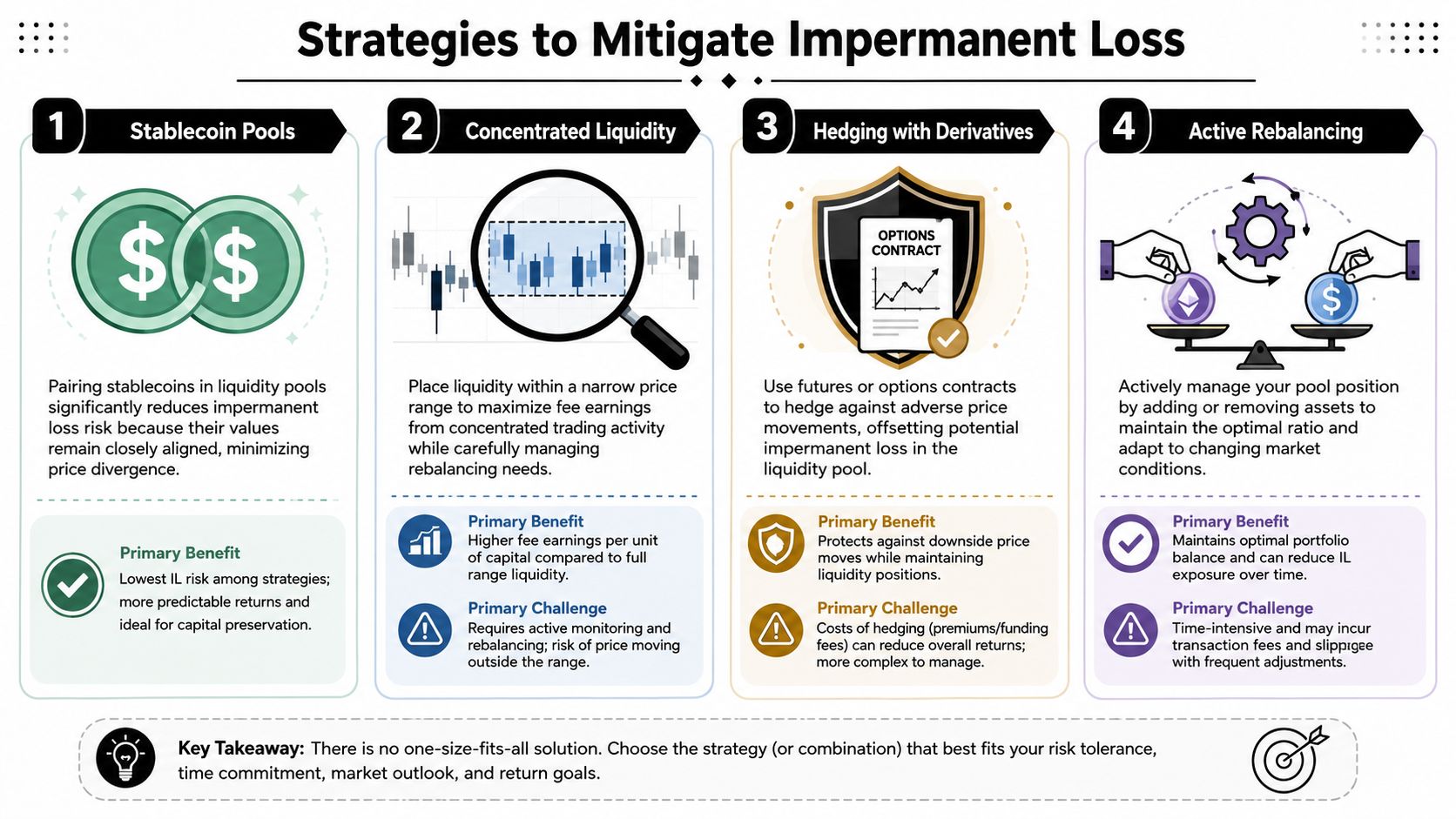
Four common approaches
Strategy | What it helps with | Main drawback | Best fit |
|---|---|---|---|
Stablecoin or correlated-asset pools | Reduces price divergence risk | Often lower upside from fee opportunities | Conservative LPs |
Single-sided liquidity systems | Avoids depositing a pair directly in some designs | Structure varies by protocol and can add other risks | Users who want simpler exposure |
Hedging with perps or options | Offsets directional market exposure | Adds cost, complexity, and basis risk | Advanced users |
Active rebalancing | Keeps positions aligned with your target view | Time-intensive and easy to execute poorly | Hands-on operators |
What each one feels like in practice
Stablecoin and correlated pairs are the default starting point for many professionals because the logic is straightforward. Smaller relative moves usually mean smaller LP distortions. The trade-off is that safer pairs can compress the payoff that attracts people to DeFi in the first place.
Single-sided liquidity sounds cleaner than it often is. In some systems, the protocol abstracts the pairing and inventory management for you. That can reduce direct friction for the user, but it doesn't erase risk. It often moves the risk around or changes its shape.
Hedging with derivatives is the most intellectually satisfying and the most operationally demanding. You can use perpetual futures or options to offset part of the directional exposure created by the LP position. In practice, this works best for people who already trade derivatives and understand funding, rollover behavior, and hedge drift.
Active rebalancing gives you the most control and creates the most room for self-inflicted damage. If you monitor ranges, update allocations, and respond quickly to market moves, you can improve outcomes. If you react late, trade emotionally, or ignore costs, manual management can become expensive theater.
The decision filter that actually helps
A simple filter works better than chasing the "optimal" method:
If you want low maintenance: Stay closer to stable or correlated pools.
If you have derivatives experience: Hedging can make sense, but only with discipline.
If you enjoy monitoring markets: Active management can outperform passive LPing.
If you hate dashboards: Don't pretend you'll manually manage concentrated liquidity forever.
For readers exploring systems that reduce that operational burden, this overview of automated liquidity management is a useful next step.
How Yield Seeker Automates IL Risk Management
Manual impermanent loss management breaks down for a simple reason. Good decisions depend on constant monitoring. You need to watch asset relationships, protocol conditions, changing yield sources, and whether your current position still pays enough to justify its risk. Many find it challenging to maintain such consistency, especially if DeFi isn't their full-time job.
An AI-driven system changes the operating model. Instead of asking a user to keep checking pools, compare strategies, and move capital by hand, the platform can monitor conditions in real time and make allocation decisions continuously. That matters because impermanent loss isn't just a knowledge problem. It's an execution problem.
Why automation is a better fit for this risk
Impermanent loss is shaped by changing relationships, not by a single static rule. That makes it a poor match for set-and-forget behavior. An automated system can evaluate whether a stablecoin-heavy strategy still looks appropriate, whether pool conditions have changed, or whether capital should move to a different venue with a better risk-adjusted profile.
In practical terms, AI delivers real value:
Continuous monitoring: It doesn't wait for you to remember to check a dashboard.
Faster response: It can react to changing conditions before small mismatches become large ones.
Cross-protocol comparison: It can weigh multiple yield sources without the user manually opening five tabs and rebuilding the same analysis.
The real advantage isn't just convenience
A lot of crypto tooling sells "automation" as comfort. The stronger case is consistency. Humans are bad at repetitive vigilance. They delay rebalancing, rationalize weak positions, and anchor to yesterday's thesis. A system built for onchain monitoring can apply the same decision logic every time.
The best IL mitigation process is usually the one you'll actually follow under stress.
That doesn't mean automation eliminates risk. It means the process becomes less dependent on mood, availability, and reaction speed. For stablecoin holders, treasury managers, and busy professionals, that's often the difference between a strategy that looks smart on paper and one that remains manageable in live conditions.
Earning Yield with Your Eyes Wide Open
Impermanent loss isn't a gotcha hidden in DeFi fine print. It's part of the economic deal you make when you provide liquidity to an AMM. You earn fees because you accept inventory risk and automatic rebalancing. If you forget that, the position will surprise you at the worst possible time.
The right response isn't fear. It's clarity. Compare LP returns against a hold benchmark. Treat stablecoin pools as lower-risk, not risk-free. Assume concentrated liquidity needs supervision. If you're using derivatives to hedge, respect the added complexity. If you're managing by hand, be honest about whether you'll maintain the process when markets get noisy.
The old habit of chasing the highest displayed APY and calling it strategy doesn't hold up anymore. Sustainable DeFi yield comes from risk-aware allocation, not from wishful thinking. Professionals who do this well don't ask only where yield is highest. They ask what exposure they are underwriting to earn it.
That's the useful frame for impermanent loss. Not a scary term. Not a reason to avoid AMMs entirely. Just a cost that has to be measured, priced, and managed like any other.
If you want a simpler way to earn on stablecoins without manually tracking pools all day, Yield Seeker offers an AI-powered approach that monitors DeFi opportunities, allocates capital with risk awareness, and keeps the experience accessible for both beginners and experienced users.