

Welcome to your definitive guide for earning sustainable, liquid yield on stablecoins in 2026. In the world of decentralized finance (DeFi), the ability to generate returns without locking up your capital is the ultimate goal. These liquid yield strategies allow you to earn passive income while keeping your funds accessible, ready to be deployed or withdrawn as your needs change. This flexibility is critical for both seasoned DeFi veterans managing complex portfolios and busy professionals looking to put their capital to work without the friction of long-term commitments.
This article moves beyond generic advice to provide a complete roundup of eight specific, actionable strategies designed for today’s market. We will break down everything from foundational approaches like lending on Aave to more advanced techniques like delta-neutral positioning and automated AI-driven allocation with tools like Yield Seeker.
Each section offers a clear, step-by-step implementation guide, a practical risk assessment, and expert tips to help you operate confidently. Forget theoretical discussions; this is a hands-on manual. You will learn how to:
Provide liquidity to automated market makers (AMMs).
Farm yield with protocol incentives.
Execute stablecoin arbitrage between exchanges.
Engage with advanced systems like Velodrome liquid lockers and Convex Finance.
Get ready to transform your stablecoins from idle assets into a powerful source of consistent, liquid returns. The goal is to equip you with the knowledge to select and execute the right liquid yield strategies for your financial objectives and risk tolerance.
1. Automated Market Maker (AMM) Liquidity Provision
One of the most foundational and accessible liquid yield strategies involves providing liquidity to an Automated Market Maker (AMM). In simple terms, this means you deposit your stablecoins into a decentralized exchange's (DEX) liquidity pool. Your assets are then used to facilitate trades for other users, and in return, you earn a percentage of the trading fees generated by that pool.
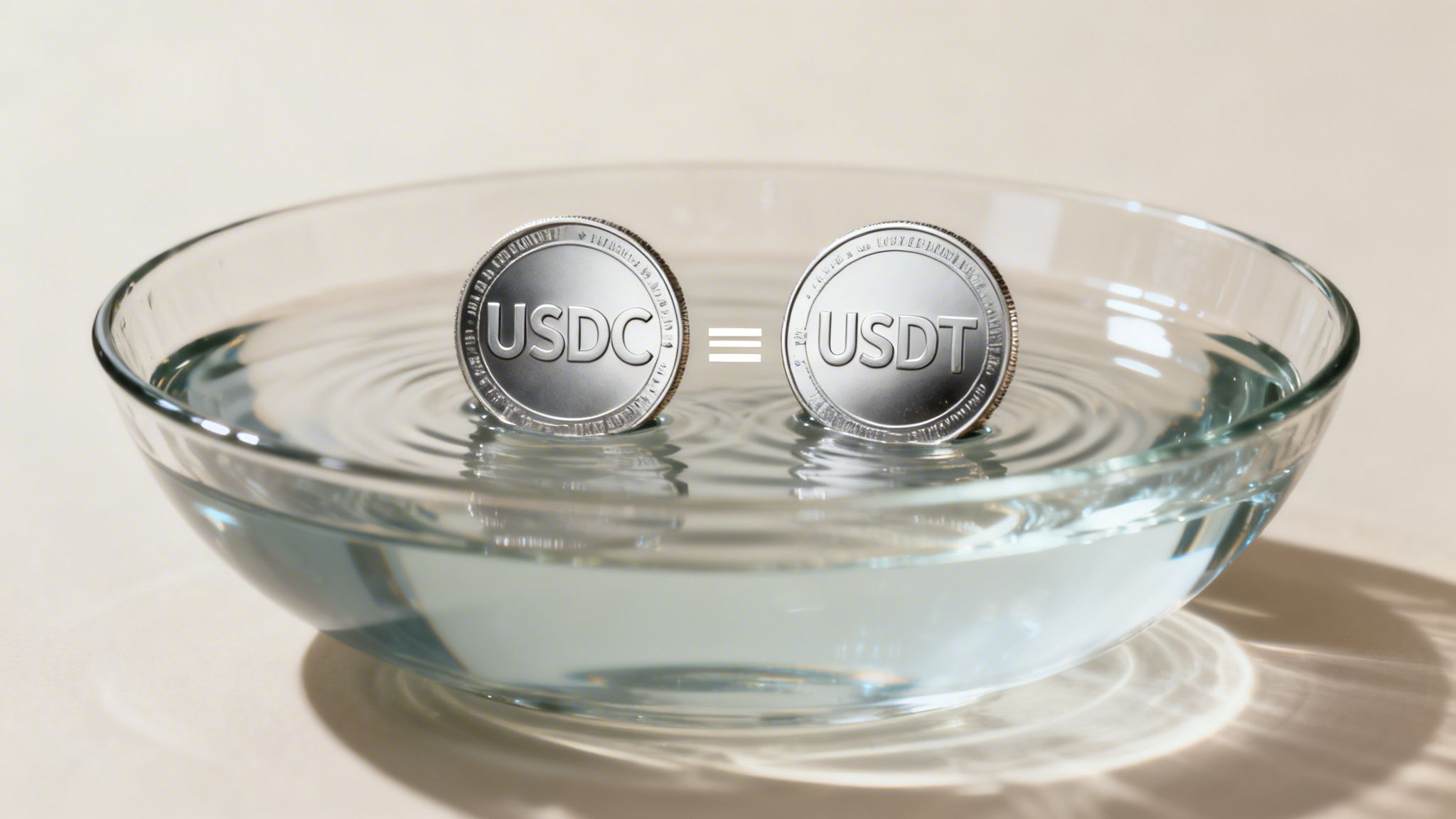
This strategy is particularly effective for stablecoin holders. By pairing two stablecoins together, such as USDC and USDT, you nearly eliminate the risk of impermanent loss, a potential downside where the value of your deposited tokens diverges. This makes stablecoin-to-stablecoin pools a lower-risk entry point into DeFi yield. You can explore a deeper explanation of how these mechanisms work by reading our guide on what liquidity pools are and why they're central to decentralized finance.
Implementation and Expected Yields
Your potential returns are directly tied to the trading volume within the pool and the specific AMM you choose.
Curve Finance: Known for its stablecoin-optimized pools, Curve's "3pool" (DAI/USDC/USDT) is a popular, lower-risk option that often generates a base APY of 3-8%.
Uniswap v3: This platform allows for "concentrated liquidity," where you can provide assets within a specific price range. A well-managed USDC/USDT concentrated position can achieve APYs between 15-25% by capturing more fees.
Balancer: This protocol enables multi-token pools and often includes extra protocol incentives, which can push yields on stablecoin pools to 20% APY or higher.
Actionable Tips for Success
To get the most out of AMM liquidity provision, a set-it-and-forget-it approach is not ideal. Active management is key.
Key Takeaway: The primary advantage of this strategy for stablecoin holders is earning trading fees with minimal price risk. Pairing stablecoins like USDC/USDT effectively sidesteps the impermanent loss associated with volatile assets.
Monitoring and Safety:
Start Small: Begin with established, high-volume pools like Curve's 3pool to understand the process with lower risk.
Track Profitability: On chains with higher transaction fees like Ethereum, always weigh your expected earnings against the gas costs of depositing, withdrawing, and rebalancing.
Adjust Positions: For concentrated liquidity on platforms like Uniswap v3, review your position quarterly to ensure it remains in an active, fee-generating range.
Automation Options: An AI-powered tool like Yield Seeker can manage these positions for you. The AI Agent can automatically monitor fee performance across different tiers and rebalance your capital to the most profitable ranges, removing the need for constant manual adjustments.
2. Lending Protocol Yield (Supply APY)
A cornerstone of DeFi, lending protocols offer one of the most direct and lowest-risk liquid yield strategies. By depositing your stablecoins into a lending protocol, you are supplying capital for other users to borrow. In exchange, you earn a variable interest rate, known as the Supply APY, paid by the borrowers.
This strategy is a popular entry point for stablecoin holders seeking passive income. Unlike providing liquidity to an AMM, there is no risk of impermanent loss. Your principal remains denominated in the stablecoin you deposited, and it simply accrues interest over time based on market demand for borrowing that asset. The safety of this approach is highest when using established protocols and their "blue-chip" asset markets.
Implementation and Expected Yields
Your returns are driven by the utilization rate of the lending pool; as more users borrow, the supply APY increases. Different protocols offer unique mechanisms that can affect your yield.
Aave: As the largest DeFi lending market, depositing USDC on Aave is a benchmark for low-risk yield. APYs typically range from 4-6% on Ethereum, but can be higher on Layer 2 networks like Arbitrum or Optimism due to lower fees and different market dynamics.
Compound: A pioneering lending protocol, Compound offers both main markets and isolated markets. Supplying stablecoins to its primary markets often yields 5-8% APY.
Morpho: This protocol acts as an optimizer on top of other lending markets like Aave. By more efficiently matching lenders and borrowers, Morpho Blue can offer superior rates, with USDC markets often reaching 8-12% APY.
Actionable Tips for Success
Maximizing your lending yield requires more than just depositing into a single protocol. Strategic placement and monitoring are crucial for capturing the best rates.
Key Takeaway: Lending protocols provide a straightforward way to earn interest on your stablecoins without exposure to price volatility or impermanent loss. The yield is generated purely from borrowing demand, making it a foundational DeFi primitive.
Monitoring and Safety:
Disable Collateral: If you do not plan to borrow against your deposit, disable its use as collateral. This is a simple security measure that prevents your assets from being liquidated in a market downturn if you had an open loan.
Focus on Layer 2s: Rates on networks like Arbitrum and Optimism are often higher than on Ethereum mainnet, and transaction costs for depositing or withdrawing are significantly lower.
Use Protocol Dashboards: Monitor the supply APY across multiple platforms. A rate that is attractive today might be lower tomorrow as market conditions change.
Automation Options: An AI-powered tool like Yield Seeker can automate this entire process. The AI Agent can constantly scan supply APYs across Aave, Compound, and Morpho on various networks. When a more profitable opportunity arises, it can automatically reallocate your funds to ensure you are always earning the highest possible, risk-adjusted yield from lending.
3. Yield Farming with Protocol Incentives
Yield farming takes the foundational strategies of lending or liquidity provision and adds a powerful layer: bonus token rewards. Many DeFi protocols distribute their own governance tokens (like CRV from Curve or BAL from Balancer) to users who provide liquidity or lend assets. This strategy combines base interest or trading fees with these valuable token incentives, often leading to significantly higher APYs.

Protocols use these incentive programs to bootstrap liquidity and attract a user base, especially when launching new markets or features. For stablecoin holders, this creates opportunities to earn amplified returns without taking on extra price volatility from the core assets. You can discover more about the mechanics behind this by exploring these DeFi yield farming strategies and how they drive growth in the ecosystem.
Implementation and Expected Yields
Your total return is a mix of the base yield and the value of the distributed reward tokens, which can fluctuate.
Aave: When launching new markets, Aave's incentive programs can push APYs on stablecoin deposits to 30-50% during the initial high-reward phase.
Curve Finance: The OG of incentive design, Curve continuously distributes CRV tokens to its liquidity providers. Certain stablecoin pools consistently offer an extra 5-15% APY in CRV rewards on top of trading fees.
Balancer: This protocol's BAL rewards are often directed toward specific pool combinations to encourage desired liquidity. It's common to find stablecoin pools with incentives that elevate total APYs to 25% or more.
Actionable Tips for Success
Actively managing your positions is critical, as incentive programs are dynamic and can change quickly.
Key Takeaway: The main draw is capturing bonus token rewards on top of your base stablecoin yield. This is one of the most effective liquid yield strategies for maximizing returns, but it requires monitoring the value of the reward token.
Monitoring and Safety:
Plan Your Exit: Compare the duration of the incentive program with any capital lock-up periods. Know when rewards are scheduled to decrease or end.
Take Profits: Don't just hold reward tokens indefinitely. Systematically sell them for stablecoins during price spikes to lock in your gains and compound your position.
Diversify: Spread your capital across multiple incentivized pools on different protocols to minimize the risk associated with a single project's reward token losing value.
Automation Options: Using an AI-powered tool like Yield Seeker can give you a major advantage. The AI Agent can automatically identify emerging, high-potential incentive programs, monitor the value of reward tokens, and rotate your capital to maintain optimal yield exposure without manual intervention.
4. Stablecoin Arbitrage (DEX to CEX Spread Trading)
One of the more active liquid yield strategies involves exploiting small price differences in stablecoins across various trading venues. Stablecoin arbitrage means you buy a stablecoin where its price is slightly lower, such as on a decentralized exchange (DEX), and simultaneously sell it where its price is higher, like on a centralized exchange (CEX), capturing the difference, or "spread."
This opportunity arises because markets are not perfectly efficient. During periods of high market volatility, network congestion, or specific platform stress, a stablecoin like USDC might trade at $0.998 on a DEX but still be redeemable for $1.00 on a CEX. While these spreads have become tighter over time due to increased market efficiency, they reliably reappear, offering brief but profitable windows for attentive traders.
Implementation and Expected Yields
Your return is a direct function of the spread width, your execution speed, and transaction costs. Unlike passive yield farming, this is an active strategy where returns are event-driven rather than time-based.
Banking Stress Events: During the 2023 US banking stress, USDC briefly de-pegged on DEXs. Traders who bought USDC on Curve and sold it on Coinbase captured spreads between 0.3-0.5% per trade.
Historical Spreads: In less volatile times, spreads between DAI and USDC on platforms like Uniswap versus Kraken have historically offered opportunities to capture 0.2-0.3%.
Cross-Chain Arbitrage: Price variations can also exist between the same stablecoin on different blockchain networks. For example, USDC on Arbitrum might momentarily trade at a different price than USDC on Optimism, creating an arbitrage opportunity for those who can bridge assets quickly.
Actionable Tips for Success
Success in arbitrage hinges on speed, accuracy, and cost management. A passive approach guarantees you will miss the fleeting opportunities.
Key Takeaway: The core of this strategy is capturing momentary price inefficiencies between different markets. Profitability depends entirely on your ability to execute faster than competitors while keeping transaction costs below the spread you aim to capture.
Monitoring and Safety:
Factor in All Costs: Before executing a trade, calculate the total cost, including DEX gas fees, CEX trading fees, and any withdrawal fees. Only proceed if the spread is wide enough to ensure profit (e.g., >0.3%).
Use Low-Cost Chains: Execute trades on Layer 2 networks like Base or Arbitrum when possible. Their lower gas fees and faster block times make it feasible to profit from smaller spreads.
Monitor Spreads in Real-Time: Use DEX aggregators like 1inch or Matcha to constantly scan for price discrepancies across multiple platforms.
Automation Options: The most effective arbitrageurs use automation. You can build custom bots or use smart contract-based services to detect and execute trades automatically. While your primary focus may be on stablecoin arbitrage across exchanges, the principle of leveraging bots for price discrepancies extends to other markets; for instance, you can learn more about how a Polymarket arbitrage bot can exploit temporary differences in odds on prediction platforms. For stablecoins, an AI agent from Yield Seeker can monitor CEX and DEX prices, automatically executing trades when a profitable spread appears, factoring in gas costs and slippage.
5. Velodrome/Thena-style Liquid Lockers and veToken Rewards
A more advanced liquid yield strategy involves engaging with protocols that use a vote-escrowed (ve) token model, such as Velodrome on Optimism or Thena on BSC. This system allows you to lock a protocol's native governance token in exchange for a ve-token (e.g., locking VELO for veVELO). Holding this ve-token grants you voting rights to direct token emissions to specific liquidity pools, and in return, you earn protocol trading fees and "bribes" from other projects seeking your vote.

The core innovation is that "liquid locker" protocols create a secondary market for these locked positions. This means you can gain exposure to the yield-generating power of ve-tokens without committing to the typical multi-year lockup periods. This strategy is excellent for users who want to participate in protocol governance and revenue sharing while maintaining a degree of liquidity.
Implementation and Expected Yields
Your returns are a combination of protocol fees, bribes, and the platform's native token emissions. APYs can be quite high but are also more variable than simpler strategies.
Velodrome (Optimism): Locking VELO for veVELO has historically generated 20-30% APY from a mix of trading fees and bribes paid to voters.
Thena (BSC): Its veTHENA token allows holders to earn a share of protocol revenue, with APYs that can reach 25-35%, depending on trading volume and bribe activity.
Aerodrome (Base): As a newer player on the Base network, its veAERO model presents an emerging opportunity to engage with a growing ecosystem from its early stages.
Actionable Tips for Success
Success in this strategy requires more active participation and research than passive lending. You must evaluate both the tokenomics and the health of the underlying protocol.
Key Takeaway: This strategy allows you to capture high yields from protocol fees and governance "bribes" without the long-term capital lockup typically required, offering a blend of utility and reward.
Monitoring and Safety:
Evaluate Fundamentals: Before locking, assess the core value and community strength of the governance token. A strong protocol is more likely to generate sustainable fees and attract valuable bribes.
Monitor Bribe Markets: Keep an eye on the bribe amounts offered each epoch. Higher bribes signal strong demand for liquidity and can significantly boost your overall APY.
Diversify Systems: To mitigate single-protocol risk, consider spreading your capital across different ve-token systems on various chains (e.g., Velodrome on Optimism and Thena on BSC).
Automation Options: An AI-powered tool like Yield Seeker can simplify this process. The AI Agent can track bribe markets and fee distribution schedules across multiple ve-token ecosystems. It can then automatically position your assets to capture the highest available rewards, removing the need for you to manually monitor voting rounds and claim rewards from different platforms.
6. Convex Finance CVX Staking and Curve Incentive Amplification
Convex Finance serves as a powerful yield amplifier for Curve Finance, one of the cornerstones of DeFi. It operates on a simple principle: by pooling user assets, Convex aggregates immense voting power within the Curve ecosystem. This allows it to direct Curve’s token emissions (CRV rewards) towards the most valuable liquidity pools, effectively boosting the yields for everyone who deposits through its platform.
This strategy is a prime example of a "money lego," where one protocol builds directly on top of another to create a more efficient financial product. Instead of staking your Curve LP tokens directly on Curve, you deposit them into Convex to earn the standard trading fees and CRV rewards, plus an additional layer of rewards in the form of Convex’s native token, CVX. This makes it one of the most popular liquid yield strategies for those already familiar with Curve.
Implementation and Expected Yields
Your returns come from a combination of trading fees, boosted CRV rewards, and CVX incentives. This multi-layered reward structure often results in significantly higher APYs than providing liquidity directly to Curve.
Convex 3pool (DAI/USDC/USDT): Depositing into this foundational stablecoin pool via Convex can boost the base APY from Curve, often achieving a total APY of 8-12% when including CRV and CVX rewards.
crvUSD/USDC Pools: Pools featuring Curve's native stablecoin, crvUSD, are heavily incentivized. Through Convex, these pairs can generate yields reaching 20% APY or more.
frxETH/ETH Pool: While not a stablecoin-only pool, this demonstrates the power of Convex for various asset types. Users often see APYs in the 12-18% range, far exceeding standard staking returns.
Actionable Tips for Success
Maximizing your earnings on Convex requires an understanding of its relationship with Curve and its reward mechanics. Simply depositing is not enough for optimal performance.
Key Takeaway: Convex boosts Curve yields by socializing the process of locking CRV for voting power. This gives individual depositors access to maximum rewards without needing to lock up their own CRV for years at a time.
Monitoring and Safety:
Compare Yields: Before depositing, always check the current APYs on Convex against depositing directly into Curve. The "Convex advantage" should be clear and justify using the platform.
Harvest Rewards: Make a habit of harvesting your earned CRV and CVX tokens. During periods of high CRV emissions, more frequent harvesting can allow you to compound your returns faster.
Assess Token Utility: Decide on a strategy for your accumulated CVX. You can sell it for more stablecoins to redeposit, or you can hold and stake it to gain voting influence on the platform.
Automation Options: An AI-powered tool like Yield Seeker can automate the entire Convex strategy. The AI Agent can monitor Curve emission schedules and gauge which pools are receiving the most votes and rewards, automatically reallocating your capital to the highest-yielding stablecoin pools on Convex. It also automates the harvesting and compounding of rewards, turning a multi-step process into a passive income stream.
7. Delta-Neutral Stablecoin Pair Strategies with Borrowed Leverage
This advanced strategy, popularized by quantitative traders, involves creating a "delta-neutral" position to capture yield from interest rate spreads between different stablecoins. You supply one stablecoin to a lending market to earn interest while simultaneously borrowing a different stablecoin against your collateral. The goal is to earn a higher yield on your supplied asset than you pay on your borrowed asset, creating a net positive cash flow without direct price exposure.
For example, if you can supply USDC to a protocol and earn a 6% APY, while borrowing USDT against it at a cost of 3% APY, you capture a 3% net yield. Since both assets are stablecoins, the risk of your collateral value dropping (and causing a liquidation) is significantly lower than when using volatile assets like ETH. This makes it one of the more calculated liquid yield strategies available.
Implementation and Expected Yields
Your return is the spread between the supply and borrow rates, minus any transaction fees. These rates are variable and depend on market demand.
Aave & Compound: These blue-chip lending protocols offer extensive markets for major stablecoins. A typical carry trade might involve supplying USDC for a 5% yield while borrowing USDT at a 2% rate, netting a 3% APY. Leverage can amplify this return, but also increases risk.
Morpho Blue: This protocol is built for efficiency, offering isolated lending markets. An optimized pair strategy on Morpho might capture a 2-4% net yield with minimal slippage and lower overhead, making it ideal for these kinds of carry trades.
Leveraged Arbitrage: A more aggressive approach involves using ETH as collateral to borrow a stablecoin like USDT, which is then swapped for USDC and supplied to a money market. This introduces price risk from the ETH collateral but can access wider yield spreads.
Actionable Tips for Success
This strategy requires diligent monitoring of interest rates and collateral health to remain profitable and safe.
Key Takeaway: The core of this strategy is capturing the interest rate differential between two stablecoins. It offers a market-neutral source of yield but demands careful management of collateralization ratios and borrowing costs to avoid liquidation and ensure profitability.
Monitoring and Safety:
Calculate Net Yield: Before entering a position, calculate all costs, including origination fees, swap fees, and gas, to confirm the trade is profitable.
Maintain High Collateral Ratios: Keep your collateralization ratio well above the liquidation threshold, ideally over 180%, especially if using volatile collateral. Using stablecoins as collateral is the safest approach.
Monitor Rate Spreads: Interest rates fluctuate constantly. Check the supply and borrow APYs daily to ensure your spread remains positive.
Automation Options: The Yield Seeker AI Agent is perfectly suited for managing delta-neutral positions. It can monitor interest rate spreads across multiple protocols in real-time and automatically trigger rebalancing actions if a spread compresses below your target profitability threshold. This automates the most labor-intensive part of the strategy, protecting your capital and optimizing returns.
8. Automated Portfolio Rebalancing with AI-Driven Allocation (Yield Seeker Model)
This advanced strategy moves beyond static positions by using artificial intelligence to continuously monitor and allocate capital across the DeFi landscape. An AI-driven system analyzes multiple protocols, automatically shifting your stablecoins to opportunities that offer the best risk-adjusted returns in real-time. It considers shifting yields, gas costs, and protocol risk metrics to make decisions, removing the need for constant manual oversight.
This approach represents one of the most dynamic liquid yield strategies available. Instead of you choosing a single pool and hoping it performs well, the AI acts as a portfolio manager, actively seeking and capturing yield on your behalf. To maintain optimal allocation and manage risk in a dynamic environment, understanding the fundamentals of automated portfolio rebalancing is key.
Implementation and Expected Yields
Returns are highly dynamic and depend on market conditions and the AI's ability to capitalize on them. The goal is to consistently outperform static single-protocol strategies.
Yield Seeker: This AI-first platform dynamically allocates stablecoins like USDC across top-tier protocols like Aave, Curve, and Compound based on live APYs.
Automated Incentive Capture: The AI can detect when a protocol like Curve launches a new incentive program, automatically deploying capital to capture the temporary yield boost before it diminishes.
Risk-Managed Exits: If a protocol's yield drops below your defined threshold or its risk score increases, the system will automatically exit the position and reallocate capital elsewhere.
Actionable Tips for Success
Trusting an automated system requires a foundational understanding of its actions. The focus here is on setting parameters and monitoring the AI's performance.
Key Takeaway: The core benefit is automated optimization. The AI handles the complex, time-consuming task of chasing the best yields across DeFi, effectively acting as a full-time analyst for your stablecoin portfolio.
Monitoring and Safety:
Start with Conservative Settings: Begin with the lowest risk profile to see how the AI allocates capital before increasing your exposure.
Review Allocation Decisions: Use the platform’s visual dashboard to see where your funds are and why. This helps build trust and understanding of the AI's logic.
Monitor Yield Alerts: Pay attention to notifications that explain when and why your capital has been moved. This provides insight into the market's yield dynamics.
Automation Options: The Yield Seeker model is automation by design. The AI Agent handles all the heavy lifting, from opportunity discovery to transaction execution. For those wanting to learn more about the mechanics, you can discover more about automated cryptocurrency portfolio rebalancing and how it fits into a broader wealth-building strategy.
8-Strategy Liquid Yield Comparison
Strategy | Complexity 🔄 | Resources & Monitoring 💡 | Expected Outcomes 📊⭐ | Ideal Use Cases ⚡ | Key Advantages ⭐ |
|---|---|---|---|---|---|
Automated Market Maker (AMM) Liquidity Provision | Medium — pool selection and optional concentrated liquidity | Moderate — two-asset capital, gas costs, periodic monitoring | Steady fee income; APY ~3–25% (stable pairs lower); impermanent loss risk with volatile pairs | Stablecoin holders seeking passive fee generation | Passive income, capital efficiency, transparent real-time earnings |
Lending Protocol Yield (Supply APY) | Low — simple deposit/withdraw workflow | Low — minimal ongoing maintenance; monitor rates occasionally | Predictable interest; APY typically 1–12% (higher on some L2s) | Conservative stablecoin holders who need liquidity and low complexity | Consistent yields, no impermanent loss, funds remain accessible |
Yield Farming with Protocol Incentives | High — track incentive schedules and manage reward tokens | High — active monitoring, frequent claim/harvest, token risk | Very high but temporary APYs (can exceed 50% during incentives); sustainability varies | Risk-tolerant users seeking outsized short-term returns during launches | Exceptional short-term returns and governance token accumulation |
Stablecoin Arbitrage (DEX ↔ CEX Spread Trading) | High — requires low-latency execution or automation | High — capital on multiple venues, bots, factor fees/gas | Small per-trade profits; spreads usually <0.5% except during stress events | Market-neutral traders and algo market makers with execution infrastructure | Low price exposure, scalable, profits from inefficiencies |
Velodrome/Thena-style Liquid Lockers & veToken Rewards | Medium — acquire gov tokens and manage locks/liquid positions | Moderate — monitor bribes, ve-token market and fee schedules | Fee- and bribe-driven yields ~15–40% (depends on protocol demand) | Users who want voting utility plus yield and fee revenue | High protocol fee share, liquidized ve positions, bribe revenue streams |
Convex Finance CVX Staking & Curve Amplification | Low–Medium — deposit LP/CRV to Convex, simpler than direct governance | Low — automated harvesting/compounding; monitor CRV emissions | Amplified Curve rewards; typical yields ~8–30% depending on pool | Curve LP providers seeking reward amplification without governance overhead | Higher CRV/CVX rewards, simplified UX, automated compounding |
Delta-Neutral Stablecoin Pair Strategies with Leverage | High — borrowing/supplying mechanics and collateral management | High — significant collateral, active rebalancing, liquidation monitoring | Capture interest-rate spreads; typical net yields ~2–4% (variable) | Sophisticated traders and funds targeting carry with minimal price exposure | Price-neutral carry, scalable, combines well with other strategies |
Automated Portfolio Rebalancing with AI-Driven Allocation (Yield Seeker) | Low (user) / High (tech) — user-facing simplicity, complex backend AI | Low for users — hands-off monitoring; relies on oracle accuracy and transparent logs | Optimized risk-adjusted returns; variable depending on market and risk settings | Users wanting automated diversification and continuous yield optimization | 24/7 automation, accessibility, personalized risk settings and educational insights |
From Strategy to Action: Building Your Personal Yield Portfolio
You have journeyed through a deep exploration of eight distinct liquid yield strategies, moving far beyond surface-level definitions. We have dissected everything from the foundational mechanics of AMM liquidity provision and simple lending to the more complex, higher-reward worlds of yield farming, veTokenomics, and delta-neutral positions. The purpose was not merely to present a menu of options, but to arm you with the operational knowledge needed to turn theory into tangible, income-generating action.
The central insight to carry forward is that success in DeFi yield generation is rarely about finding a single "best" strategy. Instead, it is about constructing a resilient, diversified portfolio. The true art lies in blending these different approaches to create a composite risk and reward profile that perfectly matches your personal financial objectives and comfort level with volatility.
Architecting Your Yield Engine
Think of yourself as an architect designing a personal yield engine. The components you have to work with each serve a different function:
The Foundation (Low-Risk, Stable Returns): Your portfolio's bedrock should consist of the most reliable strategies. This includes supplying stablecoins to blue-chip lending protocols like Aave or Compound and providing liquidity to deep, highly-trafficked stablecoin-to-stablecoin AMM pools. These are your workhorses, generating consistent, albeit modest, returns with minimal active management.
The Powerhouse (Mid-Risk, Amplified Returns): Here, you can layer in strategies that offer a significant boost in yield, accompanied by a calculated increase in risk. This tier includes participating in established yield farms with strong tokenomics, engaging with incentive amplifiers like Convex Finance, or participating in the liquid locker ecosystems of protocols like Velodrome and Thena. These require more monitoring for incentive changes and market shifts.
The Turbocharger (High-Risk, Peak Returns): For the most risk-tolerant portion of your capital, you might consider advanced methods. Delta-neutral strategies using borrowed assets or engaging in well-researched stablecoin arbitrage trades can deliver exceptional returns but demand expertise, active management, and a deep understanding of smart contract risk and potential liquidation events.
A prudent approach might allocate 60% to foundational strategies, 30% to powerhouse opportunities, and reserve just 10% for the turbocharger tier. This blended model provides a stable base of income while still capturing the upside potential that makes DeFi so compelling.
The Path Forward: Manual Execution vs. Automated Intelligence
The crucial next step is to decide how you will implement and manage your chosen liquid yield strategies. You have two primary paths. The first is manual execution, which offers complete control and a direct, hands-on learning experience. This path requires constant vigilance, disciplined research, and the time to monitor positions, claim rewards, and rebalance allocations as market conditions change. It is an excellent way to deeply learn the inner workings of DeFi.
The second path is automation. This is where a new class of AI-powered tools, as exemplified by our Yield Seeker model, comes into play. Instead of you manually chasing the highest yields across dozens of protocols, an AI agent can perform this task for you 24/7. It can analyze thousands of data points in real time to dynamically shift your capital between lending, liquidity provision, and other strategies, always aiming for the optimal risk-adjusted return. This approach is not about relinquishing control; it is about delegating the tedious, time-consuming execution to a system built for hyper-efficiency, freeing you to focus on high-level strategy and goal-setting.
Ultimately, whether you choose to be a hands-on portfolio manager or an architect overseeing an automated system, the principles of diversification, risk management, and continuous learning are your keys to lasting success. The world of decentralized finance does not stand still, and the most profitable participants are those who adapt and grow with it.
Ready to put these advanced liquid yield strategies into action without the manual complexity? Yield Seeker offers a personalized AI Agent that automatically manages and rebalances your stablecoins across the best opportunities on the Base chain. Start optimizing your stablecoin returns today at Yield Seeker.