

If you're still looking at a static APY figure to manage your stablecoins, you're leaving a lot of money on the table. Real-time DeFi yield tracking is about moving beyond those stale numbers. It's the process of watching and analyzing yield opportunities as they happen, block-by-block, giving you a live feed of both returns and risks.
This isn't just about getting a better rate; it's about being able to react instantly to market shifts and grab those fleeting high-yield moments before they disappear.
The End of Static APYs in DeFi
Forget everything you thought you knew about earning passive income with your stablecoins. In 2026, the DeFi yield game moves way too fast for last week's—or even yesterday's—APY numbers.
Relying on a static yield figure is like trying to day trade stocks using last week's newspaper. By the time you see the information, the opportunity is long gone.

The problem is simple: DeFi yields aren't fixed. They swing wildly based on token demand, protocol incentives, and the overall market vibe. A great yield you see right now could completely vanish in a matter of minutes. Manually chasing the best rates just doesn't work anymore if you're serious about getting the most out of your capital.
The Massive Opportunity Cost of Standing Still
For busy professionals and Web3 treasuries, a "set it and forget it" mindset is a recipe for missing out. While your funds are parked in a protocol earning a modest 5% APY, another one might pop up offering 15% on the very same asset, even if just for a short time.
Without real-time DeFi yield tracking, you'd never even know it happened.
The DeFi yield space has become incredibly active. To get a sense of the scale, let's look at some real numbers from 2026. This table gives a quick snapshot of the kind of yield opportunities out there.
Snapshot of 2026 Stablecoin Yield Opportunities
Protocol | Asset | Typical APY Range | Total Value Locked (TVL) |
|---|---|---|---|
Aave v3 | USDC | 4% - 8% | $2.5B |
Curve | crvUSD | 6% - 11% | $1.1B |
Morpho Blue | DAI | 5% - 14.5% | $950M |
Ethena | USDe | 7% - 12% | $2.2B |
As you can see, the returns can vary quite a bit. It’s this constant fluctuation that makes manual tracking so difficult but automated tracking so powerful. By 2026, the total value locked (TVL) in these yield protocols hit $10.765 billion, which was generating around $2.61 million in fees every single day.
This environment is where the real variance comes into play. While you can find conservative strategies offering a steady 4-12% APY, we've also seen fleeting peaks hit 14.5% for DAI in specific lending pools. Discover more insights about 2026 stablecoin metrics to see the data for yourself.
Ultimately, the difference between an average return and a top-tier one all comes down to timing and having the right information at the right moment.
Automation Is the New Standard
This is where automated platforms completely change the game. Instead of you spending hours hunting for yield, intelligent systems do the hard work of monitoring and moving funds for you. They plug directly into the blockchain's live data stream, sifting through thousands of data points every second to pinpoint the best risk-adjusted returns available.
This technology turns a ridiculously complex and time-consuming task into something you don't even have to think about. It helps you sidestep common mistakes, too:
Chasing Unstable Yields: A good AI-driven system can tell the difference between a solid, sustainable yield and a temporary, high-risk spike that's not worth the gas fees.
Missing New Opportunities: Automated agents are constantly on the lookout for new protocols and liquidity pools, so you don't miss out on the next big thing.
Ignoring Hidden Costs: A smart tracker calculates the true net yield by factoring in gas fees and potential slippage before it ever makes a move.
At the end of the day, real-time tracking is what connects passive investing with truly intelligent portfolio management. It gives everyone access to sophisticated strategies, making sure your stablecoins are always working as hard as they possibly can for you.
How Real-Time DeFi Yield Tracking Actually Works
Let's break down what ‘real-time’ really means when we're talking about the DeFi world. It’s not just about refreshing a dashboard once a day. True real-time tracking is a constant, automated process that pulls and analyzes data from tons of protocols every few seconds.
Think of it like a sophisticated air traffic control system. It doesn’t just put planes on a map; it's constantly tracking their speed, altitude, and flight path to keep things running smoothly and avoid any disasters. In the same way, a real-time DeFi yield tracking system watches the blockchain block-by-block, giving you a live feed of both performance and risk.
This non-stop monitoring is what separates a set-it-and-forget-it strategy from an active, intelligent one. It's the key to jumping on those high-yield opportunities that might only exist for a few minutes, and dodging hidden dangers like a sudden spike in network fees or a sharp APY drop before they can hit your portfolio.
The Flow of Real-Time Data
So, how does this all work behind the scenes? It all kicks off with grabbing data directly from the source. A tracking system is constantly pulling information from the blockchain, watching every new transaction and change as it happens.
This is way more than just reading a single APY number from a protocol's homepage. The system is looking at a whole bunch of metrics all at once:
Reward Emissions: How fast is the protocol actually paying out rewards?
Liquidity Levels: Is there enough capital in the pool to get in and out without taking a big hit on price?
Protocol Health: Are there any weird transactions or smart contract events that could signal a risk?
Gas Fees: What's the current cost on the network just to make a transaction?
This block-by-block analysis is the bedrock of effective yield optimization. It gives you the raw, unfiltered truth you need to make smart, data-backed decisions instead of just trusting advertised rates that might be stale or totally misleading.
From Data to Actionable Insights
Once all that raw data is collected, it has to be processed and normalized. A 10% APY in one protocol isn't the same as a 10% APY in another if the risks and costs are completely different. A good tracking system calculates the true, risk-adjusted return by crunching all those variables.
To really get what's going on here, you first have to understand the basics of liquidity pools and earning with yield farming. These are the fundamental engines that generate the yields we're trying to track in the first place.
Turning that mountain of raw data into clear, simple insights is what makes this technology so powerful. For stablecoin holders, it means you're no longer just guessing which opportunity is the best bet. For an in-depth look at how this works in practice, our guide on https://www.yieldseeker.xyz/blog/automated-apy-discovery offers further details on how platforms like Yield Seeker make this process seamless. The system just shows you the best, risk-adjusted yield available at that very moment.
Ultimately, the goal is to shrink the gap between seeing an opportunity and acting on it. By watching the blockchain in real time, you can move on opportunities with confidence, knowing your decision is based on the most up-to-the-second and complete data out there. This is the new standard for anyone serious about getting the most out of their stablecoins.
Understanding the Technology Behind the Scenes
Ever wonder how real-time DeFi yield tracking platforms get instant, block-by-block data? It’s not magic. It’s a powerful pipeline of specialized technologies working in concert to translate the raw chaos of the blockchain into clean, actionable insights. Think of it as a dedicated financial news network built just for DeFi.
To really get why an automated platform is such a big deal, it helps to peek under the hood at the core components doing all the heavy lifting. These tools are the reason you see accurate, live yield data without having to read raw smart contract code or manually check a dozen different protocol dashboards.
This diagram gives you a high-level look at the flow. It shows how raw data is collected from various sources, crunched by an analysis engine, and then used to pinpoint the best available yield opportunity at that exact moment.
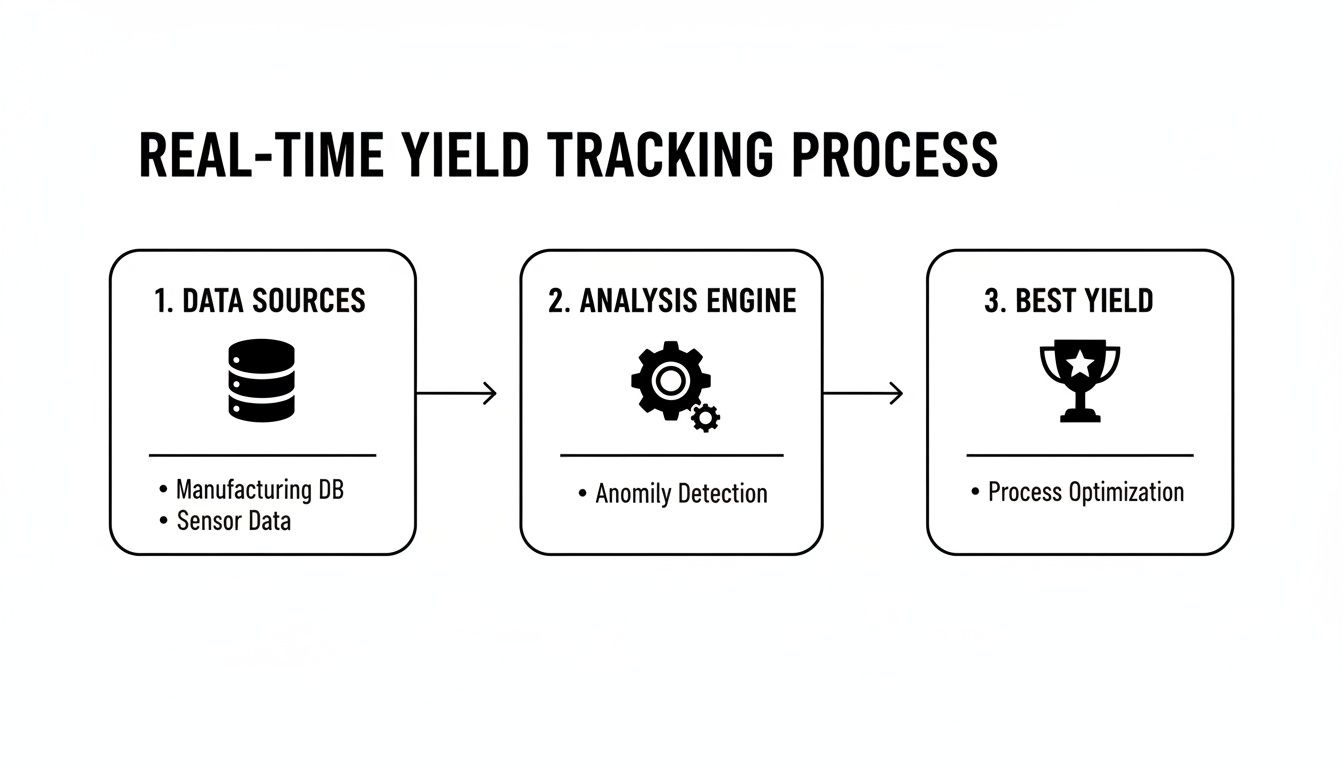
This whole process turns a flood of complex, on-chain events into a single, clear recommendation. It simplifies an incredibly difficult task.
Oracles: The Blockchain Translators
Blockchains are fantastic at keeping secure records, but they’re designed to be isolated from the outside world. This is where oracles come into play. Oracles act like trusted translators, feeding external data—like the current price of ETH in USD—onto the blockchain so smart contracts can actually use it.
For yield tracking, oracles are absolutely essential. They provide the price feeds needed to calculate the real-world dollar value of your crypto assets and the rewards you're earning. Without them, a platform wouldn't know if the 100 GHO tokens you just earned are worth $100 or have slipped to $95.
Subgraphs: The Organized Libraries
Imagine trying to find a single fact by reading an entire encyclopedia from cover to cover. That’s what it can feel like trying to query the blockchain directly for information. Subgraphs fix this by acting like a pre-organized index or a specialized library for blockchain data.
Created by The Graph, subgraphs let applications ask for specific information in a neat, structured way—for instance, "Show me all USDC deposits into this Aave pool in the last hour." This makes fetching data incredibly fast and efficient, which is non-negotiable for any real-time application.
WebSockets: The Live News Ticker
While subgraphs are great for pulling data on request, WebSockets are all about pushing it. Think of a WebSocket as a dedicated, live connection between your screen and a server. Instead of you repeatedly asking, "Anything new yet?", the server instantly pushes new information to you the second it happens.
For a yield tracking platform, this means you get live updates on things like:
APY changes: See the moment a yield rate ticks up or down.
Transaction confirmations: Get notified instantly when your deposit is complete.
Risk alerts: Receive immediate warnings about unusual activity in a protocol.
This "push" model is what makes the data on your screen feel alive and completely fresh, cutting out the lag you’d get from hitting refresh all day.
All these pieces—oracles, subgraphs, and WebSockets—have to work together flawlessly. They form the data backbone that allows a platform to monitor thousands of data points across countless smart contracts and wallet balances. If you want to go a little deeper on one part of this puzzle, our article on smart contract monitoring is a great next step.
To see how this all comes together in practice, tools like a crypto PnL tracker demonstrate how crucial real-time data is for making smart investment decisions. This complex architecture is precisely why building a DIY solution is so daunting and reinforces the value of a managed platform that handles it all for you.
Navigating the Hidden Risks of DeFi Yield Farming

It’s easy to get mesmerized by high APYs, but DeFi is a minefield of hidden risks that can blow up your returns. True real-time DeFi yield tracking isn't just about chasing the biggest numbers; it’s about spotting and sidestepping these dangers before they hit your wallet.
Think of it less like a treasure map and more like a set of night-vision goggles. It helps you see the threats lurking in the dark so you can keep your capital safe. Knowing these risks is the first step to building a strategy that actually lasts.
Slippage and Transaction Costs
One of the most common ways to lose money without even noticing is slippage. Ever been to an airport currency exchange? The board shows a great rate, but by the time your transaction goes through, it’s shifted slightly, and you get less back than you expected. That’s slippage.
In DeFi, this happens in the split second between when you submit a trade and when it’s actually confirmed on-chain. In fast-moving markets or pools with low liquidity, slippage can easily skim 1-2% off your transaction. A real-time system anticipates this by analyzing pool depth and volatility to pick the best possible moment to execute.
Maximal Extractable Value (MEV)
Maximal Extractable Value, or MEV, is a far more sinister risk. Imagine you're about to make a winning move in a card game, but someone peeks at your hand and plays a card that counters you before you even get the chance. That’s what MEV bots do on the blockchain.
These bots scan pending transactions for profitable opportunities. A classic "sandwich attack" happens when a bot sees your large buy order, jumps in front to buy the token first (driving the price up), and then immediately sells it to you at that new, inflated price. Your returns get silently eroded, and you’re left wondering why the math doesn't add up.
Stale Oracles and Data Feeds
We've talked about how oracles act as data bridges to the blockchain, but what happens when that bridge is rickety? A stale oracle feed—one that's slow or reporting incorrect prices—can cause chaos in a lending protocol, triggering wrongful liquidations or letting bad debt pile up.
Relying on a protocol with weak oracle security is like flying a plane with a broken altitude meter. It’s only a matter of time before something goes very wrong.
Your real-time DeFi yield tracking has to watch the health of a protocol's data feeds from providers like Chainlink or Pyth. If an oracle for a stablecoin suddenly reports $0.95 instead of $1.00, that’s a five-alarm fire that a real-time system flags instantly, giving you a chance to get out.
Smart Contract and Protocol Risk
This is the bedrock risk of DeFi. Every protocol is just code, and if that code has a bug, a hacker can exploit it and drain every penny. The graveyard of DeFi is filled with the ghosts of "fully audited" protocols that still got hacked.
But it’s not just about hacks. Protocol risk also includes governance decisions. A team can change key parameters, alter reward structures, or even hold keys that give them too much control. To get a better handle on this, our guide on comprehensive DeFi risk management strategies is a must-read.
The difference between a manual approach and an automated one becomes crystal clear when you look at how each handles these ever-present threats.
Manual vs Automated Yield Tracking Risk Mitigation
Risk Type | Manual Investor Challenge | How Automated Platforms Respond |
|---|---|---|
Slippage | Guessing the right slippage tolerance and hoping for the best. Often results in failed transactions or paying too much. | Analyzes real-time liquidity and volatility to calculate optimal slippage and timing for every single transaction. |
MEV | Completely blind to sandwich attacks and other MEV activity. You only see the lower-than-expected returns after the fact. | Monitors mempool data and can identify MEV-heavy pools, routing funds to safer, more efficient venues. |
Stale Oracles | Requires constant, manual checking of oracle feeds across multiple protocols, which is practically impossible for a human to do 24/7. | Continuously pings and verifies oracle data feeds for latency and price deviations, triggering alerts or automatic re-allocations if a feed goes stale. |
Smart Contract Risk | Relies on audit reports (which can be outdated) and community sentiment. You're often the last to know when an exploit is happening. | Monitors on-chain activity for red flags like suspicious function calls, admin key changes, or sudden large withdrawals that signal a potential hack or rug pull. |
Ultimately, a top-tier real-time DeFi yield tracking platform is much more than an APY aggregator. It’s your 24/7 security detail, constantly scanning for threats. By automating this vigilance, you can finally move from reacting to crises to proactively protecting your capital with data, not just hope.
The Rise of AI-Driven Yield Optimization

Simply knowing where the best yield is at any given moment is only half the battle. The real magic happens when you can automatically act on that information. This is where AI-powered platforms like Yield Seeker come in, turning real-time DeFi yield tracking from a passive dashboard into an active, money-making engine.
Think of it like the difference between a weather app and a smart sprinkler system. The app tells you it’s going to rain—that's tracking. The smart sprinkler, however, sees the forecast and automatically cancels the watering schedule to save you money and keep your lawn from getting waterlogged. That’s optimization.
This is exactly what AI brings to the table in DeFi. It closes the loop between seeing a great opportunity and actually capturing it, all without you having to lift a finger.
From Manual Drudgery to Automated Action
Let’s be honest, the old way of doing things was a pain. Even if you had amazing data telling you where to go, moving your funds was a clunky, manual process. You’d spot a better yield, connect your wallet, approve a series of transactions, pay the gas fees, and just hope the opportunity was still there by the time everything confirmed.
AI agents get rid of all that friction. They act as your own personal portfolio manager, working around the clock to execute your strategy based on the rules you set.
AI-driven optimization isn't just about chasing the highest number on a screen. It's about running a complex series of checks and balances—analyzing risk, calculating net returns after fees, and timing transactions perfectly—all in a matter of seconds.
This completely elevates the game. It’s no longer about just watching the data; it’s about using that data to make intelligent, predictive decisions that continuously put your portfolio in the best possible position.
How AI Agents Automate Your Yield Strategy
Platforms such as Yield Seeker use personalized AI agents that you control. Once you deposit funds, the agent gets to work, constantly scanning the entire DeFi landscape for the best risk-adjusted returns available.
Here’s a simplified peek at how it all works:
Constant Scanning: The agent pulls real-time data from hundreds of vetted protocols, analyzing everything from APYs and liquidity depth to protocol health scores.
Finding Opportunities: When it spots a superior risk-adjusted yield, the AI instantly calculates the potential net gain after factoring in gas fees, slippage, and any other costs.
Automatic Reallocation: If the move is profitable and fits within your risk parameters, the agent automatically and efficiently moves your capital to the new, higher-yielding position.
For example, your agent might see that a stablecoin pool on Morpho is offering a 1.5% higher net yield than your current spot on Aave. It will immediately calculate the cost to make the switch and, if it makes financial sense, execute the move for you. For busy professionals or treasury managers, this kind of automation is a total game-changer.
Unlocking Pro-Level Strategies for Everyone
What’s truly powerful here is that this makes highly advanced DeFi strategies accessible to anyone, not just quant traders with deep technical knowledge. Top trading firms like Wintermute have built their own sophisticated internal systems for this exact purpose, allowing them to scale their DeFi operations and react to market changes in minutes.
With AI-driven platforms, that same institutional-grade power is now available to individual users. This tech provides a secure, transparent, and genuinely effortless experience that bridges the gap between total beginners and seasoned DeFi pros.
Effortless Management: You don't need to be a DeFi wizard. The AI handles all the complex research and execution, letting you focus on your high-level strategy.
Enhanced Security: By sticking to a pre-vetted list of protocols and constantly monitoring for on-chain red flags, the AI adds a critical layer of security.
Total Transparency: Every move the AI makes is logged and completely visible to you. You can see exactly where your funds are, how much you're earning, and why any given reallocation was made.
Ultimately, the arrival of AI in DeFi marks a fundamental shift from manual yield hunting to intelligent, automated yield optimization. It’s about putting your capital to work with a system that is always learning, always analyzing, and always acting in your best interest.
Getting Started with Automated Yield Farming
Alright, we've covered the risks, the tech, and the insane volatility of DeFi yields. Now it’s time to actually put that theory into practice and start using real-time DeFi yield tracking for yourself. This is where you leave the endless manual grind behind and let smart automation take over.
Let's be real: the DeFi market moves way too fast for static APYs to mean anything. Trying to track it all by hand isn't just a massive time sink; it’s a recipe for missing opportunities and getting caught off guard by risks a human can't possibly monitor 24/7. Automation isn't just a nice-to-have anymore—it’s the only sane way to manage capital in this space.
So, how do you jump in without having to ape into something blindly? The good news is, you can start small and learn the ropes as you go.
Taking Your First Practical Steps
Getting started with a platform like Yield Seeker is surprisingly simple and doesn’t require you to be a DeFi degen. The whole point is to let you dip your toes in, see how it works, and build your confidence from there.
Here’s a straightforward, low-risk way to begin:
Create an Account: The setup is quick and painless, getting you straight into the platform's dashboard.
Make a Small Deposit: You can start with as little as $10 in USDC. This lets you test the waters without committing serious capital and see exactly how the AI agent operates.
Observe and Learn: Just watch. You can see how your personalized AI agent scans the market and moves your funds. The dashboard is totally transparent, showing your earnings and every single transaction so you understand what’s happening.
Stay in Control: Remember, platforms like Yield Seeker don't have lock-up periods. Your money is always yours, ready to be withdrawn whenever you need it.
This measured approach lets you prove the value of automation to yourself. You get a front-row seat to see how an AI-powered system spots new yields, manages risk, and executes trades, all while you’re off doing something else.
The real goal isn't just to chase a higher yield; it's to get your time back. Automated platforms do the constant research, monitoring, and execution for you, turning a super stressful process into something you don't even have to think about.
The Future Is Automated
The days of staring at a dozen browser tabs and manually moving funds to chase a fleeting yield are numbered. The smartest investors and treasuries have known for a while that speed and efficiency are everything. They use sophisticated systems to manage risk and optimize returns—and now, that power is available to everyone.
Your stablecoins are a productive asset, but they're only as good as the system you have managing them. By embracing real-time DeFi yield tracking and automation, you’re finally unlocking what they can really do. It’s time to stop the manual hunt and let intelligent tech put your capital to work with precision and peace of mind. The opportunity to earn smarter is already here.
Frequently Asked Questions About DeFi Yield Tracking
Whenever I talk about automated yield farming, a few questions always pop up. Let's tackle some of the most common ones head-on, especially around security, accessibility, and how these platforms really make their decisions.
How Safe Is Automated DeFi Yield Tracking?
Look, let’s be clear: nothing in DeFi is ever 100% risk-free. Anyone who tells you otherwise is selling something. That said, the best automated platforms build in multiple layers of security that make the process dramatically safer than navigating the wilds of DeFi on your own.
Safety isn't just a feature; it's baked into the core logic. Here’s how:
Protocol Vetting: These AI agents don't just ape into any new protocol with a flashy APY. They operate within a carefully curated ecosystem of battle-tested, audited protocols with a proven history.
Smart Contract Audits: The platform's own code—the smart contracts that manage your funds—goes through intense third-party audits to sniff out and fix any potential vulnerabilities.
Continuous Risk Monitoring: The system is always on watch, scanning for on-chain red flags. Think of things like weird admin actions on a protocol or an oracle price feed that looks off. This can signal a problem long before it turns into a disaster.
So, while the fundamental risks of DeFi are always there, using a platform with this kind of built-in security and monitoring drastically cuts down your personal exposure.
Can I Start with a Small Amount of Money?
Absolutely. This isn't the old world of finance where you need a huge bankroll to get started. Modern automated yield platforms are built to be accessible, and many, including Yield Seeker, let you get going with as little as $10.
This low barrier to entry is completely intentional. It’s designed so you can test the waters, see how the AI agent actually works, and get comfortable with the whole process without having to commit serious capital.
It takes all the pressure off. You can watch your small deposit move between different protocols, see the yield coming in, and build real confidence in the system. It’s the perfect low-risk way to experience the power of this tech firsthand.
Is the Highest APY Always the Best Choice?
This is probably the single biggest myth in DeFi, and chasing that crazy high APY is a strategy that almost always ends in tears. That headline-grabbing number is rarely the full picture and often hides massive risks or unsustainable tokenomics.
An AI-driven platform doesn't just blindly chase the highest number. It's looking for the best risk-adjusted return, a much smarter way of finding the most sustainable and secure yield out there.
This analysis is constantly running in the background, weighing factors like:
Protocol Health & Security: How long has this protocol been around? What do its audits look like? Is it considered "blue-chip"?
Liquidity Depth: Is there enough capital in the pool to get in and out smoothly without getting wrecked by slippage?
Yield Sustainability: Is this APY coming from real, organic activity, or is it just temporary, inflationary token rewards that are about to dump to zero?
Hidden Fees: What’s the real net return after all transaction fees and other costs are factored in?
More often than not, the smartest, most profitable long-term strategy is a solid yield from a secure protocol, not the highest number on the board. A good system finds that sweet spot for you, protecting your principal while still pulling in great returns.
Ready to stop the manual grind and let smart technology go to work for you? With Yield Seeker, you can be earning automated, risk-aware yield on your stablecoins in just a few minutes. Launch the app and make your first deposit today.