
Ever get that sinking feeling when high transaction fees turn a promising DeFi profit into a loss? I’ve been there. Put simply, low-fee DeFi on Base is the solution—it’s about using financial apps on Coinbase’s Layer 2 network where transaction costs are often just pennies. This finally makes it possible to earn decent yield, even if you’re not starting with a huge pile of cash.
Why Low-Fee DeFi on Base Is Changing the Game

If you've ever tried your hand at DeFi on the Ethereum mainnet, you know the pain of "gas" fees. A single swap or deposit could set you back anywhere from $20 to over $100. Frankly, it’s a non-starter for most people unless they’re moving whale-sized bags of crypto. This barrier has kept millions of potential users on the sidelines.
Base completely changes this dynamic. Think of it as an express toll lane for Ethereum. It works by bundling thousands of individual transactions together off-chain and then settling them on Ethereum in one big, cheap batch. The result? Transaction costs drop to a tiny fraction of mainnet fees, opening up a whole new world of possibilities.
The Rush of Capital to Base
This ultra-low-fee environment has triggered a massive flood of users and capital. Base, which was launched by Coinbase, hit an incredible $1 billion in Total Value Locked (TVL) just seven months after its 2023 debut. By mid-2025, that figure had exploded to an impressive $10 billion TVL, all thanks to its rock-bottom fees and lightning-fast speeds.
This explosive growth proves one thing loud and clear: people want to use DeFi without getting gouged on fees. The entire Base ecosystem of DeFi apps is booming because of this fundamental advantage.
The real magic of low-fee DeFi on Base is that it makes decentralized finance profitable for everyone, not just the crypto whales. Your earning potential is no longer held hostage by sky-high network costs.
Base vs. Ethereum Mainnet at a Glance in 2026
To really drive home how big of a deal this is, let's look at a side-by-side comparison of Base and the Ethereum mainnet. The difference in cost and speed is exactly why low-fee DeFi on Base has become such a game-changer for stablecoin holders looking for smart, efficient returns. If you want to dig deeper into how these platforms work, this guide on decentralized exchange crypto is a great starting point.
The table below paints a pretty clear picture.
Metric | Ethereum Mainnet | Base Layer 2 |
|---|---|---|
Average Swap Fee | $20 - $80+ | $0.01 - $0.20 |
Transaction Speed | 12 - 15 minutes | ~2 seconds |
Best For | High-value, infrequent transactions | Daily DeFi, small-medium trades |
When you're trying to compound yield daily or rebalance your positions, those pennies on Base add up to huge savings compared to the dollars you'd burn on Ethereum. It’s a no-brainer for active yield seekers.
So, How Does Base Keep Fees So Low?

There’s no magic trick behind Base’s crazy low fees. It all comes down to a smart piece of tech called a Layer 2 rollup.
Think of the Ethereum mainnet as a downtown city highway at rush hour—completely gridlocked. Every car (a transaction) gets stuck in traffic and has to pay a hefty toll just to move an inch. It's slow and painfully expensive.
Base is like a high-speed express train running on a track built right over that congested highway. Instead of forcing every single car onto the main road, it gathers thousands of them into a massive convoy. This "rollup" then zooms past all the traffic on its own dedicated track.
The Power of Batching
This bundling process is the secret sauce. Base takes thousands of separate actions—swaps, deposits, transfers—and squishes them down into one single, compact data package.
It's this tiny package that gets sent to the Ethereum mainnet. So, instead of Ethereum having to process thousands of individual, expensive transactions, it only has to check one. That single validation cost is then split between everyone in the batch, which drops the per-person fee to almost nothing.
By handling transactions off-chain and just posting a summary to Ethereum, rollups turn an expensive, gridlocked process into something incredibly efficient and cheap. This is exactly why sub-penny fees are a daily reality on Base.
Speed is the Final Ingredient
But low fees are only half the picture. Base also confirms transactions almost instantly, with block times of just two seconds. This means you’re not left waiting around for your transaction to go through, which is a common headache on the Ethereum mainnet. When you're trying to snag a fleeting opportunity in low-fee DeFi on Base, that speed is everything.
This combo of low cost and high speed is possible because Base is an optimistic rollup. The network "optimistically" assumes all the bundled transactions are valid, which lets it move incredibly fast. Just in case there's a bad actor, a challenge period exists where any fishy transaction can be flagged and corrected, giving you security without killing the performance.
If you want to go deeper on this tech, our guide on Layer 2 scaling solutions breaks down exactly how these networks work. Understanding this foundation makes it clear that Base's advantages are here to stay:
Cost Efficiency: Batching transactions slashes the gas cost for each user by over 99% compared to doing it directly on Ethereum.
High Throughput: Base handles way more transactions per second, so the network doesn't get clogged up like Ethereum does.
Ethereum Security: Because the final transaction data is recorded on Ethereum, Base gets to borrow its world-class security and decentralization.
Ultimately, this entire design is what makes complex yield strategies not just possible, but actually profitable for the average person. The low-fee environment isn't a temporary discount—it's baked into the very architecture of the network.
What Are The Top Yield Opportunities on Base?
The super-low transaction fees on Base have opened up a whole new world of yield strategies that just weren't practical on more expensive chains like Ethereum. For anyone holding stablecoins, this is a game-changer. You can finally put your digital dollars to work without watching high gas fees eat up all your profits.
Let's dig into the most common ways people are generating yield on Base. The two main pillars are providing liquidity to decentralized exchanges (DEXs) and lending out your assets on money markets. These are the bread and butter of most yield-seeking in DeFi, and they're pretty straightforward to get your head around.
Earn Fees by Supplying Liquidity to DEXs
Think of yourself as the owner of a currency exchange booth at an airport. Every time someone swaps one currency for another, you take a tiny slice of the transaction. That's exactly what you're doing when you provide liquidity on a DEX like Aerodrome or Uniswap.
You deposit your stablecoins (like USDC) into what’s called a liquidity pool, usually paired up with another crypto asset. In return for putting up the cash that traders need to make their swaps, you get a cut of the trading fees that pool generates.
How you get paid: You receive a percentage of the fees from every single trade that taps into your liquidity.
A quick example: You could deposit your USDC into a USDC-WETH pool. Now, every time a trader swaps between USDC and WETH, you earn a small piece of their fee. Simple as that.
The main risk: The big one here is impermanent loss. This happens when the price of one asset in your pair moves a lot compared to the other. But you can sidestep most of this risk by sticking to pools with two stablecoins (like a USDC-DAI pool), since their prices don't really change.
This whole model has just exploded on low-fee networks. With the total amount of stablecoins soaring past $300 billion in 2025, Base became a natural home for easy yield. The tiny fees have let DEXs go head-to-head with big centralized exchanges, and some analysts even think they could handle 50% of all crypto trading volume by the end of 2026. If you want to dive deeper into these trends, check out this in-depth analysis of top DeFi trends.
Generate Interest Through Lending Protocols
Lending is the other core strategy for earning yield on Base. It’s a bit easier to understand than providing liquidity and generally comes with less risk.
This is a lot like putting your money in a high-yield savings account, but for crypto. You deposit your stablecoins into a lending protocol like Aave or Compound. Other users can then borrow your funds by putting up their own crypto as collateral, and they pay interest for that loan. As a lender, you earn a portion of that interest.
By lending your stablecoins, you are essentially providing the capital that fuels the borrowing side of DeFi. The yield you receive is your reward for making those funds available to the market.
This is a really popular option because your returns are driven by the demand for borrowing, which tends to be more predictable and stable than the wild swings of trading volumes.
Comparing Basic Yield Strategies on Base
Here's a quick side-by-side look at these two foundational strategies.
Strategy | Where Your Yield Comes From | Main Risk to Watch For | Who It's Best For |
|---|---|---|---|
DEX Liquidity | Trading Fees | Impermanent Loss | Users okay with a bit of market risk |
Lending | Interest from Borrowers | Smart Contract Risk | Risk-averse users after steady returns |
Both of these approaches get a massive boost from Base's low-fee environment. You can deposit funds, pull them out, or reinvest your earnings as often as you like without worrying about gas costs wiping out your gains. It makes Base the perfect playground for growing your stablecoin stack.
How to Analyze DeFi Risks and Fees
It’s easy to get fixated on a juicy Annual Percentage Yield (APY), but chasing the highest number without a solid look at the risks is just asking for trouble. While low-fee DeFi on Base is a game-changer for cutting down network costs, it does absolutely nothing to remove the risks baked into the protocols themselves.
Before you put any capital to work, you have to look under the hood. This means getting past the slick marketing and really digging into the fundamentals of any DeFi protocol you're thinking of using. This is doubly true in a fast-paced ecosystem like Base, where new, unaudited projects can pop up overnight.
We saw a staggering $512 million lost to DeFi exploits in 2024 alone. In this environment, Base's speed can actually be a huge plus for those who are paying attention, allowing you to pull your funds out quickly if you spot any red flags.
Your Protocol Evaluation Checklist
Before you deposit a single dollar, run through these questions. A "no" on any of the first few should be a massive warning sign to stay away.
Has the protocol been audited? You're looking for audits from top-tier security firms like Trail of Bits or OpenZeppelin. Audits aren't a guarantee against hacks, but a project without one is a complete dealbreaker.
What is its Total Value Locked (TVL)? A healthier TVL (think over $50 million) shows that the market has at least some confidence in the protocol. Be very skeptical of brand-new platforms with tiny TVLs.
Is the team public? Anonymous teams are a classic calling card for rug pulls and scams. A transparent team with real-world experience is always the safer bet.
How long has it been live? A protocol that’s been running for months or even years without a major incident has proven itself to be far more reliable than something that just launched last week.
Getting a handle on these risks is non-negotiable. It's a core part of securing your digital assets in the wild west of crypto.
Once you’ve vetted a protocol and feel comfortable, you can start thinking about strategy. This decision tree lays out the typical path for putting your stablecoins to work on Base.
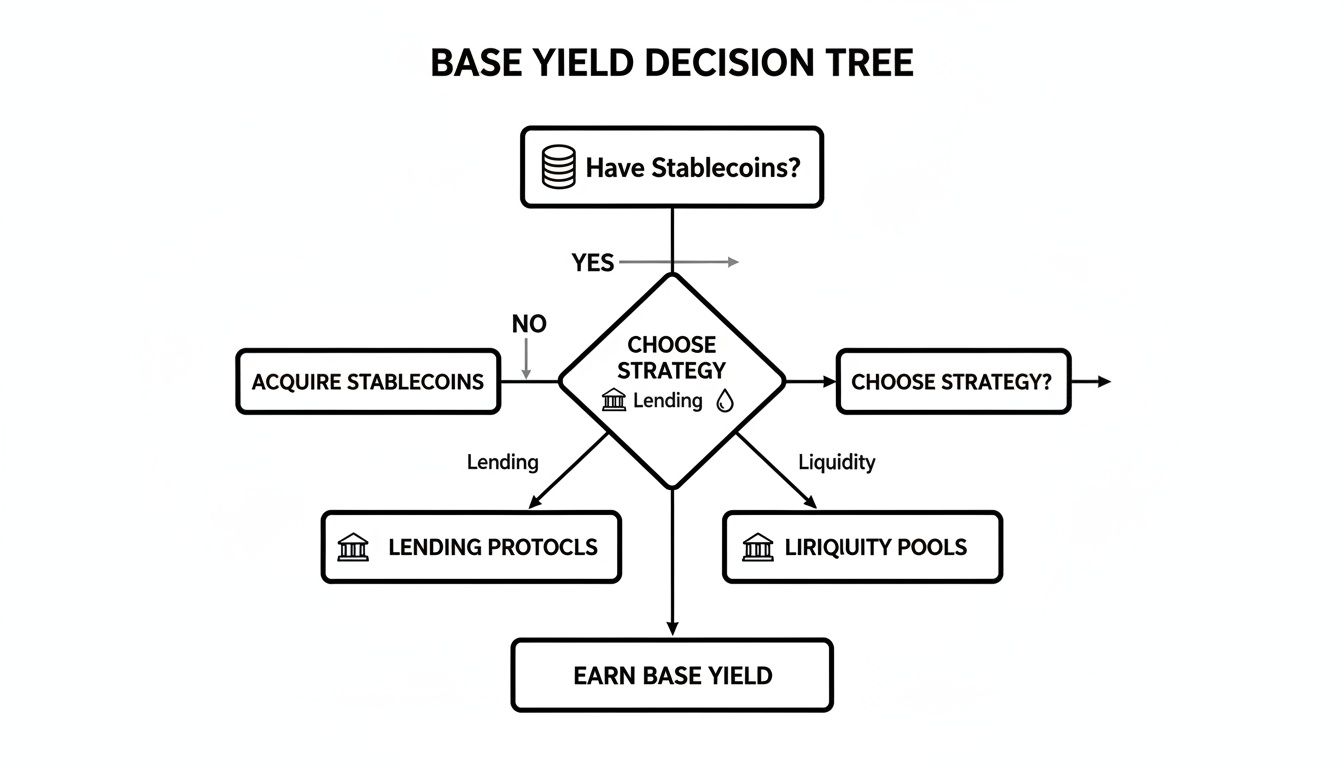
As you can see, once your stablecoins are ready, your main choices are either lending or providing liquidity. Each comes with its own set of trade-offs.
Calculating Your True Net Yield
A big, flashy APY can be incredibly misleading if you don't factor in all the costs. Your true return, or net yield, is what you have left after every single fee has been taken out.
Net Yield = Gross Yield - (Network Fees + Protocol Fees + Swap Fees)
While Base keeps network fees tiny, other costs can still eat into your profits. For instance, some protocols might charge a performance fee on your earnings or a small fee when you withdraw. Always take a few minutes to read the documentation and hunt for these hidden costs.
The goal isn't just to chase a vanity APY; it's to maximize your actual, take-home yield. This kind of careful math is what separates seasoned DeFi investors from the rest.
Automating Your Yield Strategy on Base

Let's be real: trying to manually chase the best yields is a full-time job. You're constantly researching protocols, weighing risks, and shuffling your funds around. Even on a super-efficient network like Base, the sheer number of opportunities can get overwhelming fast.
This is where automated yield platforms are changing the game. They turn this complex, hands-on grind into something you can basically set and forget. It's the next step in the evolution of low-fee DeFi on Base, moving beyond just being accessible to being truly effortless.
How Automation Puts Your Capital to Work
Think of an automated yield platform as your personal command center, constantly scanning the entire Base ecosystem. It’s built to sniff out the most promising and risk-vetted yield opportunities across different lending protocols and liquidity pools in real-time. The moment it finds a better, safer return, it can automatically move your funds to capture it.
This kind of constant rebalancing would be a nightmare on an expensive network. Your gains would get completely eaten up by transaction fees. But on Base, it’s not only possible—it’s powerful.
Automation on Base is the perfect marriage of the network's cheap, fast transactions with smart software. You get a system that can hunt for the best risk-adjusted yield for your stablecoins 24/7, something no human investor could ever keep up with.
This isn't some far-off future concept; it's quickly becoming the standard for modern investors. We're seeing a huge trend toward AI agents managing portfolios on efficient chains to squeeze out better performance and security. In fact, the data analytics market that powers these platforms is expected to hit $4.82 billion by 2025, fueling tools like Yield Seeker to find optimal yields. This shift lets anyone turn their idle stablecoins into an active income stream, without the headache.
Designed for the Modern Investor
The best automation tools are built for simplicity and control, tearing down the walls that make DeFi feel so intimidating. You'll often find features like these:
Effortless Onboarding: You can start earning yield with a small deposit, sometimes as little as $10 USDC, without needing a PhD in DeFi.
Total Transparency: A clean dashboard should show you exactly where your funds are and how much you’re earning at a glance. No black boxes.
Complete Flexibility: Your capital should never be locked up. Good platforms let you deposit and withdraw whenever you want, with no penalties or weird fees.
These features make automated yield on Base a no-brainer for anyone looking to earn passive income without the steep learning curve. Our guide on how to use AI agents in DeFi breaks down more of the tech behind the curtain.
Ultimately, automation gives you back your most valuable asset—your time—while making sure your capital is always working its hardest for you.
Your Low-Fee DeFi Questions, Answered
Jumping into decentralized finance always brings up a few questions, especially when new tech like Base comes along and changes the game. Let's tackle some of the most common ones about earning yield with low-fee DeFi on Base so you can get started with confidence.
Is It Really Safe to Use DeFi on Base?
Look, safety in DeFi is never a 100% guarantee, but you can definitely stack the odds in your favor. The Base network itself is built on top of Ethereum, so it benefits from its battle-tested security. That part is solid.
The real risk comes from the specific DeFi apps you choose to use. The golden rule is to stick with protocols that have been through multiple security audits by well-known firms. A healthy Total Value Locked (TVL) and a public team you can actually look up are also massive green flags. Just because low-fee DeFi on Base makes everything cheap, it doesn’t mean the risk of a smart contract bug magically disappears.
How Much Can I Actually Save on Fees?
The savings are night and day. A simple token swap on Ethereum can easily set you back $20 to $80, and way more if the network is clogged. On Base, you're looking at the same swap costing just $0.01 to $0.20.
For anyone who's serious about yield farming and compounds their earnings or rebalances their positions, this is a total game-changer. The savings can add up to hundreds or even thousands of dollars a year, making strategies that were once unprofitable totally worth it.
This massive drop in cost is exactly why so much attention—and money—has flooded into low-fee DeFi on Base.
What's the Minimum I Need to Start With Automated Yield?
This is where automation on Base really shines. The barrier to entry is almost non-existent. Trying to do this manually on Ethereum often meant you needed a pretty big chunk of capital just to make the gas fees worth it.
With a platform like Yield Seeker, you can get your money working with as little as $10 USDC. When you combine Base's tiny fees with an automated strategy, even small deposits can start earning for you without getting eaten alive by costs. It really opens up passive income to just about anyone.
How Do These Automated Platforms Find the Best Yields?
Think of them as your personal DeFi analyst that never sleeps. They run smart algorithms that are constantly scanning dozens of pre-vetted lending protocols and liquidity pools across the entire Base ecosystem.
These systems are looking at a few key things in real-time:
Current APYs: Pinpointing which protocols are paying out the highest returns right now.
Risk Scores: Sizing up the security and track record of each protocol.
Liquidity Levels: Making sure there's enough money in the pool to get in and out without a hitch.
When the platform's AI spots a better risk-adjusted opportunity, it can automatically shift your funds over to capture that higher yield. This keeps your capital working its hardest for you, without you having to be glued to your screen 24/7.
Ready to put your stablecoins to work without all the guesswork? Yield Seeker uses AI to automatically find and manage the best risk-aware yield opportunities on Base for you. Start earning smarter, automated yield today. Get started with Yield Seeker.