
When you hear "low-risk crypto yield," it's easy to think it's a contradiction. After all, the crypto market is famous for its wild price swings. How can any of it be low-risk?
The key is shifting your mindset. Forget speculative moonshots and think about generating sustainable, steady income.
What "Low-Risk Crypto Yield" Actually Means

Let's break it down with an analogy. Chasing a 1,000% return on some brand-new, unproven token is like betting everything on a long-shot startup. It’s a high-stakes gamble.
On the other hand, earning a 5% annual percentage yield (APY) by lending your stablecoins on a battle-tested protocol is more like putting your money in a high-yield savings account. It's a strategy built for steady, incremental growth, not explosive, heart-stopping profits.
This approach focuses on using well-audited, established protocols to earn interest—usually on stablecoins—which minimizes your exposure to the market's gut-wrenching volatility. This is all made possible by the underlying blockchain technology, which provides transparency and accountability for these on-chain activities.
The Cornerstone: Stablecoins
Stablecoins are the foundation for nearly all low-risk yield strategies. These are crypto assets designed to hold a stable value by pegging themselves to a real-world currency, most often the U.S. dollar.
By using assets like USDC, you sidestep most of the price volatility. This lets you focus purely on the yield your capital is generating, without worrying if your principal will be worth half as much tomorrow.
The goals here are simple and clear:
Protect Your Capital: The number one priority is keeping your initial investment safe.
Aim for Predictable Returns: While nothing is guaranteed, the yields are far more stable and foreseeable than trading profits.
Build Sustainable Income: The idea is to create a reliable stream of passive income from your digital assets.
A Maturing Market Helps
This isn't just wishful thinking. The digital asset space is growing up, and the data shows it.
Volatility is showing signs of a structural decline, which creates a much friendlier environment for these kinds of conservative strategies. For example, Bitcoin's daily volatility has dropped significantly. Its daily standard deviation was nearly halved from 5.3% in 2021 to just 2.1% by early 2025.
In 2023, Bitcoin even hit a milestone: it sustained a one-year realized volatility below 50% for the first time while its market cap was over $500 billion. This stabilization in major assets helps calm the DeFi ecosystem, reducing risks like sudden liquidations in yield-generating positions.
The Core Idea: Low-risk crypto yield isn't about finding a magic "no-risk" button—that doesn't exist. It's about intelligently managing risk by picking proven assets, using reputable platforms, and prioritizing consistent returns over lottery-ticket bets.
This shift has opened the door for everyone, from DeFi veterans to busy professionals, to put their capital to work safely and efficiently. By understanding these fundamentals, you can start turning your stablecoins into a productive, income-generating asset.
Comparing Top Stablecoin Yield Strategies
Choosing where to park your stablecoins to earn a return feels a lot like picking a savings account. Some offer flashy rates but come with pages of fine print, while others are steady and predictable. The truth is, not all "low-risk" crypto yield strategies are built the same, and understanding what’s going on under the hood is the key to matching the right approach to your goals.
The most common and battle-tested methods involve putting your stablecoins to work in decentralized protocols where others can borrow them. In exchange, you get a cut of the interest paid by those borrowers. It's a surprisingly direct and transparent way to earn passive income on your assets.
Let's break down the main ways to generate this kind of yield, looking at how each one actually works.
On-Chain Lending and Money Markets
Think of decentralized lending platforms like Aave or Compound as automated, peer-to-peer banks that run entirely on code. When you deposit your USDC, you're adding it to a massive pool of capital. Borrowers then take loans from this pool, and the interest they pay gets distributed back to everyone who supplied liquidity—that's you.
This model is incredibly straightforward and has become a cornerstone of DeFi. The interest rates you earn are variable, moving up and down based on simple supply and demand. When more people want to borrow, rates go up, and so does your yield.
How it Works: You deposit stablecoins into a protocol's lending pool.
Yield Source: Interest paid by borrowers who take out overcollateralized loans.
Key Advantage: It's one of the simplest and most transparent ways to earn a base-level yield in crypto.
These platforms are often considered the bedrock of a conservative portfolio. Because every loan is overcollateralized (borrowers have to lock up assets worth more than their loan), the risk of default hitting lenders is dramatically reduced.
Conservative Liquidity Pools
Another popular route is providing liquidity to a decentralized exchange (DEX). More specifically, you can add your funds to pools that pair one stablecoin with another, like a USDC/DAI pool.
Imagine you're running a currency exchange booth. To do business, you need a healthy supply of both currencies people want to trade. In DeFi, you can be that supplier. By depositing your stablecoins into a liquidity pool, you earn a small fee from every single trade that routes through it. For a deeper dive on finding these opportunities, you can learn more about the best stablecoin yields in our complete guide.
Since you're providing liquidity for two assets that are designed to hold a stable value, you almost entirely sidestep the risk of impermanent loss, a major headache for pools with volatile assets. This makes stablecoin-only pools a relatively safe way to earn a slice of trading fees.
Comparing Your Options Side-by-Side
To really make sense of it all, it helps to see these strategies laid out next to each other. Each one comes with its own trade-offs between potential returns, the risks you're taking on, and how much hands-on effort is needed.
Key Insight: The "best" strategy is completely personal. A super conservative investor might stick exclusively to blue-chip lending markets. Someone else might be comfortable with the slightly different risk of a stablecoin liquidity pool to chase higher trading fees.
The table below gives a quick snapshot of these differences, helping you see where each method shines and what to watch out for. This is a crucial first step in building a smart low-risk crypto yield portfolio.
Comparison of Low-Risk Stablecoin Yield Sources
This table breaks down the most common stablecoin yield strategies, giving you a clear look at potential returns, the main risks to be aware of, and how complex each one is for the average user.
Strategy Type | Typical APY Range | Primary Risks | Complexity Level |
|---|---|---|---|
On-Chain Lending | 3% - 8% | Smart contract failure, protocol solvency, bad debt accumulation | Low |
Money Markets | 3% - 8% | Similar to lending; smart contract bugs, counterparty risk | Low |
Stablecoin Liquidity Pools | 4% - 10% | Smart contract bugs, minor stablecoin peg deviation, protocol risk | Medium |
Centralized Platforms | 2% - 7% | Custodial risk (not your keys), platform insolvency, regulatory changes | Very Low |
Insurance-Wrapped Products | 3% - 6% | Smart contract risk, insurer insolvency, complexity of claims | Medium |
Ultimately, a smart approach is often to diversify. Spreading your capital across different types of protocols and yield sources is a powerful way to smooth out returns and protect your portfolio, all while capturing a competitive yield on your stablecoins.
Your Essential Risk Management Framework
Chasing crypto yield without a solid game plan is a bit like sailing in a storm without a compass. You might get lucky, but you're far more likely to hit the rocks. If you want to invest with any real confidence, you need a repeatable framework to size up any opportunity before you put a single dollar in.
Think of this framework as your personal due diligence checklist. It takes what can feel like an overwhelming task and breaks it down into manageable chunks. By splitting risk into distinct categories, you can methodically check each one off, making sure you don't miss a critical blind spot.
We can boil this whole process down to five core pillars of risk. Get your head around these, and you'll have the tools to tell the difference between a sustainable yield and one that's just too good to be true.
Who Built This Thing? (Protocol Risk)
At the end of the day, every DeFi protocol is just code—a bunch of smart contracts running on a blockchain. Protocol risk is all about the potential for bugs, exploits, or straight-up flaws in that code. A single vulnerability could let a hacker drain the entire protocol, leading to a total loss for everyone involved.
It's like getting a home inspection before you buy a house. You want a pro to check the foundation and wiring for hidden problems. In DeFi, that "inspection" comes from security audits by reputable firms.
Audit History: Has the protocol been audited? Even better, has it been audited by multiple well-known security firms? A single audit is the bare minimum; multiple audits over time show a real commitment to keeping things locked down.
Team Reputation: Is the team public and known in the space, or are they a bunch of anonymous avatars? While anonymity isn't an automatic deal-breaker, a public team adds a crucial layer of accountability.
Time on the Field: How long has this protocol been live without a major screw-up? A protocol that's securely handled billions in assets for years is what we call "battle-tested."
How Stable Is the Stablecoin? (Asset Risk)
Not all stablecoins are created equal—not by a long shot. Asset risk is all about the quality and reliability of the actual stablecoin you're using. The big one here is de-pegging risk, which is when a stablecoin that's supposed to be worth $1 suddenly isn't.
We all saw what happened with UST back in 2022, when the algorithmic stablecoin collapsed and wiped out billions. That disaster was a brutal lesson in the difference between fully-backed stablecoins like USDC (backed by cash and U.S. T-bills) and the more experimental, wobbly designs. Your goal is to stick with the most boring, transparently-backed stablecoins you can find.
The Golden Rule: The yield you earn means absolutely nothing if the principal you invested goes to zero. Always, always prioritize the quality of the asset over the promise of a few extra APY points.
Can I Get My Money Out? And Is the Yield Real? (Liquidity & Economic Risks)
These two are joined at the hip. They're all about the health of the market and whether the yield is actually sustainable.
Liquidity risk is the danger that you can't withdraw your funds when you want to. If there's a panic and everyone rushes for the exit at once, a protocol's liquidity pools can dry up, leaving your capital temporarily trapped.
Economic risk, on the other hand, asks a simple question: where is this yield coming from? Is it generated from real, sustainable activity like borrowing fees? Or is it propped up by printing a bunch of inflationary tokens that will eventually become worthless? Fake, unsustainable yields are a huge red flag. To get a better handle on this, check out our deep-dive on the best practices for risk management.
The infographic below shows the common, legitimate ways stablecoins generate yield—lending, providing liquidity, and staking.
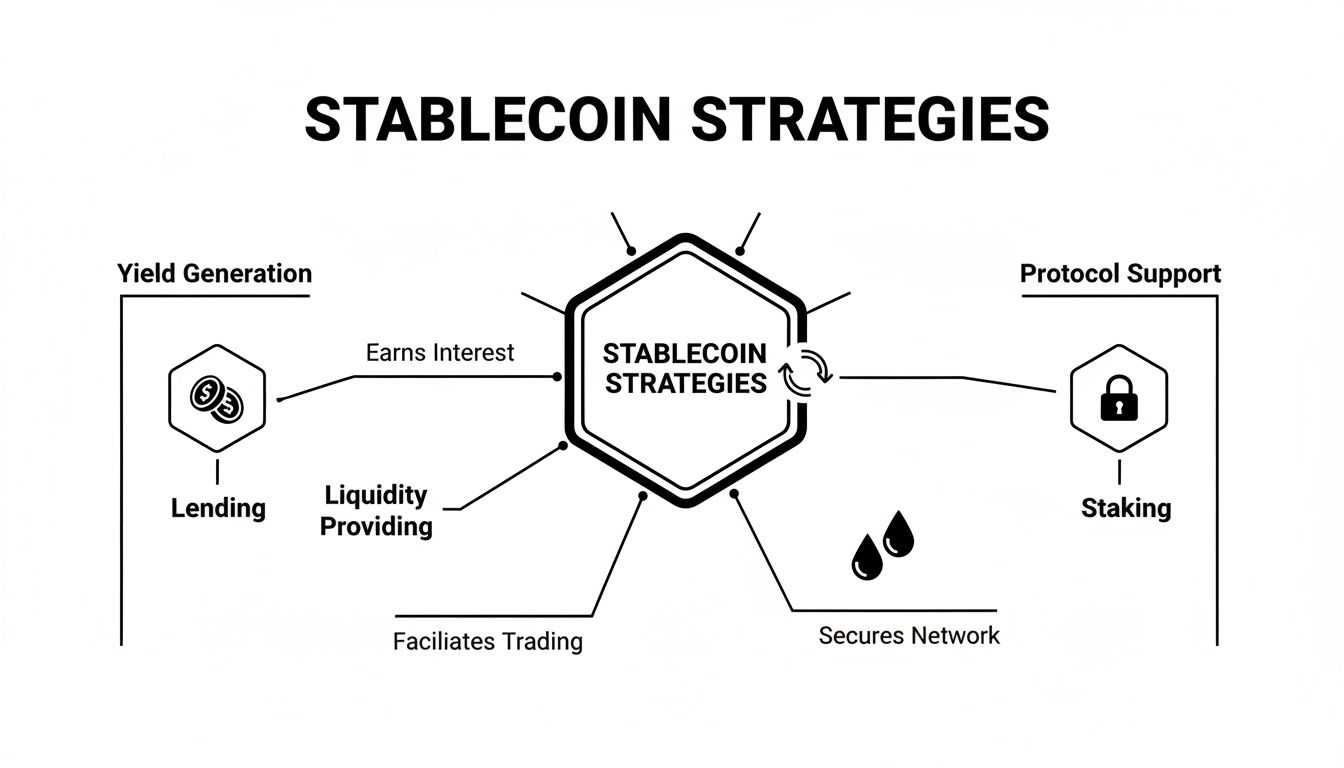
This is how real value is created in the ecosystem, which is then paid back to users like you in the form of yield.
Who Holds the Keys? (Centralization Risk)
Finally, centralization risk comes down to how much control a single person or a small group has over the protocol. A truly decentralized protocol is governed by its community of token holders. But the reality is, many protocols have "admin keys" that give the founding team a ton of power.
This could mean they have the ability to upgrade contracts, change fees, or even hit the pause button on the entire protocol. While this power is often used for good (like maintenance), it could be abused. Always dig into a protocol's governance to see who's really in charge and what checks and balances are in place.
By running every opportunity through this five-pillar framework, you can systematically cut down your risk and start chasing yield with your eyes wide open.
Building Your First Stablecoin Yield Portfolio

Alright, let's move from theory to practice. This is where the real learning happens. Now that you have a solid risk framework, we can start putting it to work and design a couple of sample portfolios. Think of these as blueprints showing how to mix and match different strategies to fit your comfort level and what you're trying to achieve.
The name of the game here is diversification. It's the same logic you'd apply to stocks—you wouldn't dump your life savings into a single company, right? The same goes for DeFi. Spreading your stablecoins across different protocols is your best defense against any single point of failure.
Just to be clear, these examples aren't financial advice. They're practical walkthroughs to help you see how the concepts we've talked about come together to build a smarter, more resilient low-risk crypto yield portfolio.
The Ultra-Conservative Portfolio
This one’s for the investor whose top priority is protecting their capital. Period. The goal is simple: generate a steady, safe yield that easily beats what you'd get from a traditional savings account, without getting into the weeds of complex DeFi strategies.
Think of it as the digital version of a portfolio packed with government bonds and blue-chip dividend stocks. The entire allocation sticks to the most established, battle-tested on-chain lending protocols out there.
Allocation A (60%): Put this into a top-tier lending market like Aave on a secure Layer 2 network. Aave has been securely managing billions of dollars for years, making it a true cornerstone for any conservative game plan.
Allocation B (40%): The rest goes into another blue-chip lending protocol, something like Compound. This move diversifies your protocol risk, so if a bug pops up on one platform, your entire stablecoin stash isn't exposed.
Target APY: You're looking at a blended rate of 3% to 5%.
This portfolio is designed to be your fortress of safety. The yield is coming purely from overcollateralized borrowing demand—one of the most sustainable sources in all of DeFi. By sticking with the industry's most trusted names, you're minimizing smart contract and economic risks as much as humanly possible.
The Balanced Portfolio
Now, this approach is for someone who's okay with taking on a bit more calculated risk to chase a higher return. We're introducing a new ingredient to the mix: liquidity pools. This lets you capture yield from trading fees on top of the usual lending interest.
Here, you're diversifying not just across different protocols, but across different types of yield sources.
On-Chain Lending (50%): Half your capital stays put in a major lending protocol like Aave. This gives you a stable, low-risk foundation for the whole portfolio.
Stablecoin Liquidity Pool (50%): The other half gets allocated to a well-vetted stablecoin-to-stablecoin liquidity pool (think USDC-DAI) on a major decentralized exchange. This is how you start earning those trading fees, which can really boost your overall APY.
Target APY: It's realistic to target a blended rate of 5% to 8%.
This balanced strategy aims for a healthier low-risk crypto yield by tapping into a completely different income stream. As crypto becomes more mainstream, the market for these kinds of opportunities just keeps growing. In fact, a 2023 survey found that 26% of millennials owned Bitcoin, which shows just how much broad retail interest there is in digital assets and the demand for stable, passive income. You can check out the full crypto adoption trends from Bankrate.com to see the data for yourself.
These hands-on examples show that building a portfolio is all about making deliberate choices based on how you see risk. Whether you're ultra-conservative or somewhere in the middle, the key is always thoughtful diversification.
Putting Your Yield Strategy on Autopilot
Let's be real: trying to manually manage a diversified portfolio to chase the best low-risk crypto yield is a full-time job. It’s a constant grind of research, fee calculations, and keeping a close eye on market shifts. It's stressful, it's inefficient, and frankly, there's a better way.
What if you could get those optimal results without the daily headache? This is exactly where smart automation steps in.
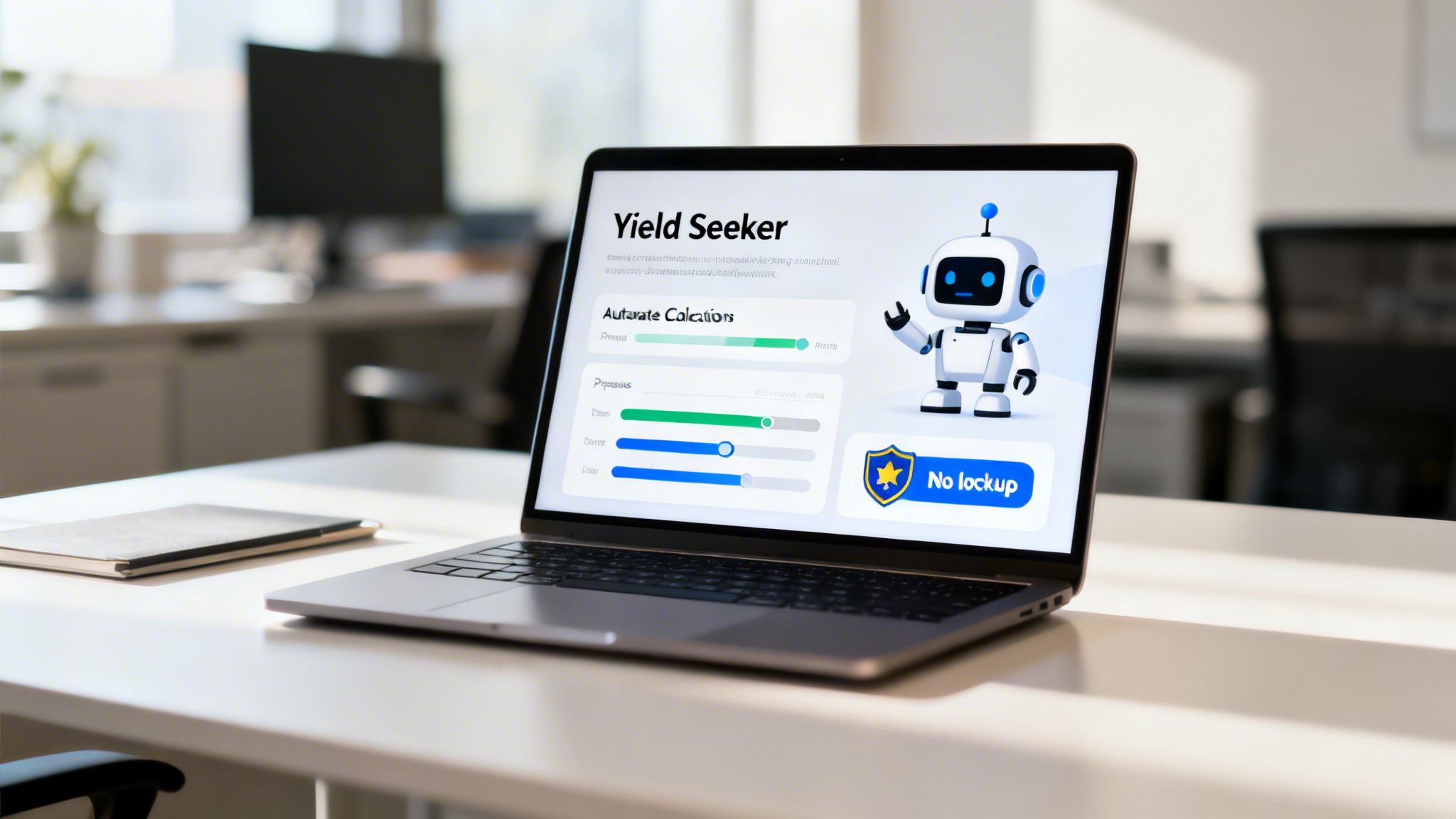
Imagine having a personal AI agent working for you 24/7, always finding the best possible spot for your stablecoins. That’s the core idea behind Yield Seeker, which acts as your intelligent agent built specifically for generating stablecoin yield on the Base blockchain. It takes the guesswork and manual labor out of the equation, creating a truly hands-off way to grow your capital.
How an AI Agent Simplifies Everything
At its heart, an AI-driven strategy uses algorithms to chew through huge amounts of data in real-time. It’s constantly scanning a pre-approved list of top-tier DeFi protocols, searching for that sweet spot between return and safety. To get a better handle on the basics, you might want to check out this ultimate guide to Artificial Intelligence.
This system is built to answer critical questions in a split second:
Which audited lending protocol is offering the highest rate right now?
Did the risk profile of a certain liquidity pool just change?
Is there a better opportunity to move capital to, even after factoring in gas fees?
Based on the answers, the AI dynamically shifts your funds to maximize your risk-adjusted return. This is something that would be practically impossible for a human to do consistently. We dive deeper into how these systems work in our article on automated crypto investing.
The Key Takeaway: Automation turns yield generation from an active, time-sucking chore into a genuine passive income stream. Your AI agent handles the heavy lifting so you can get back to your life.
A Laser Focus on Safety and Transparency
A truly useful automated platform does more than just chase the highest APY. Its number one job is capital preservation. This means it operates within a strict, predefined set of rules designed to keep your funds safe.
For example, Yield Seeker only works with a curated list of protocols that have gone through extensive audits and have a proven track record. The AI is always watching these protocols for any red flags, ready to pull funds if a platform's risk parameters change.
This commitment to safety goes hand-in-hand with total transparency. You can always see exactly where your funds are and how much yield they’re earning. And best of all, with features like a no-lockup policy, your capital is never held hostage. You can deposit or withdraw your stablecoins whenever you want, giving you complete control.
Tools like this are becoming more important as stablecoins become the bedrock of the crypto economy. They are now critical market infrastructure, and by combining AI-powered optimization with a relentless focus on security, automated platforms offer the simplest and most efficient path to capturing competitive low-risk crypto yield.
Still Have Questions About Stablecoin Yield?
Getting into stablecoin yield can feel like navigating a maze. Lots of questions pop up, and it's tough to separate the real opportunities from the hype. Let's tackle some of the most common questions head-on to clear things up and help you get started with confidence.
These are the things that newcomers (and even seasoned vets) wonder about—the core ideas around safety, what returns are actually realistic, and how automation fits into the picture.
Is Low-Risk Crypto Yield Actually Safe?
Let's get one thing straight: "low-risk" in crypto never means "no-risk." It’s more accurate to think of it as "lower-risk," especially when you compare it to the wilder, more speculative corners of DeFi. Every single on-chain protocol has some risk, whether it's a hidden smart contract bug, a weird economic flaw nobody saw coming, or a stablecoin losing its peg.
A true low-risk strategy is obsessed with one thing: capital preservation. It does this by sticking to the tried-and-true, heavily audited protocols and avoiding anything that seems overly complex or hasn't been around the block a few times.
Key Perspective: The game isn't about pretending risk doesn't exist. It's about intelligently managing and minimizing it. A smart strategy acknowledges the dangers and builds defenses, putting the safety of your principal way ahead of chasing crazy, unsustainable returns.
This is where automated tools can be a game-changer. By constantly watching key risk metrics and moving funds based on a strict set of rules, they keep your position conservative and can react to market shifts way faster than any human possibly could.
What Is a Realistic APY for Stablecoins?
A realistic and sustainable Annual Percentage Yield (APY) for these kinds of low-risk stablecoin strategies usually lands somewhere in the 3% to 10% range. This number isn't static; it moves up and down based on how much demand there is for borrowing stablecoins. When demand is high, the yield you can get goes up with it.
You should be immediately skeptical of any platform promising consistent double-digit or—even worse—triple-digit APYs on stables. Those sensational returns are almost always hiding some nasty surprises, like exposure to volatile tokens, unaudited contracts, or economic models practically designed to implode.
The goal here is simple: earn significantly more than you would in a traditional savings account without throwing your hard-earned money into the extreme volatility of speculative DeFi yield farming.
How Does an Automated Yield Tool Work?
Automated yield platforms aren't just magic black boxes. They use smart algorithms and AI to manage your funds with a clear, safety-first methodology. It usually breaks down into three steps.
Vetting the Field: First, the platform builds a curated whitelist of trusted DeFi protocols. These are the "blue-chips" of the space—protocols that are battle-tested, heavily audited, and have a long track record of keeping user funds safe.
Watching Everything in Real-Time: The AI agent then keeps its eyes on a ton of crucial data points across this approved list. It’s tracking interest rates, available liquidity, protocol health scores, and dozens of other risk factors, 24/7.
Making the Smart Move: Finally, it automatically moves your capital to the protocols offering the best possible risk-adjusted return at that exact moment.
This automated process saves you a mountain of time you'd otherwise spend manually "yield farming." But more importantly, it cuts down the chance of human error and makes sure your funds are always positioned in the most optimal spot.
Why Are So Many Platforms Using the Base Chain?
Base, an Ethereum Layer 2 network that came out of Coinbase, has quickly become a favorite playground for yield strategies. It's not by accident; it has a powerful combination of features that just make sense.
Cheap Transaction Fees: Gas fees on Base are a fraction of what they are on the Ethereum mainnet. This is a must-have for automated strategies that need to rebalance frequently to optimize your yield. High fees would just chew up all your returns.
Built on Ethereum's Security: As a Layer 2, Base gets to inherit the rock-solid, decentralized security of the main Ethereum network. This gives everyone—users and developers—confidence that the foundation is secure.
A Booming Ecosystem: Its deep ties to Coinbase have fueled a vibrant and fast-growing ecosystem. That means deep liquidity, a great selection of reputable DeFi protocols, and a constant flow of new users and builders joining the platform.
This mix of low costs, top-tier security, and a thriving community makes Base the perfect place for the next generation of yield platforms to run safely and efficiently.
Ready to put your stablecoins to work without the constant stress and research? Yield Seeker uses a personalized AI Agent to find and manage the best risk-aware yield for you on Base—all automatically. Get started in minutes at https://yieldseeker.xyz.