
If you've spent any time in crypto, you've probably heard the saying "not your keys, not your coins." This isn't just a catchy phrase; it's the entire philosophy behind non-custodial DeFi platforms.
Unlike the traditional finance world or even big centralized crypto exchanges, these platforms never actually hold your money. You’re always in charge, interacting with financial services directly from your own personal crypto wallet.
The Foundation of True Digital Ownership
Think about your regular bank account. When you deposit cash, the bank takes it into its custody. You're trusting that they'll keep it safe and give it back to you on demand. This is a custodial model, and it's the same way most centralized crypto exchanges like Coinbase or Binance operate. You send them your crypto, they hold it for you.
Non-custodial DeFi platforms completely flip that idea on its head.
Imagine your crypto wallet is a personal, high-tech briefcase that only you have the key to. When you use a non-custodial platform, you aren't handing over your briefcase to a stranger. Instead, you're using your key to open it yourself and interact directly with a financial service—a smart contract—with no middleman getting in the way. Your assets never leave your control.
This gives you total sovereignty. There’s no third party who can suddenly freeze your account, block a withdrawal, or go bankrupt and take your assets with them. This shift is a huge part of what makes decentralized finance so powerful.
An Ecosystem Built on Self-Control
It turns out people really, really like having control over their own money. This demand for self-sovereignty has sparked some incredible growth. The global DeFi market, which is dominated by non-custodial platforms, saw its total value locked (TVL) rocket to $60.73 billion by early 2026.
That’s a massive jump from $46.6 billion in 2024, and forecasters see it growing at a rate of over 10% each year through 2029.
This growth is especially important for stablecoin holders who want to earn yield without handing their assets over to someone else.
To make the difference crystal clear, let's break it down side-by-side.
Custodial vs Non-Custodial Platforms At a Glance
This table contrasts the fundamental differences between custodial and non-custodial platforms to help you quickly grasp the core concepts.
Feature | Non-Custodial Platforms | Custodial Platforms |
|---|---|---|
Asset Control | You hold your private keys and control your funds at all times. | A third party (like an exchange) holds your private keys and assets. |
Security | You are responsible for securing your own keys. Immune to exchange hacks. | You trust the third party's security. Vulnerable to company failure or hacks. |
Access | Permissionless access to a wide range of DeFi services. | Access is controlled by the platform and may be restricted. |
Motto | "Not your keys, not your coins." | "Trust us with your coins." |
Ultimately, the choice comes down to a trade-off between convenience and control. Custodial platforms can feel simpler, but that simplicity comes at the cost of giving up ownership. Non-custodial platforms put you firmly in the driver's seat.
How You Interact With Non-Custodial Platforms
Getting started with non-custodial DeFi is a totally different experience from a traditional finance app. There are no usernames, no passwords, and no lengthy sign-up forms. Instead, your personal crypto wallet is your key to everything.
You simply visit a platform's website and hit a "Connect Wallet" button. This action links your wallet—like MetaMask or Trust Wallet—to the DeFi protocol's interface. It’s your passport to the system, but a read-only one at first.
Think of it like giving a valet a special key to park your car. That key lets them perform one specific job—moving the car—but it doesn't give them access to the trunk or the glove box, and it certainly doesn't let them drive off with it. Connecting your wallet is similar; you’re granting the platform permission to see your public address and balances, not move your funds.
This is the fundamental shift from having a bank or exchange control your money to you being in the driver's seat.
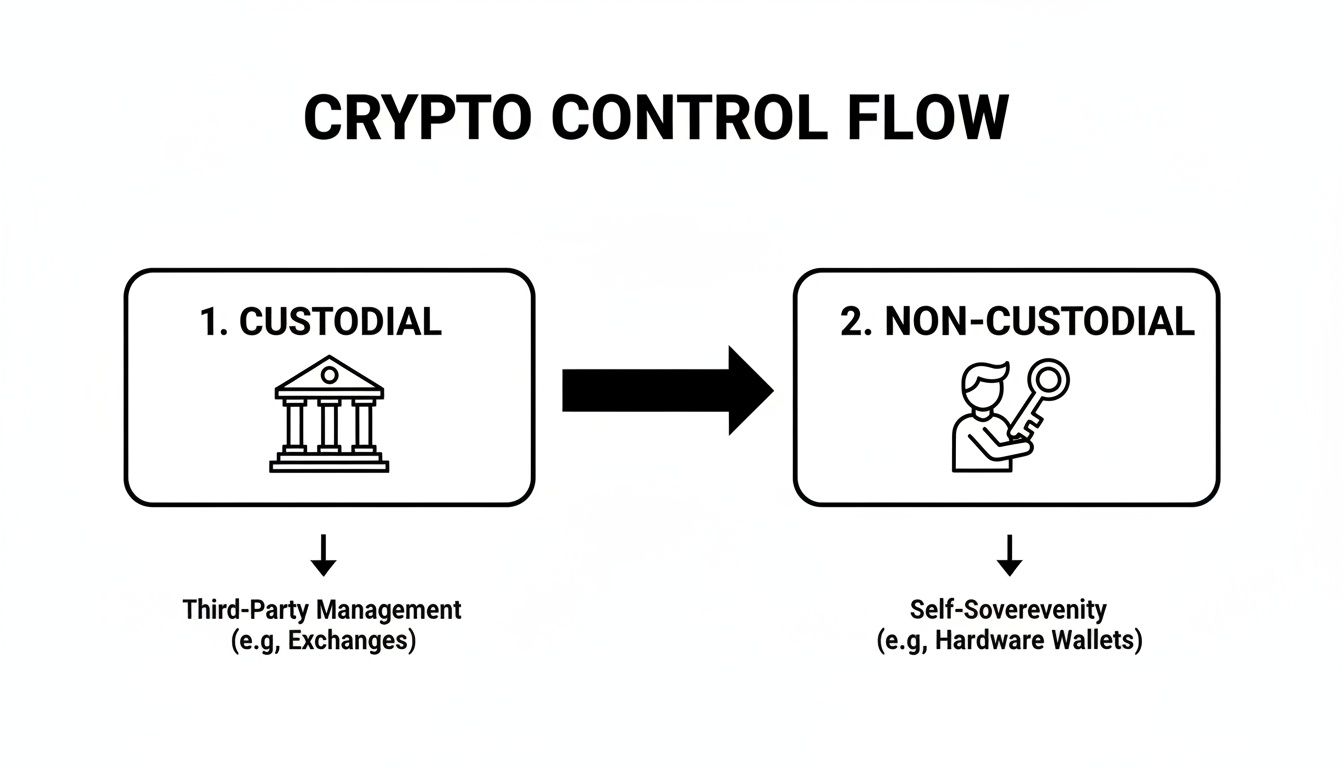
By cutting out the middleman, you get direct control over every single financial action you take.
Authorizing Transactions Securely
To actually do anything, whether it's lending, borrowing, or swapping tokens, you have to explicitly authorize each and every action by signing a transaction.
Let's say you want to deposit stablecoins into a lending protocol. The platform will pop up a request in your wallet to approve the transaction. This is you, with your digital signature, giving the smart contract temporary permission to move a specific amount of a specific token.
This is the heart of non-custodial security: your assets never leave your wallet without your direct, signed approval for each individual action. You always hold the final say.
This demand for self-sovereignty is why the self-custody space is blowing up. Projections show the non-custodial wallet market is expected to jump from $1.43 billion in 2026 to a massive $4.53 billion by 2035. It’s all driven by users who want to tap into DeFi without handing over their keys.
A Step-By-Step Example
Let's walk through what this looks like in practice on a typical non-custodial platform:
Connect Wallet: You land on a decentralized exchange (DEX) and click "Connect Wallet," choosing your wallet from the list.
Initiate a Swap: You decide to swap 100 USDC for ETH. You punch in the numbers on the DEX's interface.
Grant Permission (Approve): The first transaction you’ll be asked to sign is an "approve." This tells the DEX's smart contract, "You have my permission to access up to 100 of my USDC for this trade."
Confirm the Swap (Sign): A second request pops up to confirm the swap itself. By signing this, you execute the trade. Your USDC is sent to the smart contract, and ETH is sent back to your wallet.
At every single stage, you are in command. You make the decisions and give the authorizations. This transparent, user-controlled flow is what makes these platforms so powerful.
So, you're holding stablecoins like USDC or USDT. Smart move. But why stop there? If you're just letting them sit on a centralized exchange, you're leaving a lot of potential on the table. Let's talk about why non-custodial DeFi platforms are the real game-changer for turning those digital dollars into hard-working, income-generating assets.
It really comes down to three huge wins: you're in complete control, you get access to way better yield, and you can plug different financial tools together like Legos.
At the end of the day, non-custodial platforms are your best shield against someone else’s screw-up. When you leave your funds on a centralized exchange, you're fundamentally trusting that company. If they get hacked or, worse, go bankrupt, your funds can disappear with them. Non-custodial DeFi completely sidesteps this problem because you always maintain control of your private keys and your funds.

This idea of self-sovereignty—"not your keys, not your crypto"—is the bedrock of everything else that makes DeFi so powerful.
Unlock Superior Yield Opportunities
Beyond just keeping your assets safe, non-custodial platforms are your direct gateway to yield opportunities you just won't find in traditional finance or on most centralized exchanges. Instead of your stablecoins collecting dust, you can put them to work yourself in audited, on-chain protocols.
This is where the magic really happens for stablecoin holders. You can:
Lend your stablecoins out in over-collateralized markets and earn interest from borrowers.
Provide liquidity to decentralized exchanges (DEXs) and get a cut of the trading fees.
Stake your assets in different protocols to earn rewards for helping them run smoothly.
By plugging directly into these smart contracts, you're cutting out the middleman who would typically skim a hefty portion of the profits. That direct connection means more of the yield ends up back in your wallet.
Stablecoins are the engine of this entire ecosystem. The stablecoin market is expected to blow past $1 trillion by 2026, fueling a DeFi world projected to expand from $26.94 billion in 2025 to over $1,417 billion by 2033. This isn't just hype; it's a massive shift toward decentralized, yield-bearing strategies, and you can find more insights on DeFi's explosive growth on MEXC.
The Power of Composability
Maybe the most mind-bending—and coolest—benefit of DeFi is composability. People in the space often call it "money legos," and for good reason. Because these platforms are built on open, permissionless code, they can be snapped together to create strategies that are more powerful than the sum of their parts.
Composability means that the output of one DeFi protocol can become the input for another. This allows for an almost infinite combination of financial services, all controlled from your single non-custodial wallet.
For instance, you could deposit USDC into a lending protocol like Aave to receive a yield-bearing token (a token that represents your deposit and automatically accrues interest). You could then take that very same token and use it as collateral in another protocol to borrow a different asset, or drop it into a yield aggregator that automatically compounds your returns for you.
This ability to layer financial services, all while never giving up ownership of your assets, is something totally alien to the walled gardens of traditional finance. It's a whole new ballgame.
Navigating DeFi Risks Like a Pro
Jumping into non-custodial DeFi is freeing. You’re in complete control of your assets, which is exactly the point. But with great power comes great responsibility—you’re not just the investor, you’re also the head of security.
Getting a handle on the risks isn't meant to scare you off. It’s about building the confidence you need to navigate DeFi safely. A clear-eyed view of the potential pitfalls is what separates a smart investor from a statistic.
Understanding Smart Contract Risk
Every DeFi platform runs on smart contracts, which are just bits of code that handle all the financial magic automatically. Smart contract risk is what happens when there's a bug or a loophole in that code. If a hacker finds it, they can exploit it to drain the entire protocol. It’s one of the biggest dangers in DeFi, period.
Even the most well-meaning teams can make mistakes and ship code with hidden flaws. This is exactly why security audits are a non-negotiable part of your due diligence.
Audit Verification: Always check if a platform has been audited by one or more reputable security firms. Don't just see the checkmark—look at the reports and make sure any major issues they found have actually been fixed.
Time-Tested Protocols: Brand new protocols are naturally riskier. I always have more confidence in platforms that have been running for years without a major incident. They've been "battle-tested" in the wild, which is a real-world stress test that no audit can fully replicate.
A huge part of keeping your funds safe is simply understanding self-custodial security. It all comes down to you protecting your own private keys and funds. Honestly, that personal responsibility is your best defense against platform-level threats.
Evaluating Protocol and Team Risk
Beyond the code, you've got protocol risk. This is a broader category that covers everything from a flawed economic design to the team behind the project. A protocol's tokenomics might be unsustainable, or the team could be anonymous, which brings up the very real risk of a "rug pull"—where they just disappear with everyone's money.
You have to look at the human element and the economic logic of any DeFi platform you're thinking of using.
Key Evaluation Points:
Team Transparency: Is the team public? Do they have a solid, verifiable track record? Anonymous teams are a massive red flag.
Economic Model: Does the way the protocol generates yield actually make sense? Be super skeptical of impossibly high returns. They often mask unsustainable models or just plain reckless risk-taking.
Community Trust: A strong community and a high Total Value Locked (TVL) can be good signs, but they aren’t foolproof. Don't let social proof be your only green light.
At the end of the day, your best defense is simple: don't put all your eggs in one basket. Never commit all your capital to a single platform, no matter how safe it seems. Spreading your funds across several well-vetted, non-custodial platforms is a core principle of good DeFi risk management. This way, if one protocol fails, your entire portfolio doesn't go down with it.
Your Checklist for Vetting DeFi Platforms
With thousands of DeFi platforms all promising you the moon, it's easy to get distracted by flashy APY numbers. But before you even think about connecting your wallet, you need a way to tell the solid projects from the ones that might just run away with your funds.
Think of it as your pre-flight checklist. You wouldn't just jump into a cockpit and hope for the best. You’d check the engines, the instruments, and the fuel. Doing your homework on a DeFi platform requires that same level of diligence, and it all starts with the code.
Check for Security Audits
First things first: has the platform been properly audited? Smart contract bugs are the number one reason for catastrophic losses in DeFi. A third-party security audit isn't just a nice-to-have; it's absolutely critical.
But not all audits are created equal. Here’s what you should be looking for:
Who did the audit? Was it a top-tier security firm like Trail of Bits, OpenZeppelin, or CertiK? An audit from a well-respected name carries a lot more weight.
How recent is it? An audit from two years ago on a protocol that’s been constantly updated is pretty much useless. You need to see recent reports.
What did they find? Don't just look for a "passed" checkmark. Skim the report's summary. Did they find critical vulnerabilities? More importantly, did the team actually fix them? A team that ignores major security warnings is a massive red flag.
A clean, recent audit from a top firm is your first big green light.
Gauge Trust Through Key Metrics
Once you're confident the code has been checked, it's time to see what the community thinks. No single number tells the whole story, but a few key metrics can give you a pretty good feel for a project's health and reputation.
Total Value Locked (TVL) is the big one. It's the total amount of money users have deposited into the protocol. A platform with a consistently high and growing TVL—think hundreds of millions or even billions—shows that a lot of people trust it with their capital.
A high TVL is a good sign, but don't take it as a guarantee of safety. It's really just a popularity contest. Popularity often lines up with reliability, but it’s not the same thing.
Beyond TVL, look at the team’s transparency. Are the founders public figures with real track records on LinkedIn or GitHub? An anonymous team is a huge risk because there's zero accountability if things go sideways.
Finally, look at the fee structure. Any legit DeFi platform will be crystal clear about its fees, whether they're for trades, withdrawals, or performance. If the fees are hidden or confusing, it could be a sign of a poorly designed—or even predatory—protocol.
Automating Your Yield Strategy With AI Tools
If you've ever tried to chase the best yields across the DeFi space, you know it can feel like a full-time job. It’s a constant grind of research, comparing APYs that change by the minute, and paying for one transaction after another to move your funds around. Frankly, it’s exhausting and not always the most efficient way to manage your stablecoins.
This is where things get really interesting. Instead of spending all those hours hunting for opportunities yourself, you can now deploy an intelligent AI agent to do the heavy lifting for you.

Think of these tools as your personal DeFi analyst, working around the clock to find and capture the best returns for your portfolio.
How AI Gives You a Strategic Edge
An AI agent can process thousands of data points in real time—way more than any human could ever hope to track. It's constantly monitoring interest rates, liquidity levels, and risk factors across dozens of protocols all at once. Based on the goals you set, it automatically moves your capital to the most promising and risk-adjusted opportunities as they pop up.
This approach brings some pretty clear advantages:
Saves You Time: No more manual research or late-night transaction signing. The agent handles it all.
Optimizes Your Returns: The AI is always on the lookout, ready to pounce on the best available yields as market conditions shift.
Takes Emotion Out of It: Automation helps you stick to your strategy and avoid making impulsive trades based on market hype or fear.
But here’s the most important part: these AI tools operate within the same non-custodial framework we’ve been talking about.
The AI works for you, but it never actually holds your funds. It executes strategies by interacting with smart contracts on your behalf, while your assets stay right where they belong—in your wallet, under your control.
This blend of smart automation and self-custody is a game-changer. You get all the benefits of a sophisticated, automated strategy without giving up the core DeFi principle of owning your assets. It’s a huge leap beyond the old yield aggregators, offering a much more dynamic and personalized way to put your stablecoins to work.
If you want to go deeper, you can learn more about how to use AI agents in our dedicated guide. This new wave of tools is completely changing how investors interact with non-custodial DeFi, making advanced strategies accessible to everyone.
Answering Your Questions on Non-Custodial DeFi
Diving into non-custodial DeFi is exciting, but it's totally normal to have a few questions before you jump in. Getting a handle on these concepts is the best way to get comfortable and start making smart moves with your funds.
Here are a few of the most common questions we get.
Can You Actually Lose Money on a Non-Custodial Platform?
Yes, you absolutely can. While you’re safe from an exchange going bust and taking your funds with it, DeFi has its own set of risks you need to watch out for. The big ones are smart contract risk (a bug or an exploit in the code) and protocol risk (the team is malicious or the economic design is broken).
This is exactly why doing your own research is a must. I can't stress this enough. Stick to platforms that have multiple security audits from well-known firms and have been running successfully for a while. It’s also smart to spread your funds across a few different battle-tested protocols instead of putting everything in one place.
Think of it like this: being non-custodial means you hold the keys to your house. But it's still your responsibility to make sure the neighborhood is safe before you move in. Diligence and diversification are your best friends here.
What's the Difference Between Staking and Yield Farming?
Good question. People often use these terms interchangeably, but they're different ways to earn rewards in DeFi. You can even do both at the same time, but they serve different functions.
Staking is usually about locking up a specific token (like ETH) to help keep a blockchain network secure and running. For helping out, you get paid staking rewards.
Yield Farming is a much broader term. It generally means putting your assets to work by providing liquidity to a DeFi protocol—like depositing stablecoins into a lending market or a decentralized exchange—to earn fees or other token rewards.
How Much Money Do I Need to Get Started?
Honestly, the barrier to entry is way lower than most people think. Traditional finance often hits you with high minimums, but DeFi is wide open. You can get your feet wet with very small amounts.
Many modern DeFi platforms and tools let you start earning yield with as little as $10. This means pretty much anyone can start putting their crypto to work, learn how things operate, and begin building a DeFi portfolio without a huge pile of cash.
Ready to put your stablecoins to work without the manual grind? Yield Seeker uses a personalized AI Agent to automatically find and manage the best risk-adjusted yields for you, all while you maintain 100% control of your funds. Start earning smarter today at Yield Seeker.