
Decentralized Finance (DeFi) offers a powerful alternative for generating income, but the pursuit of triple-digit APYs often leads to catastrophic losses. The real opportunity lies not in speculative gambles but in building a portfolio of consistent, dependable returns. This guide is designed to be a practical playbook for exactly that, focusing exclusively on safe DeFi yield strategies for stablecoins, the bedrock of any sound crypto portfolio. Forget the hype and complexity; we are here to provide clear, actionable steps for earning passive income while actively managing risk.
This article will break down eight distinct, battle-tested methods for generating yield. We will move from foundational approaches like lending on overcollateralized platforms to more advanced techniques such as automated delta-neutral strategies.
For each strategy, you will find:
A clear explanation of its mechanics.
A detailed risk profile with specific mitigation tactics.
Step-by-step instructions for implementation.
Guidance on how a tool like Yield Seeker can help automate or simplify the process.
Our goal is to give you the confidence and the knowledge to construct a resilient and profitable stablecoin portfolio. By focusing on sustainability over speculation, you can effectively put your capital to work. This isn't about chasing fleeting trends; it's about applying proven financial principles to the DeFi space to build a durable source of passive income for the years ahead. Let's explore the strategies that can make that a reality.
1. Stablecoin Lending Protocols with Overcollateralization
At its core, overcollateralized lending is one of the most foundational and time-tested safe DeFi yield strategies. This method involves depositing your stablecoins (like USDC or DAI) into a decentralized lending protocol. Borrowers can then take loans against these funds, but only after they lock up their own crypto assets as collateral, valued at a significantly higher amount than the loan itself.

This overcollateralization is the key safety mechanism. For example, a borrower might need to deposit $150 worth of Ethereum to borrow just $100 of USDC. This 150% collateral ratio creates a substantial buffer. If the value of the Ethereum collateral drops, the protocol's automated liquidation engine will sell it off before it falls below the loan value, ensuring you, the lender, are made whole. Your yield comes directly from the interest paid by these well-collateralized borrowers.
Implementation and Key Platforms
Getting started is direct. You simply connect your wallet to a protocol, choose a stablecoin pool, and deposit your funds.
Aave: A dominant force in DeFi, Aave offers markets across numerous blockchains like Ethereum and Arbitrum. You can lend USDC and often see variable APYs in the 4-6% range.
Compound: A pioneer of algorithmic interest rates, Compound's rates adjust automatically based on supply and demand, providing a dynamic yield environment.
Morpho: This protocol acts as an optimization layer on top of Aave and Compound, matching lenders and borrowers peer-to-peer to offer improved rates for both sides, upgrading the risk and reward profile.
Key Insight: The safety of this strategy comes from the protocol's ability to liquidate bad debt automatically. Established platforms like Aave and Compound have processed billions in liquidations, proving the resilience of their models through multiple market downturns.
Actionable Tips for Lenders
To actively manage this strategy and maximize returns safely, consider the following steps:
Diversify Protocols: Don't place all your capital in a single protocol. Spreading your stablecoins across two or three established platforms (e.g., Aave, Compound, and Morpho) minimizes your exposure to a single point of failure, such as a smart contract bug.
Monitor Reserve Factors: Check the protocol’s "reserve factor," which is the percentage of interest income retained by the protocol's treasury. A lower reserve factor means more of the yield is passed on to you, the lender.
Automate Your Strategy: Manually moving funds to chase the best rates is time-consuming. Yield Seeker automates this process by allocating capital across a vetted basket of these top-tier lending protocols, constantly rebalancing to capture the highest available yield while adhering to strict risk parameters.
For a deeper dive into the mechanics of these platforms, you can learn more about how DeFi lending works. This approach provides a solid, reliable foundation for anyone seeking dependable passive income from their stablecoins.
2. Stablecoin Liquidity Pools with Minimal Impermanent Loss
Providing liquidity to Automated Market Makers (AMMs) by depositing stablecoin pairs is another foundational safe DeFi yield strategy. This involves adding two stablecoins, like USDC and USDT, into a liquidity pool. Because both assets are pegged to the same value (e.g., $1.00), the risk of impermanent loss, which occurs when the price ratio of two assets diverges, is virtually eliminated.

The safety here is derived from the stable nature of the underlying assets. Unlike a volatile pair like ETH/USDC, a USDC/DAI pool maintains a near-constant price ratio. Traders who swap between these stablecoins pay a small fee, and as a liquidity provider, you earn a share of these fees. This generates a consistent yield, typically ranging from 3-6% APY, directly correlated with the pool's trading volume.
Implementation and Key Platforms
To get started, you connect your wallet to a Decentralized Exchange (DEX), select a stablecoin pair, and deposit your funds. For a deeper understanding of the mechanics, you can learn more about how liquidity pools work.
Curve Finance: The original architect of stablecoin-optimized AMMs. Its 3pool (USDC/USDT/DAI) is a cornerstone of DeFi, often yielding 4-5% from trading fees across various chains.
Uniswap v3: Its concentrated liquidity feature allows you to provide liquidity in an extremely narrow price range (e.g., $0.999 to $1.001) for stablecoin pairs. This capital efficiency can lead to higher fee generation, with its USDC/USDT 0.01% fee tier often providing a solid 3-4% APY.
Balancer: Known for its Stable Pools, which use a specialized formula to accommodate assets that are expected to trade at a similar price, offering yields in the 2-6% range.
Key Insight: The yield in stablecoin pools comes directly from real economic activity: trading fees. High-volume pools on popular Layer 2 networks like Arbitrum or Base can produce competitive, low-risk returns because traders constantly use them for arbitrage and stablecoin swaps.
Actionable Tips for Lenders
To actively manage this strategy and ensure consistent returns, consider these steps:
Deploy on Layer 2s: Gas fees on Ethereum can erase your profits. By providing liquidity on Layer 2s like Arbitrum, Base, or Optimism, you significantly reduce transaction costs, making the strategy viable even for smaller capital amounts.
Choose Tight Fee Tiers: When using a platform like Uniswap v3, select the tightest fee tier (e.g., 0.01%) for stable-to-stable pairs. This attracts the most trading volume for these specific assets, increasing your fee income.
Monitor Trading Volume: Your APY is directly tied to trading volume. Use DEX aggregators or analytics platforms to track which pools have the most activity and migrate your capital accordingly to maximize earnings.
Automate Your Strategy: Manually monitoring volumes and rebalancing concentrated liquidity positions is complex. Yield Seeker simplifies this by automatically deploying capital to the most profitable and liquid stablecoin pools, handling rebalancing and fee compounding to secure optimal yields with minimal effort.
3. Yield Farming with Protocol Tokens on Established Platforms
Yield farming on mature protocols is a well-regarded safe DeFi yield strategy that layers an extra reward on top of standard interest. This approach involves depositing your stablecoins into a yield farming program on an established platform. In return, you earn a base APY from lending or providing liquidity, plus additional rewards paid out in the protocol’s native governance token (e.g., CRV, COMP).
This dual-reward system can significantly boost your overall returns. While the value of the reward token can fluctuate, the risk is managed by focusing exclusively on platforms with a long history, significant assets under management, and robust security practices. The base yield from stablecoins provides a reliable foundation, while the token rewards offer upside potential.
Implementation and Key Platforms
To start, you supply liquidity to a specific pool or gauge on a chosen protocol. Your yield is then paid as a combination of trading fees or interest and the protocol's token.
Curve Finance: The cornerstone of stablecoin liquidity, Curve offers "gauges" where you can deposit stablecoins into a pool (like the 3pool: DAI-USDC-USDT) to earn CRV tokens on top of trading fees. APYs on stable pools often range from 5-10%.
Convex Finance: Built on top of Curve, Convex allows you to stake your Curve LP tokens to receive boosted CRV rewards without needing to lock your own CRV. This often results in higher APYs, typically in the 8-12% range for stablecoins.
Aave / Compound: These lending giants sometimes run incentive programs on specific chains (like Arbitrum or Polygon) where lending a stablecoin like USDC earns you AAVE or COMP tokens in addition to the standard lending interest.
Key Insight: The strategy's safety is anchored to the reputation and longevity of the underlying protocol. Platforms like Curve have operated for years, secured billions in value, and become critical infrastructure. The risk is not in the protocol failing, but in the price volatility of the earned reward token.
Actionable Tips for Farmers
To effectively manage this strategy, focus on minimizing token price risk while maximizing your base yield:
Stick to Blue-Chips: Only farm on protocols with over $100 million in Total Value Locked (TVL) and at least two years of audited, continuous operation. This filters out newer, riskier projects.
Harvest and Diversify: Claim your reward tokens regularly, such as weekly or bi-weekly. Immediately convert a portion (or all) of these tokens back into stablecoins or a major asset like ETH to lock in gains and reduce exposure to a single volatile asset.
Track Token Emissions: Monitor the protocol's tokenomics. If the rate of new token emissions is increasing dramatically (e.g., more than 20% month-over-month), it could lead to high inflation and suppress the token's price, eroding your real yield. Use dashboards on platforms like DefiLlama to stay informed.
4. Automated Delta-Neutral Strategies with Derivative Hedging
For those seeking a more advanced, market-agnostic approach, automated delta-neutral strategies represent a compelling category of safe DeFi yield strategies. This method involves pairing a yield-generating position, like lending stablecoins, with an offsetting short position on a correlated asset using derivatives like perpetual futures. The goal is to achieve "delta-neutrality," meaning your portfolio's value isn't affected by the underlying asset's price movements.
Your yield comes from the "spread" between two sources: the interest earned from your lending position and the funding rate payments received from your short position (when funding is positive, longs pay shorts). By neutralizing directional price risk, you isolate these yield streams. The complexity of maintaining this balance makes automation, often through sophisticated agents, a necessity.
Implementation and Key Platforms
Manual execution is extremely difficult and prone to error. This strategy is best implemented through dedicated platforms that manage the complex rebalancing required.
Yearn.finance: Known for its automated vaults, Yearn has offered delta-neutral strategies that abstract away the complexity of managing the underlying derivative positions.
Aevo / Ribbon Finance: These platforms provide structured products, including delta-neutral vaults that use options to construct the hedge, offering a different risk and reward profile based on implied volatility.
Institutional Desks: Firms like Wintermute have pioneered these strategies, offering them to institutional clients and demonstrating their viability at scale.
Key Insight: The strategy's safety and profitability depend entirely on the quality of its automation. A robust system must constantly monitor the position's delta and rebalance the hedge to prevent drift, which could re-introduce directional risk. Manual hedging is simply not feasible for most investors.
Actionable Tips for Users
To engage with this strategy effectively, you must understand its mechanics and choose your platform carefully:
Understand Funding Rates: Your yield is highly dependent on the funding rate. This strategy performs best when funding rates are consistently positive, meaning you get paid to hold a short position. In negative funding environments, your hedge becomes a cost.
Verify Automation and Rebalancing: Investigate the platform's rebalancing frequency and logic. Overly frequent rebalancing can eat into profits via trading fees, while infrequent adjustments can expose you to significant risk if the market moves suddenly.
Stress-Test the Platform's History: Look at how a platform's strategy performed during historical periods of high volatility or "black swan" events. This can reveal the resilience of its risk management and liquidation engine.
Automate for Simplicity: Instead of trying to construct this yourself, rely on a trusted automated solution. Yield Seeker employs AI agents to manage USDC lending and short ETH future pairs, continuously rebalancing to maintain delta neutrality and harvest funding rate yields, making this advanced strategy accessible and manageable.
For a deeper understanding, researching how perpetual futures funding rates work is a crucial first step. This approach offers a way to generate yield that is uncorrelated with broader market direction.
5. Algorithmic Stablecoin Arbitrage with Redemption Mechanisms
While many stablecoins rely on direct 1:1 backing, algorithmic stablecoins present another compelling and relatively safe DeFi yield strategy. These assets maintain their peg to $1 through smart contracts and economic incentives rather than purely holding reserves. The strategy involves identifying arbitrage opportunities when the stablecoin’s market price deviates from its intended $1 value.
This model creates a self-correcting system. If the stablecoin, like MakerDAO's DAI, trades at $0.99, arbitrageurs are incentivized to buy it on the open market and redeem it for $1 worth of collateral, capturing a profit. Conversely, if it trades above $1, users can mint new stablecoins with approved collateral and sell them for a profit. This constant buying and selling pressure, driven by profit motives, helps enforce the peg and provides a source of yield for participants.
Implementation and Key Platforms
This strategy can be pursued actively through arbitrage or passively by earning yield from the stablecoin's native mechanisms.
DAI (MakerDAO): The original decentralized stablecoin, DAI is backed by a diversified basket of crypto assets like ETH and USDC. Users can deposit DAI into the Dai Savings Rate (DSR) to earn a variable yield, often in the 4-5% range, generated from protocol stability fees.
crvUSD (Curve Finance): Backed by crypto collateral like staked Ether (crvETH), crvUSD employs a unique liquidation mechanism that gradually converts collateral into the stablecoin, reducing the risk of sudden market dumps.
GHO (Aave): This Aave-issued stablecoin is minted against collateral deposited in the Aave Protocol. It offers yield opportunities tied to Aave's governance and lending ecosystem.
Frax (Frax Finance): A well-regarded hybrid model that is partially backed by collateral and partially stabilized algorithmically. It has a strong historical track record of maintaining its peg.
Key Insight: The safety of this strategy is directly tied to the quality and over-collateralization of the assets backing the stablecoin, as well as the resilience of its redemption mechanism. Protocols like MakerDAO have proven their models' strength through extreme market volatility.
Actionable Tips for Users
To engage with this strategy effectively while managing risk, consider the following:
Monitor Collateral Ratios: Regularly check the collateralization levels of the protocol. This buffer is your primary protection against downside risk if the value of the underlying assets falls.
Check Historical Peg Performance: Prioritize stablecoins that have historically maintained a tight peg, rarely deviating more than 0.5% from $1. A strong track record indicates a robust and reliable system.
Utilize Native Yield: For a simpler, passive approach, use features like the Dai Savings Rate (DSR). This allows you to earn income directly from the protocol's stability without actively trading.
Diversify Across Stablecoins: Avoid concentrating your capital in a single algorithmic stablecoin. Spreading funds across DAI, crvUSD, and Frax reduces your exposure to any single protocol's specific risks or collateral types.
6. Multi-Strategy Rebalancing with AI Portfolio Management
Venturing beyond single-strategy approaches, AI-driven portfolio management represents one of the most dynamic yet safe DeFi yield strategies available. This method employs automated agents to allocate capital across a diverse set of vetted protocols, including lending, liquidity provision, and yield farming. The algorithm constantly analyzes real-time data like APYs, gas costs, smart contract risk scores, and total value locked (TVL) health to optimize your portfolio.
This continuous rebalancing is the core safety and performance feature. Instead of manually moving funds, the AI model automatically shifts capital to the highest-yielding opportunities that still meet predefined risk thresholds. If a protocol's risk profile suddenly increases or its yield drops, the system can autonomously withdraw funds and redeploy them to a safer, more profitable alternative, maximizing your risk-adjusted returns without requiring constant manual intervention.
Implementation and Key Platforms
These platforms, often called yield aggregators or automated portfolio managers, simplify a complex process into a single deposit. You connect your wallet, deposit stablecoins, and the automated strategy takes over.
Yield Seeker: An AI-first platform that builds a custom portfolio for your stablecoins. It allocates across top-tier protocols like Aave, Morpho, and Curve on secure networks like Base, rebalancing based on a continuous analysis of risk and reward.
yearn.finance: A pioneer in automated yield, Yearn's "Vaults" deploy capital into complex strategies designed and managed by community-vetted strategists.
Idle Finance: Specializes in algorithmic allocation, offering "Best-Yield" and "Risk-Adjusted" vaults that automatically shift funds between different lending protocols to capture the best rates.
Key Insight: The primary advantage here is automated risk management and diversification. An AI model can process thousands of data points and execute rebalancing actions far faster and more efficiently than a human, reducing emotional decision-making and capturing fleeting opportunities.
Actionable Tips for Users
To use these powerful tools effectively, a "trust but verify" approach is best.
Start with a Test Deposit: Before committing significant capital, deposit a smaller amount ($100 to $1,000) to observe the platform's performance, user interface, and withdrawal process. This helps you build confidence in the system.
Review Strategy Documentation: Choose platforms that offer transparent, audited algorithms. Reputable services provide documentation explaining their strategy logic, risk parameters, and the protocols they interact with.
Benchmark Performance: Regularly compare the platform's APY against a simple benchmark, like the base lending rate on Aave. This confirms that the automated strategy is genuinely adding value beyond what you could achieve with a single-protocol deposit.
Automate Your Strategy: The entire purpose of these platforms is to provide hands-off management. Yield Seeker fully automates this multi-strategy approach, using its AI to build and manage a diversified stablecoin portfolio tailored to your risk tolerance.
For a more detailed look at how these systems work, you can learn more about using an AI portfolio assistant for DeFi. This strategy is ideal for those who want sophisticated, diversified yield generation without the complexity and time commitment of managing it all manually.
7. Long-Term Staking with Liquid Staking Derivatives (LSDs) as Collateral
This is a more advanced but highly effective approach that combines the foundational yield from Ethereum staking with the capital efficiency of lending protocols. The strategy involves staking ETH to receive a Liquid Staking Derivative (LSD) like stETH or rETH. This LSD token represents your staked ETH, continues to earn staking rewards, and can then be used as collateral in a lending protocol like Aave to borrow stablecoins.
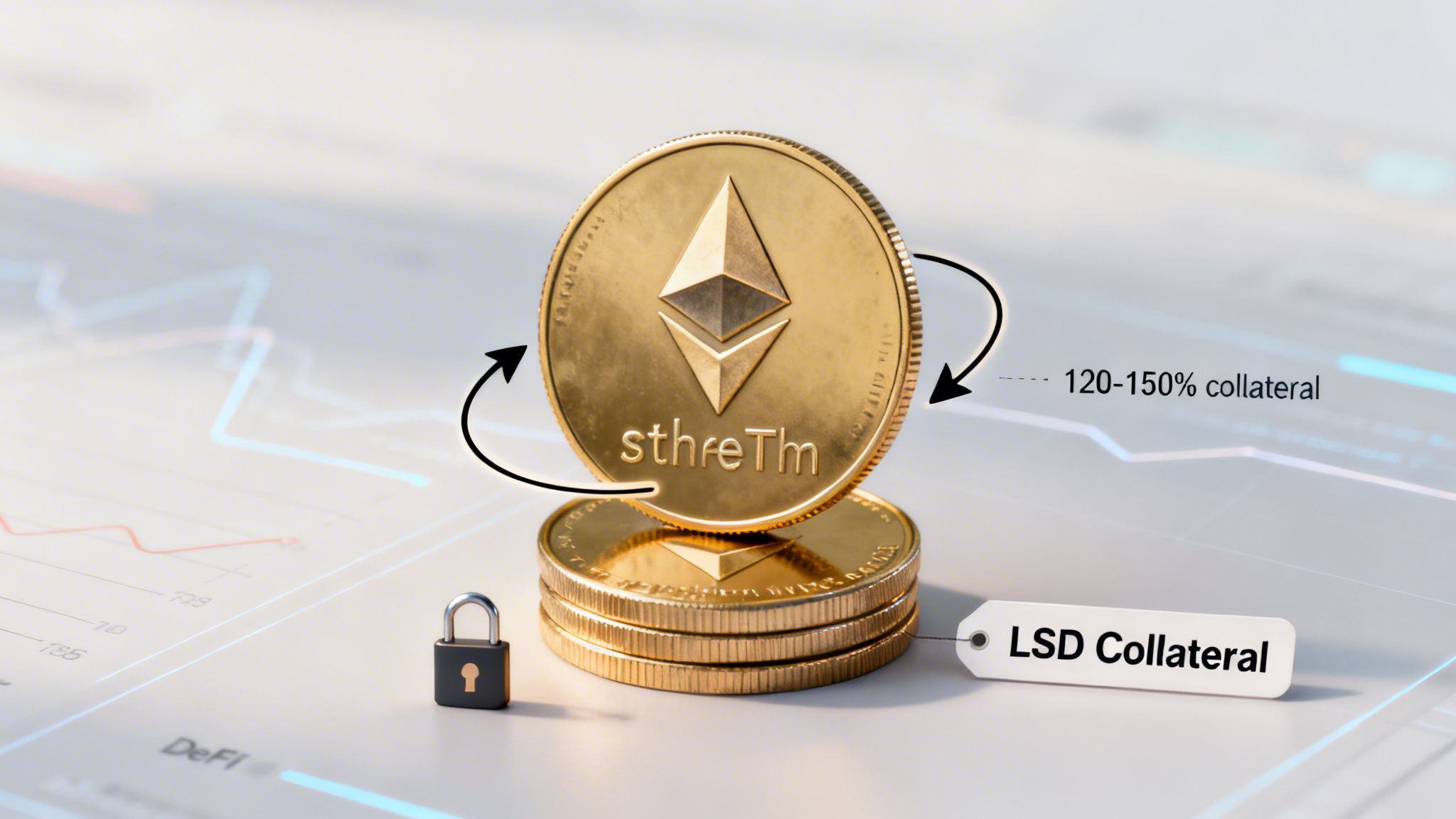
You essentially create a yield loop. Your initial capital (ETH) generates staking yield, while the borrowed stablecoins can be deployed in other safe DeFi yield strategies, amplifying your overall returns. The safety of this method hinges on using established LSDs and maintaining a healthy overcollateralized position to protect against liquidation risk from ETH price volatility.
Implementation and Key Platforms
This multi-step strategy requires careful execution. You start by staking ETH for an LSD and then proceed to a lending protocol.
Lido (stETH): The largest LSD provider. You stake ETH and receive stETH, which currently earns around 3.6% APY. You can then deposit stETH on Aave to borrow USDC.
Rocket Pool (rETH): A decentralized alternative that allows you to run a minipool or simply swap ETH for rETH. With a yield of roughly 3.2%, rETH is also widely accepted as collateral on platforms like Compound.
Frax Finance (sfrxETH): Offers a dual-token model where Frax Ether (frxETH) can be staked for Staked Frax Ether (sfrxETH), which accrues the staking yield, often reaching 3.8% or higher.
Key Insight: This strategy is powerful because your collateral is a yield-bearing asset. Unlike static collateral like WBTC, your LSD collateral (e.g., stETH) appreciates in value against ETH over time from staking rewards, which naturally improves your collateral health factor and reduces liquidation risk.
Actionable Tips for Lenders
To properly manage this looped strategy and mitigate associated risks, follow these steps:
Maintain a High Collateral Ratio: Do not get too aggressive with your borrowing. A collateral ratio above 140% is recommended to create a significant buffer against ETH price drops and avoid a liquidation cascade.
Use Price Alerts: Set up alerts for the price of both your LSD and ETH. If the value of your collateral falls more than 3-5% suddenly, be prepared to add more collateral or repay a portion of your stablecoin loan.
Automate Complex Strategies: Manually managing a looped position can be stressful and inefficient. Yield Seeker offers automated vaults that execute this strategy by using stETH as collateral, borrowing stablecoins, and then redeploying them into other high-yield, low-risk opportunities, all while managing liquidation risk for you.
This approach is best for investors with a long-term (1+ year) outlook on Ethereum, as the complexity is justified by the amplified yield potential over time.
8. Diversified Stablecoin Treasury Management with Reserve Allocation
While individuals can benefit from diversification, institutional-grade treasury management takes this concept to a new level, making it one of the most structured and safe DeFi yield strategies available. This approach, pioneered by DAOs and Web3 projects, involves creating a formal policy for deploying capital across a portfolio of low-risk yield sources. The core idea is to balance the need for liquidity with the goal of earning a return on idle assets.
This strategy isn't just about spreading funds around; it's about establishing strict rules. Capital is bucketed into different tiers based on liquidity and risk. For example, a portion is kept instantly accessible, another is allocated to medium-term lending, and a third is placed in yield-optimized strategies. Each bucket has defined risk parameters, reserve requirements, and rebalancing triggers to ensure the organization can always meet its obligations while its treasury works for it.
Implementation and Key Platforms
This strategy is less about a single platform and more about a disciplined framework. Organizations like Yearn Finance and the Aave DAO have publicly shared their treasury strategies, offering a blueprint for others.
Yearn Finance: The Yearn Treasury is a prime example, with its assets allocated across battle-tested protocols like Aave, Curve, and Morpho according to governance-approved mandates.
Uniswap Governance: Uniswap’s treasury is managed by the community, with proposals and debates on governance forums determining how its significant stablecoin holdings are put to work.
Institutional Advisors: For larger treasuries (e.g., >$10M), firms like Wintermute and Galaxy Digital provide advisory services, helping teams construct and manage sophisticated, diversified portfolios.
Key Insight: This strategy treats yield generation as a formal business operation, not just a casual investment. By defining clear liquidity tiers and rebalancing rules, it mitigates risk systemically and moves beyond reactive, ad-hoc decision-making.
Actionable Tips for Lenders
To apply treasury management principles to your own holdings or your project's treasury, adopt a structured approach:
Define Liquidity Tiers: Segment your capital. For instance, keep 20% instantly liquid (in your wallet), allocate 50% to medium-term, high-liquidity lending on Aave, and place 30% in a more optimized strategy like a managed vault.
Set Rebalancing Triggers: Don't just rebalance on a fixed schedule. Set triggers based on portfolio drift. For example, if any single bucket deviates by more than 15% from its target allocation, it’s time to rebalance.
Conduct Quarterly Audits: Formally review the protocols in your portfolio every quarter. Assess their TVL, security history, and any recent smart contract updates. Be prepared to remove a protocol if its risk profile degrades.
Automate with Precision: Manually managing a multi-tiered portfolio is complex. Yield Seeker can serve as a core component of this strategy, acting as the "optimized yield" bucket. By allocating a portion of your treasury to a managed solution, you ensure that capital is working efficiently within a pre-vetted, risk-managed environment, freeing you to focus on the overall allocation framework.
8 Safe DeFi Yield Strategies Compared
Strategy | 🔄 Implementation Complexity | ⚡ Resource Requirements | 📊⭐ Expected Outcomes | 💡 Ideal Use Cases | ⭐ Key Advantages |
|---|---|---|---|---|---|
Stablecoin Lending Protocols with Overcollateralization | Low — simple deposits, standard liquidation mechanics | Low — wallet + gas; minimal active management | Predictable yields ~4–8% APY; low volatility | Conservative stablecoin holders, treasuries, beginners | Transparent on-chain, no lockups, strong safety buffer |
Stablecoin Liquidity Pools with Minimal Impermanent Loss | Low — deposit LP; concentrated options add complexity | Low–Moderate — gas sensitive on L1; best on L2s | Fee-driven yields ~3–6% APY; negligible impermanent loss | Intermediate users, fee earners, L2 traders | Very low IL, continuous fee accrual, flexible entry/exit |
Yield Farming with Protocol Tokens on Established Platforms | Moderate — requires harvesting and token management | Moderate — active monitoring, gas, token diversification | Higher APY 8–15%+ but variable due to token volatility | Yield optimizers, intermediate users comfortable with token risk | Upside from token rewards, higher total yield potential |
Automated Delta-Neutral Strategies with Derivative Hedging | High — continuous rebalancing, advanced hedging logic | High — margin/derivatives access, automation/AI infrastructure | Targeted yields ~6–12% APY; removes directional exposure | Experienced traders, institutions, AI-assisted platforms | Delta-neutral capture of funding/basis spreads; robust in range-bound markets |
Algorithmic Stablecoin Arbitrage with Redemption Mechanisms | Moderate — peg monitoring and timely execution required | Moderate — quick execution capital and gas; arbitrage ops | Small steady arbitrage yields ~2–4%; supports peg stability | Arbitrageurs, governance participants, stablecoin purists | Built-in peg enforcement, transparent collateral mechanics |
Multi-Strategy Rebalancing with AI Portfolio Management | Moderate — setup and trust in algorithm; configurable rules | Moderate — platform fees, rebalancing gas (smart scheduling) | Optimized risk-adjusted returns; captures opportunities faster than manual | Time-constrained investors, DeFi beginners, crypto treasuries | Diversification, automated allocation, gas-aware rebalancing |
Long-Term Staking with Liquid Staking Derivatives (LSDs) as Collateral | Moderate — staking + collateral/borrow management | Moderate — ETH stake, over-collateralization, monitoring | Amplified combined yields ~6–10%; retains ETH exposure | Long-term ETH bulls, sophisticated yield optimizers, treasuries | Staking APY + yield amplification; composable collateral across DeFi |
Diversified Stablecoin Treasury Management with Reserve Allocation | Moderate — governance, rules, and periodic rebalancing | High (orgs) — governance, audits, tooling, personnel | Stable conservative yield while preserving liquidity; lower volatility | DAOs, protocols, foundations, institutional treasuries | Professional risk controls, liquidity tiers, transparent reporting |
Automating Your Way to Smarter, Safer Yield
Navigating the world of decentralized finance to find consistent, low-risk returns is an active, ongoing process. Throughout this guide, we've explored a variety of powerful, safe DeFi yield strategies, each with its own risk profile, implementation steps, and monitoring requirements. From the foundational stability of overcollateralized lending on platforms like Aave to the more intricate mechanics of delta-neutral strategies, the common thread is clear: safety is not a passive state but an active pursuit.
Successfully implementing these approaches requires more than just initial setup. It demands constant vigilance, a deep understanding of market dynamics, and the discipline to rebalance and re-evaluate as conditions shift. The most effective yield farmers are not just those who find good opportunities, but those who manage them with precision and consistency. This is where the true challenge for most investors lies, it’s not in the what, but in the how.
The Case for Intelligent Automation
Manually managing a diversified portfolio of safe DeFi yield strategies is a full-time commitment. You need to monitor protocol health, track APY fluctuations, assess smart contract risks, and execute transactions across different blockchains. This is where automation platforms like Yield Seeker offer a distinct advantage, moving you from being a manual operator to a strategic overseer.
Consider the strategies we covered:
Stablecoin Lending & Liquidity Pools: An AI agent can continuously scan dozens of protocols, automatically moving your funds to the platform offering the best risk-adjusted APY, something that would be impractical to do by hand.
Delta-Neutral & Arbitrage Strategies: These require precise, rapid execution. Automation removes the risk of human error and emotional decision-making, ensuring hedges are maintained and opportunities are captured at the optimal moment.
Multi-Strategy Rebalancing: Instead of you deciding how to allocate between lending, staking, and liquidity provision, an AI portfolio manager can do it for you, based on your stated risk tolerance and real-time market data. It diversifies not just across assets, but across strategies themselves.
Key Insight: The future of sustainable DeFi yield is not about finding a single "set and forget" strategy. It's about building a dynamic, responsive system that intelligently allocates capital across multiple, risk-assessed opportunities. Automation makes this system accessible to everyone.
Bridging Strategy and Execution
The principles behind these automated systems are not exclusive to DeFi. For a broader perspective on how algorithms execute predefined rules to manage risk and capture opportunities, understanding the fundamentals of automated trading strategies provides valuable context. This knowledge helps demystify the process, showing that at its core, automation is about applying a logical, data-driven framework with speed and precision that humans simply cannot match.
By using a tool like Yield Seeker, you are not ceding control; you are upgrading your execution. You still set the high-level parameters, your risk tolerance, and your overall goals. The AI agent then works within those boundaries, handling the tedious, moment-to-moment tasks that are critical for success but draining on your time and attention. It frees you to focus on bigger-picture strategy rather than the minutiae of transaction signing and APY chasing.
This approach makes safe DeFi yield strategies more accessible and sustainable. It reduces the steep learning curve for newcomers and provides a powerful efficiency tool for experienced users. The ultimate goal is to make your capital work for you in the most intelligent way possible, ensuring your path to passive income is both profitable and secure.
Ready to stop manually managing your DeFi portfolio and start earning smarter? Yield Seeker uses a personalized AI agent to automatically deploy your stablecoins across the safest, highest-yielding strategies we've discussed. Experience the power of automated DeFi by visiting Yield Seeker and put your capital to work, effortlessly.