
When people talk about transparency in DeFi, what do they really mean? It’s a term that gets thrown around a lot, but its true meaning is often misunderstood. It’s not just about having transactions on a public blockchain. True transparency is about having verifiable, understandable, and complete information that lets you make smart decisions instead of just blindly trusting a project with your money.
What Does Transparency in DeFi Actually Mean

Think of it like a restaurant with a kitchen made entirely of glass. You can see every ingredient, watch exactly how the chefs prepare your food, and check for yourself how clean everything is. That’s the gold standard for transparency in DeFi—an environment where nothing is hidden behind a curtain.
Too many people fall into the trap of thinking that if a transaction is on a public ledger, the protocol is automatically transparent and safe. This is a massive and dangerous oversimplification. Real transparency is about having both technical proof and clear, honest communication.
It means you should be able to answer these critical questions without hesitation:
Where are the funds actually held?
What are the specific risks involved in a strategy?
Who has control over the smart contracts?
How does the protocol make money, and where does it go?
If you can't get straight answers, you’re not investing—you’re gambling. Getting this distinction right is the foundation of managing risk in DeFi.
Moving Beyond Surface-Level Metrics
For a long time, Total Value Locked (TVL) was the main metric everyone pointed to. But here’s the problem: this number can be easily pumped up by a project's own tokens, painting a misleading picture of its actual health.
Thankfully, the industry is growing up, and so are the metrics we use. We’re moving away from inflated TVL and toward more honest indicators like stablecoin TVL. This shows real capital being trusted to the protocol, not just funny money from token incentives. It’s a much cleaner signal of genuine use.
The Transparency Test: If you can't easily explain to a friend where your money is and what risks it's exposed to within a DeFi protocol, that protocol probably isn't truly transparent. It should be simple, not a black box.
To really get a handle on what to look for, it helps to see how transparency works in traditional finance. For example, things like call reports are central to banking's financial transparency, giving a structured view of a bank's health. In DeFi, we have our own set of pillars.
This table breaks down the four essential pillars that make up genuine transparency in any DeFi protocol. It’s a great checklist for what you should be looking for.
The Four Pillars of DeFi Transparency
Pillar | Description | Why It Matters for Investors |
|---|---|---|
Code & Security | Publicly available and professionally audited smart contract code. | Verifies that the protocol functions as described and has been checked for common vulnerabilities, reducing the risk of hacks. |
Operational Clarity | Clear, comprehensive documentation on how the protocol works, its fee structure, and governance processes. | Empowers you to understand the system's mechanics and risks without needing to be a developer. |
Financial Verifiability | Real-time, accessible data on reserves, collateralization ratios, and revenue streams, often via public dashboards. | Allows you to independently confirm the protocol's financial health and solvency, ensuring assets are properly backed. |
Team & Governance | Open communication from the team (public or anonymous) and transparent on-chain governance mechanisms. | Provides accountability and insight into who controls the protocol and how key decisions are made, preventing rug pulls. |
Having all four of these pillars in place is what separates the truly trustworthy projects from the rest. It shows a commitment to user safety and gives you the tools you need to invest with confidence.
Understanding On-Chain Versus Off-Chain Transparency
To really get a handle on transparency in DeFi, you have to know where the information is coming from. It’s not all the same. Data falls into two buckets: on-chain and off-chain. Getting the difference between these two is absolutely critical if you want to separate hard facts from slick marketing.
Think of on-chain data like a public, legally-binding contract that's been notarized and filed away for anyone to see. It’s the raw, unchangeable truth that’s recorded right on the blockchain. Anyone with an internet connection can look it up and verify it themselves. You don't have to trust anyone, because the code itself is the proof.
Off-chain information is more like a company's glossy brochure or their latest press release. This is everything that lives outside the blockchain—the project’s website, announcements on X (formerly Twitter), or those PDF audit reports. It's usually easier to digest, but it means you have to place your trust in the people who created it.
What is On-Chain Transparency
On-chain transparency is the real magic of DeFi. It covers all the data that's native to the blockchain, which means you can independently check it without needing to ask for permission.
Some key examples of on-chain data include:
Transaction Histories: A complete, permanent log of every single move a wallet or smart contract has ever made.
Smart Contract Code: The actual lines of code that dictate how a protocol works. You can (and should) have this reviewed to confirm its logic.
Wallet Balances: The real-time amount and type of tokens sitting in any public wallet address, including a protocol's own treasury.
On-chain data doesn’t lie. It is the ultimate source of truth in DeFi, providing a transparent ledger of all activities. If it happened on the blockchain, the evidence is there forever.
This kind of verifiability is incredibly powerful. You don't have to take a team’s word that their protocol is holding $50 million in reserves; you can just go look at the blockchain yourself. The catch? This raw data can be super complex and tough for non-developers to make sense of without the right tools.
What is Off-Chain Transparency
While on-chain data gives you the hard evidence, it doesn't paint the full picture. Off-chain transparency fills in the critical context that code alone just can't give you. It's the human side of the project.
This includes stuff like:
Team Identity and Experience: Public profiles of the founders and devs, which creates real-world accountability.
Official Documentation: Whitepapers, GitBooks, and blog posts that explain what the project is trying to do in plain English.
Security Audit Reports: Findings from respected third-party firms that have scoured the smart contract code for any nasty vulnerabilities.
These things are vital for building trust. Knowing who’s behind a project and seeing they’ve paid for a professional audit can give you a lot more confidence. But always remember, this information is curated. A team has full control over what goes on their blog, and an audit is just a snapshot in time—it only covers what was reviewed on that specific day.
Balancing Both for a Complete Picture
Here’s the thing: neither on-chain nor off-chain data is enough on its own. If you only look at complex on-chain data, you might completely misunderstand what's happening. But if you only trust the polished off-chain marketing, you're opening yourself up to being misled. Smart risk management is all about blending the two.
Use the off-chain info to figure out what a protocol says it's doing, and then jump on-chain to verify its actions. If a project's blog claims its treasury is growing, pull up a blockchain explorer and confirm it. For a deeper look at how to do this in practice, check out our guide on holistic on-chain risk management strategies. This balanced approach gives you a complete, reliable view of a protocol's health, so you can invest with clarity and confidence.
Key Indicators for Evaluating Protocol Transparency
Alright, let's move from the 'what' to the 'how'. How do you actually measure transparency in DeFi? Vetting a protocol isn't just about a gut feeling; it’s about running through a checklist of specific, verifiable signs. Think of it as a pre-flight check before you commit your capital—every item you tick off adds another layer of confidence.
These indicators are the real-world proof that separates a genuinely transparent project from one just paying lip service. They give you a solid framework for your own research, helping you cut through the marketing fluff and pinpoint protocols that actually walk the talk on user safety.
Let’s break down exactly what you should be looking for.
Audits and Code Accessibility
The absolute foundation of transparency is the code itself. If you can't look under the hood, you can't trust the car. Simple as that.
Publicly Available Code: A serious protocol will have its complete smart contract code up on a platform like GitHub. This is non-negotiable. It allows anyone, from curious developers to professional security researchers, to kick the tires and see what's really going on.
Professional Security Audits: Reputable projects don't shy away from spending money on multiple audits from well-known security firms. These audits are like getting a professional, third-party inspection, looking for common bugs and security holes.
But remember, an audit isn't a magical shield guaranteeing 100% safety. It's just a snapshot of the code at a specific moment. For a better sense of what these reports actually cover (and what they miss), you might want to check out our guide on evaluating smart contract security audits. Always look at the date of the audit and make sure the team actually fixed the problems the auditors found.
Clear and Comprehensive Documentation
Next up, a transparent project has to explain itself clearly. Using complex tech is never an excuse for confusing or missing information. You should be looking for a well-maintained GitBook or a documentation site that lays everything out in plain English.
A protocol that can't explain its own mechanics in simple terms is a major red flag. True transparency means making complex systems understandable to the average user, not just to elite developers.
Good documentation should make it easy to find answers to basic questions like:
What are the exact fees and where do they go?
What's the governance process? Who holds the admin keys?
What are the specific risks tied to each investment strategy?
If you have to dig for this info, it's a bad sign.
Real-Time Financial Dashboards
The best protocols don't just tell you they're healthy—they show you. This is where public-facing dashboards come in. These tools are crucial for verifying a project's financial health in real time by pulling data directly from the blockchain and serving it up in a way anyone can understand.
This decision tree gives you a good mental model for how to approach data verification, whether you're looking at data on-chain or off-chain.
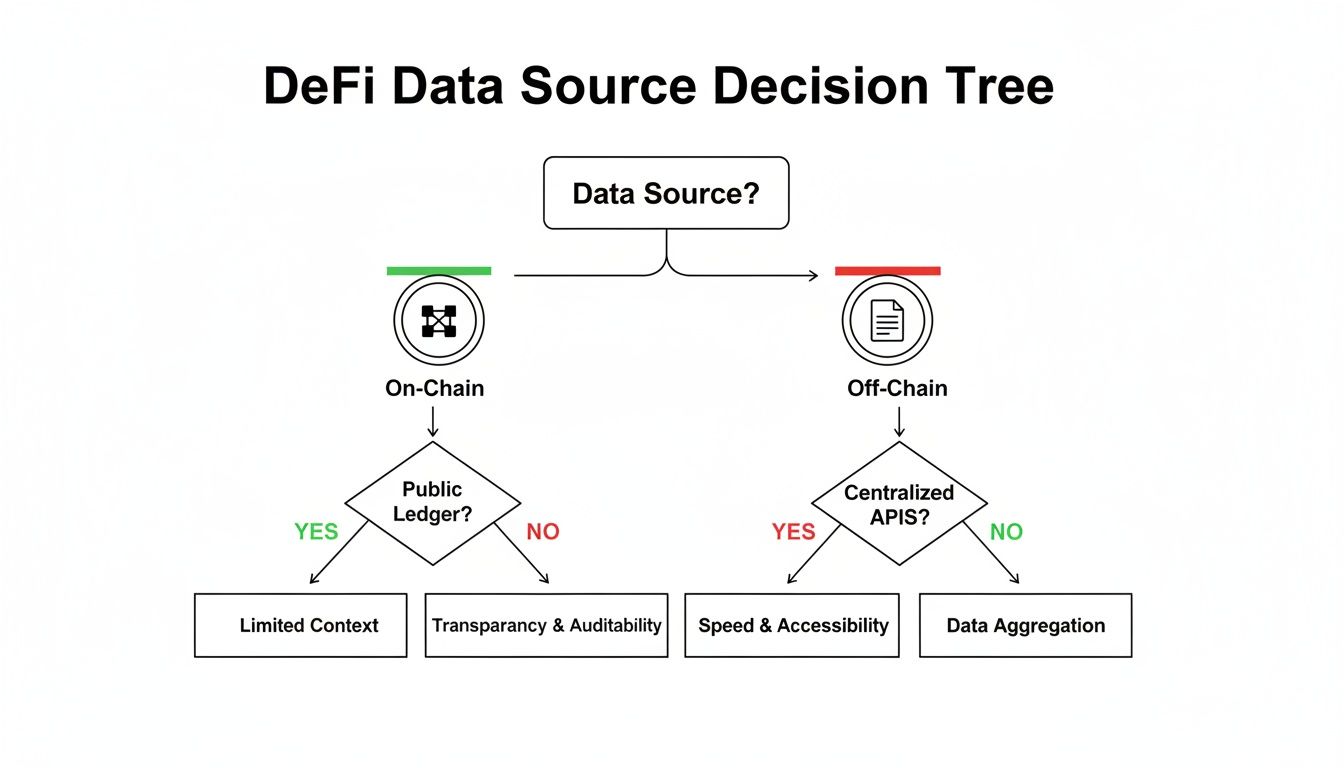
The main takeaway here is that while off-chain info is helpful for context, on-chain data is the ultimate source of truth. It's the trustless, verifiable proof of a protocol's claims.
Platforms like DeFiLlama have become essential tools for this. They aggregate on-chain data from thousands of protocols, letting you track metrics like Total Value Locked (TVL), fees, and revenue streams all in one place. You can compare protocols side-by-side and check key financial data without having to read a single line of code yourself.
One crucial metric to watch isn't just the total TVL, but the stablecoin TVL. A huge TVL can easily be inflated by the protocol’s own volatile token. A high stablecoin TVL, on the other hand, shows that users are trusting the protocol with real, stable capital—a much stronger signal of a project's health and legitimacy.
Spotting Red Flags and Common Deception Tactics

While the public ledger of a blockchain gives us a great starting point for seeing what’s going on, it's not a magic shield. Shady teams have gotten pretty clever at using that very openness to create a false sense of security, hiding major risks right under our noses.
Learning to spot these red flags is probably the most important skill you can develop to keep your money safe in DeFi. Think of this as your field guide for navigating the wild west of crypto yields.
That Looks Too Good To Be True: Suspiciously High APYs
The oldest trick in the book is dangling an absurdly high Annual Percentage Yield (APY) to lure people in. If you see a protocol promising 1,000% APY or more, your first question should be: where is that money actually coming from?
More often than not, it’s not from sustainable sources like trading fees or lending interest. Instead, the project is just printing its own native token like there's no tomorrow and paying you out with that. This creates a quick rush of profit, but as everyone cashes out, the token's value collapses, leaving you holding a bag of worthless rewards.
These schemes often mirror classic scams. If you want to get better at spotting them, it helps to understand the basics of What Is a Ponzi Scheme and How Do You Spot One?, as many DeFi rug pulls use a similar playbook.
Hiding in Plain Sight: Complexity and Hype
Another huge red flag is when a project’s docs are a mess of confusing jargon or are just plain vague. This is usually on purpose. The goal is to overwhelm you with complexity so you miss the simple, glaring risks they've hidden.
If you can't figure out how a protocol works after reading its whitepaper, it’s not because you’re not smart enough. It’s because the project is failing the transparency test.
Be wary of projects that spend more time on influencer marketing and social media hype than on clear, verifiable data. A project's real value comes from its tech and its utility, not a flashy marketing budget.
A protocol's complexity should never be an excuse for a lack of clarity. True transparency in DeFi means making intricate systems understandable to the average user, not hiding behind a wall of technical jargon.
A Quick Checklist of Common Red Flags
Keeping an eye out for these warning signs will help you dodge a lot of bullets. Here’s a quick list of things that should make you pause and dig deeper:
Anonymous Teams with No Track Record: Anonymity isn’t automatically a deal-breaker, but it puts the burden on the project to be flawless in every other way, like having multiple audits and a perfect on-chain history.
Missing or Outdated Audits: Any legit project will be proud to show off its security audits. If you can't find them, or they’re old and the code has changed since, that's a serious concern.
Vague or Incomplete Documentation: If the whitepaper or docs don't clearly spell out the risks, fees, and how governance works, consider it a warning shot.
Unverified Smart Contracts: The code on GitHub should match what's actually running on the blockchain. If the contract isn't verified on a block explorer like Etherscan, you have no way of knowing what it really does.
Even with these tactics, the fundamental transparency of the blockchain is a powerful tool. While illicit crypto volume reached an all-time high of USD 158 billion in 2025, its share of total on-chain activity actually dropped to just 1.2%. This shows that even though scams exist, the auditability of public ledgers helps to contain them.
Of course, even legitimate projects have risks. Understanding the specific dangers associated with liquidity pools is another key part of protecting your funds.
How Yield Seeker Delivers True Transparency and Safety
It’s one thing to talk about transparency in DeFi, but actually practicing it is a whole different beast. Trying to manually vet protocols, track yields across a dozen different platforms, and keep an eye on every security risk is basically a full-time job.
This is the exact headache we built Yield Seeker to solve.
Instead of leaving you to drown in a sea of browser tabs and complex jargon, our platform acts as your expert filter and automated co-pilot. We do the heavy lifting of continuous research and risk management, only interacting with DeFi protocols that pass our strict tests for safety, clarity, and real, sustainable performance.
A Unified Hub for Effortless Clarity
One of the biggest frustrations in DeFi today is just how fragmented everything is. Your funds might be split across five different protocols, which means you’re constantly juggling multiple dashboards just to get a clear picture of what’s going on. It’s confusing and makes it almost impossible to know how you’re really doing.
Yield Seeker cuts right through that noise. We give you a single, unified dashboard designed for one thing: giving you complete clarity in a single glance.
Total Balance & Earnings: See your total capital and net earnings in one spot, updated in real time. No more busting out the calculator or updating a spreadsheet.
Strategy Allocation: Know exactly where your money is working for you at all times. Our interface clearly shows which protocols your capital is in, giving you a direct line of sight.
Performance History: Easily track your APY over time to see how strategies are performing and watch the results of our automated optimizations.
This unified view is central to how we think about transparency. We believe you should always have a simple, instant answer to the question, "Where's my money and how's it doing?"
The Yield Seeker dashboard gives you a clean, intuitive interface that brings all your stablecoin yield activities together.
This visual approach means you can skip navigating five different clunky protocol UIs and instead get a clean, consolidated view of your financial position.
Demystifying DeFi with Visual Walkthroughs
But transparency isn't just about throwing data at you; it’s about making sure you actually understand what it all means. So many protocols hide behind complicated terms, but we do the exact opposite. We want to empower you with real knowledge.
Our platform has unique visual walkthroughs and even an integrated terminal that breaks down the underlying yield strategies in plain English. Before you ever put capital to work, you can explore exactly how a strategy functions, what the potential risks are, and why our AI agent might select it.
We operate on a simple principle: you should never invest in something you don't understand. Our platform is designed to be an educational tool as much as an investment one, demystifying DeFi one strategy at a time.
This commitment to clarity keeps you in the driver’s seat, making informed decisions with confidence. It's about giving you true control through understanding, not just a bunch of buttons on a screen.
Non-Custodial Control and No Lockups
A final, and absolutely crucial, piece of our safety and transparency puzzle is making sure you always have full control over your funds. Unlike some platforms that might lock your assets up for a fixed period, Yield Seeker is all about flexibility.
It's a huge difference from the manual grind of doing it all yourself. Here's a quick comparison of the two approaches.
Yield Seeker Transparency Features vs Manual DeFi
Feature | Manual DeFi Approach | Yield Seeker Approach |
|---|---|---|
Portfolio Tracking | Juggling multiple dashboards, browser tabs, and spreadsheets to track performance. | A single, unified dashboard showing all assets and earnings in real time. |
Strategy Vetting | Hours of personal research into audits, documentation, and team reputation for each protocol. | Access to pre-vetted protocols that meet our rigorous, ongoing safety and transparency criteria. |
Risk Management | Constant monitoring of market conditions and protocol health on your own. | Automated, AI-driven risk management that rebalances capital based on real-time data. |
Fund Control | Potentially encountering unexpected fund lockups or complex withdrawal processes. | Complete self-custody and the ability to withdraw your funds at any time, with no fees. |
With Yield Seeker, your funds are never locked. You can deposit or withdraw your stablecoins whenever you want, giving you the freedom to react to market changes or your own financial needs.
By putting automated research, total user control, and radical clarity together, we offer a smarter, safer way to tap into the opportunities DeFi has to offer.
The road to real transparency in DeFi isn't ending anytime soon. If anything, it’s just getting started, and the next big push is coming from a surprising place: Traditional Finance (TradFi). This isn't some old-school vs. new-school showdown. It's a mashup that's set to bring a whole new level of clarity and compliance to crypto.
As DeFi grows up, it’s catching the eye of the big institutions that used to write it off. Major financial players aren't just dipping their toes in anymore. They're actively building on public blockchains, finally waking up to the power of a permanent, transparent ledger for their own businesses.
It’s a win-win. DeFi gets the legitimacy and big money it needs to scale, and TradFi finally gets to ditch its clunky, slow, and often murky back-office systems.
The Blurring Lines Between TradFi and DeFi
This crossover between TradFi and DeFi is going to crank up transparency for everyone. The World Economic Forum has pointed out that as big banks start using blockchain, they're actually making global finance less opaque. You can see it happening already with projects like JPMorgan's JPM Coin and Citi's Token Services. They're using public ledgers for 24/7 USD clearing, which cuts costs and creates a perfect audit trail that was impossible before. You can see more on how digital assets are reaching an inflection point in their 2026 outlook.
This isn't just about moving faster; it's about being held accountable. When a global bank settles transactions on a public blockchain, it's opening itself up to a level of public scrutiny that just doesn't exist in their private, internal systems. It sets a huge precedent, showing that transparency isn't just some crypto-nerd ideal—it's what modern, trustworthy finance looks like.
The real prize here is a financial system that combines the trust-building transparency of DeFi with the scale and regulatory smarts of TradFi. This hybrid model could easily become the new global standard.
Innovations Driving Verifiable Privacy
Of course, as institutional money pours into DeFi, we hit a classic problem: balancing total transparency with the need for privacy. Not every single transaction can, or should, be blasted out for the whole world to see, especially when regulations are involved. This is where some seriously cool tech like Zero-Knowledge Proofs (ZKPs) comes into the picture.
Think of ZKPs as a way to prove something is true without actually showing the sensitive data behind it. For example, a protocol could use a ZKP to prove it has enough funds to cover its debts without revealing a single wallet address or transaction detail. This unlocks some incredible possibilities:
Confidential Transactions: You can use a protocol while keeping your personal financial activity private.
Regulatory Compliance: Institutions can prove they're following the rules (like anti-money laundering checks) without leaking sensitive customer info.
Verifiable Audits: Protocols can confirm to auditors that they are financially healthy without handing over the keys to the kingdom.
This ability to provide mathematical proof without giving away the farm is a total game-changer. It solves the tug-of-war between the need for privacy in regulated finance and DeFi's core belief in being able to verify everything.
The path forward seems pretty clear: the push for more transparency in DeFi is here to stay. The protocols and platforms that really lean into this—by adopting institutional standards, using privacy-first tech like ZKPs, and committing to being radically open—are the ones that are going to win in the long run. The future of finance isn't just decentralized; it's verifiably transparent.
A Few Common Questions
Even after you get a handle on what transparency in DeFi really means, a few common questions always seem to pop up. Let's tackle some of the most pressing ones so you can put these ideas into practice.
Is a High TVL a Reliable Sign of a Safe Protocol?
Not always. It's tempting to see a huge Total Value Locked (TVL) and think a protocol is a safe bet, but this number can be really misleading.
Often, a protocol’s TVL gets pumped up by its own native tokens, which are dished out as rewards to attract liquidity. This doesn't represent real, stable capital. What you really want to look at is the stablecoin TVL.
This figure tells you how much actual dollar-pegged value people are comfortable locking into the system, cutting through the hype of volatile native tokens. A truly transparent protocol will make it dead simple for you to find this data, either on their own site or through third-party tools.
Does a Smart Contract Audit Guarantee 100% Safety?
Absolutely not, and this is a crucial point to get your head around. A smart contract audit is a must-have security check, but it’s not an ironclad guarantee of safety. Think of it like a building inspection before buying a house—it spots known issues at one specific moment in time and drastically cuts your risk, but it doesn't magically eliminate every potential problem.
An audit is a snapshot, not a permanent shield. It checks for known vulnerabilities in the code but doesn't cover economic risks, future exploits, or the integrity of the team running the protocol.
So, you should always see a positive audit as a great starting point, but it's just one piece of the puzzle. It's definitely not the end of your research.
How Can I Verify On-Chain Data Without Being a Developer?
You don't need to be a developer or know how to read code to check on-chain data. Thankfully, the DeFi world has spawned a bunch of user-friendly analytics platforms that do all the heavy lifting for you, turning raw blockchain data into clean, visual dashboards.
Here’s how you can do it:
Use Public Dashboards: Platforms like DeFiLlama and Dune Analytics are your best friends. They offer real-time data on thousands of protocols, tracking everything from TVL to revenue.
Check Protocol Links: The good guys—the truly transparent projects—will link directly to their dashboards on these platforms. They want you to go and check their claims.
Leverage Curated Platforms: Tools like Yield Seeker take this a step further. We don't just vet protocols for you; we present all this crucial on-chain data in a simple, easy-to-digest format, saving you hours of research.
Why Would a Legitimate DeFi Team Remain Anonymous?
Anonymity runs deep in crypto culture. It often comes from the community's cypherpunk roots, personal security concerns, or simply wanting to avoid the headaches of potential regulation. While an anonymous team isn’t an automatic red flag, it puts a much bigger responsibility on them to prove they're trustworthy in other ways.
If a team stays anonymous, they have to go above and beyond with their transparency in DeFi practices. This means getting multiple, tough third-party audits, keeping their documentation incredibly clear and thorough, and making sure all governance moves are executed transparently on-chain.
For most people, though, a public, accountable team adds a vital layer of trust and a clear path for recourse if things go wrong.
Ready to stop hunting for yields and start earning smarter? Yield Seeker uses AI to automatically find and manage the best stablecoin yields for you, all while prioritizing safety and transparency.