

You're scanning yields, a vault flashes an APY that looks meaningfully better than the rest, and the temptation is obvious. Park stablecoins there, let it run, collect the spread. Users frequently stop their diligence at the strategy label, the protocol brand, or whether the UI looks clean.
That's not where a lot of real risk sits.
In DeFi, your money often depends on a number you never see directly. The reported value of collateral. The mark price used to trigger liquidations. The exchange rate used to mint, redeem, borrow, unwind, or rebalance. If that number is wrong for even a short window, a “safe” yield strategy can turn into forced selling, bad debt, or a stablecoin position that no longer behaves like cash.
That hidden dependency is the oracle.
Why Oracles Are a DeFi Investor's Biggest Blind Spot
Most yield farmers think first about smart contract risk, stablecoin risk, and maybe governance risk. That's sensible. But oracle risk often sits underneath all three, and it gets ignored because it feels infrastructure-level instead of personal.
It is personal.
If you deposit stablecoins into a lending market, the protocol still needs price data to value collateral across the system. If you use a delta-neutral strategy involving borrowed capital, an oracle may decide when the position gets rebalanced or liquidated. If you farm a synthetic dollar product, some oracle setup is usually helping define whether that synthetic asset is worth one dollar, less than one dollar, or more.
The yield number is downstream from the oracle
A high APY can distract you from the machinery producing it. The sharper question is this: what data does the strategy trust, and what happens if that data breaks?
When that answer is weak, the advertised yield doesn't matter much.
Practical rule: If a DeFi strategy depends on collateral values, liquidations, or synthetic pricing, assume oracle design matters as much as the contract code.
This is the blind spot because oracle failure usually doesn't look dramatic at first. It can start as a stale price, a delayed update, or a feed that's technically “working” while the market has already moved. Then liquidators, arbitrageurs, and attackers do what they always do. They exploit the gap before regular users even realize there is one.
Why stablecoin users should care more than they think
Stablecoin holders often believe they're taking the conservative path. Relative to directional bets, they usually are. But in practice, stablecoin yield strategies still touch volatile collateral, DEX pricing, cross-market reference prices, and liquidation engines.
That means you can lose money without the stablecoin itself failing.
A protocol can overvalue collateral and lend too much. It can undervalue collateral and liquidate healthy borrowers. It can pause redemptions at the worst time. It can route funds into a market that looks solvent on the dashboard but is relying on fragile price feeds behind the scenes.
The investor mistake is treating oracle risk as a builder problem. It isn't. It's balance-sheet risk for anyone chasing yield with actual capital on-chain.
How Oracles Bridge Blockchains and the Real World
A blockchain is good at verifying what already happened on-chain. It isn't good at knowing what happened elsewhere. It can't natively look up the price of ETH on an exchange, check whether a football match ended, or confirm whether a treasury bill yield changed off-chain.
That separation is a feature. It keeps blockchains deterministic. But it creates a hard limitation.
A blockchain oracle is the mechanism that carries outside information into that closed system so smart contracts can use it.
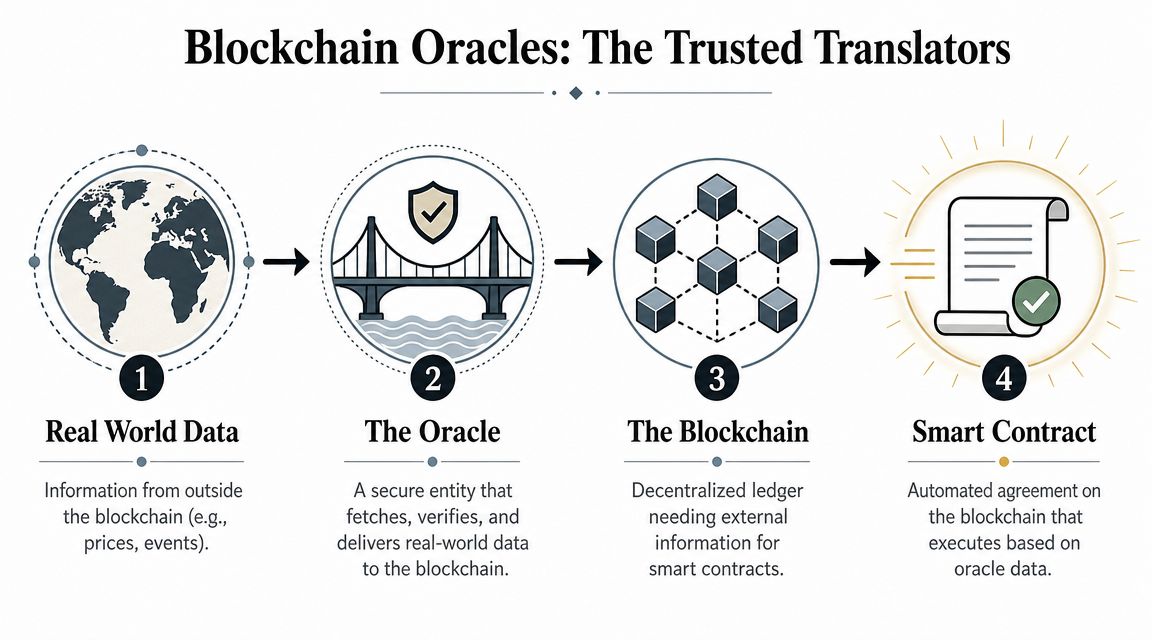
Think of the oracle like a market translator
The simplest analogy is a translator between two parties that can't speak directly.
The blockchain speaks in validated on-chain state. Markets speak through exchange data, APIs, news, off-chain systems, and event feeds. Smart contracts need someone to translate that outside information into a form they can trust enough to execute against.
Without that translator, a lending protocol can't know whether collateral is still sufficient. A perpetuals venue can't settle fairly. A synthetic asset protocol can't maintain any believable reference value.
This design pattern matters outside finance too. Projects building real-world data workflows in Web3 run into the same problem. If you want a practical example of blockchain systems needing trustworthy off-chain inputs, the Pestivid Web3 initiative is a useful reminder that oracle design isn't just a DeFi niche. It's a broader coordination problem any serious on-chain application has to solve.
What actually happens in the data flow
At a high level, the process usually works like this:
A smart contract needs external data
A lending market may need the current price of ETH, BTC, or a liquid staking token.The oracle system fetches data from outside the chain
That could include exchange feeds, market APIs, or other reference sources.The oracle applies some validation logic
Different systems do this differently. Some aggregate several sources. Some filter outliers. Some rely on designated publishers. Some have update thresholds.The final value gets posted on-chain
The smart contract reads that value and executes according to its own rules.Users experience the consequence
Borrowing limits change. Liquidations trigger. Swaps settle. Vaults rebalance.
A smart contract can be perfectly written and still behave disastrously if it's fed bad data.
Why this matters in plain money terms
People hear “oracle” and think infrastructure plumbing. You should think decision input.
A protocol is making financial decisions with that number. If the number is delayed, manipulated, or derived from weak sources, the smart contract will still execute. It won't pause to ask whether the data makes sense. Code is obedient like that. It follows instructions, even when those instructions are attached to bad inputs.
That's why oracle quality isn't a side detail. It's part of the strategy itself.
Exploring the Main Types of Blockchain Oracles
Not all oracle systems make the same trust trade-offs. The most useful split for investors is centralized versus decentralized.
That distinction tells you where failure is likely to come from.
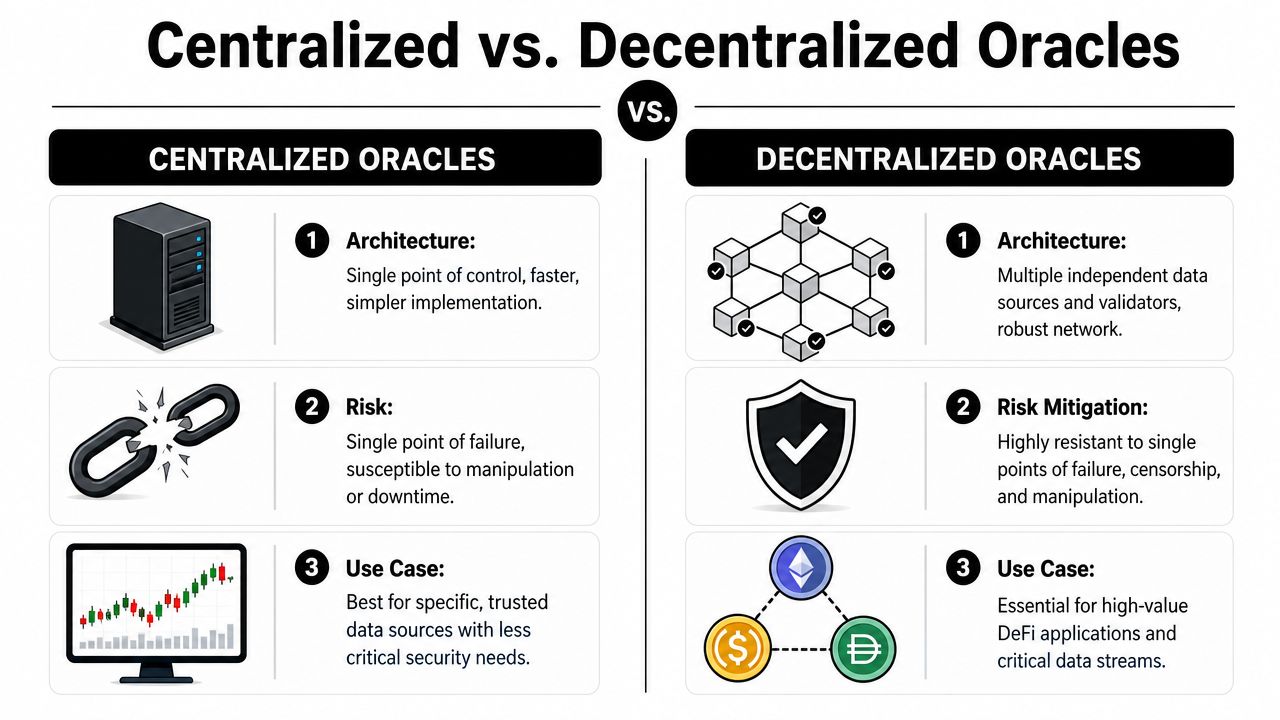
Centralized oracle
A centralized oracle depends on one operator or one tightly controlled source of truth. That can be a team-run server, a single publisher, or a narrow data pipeline.
This model is often simpler. It can be fast. It can be easier for a protocol to integrate and maintain. For lower-stakes use cases, that may be acceptable.
The problem is obvious once real money gets large. If one operator fails, gets compromised, goes offline, or posts bad data, the whole dependency chain can break.
Decentralized oracle
A decentralized oracle spreads trust across multiple participants, data publishers, or validators. In DeFi, this is usually the safer design for high-value systems because it reduces dependence on any one party behaving correctly.
This doesn't mean “risk-free.” It means the attacker has a harder job. Instead of corrupting one publisher, they may need to influence several moving parts. Instead of betting on one server outage, they need broader disruption.
Chainlink and Pyth are common examples people evaluate in practice. They differ in architecture and data delivery style, but from an investor's perspective the key question is the same: how hard is it for this oracle path to fail in a way that hurts users?
Centralized vs. Decentralized Oracles
Feature | Centralized Oracle | Decentralized Oracle |
|---|---|---|
Control | One main operator or tightly controlled provider | Multiple operators, publishers, or nodes |
Speed | Often simpler and fast to ship | Can be more complex depending on design |
Failure mode | Single point of failure | More resilient to one party failing |
Trust assumption | You trust one source or team | You trust a distributed process |
Attack surface | Easier target if critical controls are concentrated | Harder to manipulate cleanly, but not impossible |
Typical fit | Simpler apps, narrow data needs, lower-value workflows | Lending, derivatives, synthetic assets, high-value DeFi |
What actually works in production
A lot of teams talk as if decentralized automatically means good. That's too loose.
A weak decentralized design can still be fragile if source selection is poor, update logic is sloppy, or the consuming protocol fails to add safeguards. On the other side, a tightly scoped centralized oracle can be acceptable if the blast radius is small and the protocol limits what bad data can do.
Investor lens: Don't ask whether a protocol “has an oracle.” Ask what trust assumption you're inheriting when you deposit.
For stablecoin yield strategies, the stronger default is usually to prefer protocols whose oracle stack was built for adversarial conditions, not convenience.
Common Oracle Attacks and How They Work
Oracle exploits rarely feel exotic once you strip away the jargon. Most are versions of the same basic play. Get the protocol to believe a false number, act on that number faster than everyone else, extract value, leave ordinary users holding the damage.

Price manipulation through thin markets
Start with the simplest case. A protocol reads price data from a market that doesn't have much depth. An attacker uses borrowed capital, often in a flash loan-powered setup, to push that market price hard for a brief window. The oracle reads the distorted price as if it were real.
Now the attacker interacts with the target protocol while the fake price is live.
If the protocol thinks an asset is worth more than it really is, the attacker can post inflated collateral and borrow good assets against it. If the protocol thinks an asset is worth less than it really is, the attacker may trigger liquidations that shouldn't happen and buy collateral at a discount.
The manipulation doesn't need to last long. It just needs to last long enough for the oracle consumer to trust it.
Corrupt source, clean on-chain execution
Some oracle failures don't begin on-chain at all. The on-chain contract may execute exactly as designed while the off-chain source is wrong, stale, or compromised.
That's what makes oracle risk dangerous for investors. You can read the contract, audit the code, and still miss the point. The code can be secure while the data pipeline feeding it is weak.
A lot of users evaluate protocol safety without digging into these dependencies. If you want a broader framework for that process, this guide to smart contract security audits and what they actually tell you is useful because audits matter, but they don't automatically protect you from bad oracle assumptions.
Latency attacks during violent markets
The third pattern is delay.
Markets move fast. Some oracle systems update on thresholds, schedules, or keeper incentives. During normal conditions that may be fine. During a sharp move, the lag becomes exploitable.
Astute traders see the market change before the protocol's internal view catches up. They trade against stale values, unwind before the update lands, and capture low-risk profit while slower users absorb the aftershock.
This is one reason “the oracle wasn't hacked” isn't a comforting defense. A feed can be honest and still be too slow for the conditions that matter most.
Here's a visual walkthrough if you want a compact explanation of how oracle weaknesses become protocol exploits:
If a protocol can be gamed only when volatility spikes, that's not a rare edge case. That's the exact environment where risk controls need to work.
The practical lesson is simple. Oracle attacks don't require cinematic complexity. They require weak assumptions, available liquidity, and a protocol willing to treat bad inputs as truth.
How Oracle Risk Impacts Your Stablecoin Yields
Stablecoin investors often think in terms of APY, not plumbing. But oracle failures hit stablecoin strategies in the most direct place possible. Your principal, your withdrawal path, and the protocol's ability to keep operating normally.
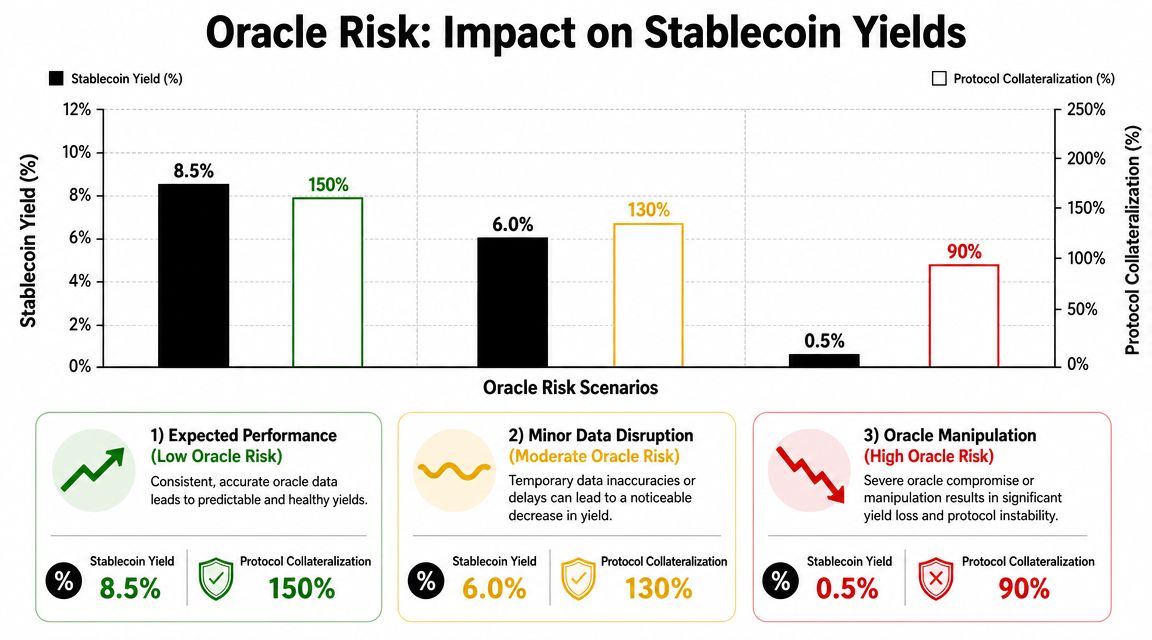
The first loss channel is bad collateral valuation
Suppose you deposit stablecoins into a lending protocol. You may never borrow, trade, or amplify your positions with borrowed funds yourself. Still, the health of that market depends on collateral across the system being priced correctly.
If the oracle overstates collateral value, the protocol can lend too aggressively. That creates bad debt when positions should've been liquidated earlier. The market becomes less solvent, and your “passive” stablecoin yield starts depending on whether the hole gets socialized, paused, or papered over.
If the oracle understates collateral value, healthy positions can get liquidated. That spooks borrowers, drains activity, and weakens utilization. Yields can drop right when users want safety most.
The second loss channel is stablecoin behavior itself
A stablecoin strategy can also break because the system around the stablecoin starts making bad oracle-driven decisions. That's especially relevant for synthetic dollars, collateral-backed products, and vaults routing through several protocols.
When the market questions the reference price, redemptions can get messy, exits can widen, and “stable” turns into “tradable, but painful.” If you want a grounded view of how these layers stack, this piece on understanding stablecoin risks helps because oracle weakness usually compounds the risks already present in the asset design.
Why yield can vanish before principal does
A lot of people wait for obvious insolvency signals. By then, the better move is often long gone.
In practice, oracle stress tends to show up earlier through second-order effects:
Utilization shifts because borrowers leave or reduce their debt
Incentive emissions lose meaning because users don't trust the market
Withdrawals slow down as liquidity fragments
Risk premiums rise and the strategy stops being worth the hassle
That's the part stablecoin users underestimate. You don't need a total collapse to lose money. A protocol can remain online while the economics deteriorate enough to erase months of yield or trap capital at the wrong time.
The cleanest stablecoin strategy is the one where you understand what price assumptions your return depends on before the market tests them.
How to Assess Oracle Risk When Choosing Protocols
You don't need to read oracle source code to filter out a lot of bad setups. You need a disciplined checklist and the habit of asking where the protocol gets truth from when money is on the line.
Questions worth asking before you deposit
Which oracle system does the protocol use
Naming the provider matters. “Custom oracle” isn't automatically bad, but it should make you slow down and investigate further.What assets does that oracle price well
A setup that works for major assets may be much weaker for thinly traded tokens, LP tokens, or exotic collateral.How fresh is the data during stress
The key issue isn't whether the feed updates in calm conditions. It's whether the protocol still has a usable market view when prices move quickly.Is there a fallback path
Better protocols don't assume the primary feed is always fine. They define what happens when data is stale, disputed, or unavailable.What can the protocol do if the oracle misbehaves
Look for pause functions, circuit breakers, conservative collateral factors, or clear emergency procedures.
What strong operator behavior looks like
The protocol team should be able to explain its oracle design in plain language. Not marketing copy. Actual mechanism.
Good signs include:
Check | Why it matters |
|---|---|
Clear oracle documentation | Shows the team understands the dependency and expects users to evaluate it |
Conservative asset listings | Harder-to-price assets create more room for oracle error |
Defined failure handling | A protocol that plans for bad data is safer than one that assumes perfection |
Visible monitoring | Teams that watch feed health usually react faster when conditions change |
A fast filter for busy investors
If you don't have time for deep protocol research every week, use this shortcut:
Identify the oracle provider
Check whether the strategy depends on liquidations or synthetic pricing
Look for fallback and pause mechanisms
Avoid protocols that are vague about data sources
Reduce size when the oracle path looks bespoke or hard to verify
For a broader process that goes beyond the oracle itself, this framework for protocol safety analysis is worth keeping in your diligence stack.
The edge isn't finding a protocol with zero oracle risk. It's avoiding the ones where the oracle risk is hidden, concentrated, or clearly underappreciated by the market.
How Yield Seeker Automates Oracle Risk Management
Manual oracle review is possible. It's also a time sink, especially if you're comparing multiple strategies across changing market conditions. Most investors won't keep re-checking feed quality, update behavior, collateral dependencies, and protocol responses every time volatility picks up.
That gap is where automation makes sense.
What an automated process should actually monitor
A useful risk system doesn't just note which oracle a protocol uses and stop there. It needs to watch for operational signals that change the quality of that dependency in real time.
That includes things like:
Data freshness during active markets
Source diversity where applicable
Protocol dependency depth, meaning how many moving parts rely on the same feed
Failure response design, such as pauses or alternate paths
Market context, because a tolerable setup in quiet conditions may look weak in stress
This is also why serious DeFi operators spend time studying market structure, not just APY pages. If you want a useful example of how traders think about infrastructure dependence in derivatives, this deep dive into Perpetual Protocol is a good companion read.
Where a tool can help and where judgment still matters
Tools can reduce the research burden. They can flag brittle dependencies, compare opportunities faster, and react when conditions worsen. They can't remove the need for judgment about strategy fit, stablecoin exposure, or how much concentration you're willing to tolerate.
One example is Yield Seeker, which uses an AI agent to monitor DeFi opportunities and allocate stablecoin capital based on risk and return conditions. In practice, that kind of workflow is useful because oracle-related risk often changes faster than a casual investor can track manually.
Working heuristic: Automation is most valuable when it cuts response time to infrastructure risk, not when it simply surfaces more dashboards.
The primary benefit isn't magical prediction. It's disciplined re-evaluation. Oracle quality isn't a one-time checkbox. It's an ongoing input into whether a yield strategy is still worth owning today, under current market conditions, with current liquidity and current stress.
If your process only notices oracle risk after social media starts posting incident threads, your process is late.
Yield Seeker helps stablecoin holders automate that monitoring burden instead of manually chasing protocols, feeds, and shifting market conditions. If you want a hands-off way to pursue risk-aware yield while keeping funds accessible, you can explore Yield Seeker.