

The popular advice is simple: deposit stablecoins into DeFi, find the highest APY, and let the returns compound while you sleep. That advice leaves out the part that matters most. A DeFi yield rate is compensation for risk, complexity, or borrower demand, not a free upgrade on cash.
Passive income DeFi can work, but it makes more sense as a risk-adjusted capital allocation decision than as a hunt for eye-catching percentages. Stablecoin lending, liquidity provision, staking, and automated strategies can produce useful returns when the underlying activity is sound. They can also expose your capital to smart-contract failure, liquidity constraints, governance decisions, platform risk, and stablecoin depegging.
The practical question is therefore narrower and more useful: what are you being paid to accept, and is that payment worth the trade-off?
Why Most DeFi Yield Is Not What It Seems
DeFi yield isn't automatically better than Treasury bills, money-market instruments, or other conventional cash alternatives. In many cases, the advertised return looks attractive only because the comparison ignores the risks embedded in the strategy. A stablecoin vault paying a few percentage points may still leave you carrying technical and liquidity risks that a conventional cash instrument doesn't impose in the same way.
The most contrarian fact is that much of the supposedly conservative stablecoin market earns modest returns. One recent analysis found that 58% of stablecoin vault TVL on Ethereum and its Layer 2s was earning under 3% APY, while on-chain yield in 2025 totaled about $8 billion. Those figures don't prove that DeFi is unattractive, but they do challenge the idea that passive income automatically means superior income. The data is discussed in the analysis of on-chain yield in 2025.
Yield is a payment for something
When a protocol offers yield, identify the source before you assess the rate.
Borrower interest compensates lenders for supplying capital that other users want to borrow.
Trading fees compensate liquidity providers for helping traders exchange assets.
Token incentives may subsidize participation, but they can change quickly and may expose you to a volatile reward asset.
Basis strategies can increase the return while adding liquidation, execution, and market-structure risk.
New protocol exposure may offer a higher rate because users are accepting less established contracts, governance, or liquidity.
That distinction matters because a return above a conventional benchmark isn't necessarily a free premium. It may be the market's way of pricing risks that aren't visible in the headline APY.
Practical rule: Treat every DeFi yield rate as a risk statement. Ask what must remain true for the rate to continue.
When DeFi can make sense
DeFi becomes more compelling when you value on-chain settlement, direct control, programmable liquidity, or access to strategies that conventional accounts don't provide. It may also fit users who already hold stablecoins and understand wallet security, network fees, withdrawal mechanics, and smart-contract approvals.
It makes less sense to move emergency cash into a complex vault just because the dashboard displays a higher rate. If the extra return is small, the operational burden and technical exposure may outweigh the benefit. For many users, the right allocation may be a conservative core position, a limited DeFi sleeve, and enough liquid capital outside protocols to avoid forced withdrawals at an inconvenient time.
The shift in mindset is important. Don't ask only, “Which pool pays the most?” Ask, “What risk-adjusted return remains after I account for the contract, platform, liquidity, and depeg risks?”
How Passive Income in DeFi Works
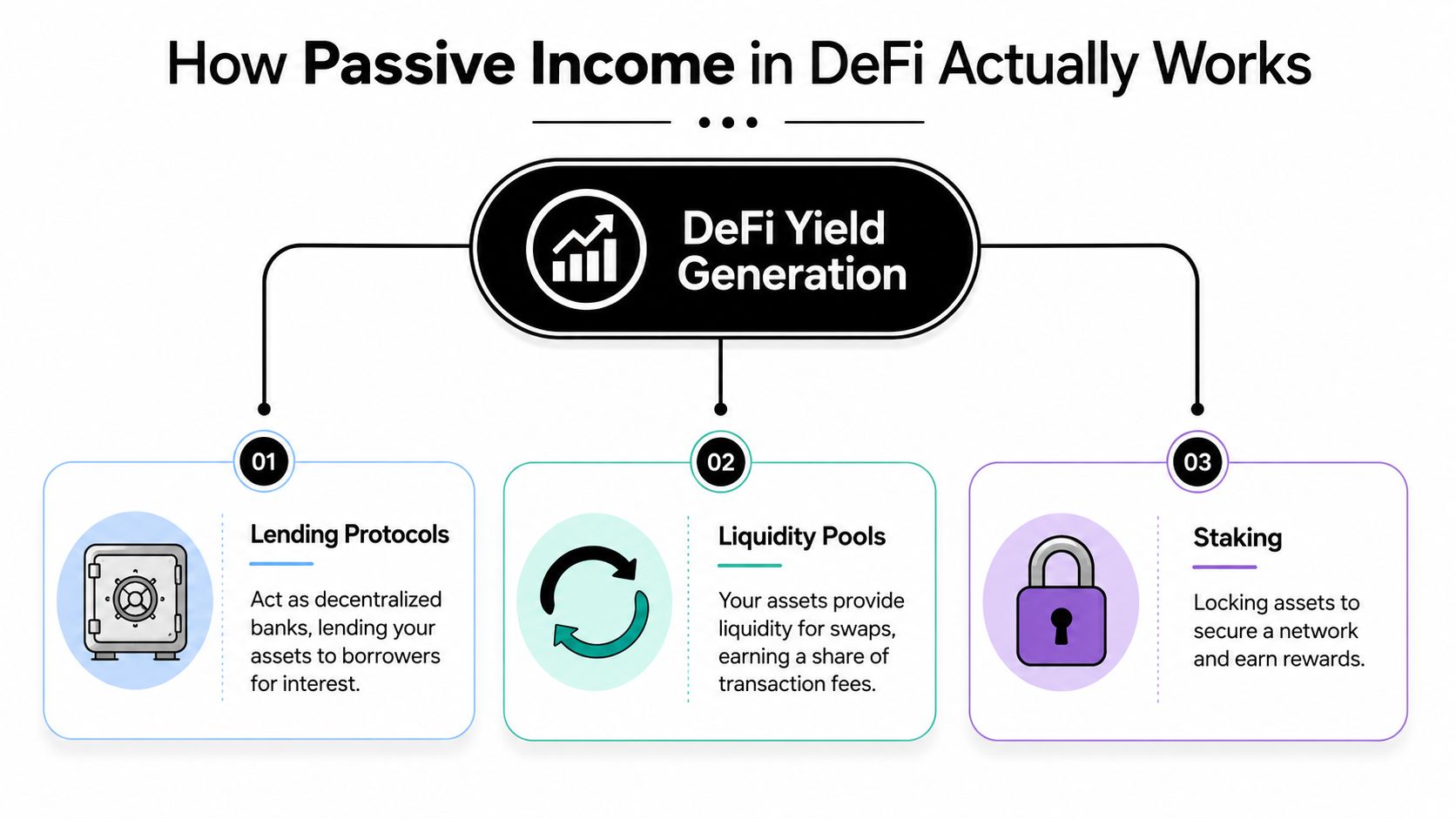
DeFi yield is payment for identifiable activity, not money created by a dashboard. Borrowers pay for liquidity, traders pay swap fees, and networks issue rewards for security. Smart contracts automate the rules, but they do not remove the underlying market or technical risks.
Lending protocols accept supplied assets and make them available to borrowers. Supply a stablecoin, and borrowers may pay interest for access to that liquidity. The protocol sends part of the interest to suppliers under its distribution rules, while allocating the remainder according to its design. Rates move with demand and utilization, so a quoted APY is a current condition, not a promise.
Liquidity pools use a different engine. You deposit assets into a pool that traders use for swaps, then receive a share of transaction fees. The result depends on trading volume, fee distribution, pool composition, and how the assets behave relative to each other. Stablecoin pools can limit price divergence compared with volatile-asset pairs, but smart-contract, depeg, and liquidity risks remain.
The three building blocks
Lending pays you for making capital available to borrowers. Its rate changes with demand, while the protocol adjusts borrowing and supply rates through a utilization model.
Liquidity provision pays you for supporting swaps. Fees can look attractive during active markets, yet pool composition and asset divergence can reduce the realized return.
Staking pays rewards for helping a network reach or maintain consensus. Assets may be locked or subject to an unbonding period, depending on the network and arrangement. Withdrawal timing therefore belongs in the yield calculation.
Stablecoins connect all three activities. They provide a digital dollar-like unit for lending, trading, collateral, and treasury operations. Stablecoin supply and transaction activity have expanded substantially, as described in the 2026 DeFi market review. Greater liquidity supports more borrowing, settlement, and fee-generating activity, but scale does not make an individual protocol safe.
The practical distinction is automatic execution and passive ownership. A contract can execute deposits, rebalancing, or withdrawals according to its code, while you still retain every exposure. You choose the asset, protocol, network, and withdrawal path, and you absorb the consequences when liquidity dries up, a peg breaks, or the contract behaves unexpectedly. Passive DeFi income is therefore a capital-allocation decision, not a high-APY treasure hunt.
The Main Yield-Generating Strategies Explained
The five common approaches differ more than their dashboards suggest. Staking may be relatively straightforward but can involve lockups or token price exposure. Lending is usually easier to understand, while liquidity provision can add market-making risks. Aggregators and automated strategies reduce manual work, but they introduce another layer of contracts and decision logic.
Strategy | Typical APY Range | Risk Level | Effort Required | Best For |
|---|---|---|---|---|
Staking | Network-dependent and variable | Moderate | Low to moderate | Users comfortable with network and token exposure |
Stablecoin lending | Low to mid single digits in conservative markets | Moderate | Low | Users seeking simpler on-chain income |
Liquidity provision | Variable with pool activity and incentives | Moderate to high | Moderate | Users who understand pool and asset risks |
Yield aggregation | Depends on underlying protocols | Moderate to high | Low after setup | Users who want fewer manual transactions |
Automated strategies | Variable and strategy-dependent | Moderate to high | Low after setup | Time-constrained investors willing to delegate execution |
Staking
Staking uses your assets to support network operations. The reward isn't the same as lending interest, because the source is network issuance or validator economics rather than borrower demand. You must consider token volatility, validator performance, slashing rules where applicable, and how quickly you can exit.
Lending
Stablecoin lending is often the clearest starting point. Deposit USDC or another supported stablecoin into a lending market, and the protocol tracks your share of the supplied pool. Your income rises when borrowers use more of the available liquidity and falls when demand weakens.
Liquidity provision
A stablecoin pair can look conservative because both assets aim to maintain similar values. That doesn't eliminate the possibility of a depeg, pool imbalance, contract failure, or fee income that doesn't justify the exposure. Volatile pairs add another major variable, because your holdings can shift toward the weaker-performing asset.
Aggregation and automation
Aggregators route capital across underlying markets or strategies. They can reduce the need to monitor each protocol manually, but you must evaluate the aggregator's contracts, allocation rules, and dependencies. Automation improves convenience, not safety by itself.
Readers comparing more advanced approaches can use this guide to high-yield DeFi strategies, but the higher-return label shouldn't replace protocol-level due diligence.
Evaluating DeFi Opportunities Beyond the Headline APY
Start with a benchmark. Independent market reporting describes conservative stablecoin strategies as commonly offering roughly 2% to 4% APY in many mainstream pools and around 4% to 7% in safer lending or protocol-savings tiers. Returns above 8% typically require additional exposure, such as amplified positions, basis trading, or newer protocol risk, according to the 2026 review of DeFi yield tiers.
Those ranges are not promises. They're a reminder to compare like with like. If a strategy pays a modest premium over U.S. Treasuries or SOFR, you need to decide whether the additional smart-contract, platform, liquidity, governance, and borrower-credit risks are worth accepting.
Utilization explains lending APY
In a lending market, utilization is the borrowed amount divided by the supplied amount. As borrowers take more liquidity, utilization rises and the protocol's rate curve generally increases the cost of borrowing. Suppliers can then receive a higher rate.
The reverse also happens. If borrowers repay loans or new supply enters the pool, utilization falls and the supply APY can compress. The formal lending model and central-bank analysis describes this relationship and explains why a displayed rate is a changing market output, not a fixed savings rate.
A practical diligence screen
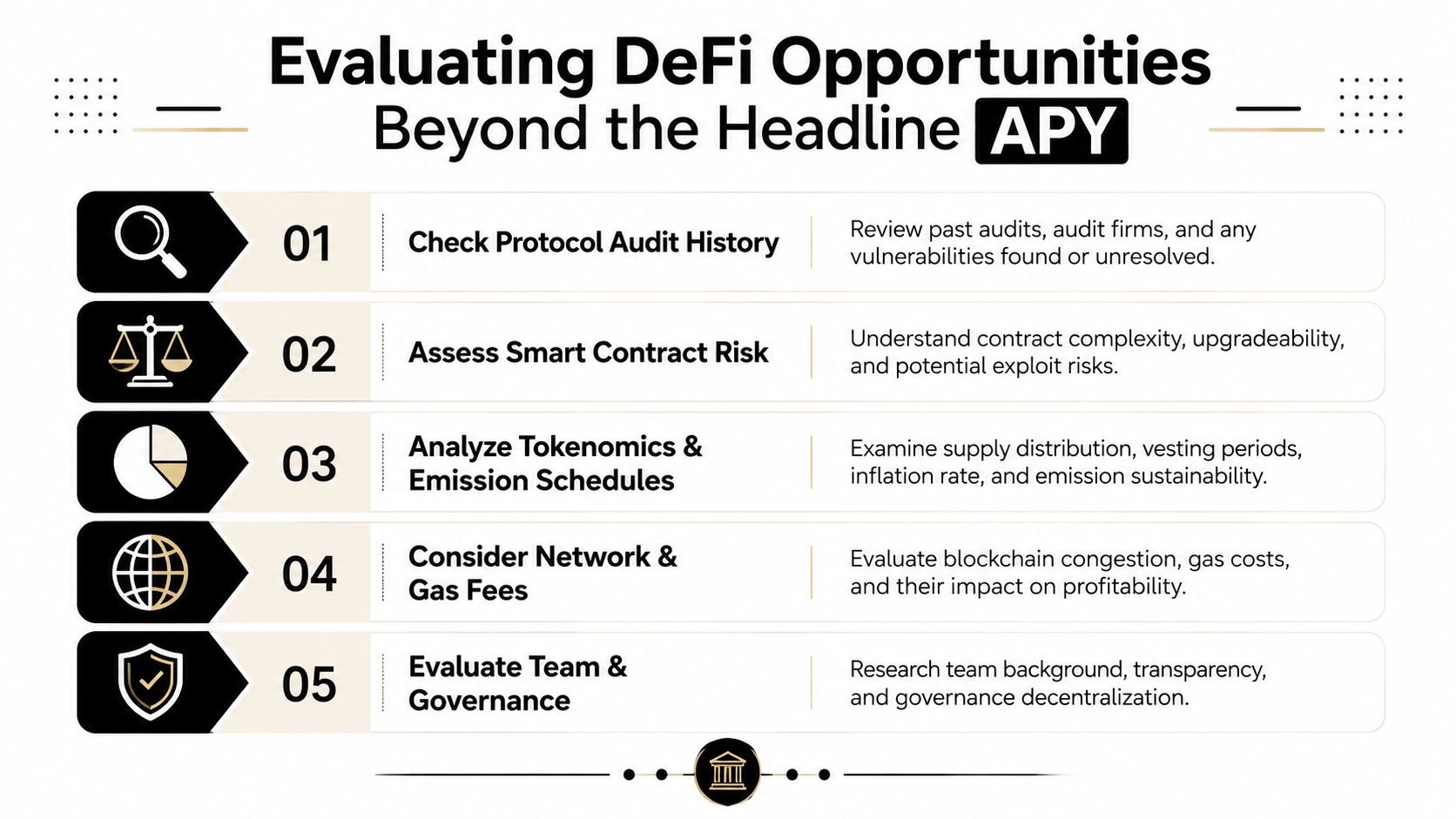
Before depositing, check:
Contract history: Look for public documentation, audits, upgrade permissions, and evidence of how the protocol has operated through different market conditions.
Liquidity and exits: Verify how withdrawals work, whether liquidity is immediately available, and whether a queue, cooldown, or market conversion is involved.
Rate composition: Separate base yield from token incentives, temporary bonuses, borrowed positions, or unhedged asset exposure.
Governance control: Understand who can change parameters, pause markets, upgrade contracts, or redirect funds.
Operational fit: Review network fees, wallet approvals, reporting requirements, and the time you'll need to monitor the position.
Teams that need a repeatable way to analyze financial data in 2026 can apply the same discipline here, especially when comparing rates across fragmented dashboards. For a DeFi-specific framework, risk-adjusted APY analysis is more useful than ranking opportunities by the largest number on screen.
The Complexity Problem and How AI Changes the Game
The word “passive” is misleading when you manage DeFi positions manually. You may need to compare lending markets, watch utilization, inspect incentive changes, monitor liquidity, review governance proposals, manage approvals, and decide when a rate no longer compensates for its risks. Each task is manageable in isolation. Together, they create a portfolio-management workload that many investors underestimate.
Manual management also creates timing problems. A user can deposit into an attractive pool, miss a change in utilization, overlook a depleted incentive, or leave capital in a market whose withdrawal conditions have changed. The strategy may still be technically automated, but the decision-making around it isn't.
Automation can remove repetitive execution. It can't remove the need to define acceptable risk.
What AI can reasonably automate
An AI-driven allocation system can monitor multiple protocols, compare rates and liquidity conditions, apply a defined risk policy, and route transactions when the strategy calls for a change. It can also make the interface easier to use by presenting balances, earnings, and allocation decisions in one place rather than forcing users to maintain several dashboards.
Yield Seeker is one example of this model. Its personalized AI Agent monitors and allocates stablecoin capital across DeFi protocols in real time, while users retain access to their funds without lockups or withdrawal fees. The platform accepts deposits as little as $10 USDC on Base, according to the publisher's product information, which lets a user test the workflow with limited capital before considering a larger allocation.
The value isn't that AI makes yield safe. The value is that it changes the effort-to-return equation. A strategy that requires constant surveillance may be unsuitable for a busy investor even when its underlying mechanics are sound. Automation can make monitoring and rebalancing practical, while the investor still decides how much capital to expose.
Delegation adds its own risk
Automation introduces another layer of trust. You must evaluate the platform's permissions, custody model, transaction routing, strategy constraints, and failure handling. The concept is similar to automated financial workflows in other industries, where software coordinates repeatable actions, but financial automation requires stricter attention to approvals and loss scenarios.
A useful resource for understanding the broader application is this overview of crypto income automation. The central question remains practical: does the automation reduce enough operational burden to justify the additional platform and strategy exposure?
Getting Started with Passive DeFi Income Safely
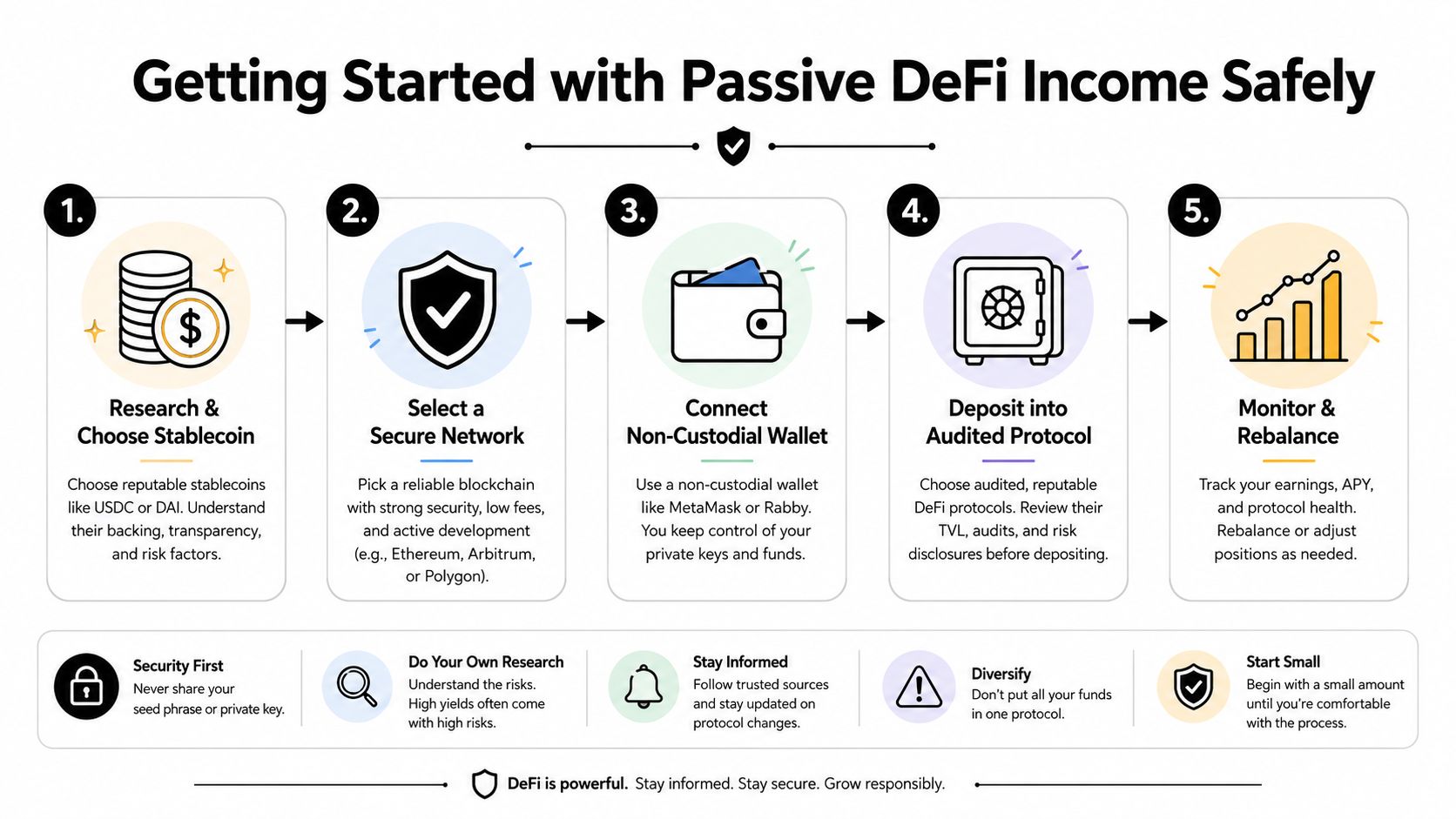
Start with the exit route, not the deposit button. Before moving funds, confirm which stablecoin the strategy accepts, which network it uses, how withdrawals are processed, and what permissions your wallet will grant. If you can't explain how to get your funds back, you haven't finished evaluating the position.
A cautious setup sequence
Choose the asset. Stablecoins can simplify price exposure, but they still carry issuer, reserve, liquidity, and depeg risks. Read the protocol's documentation and confirm that the asset is supported on the network you intend to use.
Select the network. Network choice affects transaction costs, liquidity, wallet support, and the availability of protocols. Don't bridge capital casually. Verify the destination contract and the transaction details before signing.
Use a controlled wallet. A non-custodial wallet keeps signing authority with you, but that control also makes seed-phrase security and transaction review your responsibility. Use a separate wallet for experimentation rather than exposing every asset to a new protocol approval.
Make a small first deposit. A limited test can reveal whether deposits, withdrawals, reporting, and support work as expected. Yield Seeker's stated minimum of $10 USDC on Base provides one example of a low-commitment entry point, but the right test size depends on your own loss tolerance.
Monitor the position. Review the source of yield, current allocation, withdrawal status, contract changes, and actual net return. Rebalancing should respond to risk and liquidity changes, not just a temporary APY increase.
Keep records of deposits, withdrawals, rewards, swaps, and fees. Tax treatment depends on your jurisdiction and the nature of each transaction, so consult a qualified tax professional rather than assuming that “passive” means administratively simple. Regulatory treatment can also differ by product, provider, and location.
Watch for red flags: guaranteed returns, unclear contract addresses, anonymous upgrade authority, unexplained withdrawal restrictions, pressure to deposit quickly, and yield that depends entirely on a reward token. No audit can guarantee safety, and no interface can compensate for a strategy you don't understand.
Where DeFi Yield Is Heading and How to Position Yourself
DeFi is moving toward clearer risk tiers, more automated allocation, and interfaces that make complex strategies easier to inspect. That doesn't eliminate risk. It makes risk selection more important because investors can access more strategies with less effort.
A treasury manager may prioritize liquidity and reporting. A busy professional may value automated monitoring and simple withdrawals. A crypto-native user may accept more protocol complexity in exchange for broader strategy access. Each can use DeFi differently, but none should treat APY as the entire investment thesis.
The durable approach is to define a risk budget, compare the net return with conventional benchmarks, and use automation only where it reduces operational friction without obscuring control.
Yield Seeker offers AI-powered stablecoin yield allocation across DeFi protocols, with real-time monitoring, automated strategy adjustments, and accessible funds without lockups or withdrawal fees. Visit Yield Seeker to explore a lower-maintenance way to evaluate and manage passive DeFi income.