
Tired of the laughably low interest rates at your bank? Earning passive income with stablecoins is a whole new ball game. It’s about putting your digital dollars to work by lending them out on decentralized finance (DeFi) platforms, making you a liquidity provider for a new-age digital economy and getting paid for it.
This approach turns your otherwise static cash into an asset that actually works for you.
Unlocking a New Kind of Savings Account

If you've ever looked at your bank statement and felt that familiar pang of disappointment at the tiny interest payment, you're definitely not alone. Think of earning with stablecoins as discovering a high-yield savings account built for the internet age—one that lets you put your money to work without getting caught up in the gut-wrenching volatility of assets like Bitcoin or Ethereum.
So, what are stablecoins? They're simply digital currencies built to hold a steady value, usually by pegging themselves 1-to-1 to a real-world asset like the U.S. dollar. Coins like USDC (USD Coin) or USDT (Tether) are basically digital dollars you can send anywhere in the world, 24/7, almost instantly.
Why This Matters for Your Money
Instead of collecting dust in a wallet, your stablecoins can be put into lending pools on DeFi platforms. Borrowers—maybe traders looking for leverage or other protocols needing capital—tap into these pools. For providing this much-needed liquidity, you get a cut of the interest they pay. It’s a much more direct line between savers and borrowers than you'll ever find in traditional banking.
The advantages are pretty clear:
Higher Potential Yields: DeFi lending rates often leave the returns from old-school financial institutions in the dust.
Anyone Can Join: You can get going with just a small amount of cash and a digital wallet, which opens this up to a global audience.
Total Transparency: Every single transaction is logged on a public blockchain. Good luck getting that level of transparency from your bank.
Stay Flexible: Many platforms let you withdraw your funds whenever you want, with no lock-up periods.
The big idea here is simple: you aren't gambling on price swings. You're earning a consistent yield on a stable asset by helping fuel the digital economy. It's a shift from high-risk trading to a practical, income-focused strategy.
To really get a feel for how different this is, let's put it side-by-side with a traditional savings account.
Stablecoin Passive Income at a Glance
This table breaks down the core differences, showing why so many are turning to DeFi for their savings.
Concept | Stablecoin Passive Income (DeFi) | Traditional Savings Account |
|---|---|---|
How Yield Is Generated | Directly lending stablecoins to borrowers on decentralized protocols. You become the bank. | The bank lends out your deposits and gives you a tiny fraction of the interest it earns. |
Typical APY | Often ranges from 5% to 20%+, but is variable and depends on market demand. | Usually under 1%, often closer to 0.1%, and set by the bank. |
Accessibility | Global, 24/7 access. All you need is an internet connection and a digital wallet. | Restricted by geography, banking hours, and requires a traditional bank account. |
Transparency | All rates and transactions are publicly viewable on the blockchain. | A black box. You have no visibility into the bank's lending activities or profit margins. |
Control Over Funds | You maintain self-custody of your assets, giving you direct control. | The bank holds your funds. Access can be restricted or frozen. |
As you can see, the DeFi approach puts you squarely in the driver's seat, offering a much more direct and potentially rewarding way to make your money work.
The sheer growth in this space tells you everything you need to know. The stablecoin market cap kicked off 2026 at a record-breaking $310 billion, a massive jump from just $20 billion back in 2020. With 1.4 billion Stablecoin-Ready Accounts now active globally and transaction volumes exploding, the hunger for stablecoin liquidity—and the yields it produces—has never been greater. If you want to dive deeper, you can learn more about the rise of stablecoins and their impact. This isn't some niche experiment anymore; it's a core piece of a new financial system.
Those high-yield numbers you see on stablecoins might feel a bit like magic, but I promise you, there’s no wizard behind the curtain. The return you're earning, often just called "yield," comes from real economic activity happening every second inside the world of decentralized finance (DeFi).
Your stablecoins aren't just collecting digital dust; they’re being put to work. Once you understand how they're working for you, you'll feel much more confident about your passive income strategy. It all boils down to good old supply and demand, just running on brand-new, hyper-efficient digital rails.
Let's pull back the curtain on the three main ways your digital dollars generate that sweet, sweet yield.
The Foundation of Yield: Lending and Borrowing
The most straightforward source of stablecoin yield is lending. Think of platforms like Aave or Compound as fully automated banks that never close. No tellers, no loan officers, just code running 24/7.
When you deposit your stablecoins, you're adding them to a massive pool of capital. People who need to borrow stablecoins can take a loan from that pool. To keep things safe, they have to lock up other crypto assets as collateral—usually worth more than the loan itself.
For the privilege of borrowing your funds, they pay interest. A huge slice of that interest gets passed directly back to you and everyone else who supplied the capital. Simple as that.
So, why are people borrowing stablecoins anyway? All sorts of reasons. A trader might borrow stablecoins to get more leverage without having to sell their Bitcoin or Ethereum. A crypto-native business might use them to pay salaries or suppliers. Others just want access to cash without triggering a taxable event by selling their crypto. This constant demand is what keeps the interest rates ticking.
Becoming a Market Maker: Providing Liquidity
Another powerful way to earn stablecoin yield is by acting as a "liquidity provider" on decentralized exchanges (DEXs) like Uniswap or Curve. These aren't like the stock market with its old-school order books. Instead, they run on something called "liquidity pools."
Picture an exchange booth at the airport. To swap dollars for euros, the booth needs to have both currencies on hand. A liquidity pool is the digital version of that, holding a pair of tokens so people can trade between them instantly.
When you provide liquidity, you deposit a pair of assets—let's say two stablecoins like USDC and DAI—into a pool. In return for helping the exchange function, you get a cut of the trading fees every single time someone swaps tokens using that pool.
You've essentially become a mini market-maker. It’s like owning a tiny piece of a tollbooth on a bustling crypto highway; the more cars that pass through, the more tolls you collect. If you want to dig deeper into how market demand shapes these returns, you can learn more about what drives stablecoin interest rates.
Cashing In on Protocol Incentives and Staking
Finally, a good chunk of yield comes from what are basically loyalty programs. DeFi protocols need capital to get off the ground and grow. To attract you and your funds, they often offer bonus rewards, usually in their own native token.
Staking, in this context, often means locking up your stablecoins to help a protocol with a specific goal, like securing its network or funding its operations.
Platform Growth: By adding your stablecoins, you make the platform stronger and more useful for everyone.
Incentive Programs: New projects often dangle very high initial yields to attract early users and bootstrap their liquidity. It's a marketing expense for them and a big opportunity for you.
Governance Power: The reward tokens you earn often come with voting rights, giving you a say in the protocol's future.
These rewards can be incredibly profitable, but they do add a bit of risk since the price of the reward token can go up or down. Still, it's a huge part of the overall yield picture. Each of these engines—lending, providing liquidity, and staking—is a real service you're providing to the digital economy, and the yield you earn is your fair payment.
The Core Strategies for Earning Stablecoin Yield
Alright, so you get the theory of where the yield comes from. Now, let's get into the practical side of things: how do you actually earn it?
Earning passive income with stablecoins isn't a one-size-fits-all deal. There are different approaches, each with its own mix of complexity, risk, and potential reward. You can think of it like picking an investment vehicle—some are like steady government bonds, while others are more like high-growth tech stocks.
We'll break down the three main methods, starting with the absolute easiest way to get going and moving up to the more advanced stuff. This should help you figure out which path lines up best with your own financial goals and how comfortable you are with the tech.
As you can see, the main roads to earning yield are lending, providing liquidity, and staking.
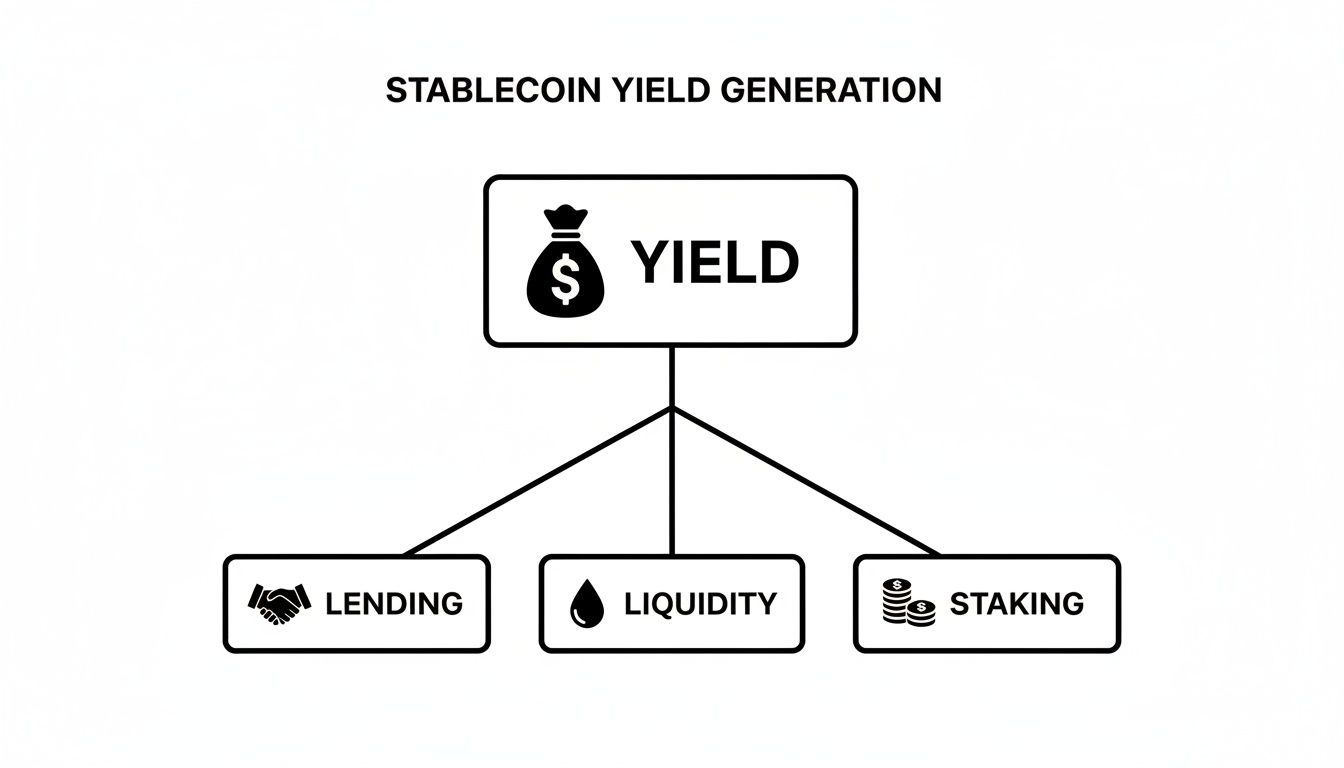
Each of these taps into the core economic engine of DeFi to turn your digital dollars into a productive, yield-generating asset.
Comparison of Stablecoin Income Strategies
Before we dive into the nitty-gritty of each strategy, it helps to see them side-by-side. This table gives you a quick snapshot of what to expect from each method in terms of returns, risks, and the amount of effort required on your part.
Strategy | Typical APY Range | Key Risks | Best For |
|---|---|---|---|
Lending | 3% - 10% | Smart contract bugs, protocol insolvency | Beginners & anyone looking for a simple, low-effort approach. |
Liquidity Pooling | 5% - 15%+ | Smart contract bugs, impermanent loss | Users comfortable with a bit more complexity for higher returns. |
Yield Farming | 15% - 50%+ | High smart contract risk, market volatility, complexity | Experienced DeFi users willing to actively manage their capital. |
Think of this table as your starting map. It helps you choose a path based on your appetite for adventure (and risk). Now, let's explore each of these territories in more detail.
Single-Asset Lending: The Digital Savings Account
The most straightforward way to start is through single-asset lending. If you’ve ever put money into a high-yield savings account at a bank, you've got the basic idea down.
You just deposit your stablecoins, like USDC or USDT, into a lending protocol. These platforms are essentially automated matchmakers, connecting your funds with borrowers who need capital and are willing to pay interest for it. It's the cleanest and simplest strategy out there, which makes it a perfect launchpad for anyone new to DeFi.
Typical APY: 3% - 10%
Key Risk: Smart contract risk. This is the chance that a bug in the protocol's code could be found and exploited, leading to a loss of funds.
Best For: Beginners, the risk-averse, or anyone looking for a "set it and forget it" way to earn.
The real beauty here is the simplicity. You don't have to worry about managing complex positions or pairing different assets together. You just deposit your stablecoins and start earning almost right away.
Liquidity Pooling: Earning from Trades
A slightly more involved—but often more rewarding—strategy is liquidity pooling. On decentralized exchanges (DEXs), people trade crypto directly with one another through automated pools of capital, not a central company.
By depositing your stablecoins into one of these pools, you become a liquidity provider (LP). Every time a trader uses that pool to swap tokens, they pay a small fee, and you get a cut. A popular low-risk approach is to provide liquidity to a pool with two different stablecoins, like USDC and DAI. This avoids the risk of impermanent loss, which can happen when you pair a stablecoin with a volatile asset like Ethereum.
Think of it like owning a tiny piece of a currency exchange booth at an airport. You provide the cash on hand (liquidity) so travelers (traders) can swap currencies, and for that service, you collect a small fee on every transaction.
Typical APY: 5% - 15%+
Key Risks: Smart contract risk and potential impermanent loss (mostly when pairing with a volatile coin).
Best For: Users who are okay with a bit more complexity in exchange for higher returns than simple lending.
Yield Farming: Chasing the Best Returns
Yield farming is the most active and advanced strategy of the bunch. It’s all about moving your funds between different DeFi protocols and liquidity pools to constantly chase the highest yields available at any given moment.
It’s like being an active portfolio manager, but instead of stocks and bonds, you're juggling stablecoin positions across the DeFi ecosystem. A yield farmer might lend stablecoins on one platform to earn a base APY, then take the "receipt token" from that deposit and use it as collateral to borrow another asset or provide liquidity somewhere else. It's all about stacking yields.
For those wanting to tap into these kinds of returns without the headache of managing it all, options like Staking as a Service platforms can handle the heavy lifting for you.
This constant hunt for yield isn't just a game; it's driven by massive economic demand. In 2024, stablecoin transactions on public blockchains are projected to hit $9.5 trillion. This incredible volume, fueled by everything from B2B payments to major players like Visa settling transactions, is what powers the entire passive income machine for stablecoin holders.
Typical APY: 15% - 50%+ (can be extremely volatile)
Key Risks: Higher smart contract risk from interacting with multiple protocols, market shifts, and a ton of complexity.
Best For: Experienced DeFi pros who are willing to actively manage their capital and take on more risk for the shot at much higher rewards.
Understanding and Managing the Risks Involved
Earning passive income with stablecoins can be incredibly rewarding, but it's not a free lunch. Let's be real: higher yields almost always come with higher risks. The key isn't to avoid risk entirely—that's impossible. It's about understanding what you're getting into so you can manage it smartly.
Think of it this way: decentralized finance isn't your local bank. There's no FDIC insurance coming to the rescue if something goes wrong. Security here is all about solid code, well-designed protocols, and the stability of the stablecoins themselves. So, let's break down the main risks you'll face.
Smart Contract and Protocol Risk
The entire world of DeFi runs on smart contracts. These are just pieces of code that execute transactions automatically, no middlemen needed. When you lend out your stablecoins, you're trusting that code to work perfectly. The big risk here is a bug or vulnerability that a hacker could exploit, which could mean your funds disappear in an instant.
Then there's protocol risk, which is about the overall health of the platform you're using. A poorly designed protocol might have economic loopholes that can be drained, or its "admin keys" could be compromised, giving a hacker the keys to the kingdom.
So, how do you protect yourself?
Stick to the Blue-Chips: Use platforms that have been around the block, have stood the test of time, and manage billions in assets. Think names like Aave, Compound, and Curve.
Look for Audits: Reputable projects pay top-tier security firms to pick their code apart. You want to see multiple, recent audits from well-known firms before you deposit a dime.
Don't Put All Your Eggs in One Basket: This is fundamental. Spreading your capital across several trusted protocols is one of the smartest moves you can make. For a deeper dive, check out our guide on the best practices for crypto risk management.
De-Pegging and Regulatory Risk
A stablecoin is only stable if it holds its value. De-pegging risk is the chance that your stablecoin, which is supposed to be worth $1.00, suddenly isn't. While this is rare for major, fully-backed coins like USDC, it can happen. Market-wide panic or problems with the issuer's reserves can cause a stablecoin to wobble off its peg.
This is why the reserves backing a stablecoin are so important. Some, like USDC, are backed by boring (in a good way) assets like cash and short-term government bonds. Others might hold a riskier mix. You absolutely need to know what's propping up your stablecoin.
A critical takeaway: not all stablecoins are created equal. An algorithmic stablecoin with no real-world collateral is a completely different beast than a fully-backed one that publishes regular, transparent audits of its reserves.
Finally, there's the ever-present shadow of regulatory risk. Governments are still trying to figure out how to handle crypto. New rules could pop up and impact certain stablecoins or DeFi protocols, maybe even affecting whether you can access them. Staying plugged into the regulatory chatter isn't just for policy wonks—it's essential for any serious, long-term investor.
How Automation Simplifies Stablecoin Earnings
Trying to manually chase the best yields in DeFi is a full-time job. Seriously. One protocol might have a killer rate today, but it could tank tomorrow, forcing you to move your funds all over again.
This constant loop of researching, moving assets, and burning cash on gas fees is exhausting. It makes the whole idea of "passive income with stablecoins" feel anything but passive.
This is where automation completely changes the game. AI-driven platforms are like having your own personal asset manager on autopilot, built to solve the biggest headaches for anyone trying to earn yield.
These tools are constantly scanning the market for the best risk-adjusted returns, automatically shifting your funds to capture them, and analyzing protocol safety to keep your capital protected.
Putting Your Stablecoin Savings on Autopilot
Imagine you had an analyst working for you 24/7. Their only job? Find the safest, most profitable homes for your stablecoins. That's the power of automation in a nutshell. These platforms plug into a whole range of vetted DeFi protocols, treating them like a menu of options to pick from at any moment.
When a better, safer opportunity pops up, the system can automatically rebalance your portfolio to grab it. This process, often called dynamic allocation, makes sure your capital is always working as hard as possible—without you needing to lift a finger. It makes sophisticated strategies accessible to everyone, from DeFi beginners to busy professionals who just don't have the time. You can learn more about how to achieve automated crypto earnings without the endless screen time.
The benefits are pretty clear:
Time Savings: No more spending hours every week glued to dashboards and tracking rates. The system does all the heavy lifting.
Reduced Complexity: You don't need to be a DeFi wizard to get competitive returns. The platform handles all the tricky technical stuff.
Optimized Returns: Automation ensures your money isn't just sitting around in a low-performing protocol. It's actively seeking out better opportunities for you.
How AI-Driven Platforms Work
AI-powered systems like Yield Seeker take this a step further. They don't just execute trades; they layer intelligent decision-making on top. They aren't just blindly chasing the highest number on a screen. Instead, they weigh the risks by looking at things like a protocol's code audits, how long it's been around, and its total value locked (TVL).
This approach is all about finding the best risk-adjusted returns. The goal isn't just the highest APY, but the best APY for the amount of risk you're taking on. It’s about smart, sustainable growth, not just reckless yield chasing.
This intelligent oversight is what separates modern automation from a simple script. It's like having an experienced financial analyst's brain running at the speed and scale of a machine.
This dashboard from Yield Seeker is a great example of how an automated system gives you a clean, simple view of your earnings and where your money is. The platform boils down all that complex DeFi activity into a straightforward interface, so you can track your performance without having to jump between a dozen different websites.
The sheer size of the stablecoin market makes this kind of automation incredibly valuable. In January 2026, the total stablecoin supply hit $266.22 billion. Platforms like Aave and Morpho were handling $17 billion in stablecoin loans that month alone, which generates real yield—often between 4-9% APY. An AI agent can navigate this massive ecosystem, moving a $10,000 USDC deposit on a network like Base (home to $4.19 billion in stables) to the best opportunities for you. You can dig into these stablecoin statistics from January 2026 to get a sense of the scale.
By automating this, you're turning a complicated, time-sucking task into a simple, hands-off income stream.
Your Step-by-Step Guide to Getting Started

Alright, enough with the theory. Ready to put your digital dollars to work? Getting started can feel like a big leap, but I’ve broken it down into five simple steps to get you from zero to earning passive income in minutes, not hours.
Think of this as your launch checklist. Each step builds on the last, giving you a smooth and secure path into the world of DeFi yield without the usual technical headaches.
Step 1: Get Your Stablecoins
First things first, you need the right assets before you can earn. Your opening move is to grab some stablecoins like USDC (USD Coin). The most straightforward way to do this is by buying them on a reputable, centralized crypto exchange.
Most exchanges let you buy stablecoins directly with your local currency, like U.S. dollars, using a simple bank transfer or debit card. Just be sure to pick an exchange with a solid security track record and transparent fees.
Step 2: Set Up a Digital Wallet
Next up, you need a secure spot to hold your stablecoins. A self-custody digital wallet gives you total control over your funds—unlike an exchange, which holds them for you.
Popular choices include browser-based wallets like MetaMask or mobile-first options like Rainbow. Setting one up is free and takes just a couple of minutes. Here’s the critical part: write down your secret recovery phrase and store it somewhere safe offline. This phrase is your master key; lose it, and you lose your funds.
Step 3: Move Funds to an Efficient Network
Transaction fees, often called "gas fees," can seriously eat into your returns, especially on busy networks like Ethereum. To keep more of your earnings, it’s a smart move to shift your stablecoins to a more cost-effective blockchain, often called a Layer 2 network.
For instance, you can withdraw your USDC from the exchange directly to your wallet address on an efficient network like Base. This one move can slash your transaction costs from several dollars down to just a few cents.
Choosing a low-fee network ensures more of your money stays in your pocket, compounding over time instead of getting burned on fees. This is a pro move that even beginners can easily pull off.
Step 4: Connect to an Automated Platform
This is where the magic happens. Instead of manually hunting for the best yields, you can connect your wallet to an automated platform like Yield Seeker. With just a few clicks, you authorize the platform to put your stablecoins to work for you.
Making your first deposit is as simple as typing in the amount you want to invest and confirming the transaction in your wallet. From there, the platform starts allocating your capital across different vetted DeFi protocols to find competitive, risk-adjusted returns.
Step 5: Track Your Earnings
Once your deposit is in, your job is done. Seriously. Now you can sit back and watch your balance grow. Automated platforms offer a clean dashboard showing your total deposits, current earnings, and the blended APY you’re getting.
You can pop in anytime to see your passive income with stablecoins accumulate in real time. No fuss, no constant management—just results.
Got Questions About Stablecoin Income?
As you start digging into earning passive income with stablecoins, a few questions are bound to pop up. Let's tackle the most common ones head-on so you have a clear picture of what to expect.
How Does Tax Work on This Stuff?
The money you make from stablecoin lending or yield farming is generally seen as income, which means it’s likely taxable. The exact rules can get tricky and change a lot depending on where you live and how regulators classify the earnings—is it interest, capital gains, or something else entirely?
Since the tax laws for crypto are still a moving target, it's absolutely critical to talk to a qualified tax professional who actually understands this space. They can give you advice that fits your specific situation and make sure you're playing by the rules. This is not financial advice, and getting a pro's opinion is a must.
Do yourself a huge favor: keep meticulous records of all your transactions. Every deposit, withdrawal, and bit of earnings. This paper trail will be a lifesaver when tax season rolls around and can prevent some serious headaches.
What Are Realistic Returns, Really?
One of the biggest draws to earning with stablecoins is the potential for much better yields than you'd find in a traditional bank. But there's no single "average" return. Yields are constantly shifting based on market demand for borrowing, a protocol's incentives, and the overall crypto market weather.
A realistic Annual Percentage Yield (APY) can swing anywhere from 3% to 15%, and sometimes even higher. Simpler strategies like basic lending usually offer lower, more predictable returns. More involved methods like providing liquidity or active yield farming can push those APYs up, but they also bring more risk to the table. Be very skeptical of platforms promising ridiculously high and stable returns—that’s often a red flag for something unsustainable or overly risky.
Can I Actually Lose Money?
Yes, you can, and it’s vital to understand that from the get-go. The risks here are different from the usual stock market ups and downs, but they are just as real. The main things to watch out for are:
Smart Contract Risk: A bug or exploit in a platform's code could be targeted by hackers, potentially leading to a loss of funds.
De-Pegging Risk: The stablecoin you're holding could lose its 1-to-1 peg to the US dollar, meaning its value drops below $1.
Protocol Risk: The platform you've deposited your funds into could fail, run into financial trouble, or shut down.
The smart way to handle these risks is not to put all your eggs in one basket. Spread your capital across a few different reputable platforms, stick to protocols that have been thoroughly audited, and use well-backed stablecoins like USDC.
How Much Do I Need to Start?
This is one of the best parts about DeFi—it’s open to everyone. You don't need a pile of cash to start generating passive income with stablecoins. Most platforms have super low or even no minimum deposit rules.
Honestly, you can often get started with as little as $10. This low barrier to entry means anyone can jump in, learn how it works, and start compounding their money without needing a big upfront investment. It truly opens the door for people all over the world to access yield.
Ready to put your stablecoins to work on autopilot? Yield Seeker uses AI to sniff out and manage the best risk-adjusted yields for you. You can get started in a few minutes and let our platform do the heavy lifting.