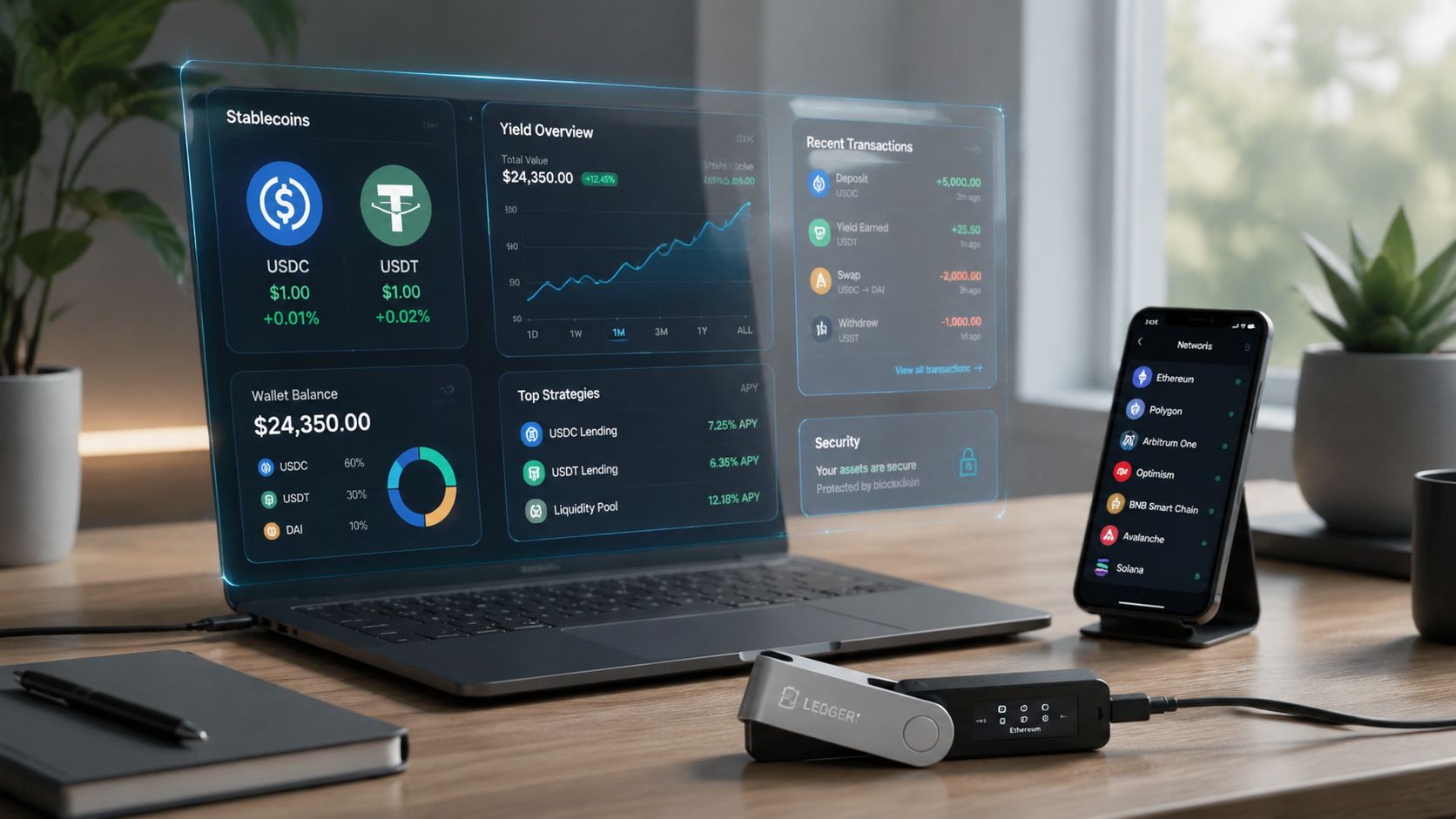
If you hold stablecoins across a few wallets, a lending app, maybe an LP position, and one or two vaults, you already know the problem. You open five tabs, check balances that don't quite match, copy numbers into a sheet, and still can't answer the one question that matters: am I earning well for the risk I'm taking?
That gap is where most DeFi users stay stuck. They track balances and headline APY, but they don't track the quality of the income, the concentration of the risk, or the drag from fees, routing, and idle cash. Good portfolio tracking fixes that. It turns a pile of positions into a system you can manage.
Moving Beyond DeFi Dashboard Chaos
Individuals often begin with whatever works fastest. A wallet tracker for balances, a protocol page for APY, a spreadsheet for notes, and maybe a Telegram alert bot if they're disciplined. That setup is fine when you've got one wallet and one strategy. It breaks the moment your stablecoins spread across chains, wrappers, vaults, and incentives.
By 2023, the DeFi market had passed $50 billion in total value locked, yet only about 15% of that capital was managed through automated tools, and manual tracking across just five platforms took more than 45 minutes per week on average, according to the assigned source for this section. That's why so many users end up bouncing between fragmented dashboards instead of managing a coherent strategy. If you want a feel for why DeFi interfaces often add to that confusion, this breakdown of DeFi dashboard analytics is worth reading.
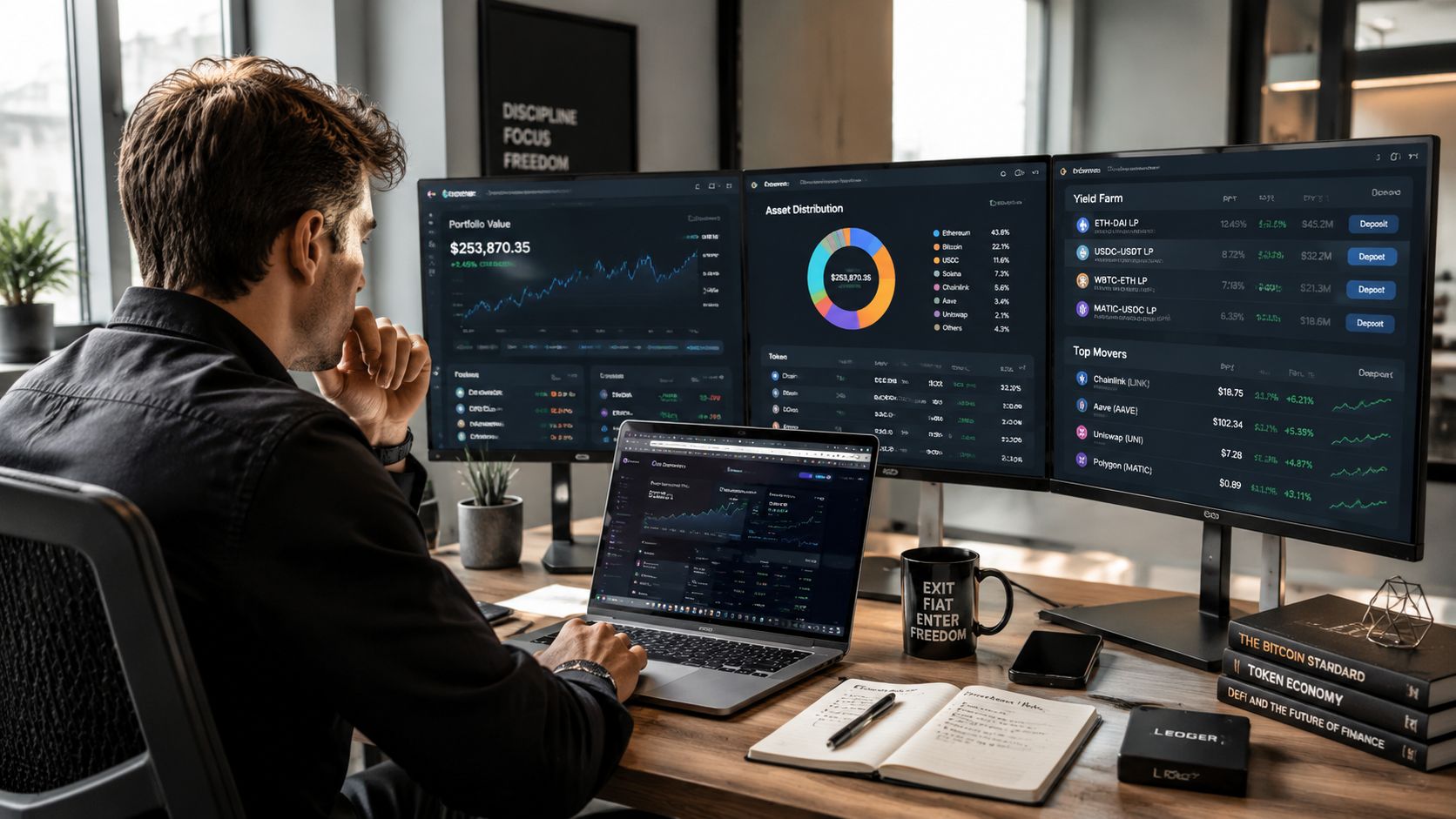
Balance isn't the same as understanding
A wallet balance tells you what sits there now. It doesn't tell you whether the yield is stable, whether your capital is overexposed to one protocol, or whether you're earning less than you think after costs. That's the trap.
I see this all the time with stablecoin users who think they're diversified because they hold several yield-bearing tokens. On the surface, that looks tidy. Underneath, those positions can still point back to the same lending venue, the same collateral profile, or the same withdrawal bottleneck.
Practical rule: If you can't explain where your yield comes from, what can interrupt it, and how fast you can exit, you're not really tracking a portfolio. You're checking balances.
Manual tracking fails in predictable ways
The issue isn't laziness. It's that humans are bad at repetitive monitoring across fragmented systems. A spreadsheet won't warn you that one protocol changed incentives, that your effective yield dropped after gas, or that two different vaults increased your exposure to the same underlying risk.
Manual tracking usually breaks in four places:
Fragmented visibility: One wallet app won't show your whole picture.
Delayed decisions: By the time you notice a drop in net yield, the opportunity has passed.
Hidden overlap: Different tokens can carry the same underlying exposure.
Messy records: When you need to review what happened, your history is split across apps and notes.
The upgrade isn't more tabs. It's a shift in mindset. You stop acting like a passive holder and start operating like a portfolio manager, even if your portfolio is small.
Building Your Central Command Center
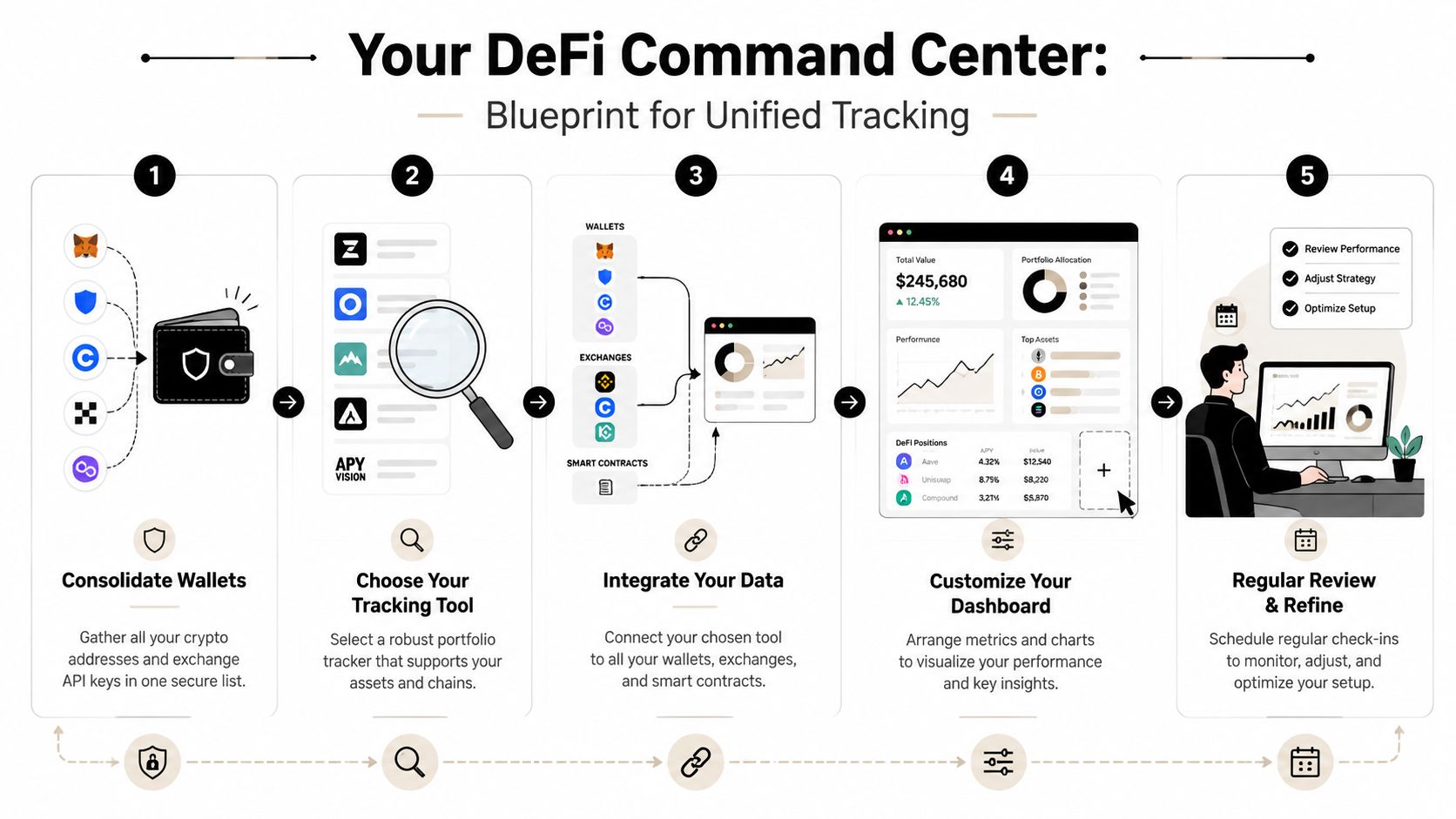
The first useful upgrade is simple. Pick one place where every wallet, chain, exchange account, and protocol position gets pulled together. That's your command center. It can be a portfolio tracker, a custom dashboard, or a combination of tools, but it has to become your default screen.
For most DeFi users, that means connecting wallets such as MetaMask or Rabby, importing addresses from Base and Ethereum, and making sure you can see cash balances, vault tokens, LP positions, and recent transactions in one view. If your current setup can't do that, it isn't a command center. It's a collection of widgets.
Use a process, not a pile of tools
A solid portfolio-tracking workflow follows a four-step loop: collect, analyze, act, and review, as outlined in Info-Tech's portfolio monitoring process guide. That sounds corporate, but it maps cleanly to DeFi.
In practice, this appears as follows:
Collect
Pull every holding into one place. Wallets, exchange balances, vault shares, LP tokens, and debt positions all count.Analyze
Check allocation, current yield sources, idle cash, maturity or withdrawal constraints, and obvious concentration.Act
Rebalance, close low-conviction positions, move idle funds, or reduce exposure where one protocol dominates too much of the book.Review
Repeat on a schedule. Daily for active users. Weekly for most stablecoin portfolios is usually enough.
The biggest mistake is stopping at collect. Plenty of users build a nice dashboard and never turn it into decisions.
Make your records usable later
A command center should also leave an audit trail. That's where journaling matters. Even if you aren't a trader in the usual sense, the habit of writing down why you entered, why you exited, and what changed saves you from repeating bad decisions. This guide to Rize Trade's trading journal explanation is useful because it shows how structured notes turn scattered activity into learnable history.
A clean dashboard tells you what happened. A journal tells you why you did it.
A practical setup doesn't need to be fancy. Start with:
One tracking hub: A dedicated dashboard that supports your chains and token types. If you need a starting point, this overview of a DeFi portfolio tracker gives a practical baseline.
One wallet inventory file: Keep every address and label in a secure document so you know what belongs to you.
One review cadence: Put it on the calendar. If it's not scheduled, it won't happen.
One note field per move: Record the reason for reallocations, not just the transaction hash.
That structure does more for your portfolio tracking than another week of spreadsheet tweaking.
Choosing Metrics That Actually Tell a Story
The easiest way to mismanage stablecoin yield is to sort by APY and stop thinking. A high number looks efficient. Sometimes it is. Often it's just noisy, temporary, or attached to risks you're not measuring.
Good portfolio tracking doesn't ask only, "What's my top rate?" It asks, "What's my net income after costs, how concentrated is this income source, what benchmark am I comparing it against, and how fragile is the setup if conditions change?" Institutional analytics platforms focus on exposure, risk, benchmark-relative metrics, and performance because those are the measures that reveal problems before they show up in the headline return, as described by FactSet's overview of portfolio analytics.
The metrics that matter for stablecoin portfolios
For a stablecoin holder, useful tracking usually includes:
Net yield: What you keep after gas, bridge costs, and any protocol-level friction.
Income consistency: Whether the yield source stays reasonably stable or swings with incentives.
Liquidity profile: How fast you can get out, and under what conditions.
Protocol concentration: How much of your portfolio depends on one venue or one mechanism.
Benchmark comparison: Whether the extra complexity is paying you more than a simpler baseline.
Counterparty exposure: Which protocols, wrappers, or issuers sit between you and your cash flow.
Comparing basic and meaningful portfolio metrics
Metric Category | Basic Metric (What most people track) | Advanced Metric (What you should track) |
|---|---|---|
Return | Displayed APY | Net yield after costs and friction |
Allocation | Token balance by wallet | Exposure by protocol, strategy, and underlying source of income |
Performance | Portfolio value today | Performance versus your chosen benchmark |
Risk | "It's stablecoins" | Concentration, liquidity limits, and dependency on one platform |
Volatility | Token price barely moved | Variability of yield and reliability of income stream |
Operations | Number of positions | Which positions require attention and why |
Why benchmark-relative thinking changes decisions
A lot of bad DeFi decisions come from looking at positions in isolation. You see one vault paying more than another and move funds. That isn't enough. You need a benchmark.
If your baseline is "hold USDC in a simpler venue with high liquidity," every move away from that baseline should buy you something clear. Maybe it's more income. Maybe it's diversification. Maybe it's lower management effort. If it buys you none of those, the complexity is dead weight.
What to remember: A stable 8% can be better than a shaky 12% if the higher number depends on incentives that vanish, poor exit liquidity, or a risk stack you don't fully see.
Portfolio tracking makes the activity less about admiring yields and more about exercising judgment. A dashboard should help you answer questions like:
Is this return repeatable or promotional?
Is my income diversified across mechanisms, or am I dressed-up concentrated?
Did I improve my net result, or did I just move money around and pay more gas?
If I needed to exit quickly, which position would become a problem first?
If you're working on this seriously, a practical primer on risk-adjusted return calculations helps bridge the gap between simple APY chasing and actual portfolio management.
Putting Your Portfolio Tracking on Autopilot
A spreadsheet works when you have three positions and plenty of patience. It breaks down once stablecoin income is spread across vaults, lending markets, LPs, and chain-specific opportunities that change faster than you can review them. At that point, the job is no longer logging balances. The job is building a system that watches the portfolio for you and flags the moments that need human judgment.
Automation earns its place by cutting operational drag. Missed rate drops, idle cash, unnoticed allocation drift, and slow reactions to changing conditions all chip away at returns. For stablecoin strategies, those leaks matter because the spread between a disciplined portfolio and a sloppy one is often not dramatic APY differences. It is consistency, lower friction, and fewer avoidable mistakes.
What automation should do
Useful automation covers three jobs.
Monitoring: Track balances, yield changes, depeg signals, utilization shifts, and position drift without constant tab-checking.
Rule checking: Compare each position against the limits you set for protocol exposure, liquidity, net yield, and acceptable complexity.
Execution support: Surface a recommended move, or help execute one, when a position falls outside those rules.
That structure matters because automation should follow a policy, not a mood. If the goal is dependable stablecoin income, the system should favor durability, exit liquidity, and manageable risk. If the goal is maximum yield with a higher tolerance for churn, the rules should reflect that too. Good tooling enforces the strategy you chose instead of tempting you into whatever number looks highest this hour.
Where an AI layer helps
AI becomes useful once the portfolio has enough moving parts that manual review turns into background noise. It can summarize what changed overnight, group alerts by urgency, and point out patterns that are easy to miss when you are bouncing between dashboards.
That is especially valuable for stablecoin portfolios because the hard part is not finding yield. The hard part is sorting income by quality. A 12% rate backed by thin liquidity, token incentives, and a fragile route is a different product than 8% from a simpler, deeper market. An AI layer can help rank those options by safety, consistency, and maintenance burden instead of just headline APY.
Yield Seeker is one example of that shift. Users can deposit USDC on Base and use an AI agent to monitor and allocate capital across DeFi protocols while keeping funds accessible without lockups or withdrawal fees. The point is not that software replaces judgment. The point is that software can handle the repetitive scanning so you can spend your time setting limits and reviewing exceptions.
I have seen the same change in my own process. Once I stopped trying to manually chase every rate change, portfolio management got simpler and better. The focus moved to a few rules that hold up under stress:
Keep enough liquidity to exit without pain
Cap exposure to any single protocol or mechanism
Prefer repeatable yield over temporary incentive spikes
Reduce idle balances, gas drag, and unnecessary rotations
A quick product walkthrough helps make that shift more concrete:
What to avoid
Bad automation creates more work than it removes. It hops between venues for small yield differences, ignores liquidity conditions, and treats every source of income as interchangeable. That usually leads to more taxable events, more hidden concentration, and a portfolio that looks optimized on paper but is harder to unwind in real conditions.
Use automation for surveillance, discipline, and faster response times. Keep the decision rules human. You still need to define how much protocol risk you will accept, how quickly you may need to exit, and what kind of stablecoin income is worth holding in the first place.
Interpreting Performance and Uncovering Hidden Risk
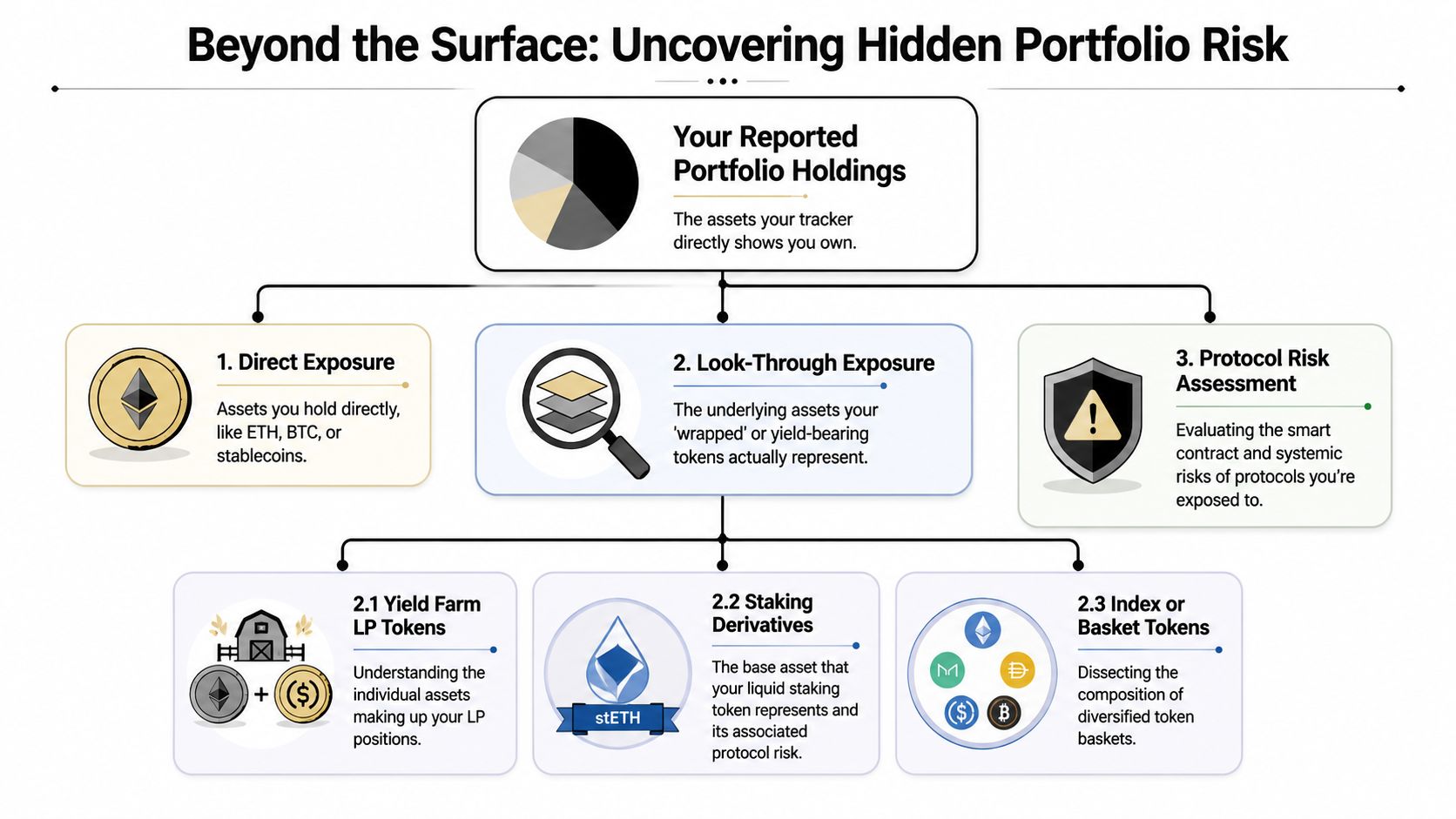
A dashboard can tell you that you hold a vault token, an LP token, and two yield-bearing stablecoins. That's surface-level information. The better question is what those positions represent underneath.
Many DeFi portfolios look diversified and aren't. One token may wrap a lending position. Another may represent an LP share. A third may route through a vault that itself deposits into another protocol. If your tracker only shows top-level balances, you can miss that a large share of your portfolio still depends on the same core venue or the same underlying risk.
Look-through exposure matters more than neat labels
Institutional research puts a lot of weight on look-through exposure, meaning the ability to measure the underlying assets and risks nested inside funds or structured products. CRD's discussion of fund look-through makes the core point clearly: you need to aggregate what you own underneath the wrapper to understand concentration and act quickly when risk builds.
In DeFi, that matters even more because wrappers are everywhere. A stablecoin portfolio can contain direct stablecoins, LP tokens, staking derivatives, vault shares, and synthetic positions. A simple balance tracker might count those as separate buckets even when they collapse into the same exposure on inspection.
Questions that reveal the real risk
When reviewing a position, ask:
What sits underneath this token? If it's a vault share, where is that vault deployed?
Which protocol generates the yield? The interface you use may not be the true source of risk.
How many layers sit between me and withdrawal? More layers usually mean more assumptions.
If one venue freezes, how much of my "diversified" income disappears?
A pretty allocation chart can hide a lopsided risk book.
Redefining performance for stablecoin income
A lot of users still grade performance like this: highest APY wins. That's too narrow, especially for stablecoins.
A better standard is closer to income investing. You want to know whether the cash flow is dependable, whether the capital remains accessible, and whether the downside is acceptable if a protocol degrades. Research on high-net-worth portfolios highlights that investors increasingly care about income and cash flow across alternative assets, with 94% of surveyed HNW investors holding private or alternative assets and 42% allocating to crypto, while yield and cash flow remain the largest objective within those alternative allocations, according to Long Angle's asset allocation research.
That framing fits DeFi stablecoin portfolios surprisingly well. For many users, the actual scorecard is:
What to assess | Why it matters |
|---|---|
Income stability | Spiky yield is harder to rely on than steadier earnings |
Liquidity | A strong rate doesn't help much if exits are slow or uncertain |
Exposure overlap | Several products can still map to one hidden dependency |
Downside control | Preserving capital matters more than squeezing one extra point of yield |
The contrarian lesson is simple. Portfolio tracking is no longer just a performance problem. It's a risk-translation problem. Your system needs to translate wrappers, pooled products, and protocol chains into plain-language exposure so you can decide if the income is worth the structure behind it.
Finalizing Your System with Security and Tax Prep
A polished dashboard won't protect you from bad wallet hygiene. The last step in portfolio tracking is operational hardening. If you skip it, the rest of the system is incomplete.
Security habits that aren't optional
A few basics carry most of the weight:
Use a hardware wallet: Keep signing isolated from your daily browser habits whenever possible.
Separate roles: Don't use the same wallet for long-term holdings, active experimentation, and random airdrop interactions.
Review approvals: Revoke token approvals you no longer need, especially after testing new protocols.
Label addresses clearly: If you manage multiple wallets, confusion itself becomes a security risk.
Treat browser extensions carefully: Most wallet mistakes start with rushed clicks, not exotic exploits.
Keep tax data before you need it
Tax prep is where sloppy records come back to punish you. You don't need to predict every reporting rule yourself, but you do need clean data. Save transaction history, wallet labels, transfer context, cost basis notes where relevant, and timestamps for major moves.
A useful reference point is EndureGo Tax crypto insights, which gives a practical view of why transaction-level records matter and what people often forget to document. Even if your jurisdiction differs, the record-keeping lesson carries over.
One non-negotiable: If you can't reconstruct what happened in your wallet activity six months later, your tracking system isn't finished.
The professional version of DeFi isn't complicated for the sake of it. It's disciplined. One command center. One review process. One security routine. One transaction history you can use.
If you want a lower-friction way to manage stablecoin yield without living in spreadsheets and protocol tabs, Yield Seeker is built for that style of workflow. You can deposit USDC on Base, monitor balances and earnings in one interface, and let an AI-driven system handle the repetitive part of tracking and allocation while you stay focused on risk, liquidity, and overall portfolio quality.