
Your stablecoins might be sitting in a wallet right now doing nothing. That's a common starting point. You moved into USDC or another stable asset for safety, optionality, or convenience, then realized idle capital has a cost.
DeFi offers a tempting answer. Put those stablecoins to work and earn yield while keeping more flexibility than you'd get from many traditional products. But the moment you start digging, the simple idea gets messy. You see staking, lending, liquidity mining, points, emissions, utilization, APR, APY, lockups, vaults, and a dozen dashboards all competing for attention.
Under almost all of that sits one core idea: protocol rewards.
If you understand protocol rewards, DeFi starts making more sense. You can see why a protocol pays users, what kind of work it's trying to incentivize, why yields move around, and why a high headline APY often hides real operational risk.
This matters even more if you're trying to earn passively. Manual reward hunting isn't really passive. It's research, monitoring, comparing, moving funds, checking exit conditions, and keeping track of changing incentives. If you're still learning the category, start with a broader primer on how DeFi works in practice, then come back to protocol rewards as the engine behind the yield.
Introduction The Promise of Passive DeFi Yield
Users engage with DeFi with a straightforward goal. They want their digital dollars to earn something instead of sitting still.
That instinct is reasonable. In decentralized systems, protocols need users to supply capital, secure networks, provide liquidity, and participate in ecosystem growth. To attract that behavior, they pay rewards. In simple terms, protocol rewards are the payments a protocol uses to get important work done.
A helpful way to think about it is this: if a protocol is a digital machine, rewards are the fuel budget. If a protocol is a marketplace, rewards are the incentives that bring buyers, sellers, and operators into the same place at the same time. If a protocol is a network, rewards are what persuade people to help maintain it.
Practical rule: Rewards aren't free money. They're compensation for taking on a role the protocol needs.
That's why protocol rewards show up everywhere in DeFi. Sometimes you earn them by staking assets to support network security. Sometimes you earn them by supplying capital to a liquidity pool or a lending system. In other cases, rewards are tied to ecosystem programs that help founders, developers, and users grow the network over time.
The opportunity is real, but so is the complexity. The hard part isn't finding a number on a dashboard. The hard part is understanding what that number means, what's funding it, how quickly it can change, and what happens if the protocol itself changes direction.
For stablecoin holders, that gap matters a lot. You're often looking for low-friction yield, not a new part-time job. To get there, you need a clean mental model first.
What Are Protocol Rewards Anyway
Protocol rewards are payments a DeFi system makes to people who perform work it needs done.
That sounds simple, but the phrase gets fuzzy fast because "work" in crypto does not always look like a normal job. One user might lock tokens to help secure a chain. Another might supply stablecoins to a lending market so borrowers can access capital. Someone else might provide liquidity so trades can clear without large price swings. Different tasks, same basic structure. The protocol needs participation, so it offers a payout.
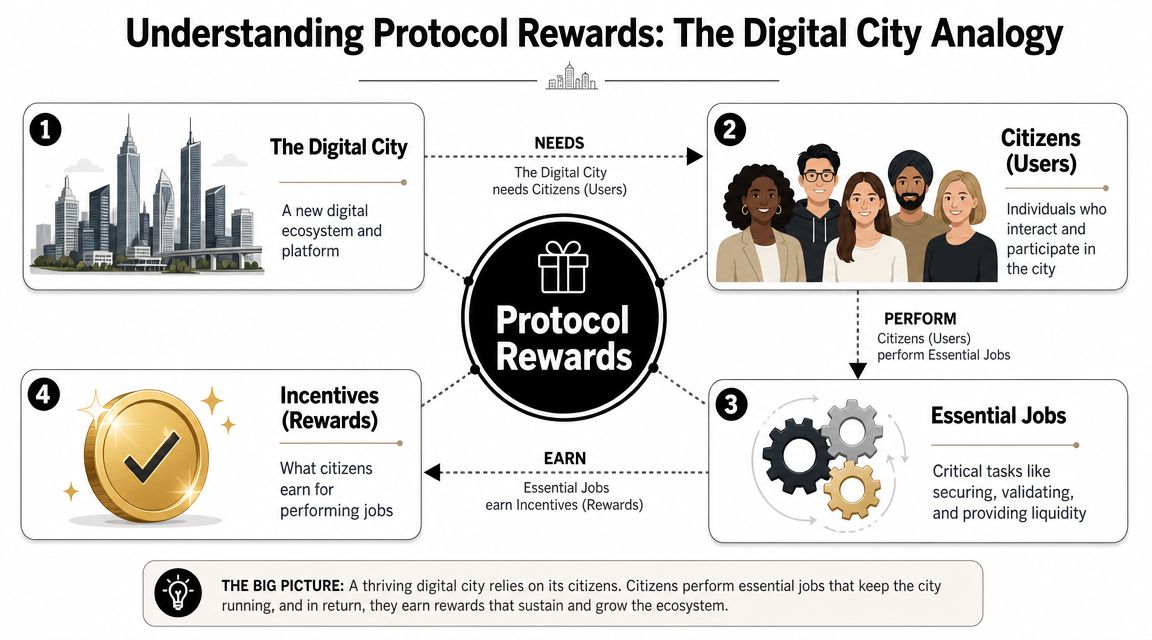
A city analogy helps here. A growing city needs guards, builders, merchants, and early residents willing to show up before everything is polished. A protocol has the same coordination problem. It needs security, liquidity, governance, and early usage before the network becomes useful. Rewards are the budget it uses to attract those participants.
That is why protocol rewards are better understood as compensation than as passive income.
Here is the simplest way to frame it:
The protocol has a goal
A user takes an action that helps achieve that goal
The protocol pays for that action
Once you use that lens, the category becomes much easier to read. In staking-based blockchains, protocol rewards often refer to the payouts users receive for helping secure the network, typically funded by newly issued tokens, transaction fees, or both, as described in Figment's explanation of staking reward mechanics.
Why protocols pay in the first place
Protocols are not handing out money for no reason. They are funding growth, security, and market function.
A useful comparison is a startup spending on payroll, incentives, or customer acquisition. Early on, the system is fragile. If there are not enough stakers, security suffers. If there is not enough liquidity, trading gets expensive and unreliable. If there are not enough users, the network can stall before it becomes useful. Rewards help solve that bootstrapping problem.
The same logic shows up outside crypto. The U.S. State Department's Transnational Organized Crime Rewards Program offers payouts for information that helps disrupt criminal networks, as described on the program page from the U.S. State Department. Different setting, same mechanism. A system defines a valuable outcome, then pays to encourage behavior that supports it.
Crypto uses the term more broadly too. NEAR's documentation describes Protocol Rewards as support for founders and developers through funding, visibility, and hands-on help that contributes to ecosystem growth. That broader use matters because it clears up a common misunderstanding. Protocol rewards are not limited to staking yield on a dashboard. They can also include structured incentive programs designed to make a network stronger over time.
For stablecoin holders, this distinction matters a lot. A posted APY is only the surface. Underneath it is a specific job, a specific funding source, and a specific set of tradeoffs. Understanding that by hand across multiple protocols starts to feel less like passive investing and more like shift work. That is exactly why reward hunting becomes so time-intensive, and why automation has such a clear advantage.
A short visual helps lock the idea in:
Protocol rewards make more sense when you ask one question first: “What job is the protocol paying for?”
The Main Types of Protocol Rewards
Once you know rewards are payments for useful work, the different categories become easier to sort. They aren't random yield products. They're compensation schemes with different goals.
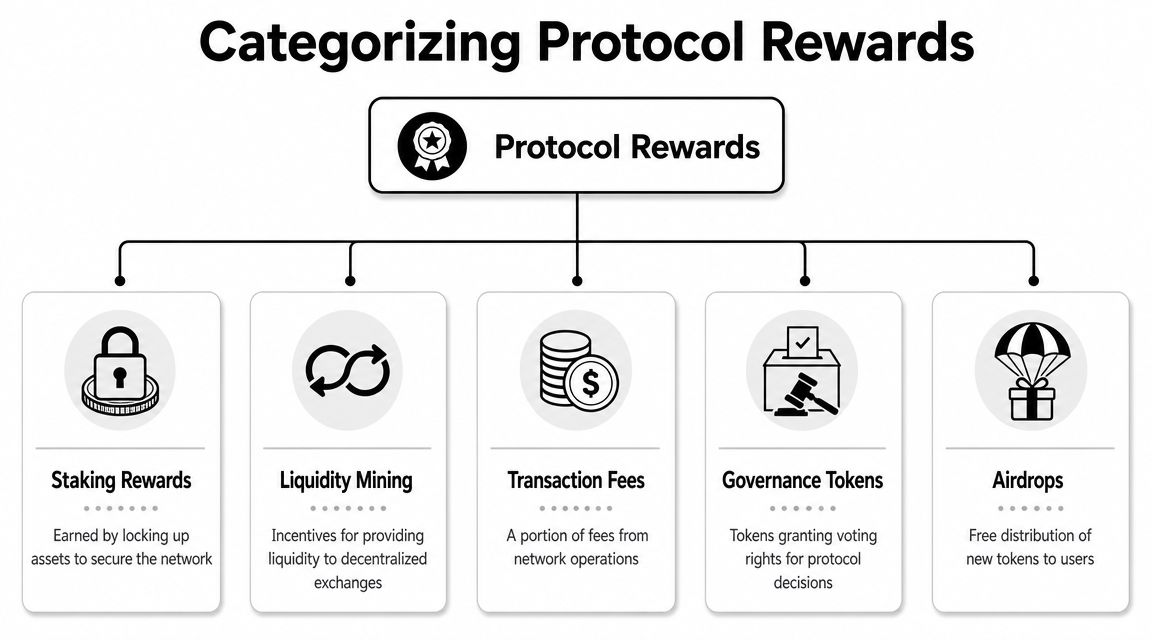
Staking rewards
In the city analogy, this is the security team.
In staking-based blockchains, users lock or delegate assets to help validate transactions and support consensus. In return, they receive rewards. The SEC's 2025 statement says validator rewards in proof-of-stake networks are typically made up of two streams: newly minted tokens and a share of transaction fees paid by network users, as explained in the SEC statement on certain protocol staking activities.
That same statement also says staking increases network security by raising the amount of capital an attacker would need to control a majority of staked assets. So the reward isn't just a yield feature. It's part of the protocol's security budget.
Transaction fee sharing
This is less like a salary and more like revenue participation.
Some protocols route a portion of user-paid fees to the people who help operate or support the system. In staking systems, fee sharing can be one component of validator rewards. In other DeFi systems, fees may flow to liquidity providers, token lockers, or governance participants depending on the design.
The key idea is simple: users pay to use the network, and the protocol shares part of that economic activity with the participants it wants to retain.
Liquidity mining
In the city analogy, this is the “we need more exchange booths” bonus.
A decentralized exchange or lending market needs capital on both sides to function smoothly. To attract it, protocols often add token incentives on top of normal fee earnings. That extra layer is what many people call liquidity mining.
If you want a deeper walkthrough of the mechanics, this liquidity mining guide is a useful companion. The short version is that your action is supplying capital, and the protocol's goal is deeper liquidity and better user experience.
Governance-linked rewards and vote incentives
Some ecosystems pay users to lock tokens, vote on emissions, or direct rewards toward certain pools.
This can feel abstract at first, but the city analogy helps. If governance decides which neighborhoods get more funding, people who benefit from that funding may try to influence the vote. In DeFi, that can create a layer of rewards tied to governance participation itself.
These structures are common in mature ecosystems where who gets emissions matters almost as much as how much gets emitted.
Airdrops and ecosystem incentives
Airdrops are closer to early-citizen grants.
Protocols use them to reward adoption, bootstrap communities, or distribute ownership more broadly. Sometimes they reward usage. Sometimes they reward participation in an ecosystem campaign. Sometimes they're aimed at developers or builders rather than everyday users.
These are still protocol rewards. They just aren't always tied to recurring yield.
Reward type | What the user does | What the protocol wants |
|---|---|---|
Staking rewards | Helps secure the network | Stronger consensus and validator participation |
Fee sharing | Supports protocol activity | Retention of productive participants |
Liquidity mining | Supplies capital to markets | Better liquidity and market depth |
Governance incentives | Votes or locks tokens | Coordinated allocation decisions |
Airdrops | Uses or grows the ecosystem | Adoption and distribution |
One detail advanced users watch closely is tuning. Rewards aren't set once and forgotten. In Celo's validator reward discussion, the proposal targeted annual validator rewards of 85k cUSD, adjusted by an 87% rewards multiplier to roughly restore a prior 75k cUSD level while keeping validator compensation below one-quarter of total voter payouts, according to the Celo validator rewards discussion. That's a practical reminder that protocol rewards are engineered. Small changes in who gets what can materially affect participation.
How Protocol Rewards Are Calculated and Paid
The first number one sees is yield. The second thing one usually discovers is that the number keeps moving.
That isn't a bug. It's how many protocols work.

APR and APY aren't the same
APR is the simpler number. It reflects a yearly rate without assuming you reinvest rewards.
APY includes compounding. If rewards are added back into the strategy and start earning additional rewards, APY captures that effect.
A bank account analogy works well here. If a bank pays interest and you pull it out each month, you're thinking more in APR terms. If you leave it in and the balance keeps earning on itself, APY is the more useful lens.
Working habit: When you compare protocols, check whether the displayed figure assumes compounding, and whether that compounding actually happens automatically or only if you manually reinvest.
That sounds basic, but it matters. Two products can show very different headline yields because one assumes frequent reinvestment and the other doesn't.
Why the number changes
A lot of users treat displayed APY like a fixed promise. It usually isn't.
Some protocols tie rewards to a utilization or allocation model. When demand changes, the yield changes too. Angle's Arbitrum governance post stated that stUSD was yielding 20% and stEUR 6.9% at the time, and that the yield is updated every week following the utilization rate, according to the Angle governance post on Arbitrum. The exact percentages matter less than the mechanism. The rate moved because utilization moved.
That creates a useful checklist:
Ask what drives the rate: Is it utilization, emissions, fees, treasury spending, or some mix?
Check update frequency: Some yields adjust quickly, so a dashboard snapshot may age badly.
Look for hidden mechanics: The user experience can feel stable even when the underlying drivers are changing week to week.
How rewards actually reach the user
Protocols don't all pay rewards the same way.
Some distribute tokens directly into your wallet or claimable balance. Some roll value into a vault share price. Some use accounting systems that make rewards feel invisible until you withdraw. Yield.xyz's integration notes describe rewards accruing through a pricePerShare mechanism and immediate withdrawal with no unbonding period. That's a good reminder that the interface can hide important mechanics even when the economics are still there.
A practical takeaway for stablecoin holders is that “high APY” isn't the main question. The better questions are: what variable drives the APY, how sensitive is it to demand, and how is the reward reflected in the asset you hold?
The Hidden Risks and Headaches of Chasing Yield
Manual yield chasing looks easy from a screenshot. In practice, it behaves more like operations work.
You have to find opportunities, compare reward structures, read docs, evaluate smart contract risk, watch for governance changes, monitor wallet positions, decide when to move, and keep enough context in your head to know whether a falling yield is normal or a warning sign. If you do this across multiple protocols, the workload grows fast.
High APY can distract from basic questions
A common mistake is staring at the reward rate and ignoring the exit path.
That's especially dangerous when a protocol's lifecycle changes. Angle Protocol announced it was “entering its final chapter” and said USDA and EURA remain redeemable 1:1 only until March 1, 2027, according to Angle's own site. That's one of the clearest examples of why protocol rewards should never be evaluated in isolation from redemption and shutdown risk.
A yield number tells you how rewards may accrue. It doesn't tell you what happens if the protocol winds down, emissions stop, or confidence fades before you exit.
For stablecoin users, this is a bigger issue than it first appears. Many people approach reward-bearing stable assets as low-drama cash management tools. But lifecycle risk can turn a “passive income” position into a deadline-driven operational task.
The risk list most dashboards don't show
Manual participation means carrying several categories of risk at once:
Smart contract risk: Code can fail, integrations can break, and audits don't remove all risk.
Economic design risk: Rewards can compress if utilization falls, liquidity shifts, or emissions become less attractive.
Liquidity risk: You may be able to withdraw in theory but not at the size, timing, or price you want.
Governance risk: Token holders can vote to change emissions, collateral rules, or pool incentives.
Lifecycle risk: The protocol itself can sunset, merge, pause, or narrow redemption windows.
Those are the protocol-level risks. Then there's the human overhead.
Manual yield hunting is a workflow problem
Even when nothing goes wrong, the process is demanding.
You're opening multiple tabs, signing transactions, tracking cost basis, deciding whether gas is worth it, and figuring out whether a better opportunity is better after fees and friction. If you manage treasury funds or larger stablecoin balances, the administrative burden gets even heavier because every move needs more discipline and better documentation.
A lot of users discover the same thing after a few months. They didn't build passive income. They built a recurring research loop.
Here's the primary pain point in one line:
What looks simple | What you actually do |
|---|---|
“Earn protocol rewards” | Research, compare, move funds, monitor, rebalance, document, exit carefully |
That's why many otherwise capable users either stop chasing yield or settle for suboptimal positions they no longer have time to review.
Automating Your Strategy with Yield Seeker
If the manual version of this job feels heavier than expected, that reaction is correct. DeFi yield is fragmented, dynamic, and operationally noisy.
One response is to simplify your stack and do less. Another is to use software that handles more of the monitoring and allocation work for you.
What automation changes
An automated approach can reduce a lot of the repetitive burden:
Research load drops: You don't have to check every protocol and dashboard by hand.
Reallocation gets faster: Software can respond to changing conditions without waiting for your weekend spreadsheet session.
Monitoring improves: It's easier to keep one view of balances and earnings than to piece together a dozen apps.
Stablecoin management becomes more practical: You can pursue yield without turning every position into a manual project.
That doesn't remove risk from DeFi. Nothing does. But it can make the process more systematic and less dependent on constant attention.
One example for stablecoin holders
Yield Seeker's AI yield optimization approach is one example of this model. The platform lets users deposit USDC on Base, then uses a personalized AI Agent to monitor and allocate capital across DeFi protocols in real time while presenting balances and earnings in a single interface. According to the company's product description, funds remain accessible, there are no lockups or withdrawal fees, and the workflow is designed to reduce the research burden of managing fragmented yield opportunities.
That framing matters because it shifts the job definition. Instead of asking, “Which protocol should I personally babysit this week?” you ask, “What system helps me stay exposed to opportunity without adding constant maintenance?”
The strongest case for automation isn't convenience alone. It's consistency. A process that depends on spare time usually breaks the moment life gets busy.
For stablecoin holders, that's often the difference between earning protocol rewards and just reading about them.
Conclusion Earn Smarter Not Harder
Protocol rewards are the foundation under a huge share of DeFi yield. They're how networks pay users to secure systems, provide liquidity, participate in governance, and help ecosystems grow.
Once you understand that, the space gets easier to read. A reward is no longer just a shiny APY on a dashboard. It's a signal about what the protocol needs, how it funds participation, and what tradeoffs you're accepting in return.
The harder lesson is operational. Earning manually sounds passive, but it rarely stays that way. Yields move. Mechanisms differ. Exit conditions matter. Protocols evolve. The work of staying on top of all that can easily outweigh the benefit for anyone who isn't treating DeFi like a daily practice.
That's why the smarter path for many stablecoin holders is automation. Not because thinking no longer matters, but because software can handle more of the repetitive monitoring, routing, and decision support that manual reward chasing turns into.
If you want a simpler way to put idle stablecoins to work, Yield Seeker offers an AI-powered workflow for monitoring and allocating USDC across DeFi opportunities without turning yield farming into a second job.