
If you're holding stablecoins and trying to earn something better than idle wallet returns, you already know the routine. One tab for Aave, another for Morpho, another for dashboards, another for gas, another for risk. You check rates, move funds, second-guess the move, then watch yields change again.
That workflow gets old fast.
Many users don't lose money in DeFi because they picked the worst protocol on purpose. They lose edge because manual yield hunting is fragmented, time-consuming, and emotionally messy. You either babysit positions all week or you stop paying attention and hope nothing breaks.
A robo advisor for crypto exists to remove that grind. Done well, it automates more than clicks. It automates judgment within clear rules: where capital can go, how much risk is acceptable, when to rebalance, and when not to chase a headline APY. That's the difference that matters.
The End of Manual Crypto Investing
Manual crypto investing often starts with a simple goal. Park USDC somewhere sensible. Earn yield. Stay liquid.
Then reality kicks in. You move funds into one protocol because the rate looks good. A few days later, another venue offers more. Gas matters. Liquidity matters. Smart contract trust matters. The “best” option on paper isn't always the best option after switching costs and risk.

That is why a lot of users end up in one of three bad habits:
They over-trade: They keep rotating capital for tiny yield differences and eat into returns with costs and bad timing.
They freeze: They pick one protocol and never revisit the decision, even when conditions change.
They drift into risk: They chase the highest number on the screen without understanding what sits underneath it.
I've seen this pattern enough times to know the problem isn't a lack of information. It's too much of it, spread across too many places, with no disciplined execution layer.
Traditional finance is moving toward more structured crypto exposure too. In 2025, 32% of financial advisors invested in crypto for client accounts, up from 22% in 2024, and 99% of advisors with crypto allocations planned to maintain or increase exposure into 2026, according to the Bitwise/VettaFi survey coverage from Morningstar. That matters because it signals a shift away from ad hoc speculation and toward repeatable portfolio processes.
Why automation became necessary
A mature market doesn't run on constant manual intervention. It runs on systems.
Crypto needed the same evolution. Not another trading bot chasing candles, but software that can monitor risk, compare opportunities, and act within boundaries you set. If you want a broader look at where that shift is heading, this piece on automated crypto investing is a useful companion.
The true upgrade isn't “AI.” It's having a process that still works when you're offline.
For stablecoin holders, that process is often more valuable than any single yield source. Consistency usually beats frantic optimization.
What Exactly Is a Crypto Robo Advisor
A crypto robo advisor is the crypto-native version of the automated investment tools people know from platforms like Betterment or Wealthfront. You tell the system your goals and risk tolerance. The software builds and manages the strategy for you.
The crypto version takes that idea on-chain.
More than a trading bot
A lot of people confuse a robo advisor for crypto with a bot that buys and sells tokens. That misses the point.
A trading bot usually focuses on market signals and execution. A robo advisor focuses on portfolio management. It decides how capital should be allocated, when allocations have drifted, whether a move is still worth making after costs, and how the strategy should adapt to changing conditions.
That distinction matters most in DeFi, where the question often isn't “Should I buy BTC now?” It's closer to this:
Should idle USDC sit in a lending market or move elsewhere?
Is the higher yield worth the smart contract and liquidity trade-off?
Should the portfolio stay simple, or split across several protocols?
How often should capital move before costs outweigh the benefit?
How crypto changes the model
Traditional robo advisors work with stocks, bonds, ETFs, and tax logic. Crypto robo advisors work with wallets, smart contracts, protocol risk, and on-chain execution.
That means the platform may manage exposure to assets such as BTC, ETH, SOL, and stablecoins, but it can also interact with DeFi tools like lending markets, staking systems, and liquidity venues. Some tools focus on broad crypto portfolios. Others specialize in narrow use cases like automated stablecoin yield.
The category is also becoming larger on its own terms. The broader robo-advisory market was valued at USD 6.61 billion in 2023, grew to USD 8.47 billion in 2024, and is projected to reach USD 41.83 billion by 2030 at a 30.5% CAGR, according to Grand View Research's robo-advisory market report. Crypto products are riding that same move toward automated portfolio tools, but with extra complexity because on-chain environments change faster and break in different ways.
The simplest mental model
Consider it autopilot for a boat. You still choose the destination and how much risk you're willing to take in rough water. The system handles the constant small adjustments that keep you on course.
A strong robo advisor for crypto usually does four things well:
Takes your inputs seriously Risk tolerance, liquidity needs, and asset preferences shouldn't be a skin-deep questionnaire.
Builds a strategy, not a single move Good automation is a rules engine. It isn't one-off yield chasing.
Executes on-chain It has to interact with real protocols, not just show analytics.
Reports clearly You should know where funds are, why they moved, and what risks you're carrying.
If a platform can't explain those four points in plain English, it's usually hiding behind buzzwords.
How These Platforms Automate Your Strategy
The easiest way to understand a robo advisor for crypto is to split it into three layers. Strategy. Decisioning. Execution.
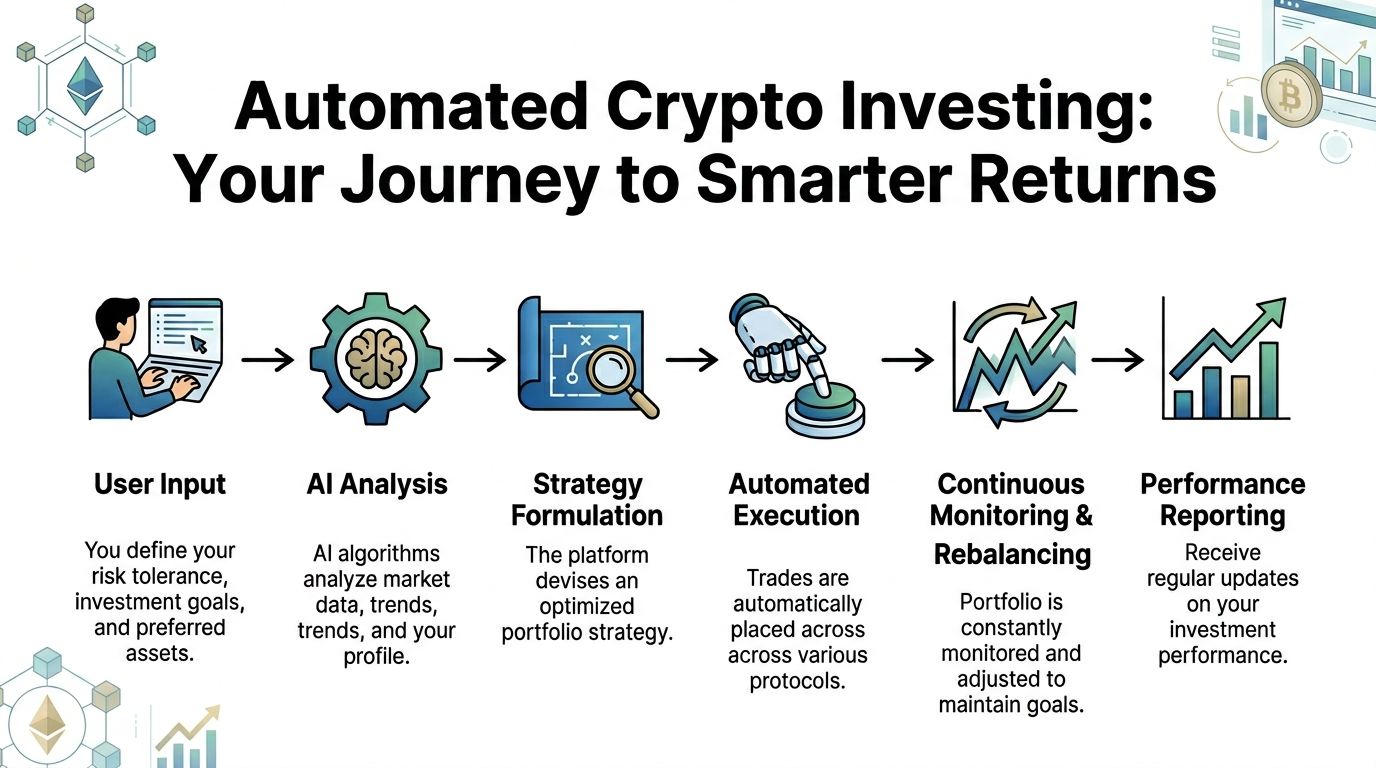
The strategy layer
This is the rulebook.
Crypto robo-advisors use risk-adjusted algorithmic rebalancing to keep a portfolio aligned with the user's target profile. Instead of reacting emotionally, the system watches for allocation drift and adjusts when a position no longer matches the plan.
Some platforms build that logic on portfolio models inspired by Modern Portfolio Theory, then add machine learning to personalize thresholds and timing. The practical result is simple: if your stablecoin strategy drifts away from its target mix, the platform can decide whether to leave it alone or rebalance.
That sounds minor. It isn't.
In DeFi, small drifts compound. A previously attractive allocation can become stale because rates moved, liquidity changed, or the risk-reward profile no longer justifies the position.
The decisioning layer
Here, people hear “AI agent” and assume magic. It isn't magic. It's software with scope.
AI Agent means a program that monitors conditions, applies predefined rules, and takes actions on your behalf without waiting for you to click every button.
A good agent doesn't “predict the future” in some cinematic sense. It continuously checks whether the current state still matches the intended strategy. If not, it proposes or executes the next step.
That can include:
Monitoring yield changes across protocols
Comparing net outcomes after slippage and gas
Checking portfolio drift against the user's limits
Avoiding pointless moves when the gain is too small to matter
If you're new to the concept, this breakdown of AI yield optimization helps connect the software logic to actual on-chain behavior.
Some adjacent crypto activities already train users to think this way. For example, people exploring staking get used to the idea that crypto returns depend on infrastructure, network conditions, and changing reward dynamics, not just price appreciation. Robo-advisors extend that mindset into automated allocation.
The execution layer
Automation becomes real at this layer.
Crypto robo-advisors often rely on multi-exchange API integration and on-chain transaction logic to move capital between venues. The verified technical example is straightforward: an agent can detect that a stablecoin allocation has drifted from an optimal yield, such as moving from 4.2% to 3.8%, query liquidity pools across protocols like Aave and Compound, and execute a rebalancing transaction to capture the higher yield while trying to minimize slippage and gas costs on chains like Base, as described by Empirica's overview of crypto robo infrastructure.
That reveals what the system is doing under the hood:
Layer | What it asks | What it does |
|---|---|---|
Strategy | What should this portfolio look like? | Sets target allocations and risk limits |
Decisioning | Does reality still match the plan? | Evaluates drift, yield changes, and switching logic |
Execution | Can the move be done efficiently right now? | Routes transactions and updates positions |
What works and what doesn't
What works is narrow, disciplined automation.
Platforms tend to perform best when they operate inside a defined lane, such as stablecoin yield, treasury management, or diversified crypto baskets with clear constraints. The narrower the mandate, the easier it is to measure whether the automation is doing a good job.
What doesn't work is vague “AI investing” language with no detail about inputs, rebalancing rules, or execution standards.
If a platform can't explain why it moved your funds, you don't have automation. You have outsourced confusion.
For practical users, that's the test. Not whether the interface says AI. Whether the machinery behind it is understandable and controlled.
Understanding the Benefits and Real-World Risks
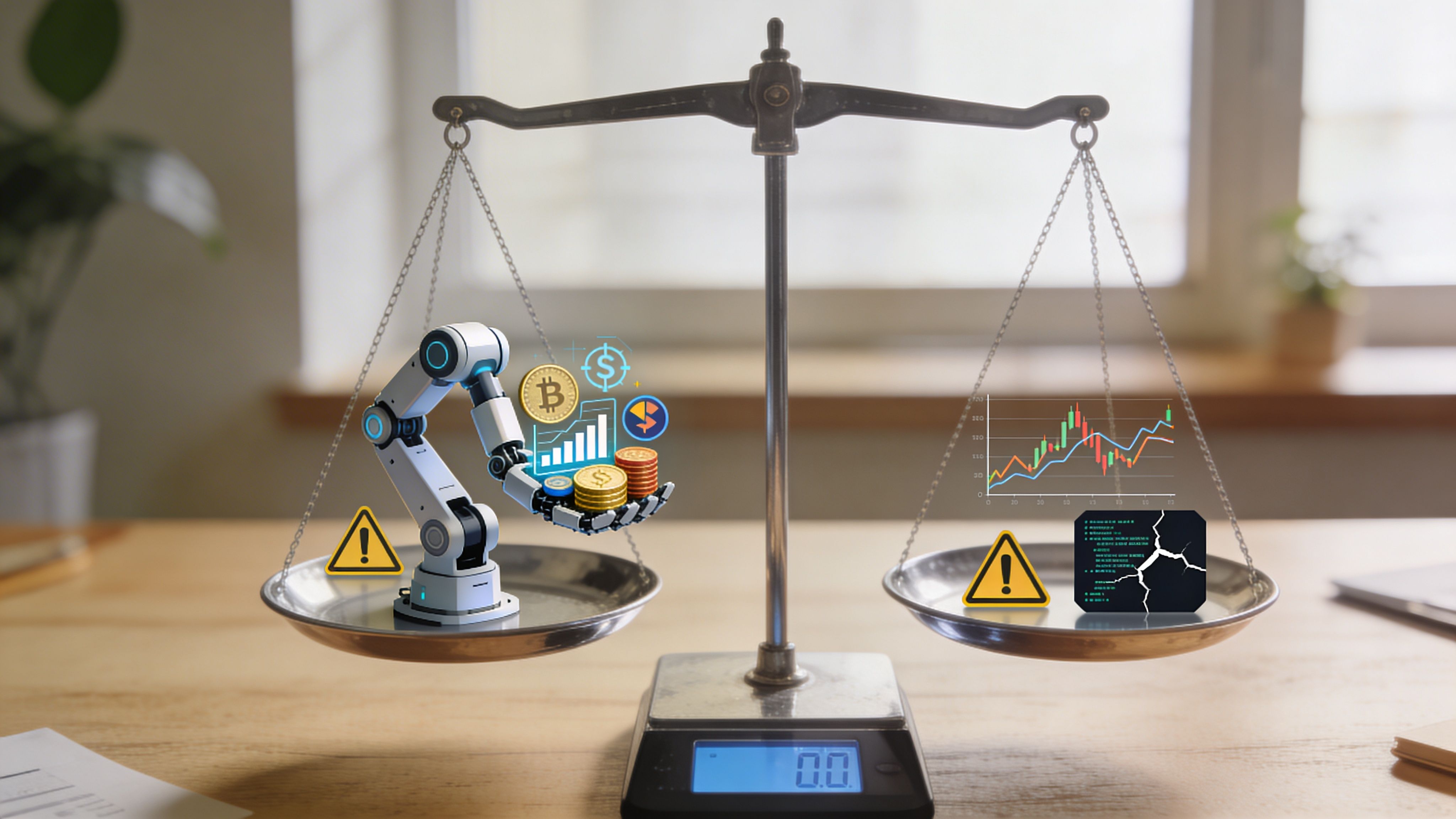
The appeal is obvious. A robo advisor for crypto can save time, remove impulsive decisions, and make DeFi usable for people who don't want to monitor rates all day.
Those benefits are real. So are the failure modes.
Where automation helps
First, automation gives users discipline. Underperformance in crypto often isn't caused by a lack of opportunity. It's caused by poor timing, scattered attention, and inconsistent process.
Second, it lowers the operational burden. You don't need to track every protocol update or spend your evening comparing lending dashboards.
Third, it makes advanced workflows more accessible. Someone who understands stablecoins but doesn't want to manage every move manually can still participate in DeFi with a rules-based system.
A short comparison makes the trade-off clearer:
Approach | Strength | Weakness |
|---|---|---|
Manual DeFi management | Full control over every move | High time cost and easy to make emotional decisions |
Basic trading bot | Fast execution | Usually too narrow and market-price focused |
Crypto robo advisor | Ongoing portfolio management and automation | Requires trust in the platform's risk logic and infrastructure |
The risks most reviews skip
Many reviews mention “crypto is volatile” and stop there. That isn't enough.
The primary issue is DeFi-specific risk. According to Crypto Adventure's review roundup, a major gap in this category is weak guidance on protocol-level dangers. The same piece notes that DeFi hacks caused an estimated $1.7 billion in losses in 2025, yet many guides still don't compare robo-advisors based on audited protocol usage or how they handle risks like impermanent loss in stablecoin pools.
That gap matters because users often assume automation reduces all risk. It doesn't. It changes the kind of risk you're taking.
Here are the ones that deserve direct attention:
Smart contract risk If the underlying protocol has a bug, your robo-advisor can't code its way out of that after the fact.
Protocol counterparty risk “Decentralized” doesn't mean equally trustworthy. Teams, governance, and upgrade paths still matter.
Liquidity risk Yield is irrelevant if exiting a position becomes slow, expensive, or disruptive.
Oracle and dependency risk Some strategies depend on price feeds, bridge assumptions, or interconnected contracts. A failure in one layer can ripple.
Strategy opacity If the platform can't show where funds go and why, you can't judge whether the system is prudent or reckless.
What a careful operator looks for
A platform doesn't need to eliminate risk. It needs to show that risk is being managed deliberately.
That includes visible protocol selection standards, plain-language explanations of where capital goes, and evidence that someone has reviewed the underlying code paths. For teams evaluating custom tooling or internal automation, an external review such as an AI code security audit can be a useful reference point for how automated decision systems should be examined.
Practical rule: Never treat a smooth UI as proof of a safe strategy. In DeFi, danger usually sits below the interface.
The strongest platforms don't promise safety in the abstract. They explain exposure in concrete terms.
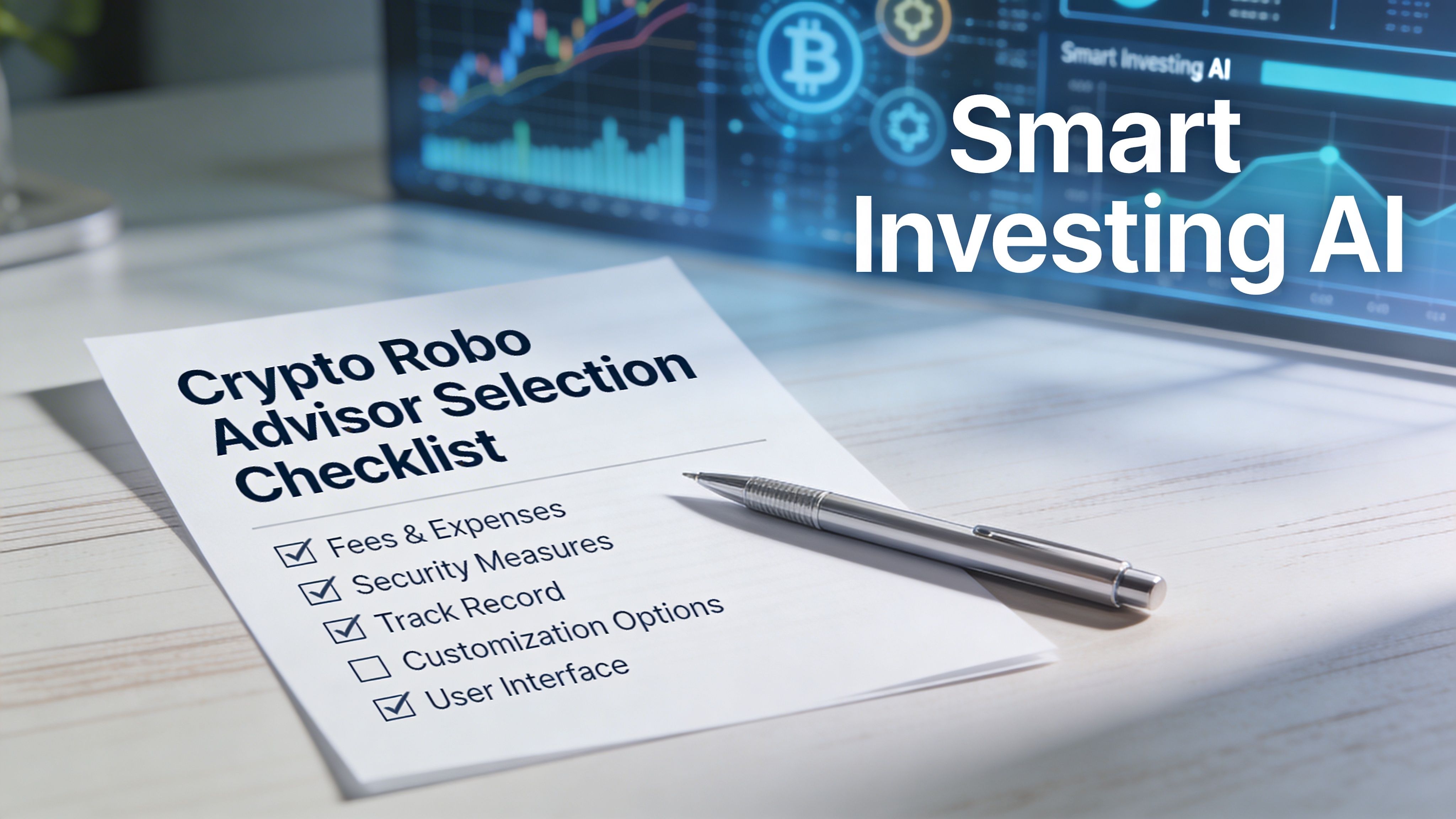
A Checklist for Choosing a Crypto Robo Advisor
Many users ask the wrong first question. They ask, “What's the APY?”
A better first question is, “How does this platform make decisions, and can I verify them?”
Start with transparency
Performance transparency is where many products fail. As noted by CoinGape's roundup of crypto robo-advisors, many platforms promote AI features but provide no 12-month Sharpe ratios or max drawdown data, and some robo-advisors in 2025 trailed simple BTC HODL strategies by 15% to 20% because of over-trading and fees.
That doesn't mean automation is bad. It means unverified automation is bad.
Ask these questions first:
Can I see real historical performance? Not marketing screenshots. Actual performance history, APY tracking, and enough context to judge the strategy.
What is the benchmark? A platform should compare itself against sensible alternatives, not against nothing.
How often does it trade or rebalance? Too much movement can destroy results.
Then check the risk model
The second layer is risk control.
Look for platforms that explain the rails around the strategy. If the answer to every risk question is “our AI handles it,” move on.
Use this checklist:
Which protocols can the system allocate to? Named venues matter. If funds move on-chain, the platform should say where.
What assets does it support? Broad multi-asset support is useful for some users. Others want a focused stablecoin product.
Is there a custody trade-off? Understand whether you're handing assets to the platform directly or interacting through a structure that preserves more user control.
How liquid are withdrawals? A good yield strategy isn't much use if access to capital becomes uncertain.
How are strategy changes communicated? Silent changes are a red flag.
Evaluate the user experience like an operator
Good UX in DeFi isn't cosmetic. It reduces mistakes.
You want:
Clear position visibility so you know where funds are allocated
Simple earnings reporting without spreadsheet gymnastics
Low-friction onboarding for approvals, deposits, and strategy selection
Educational context so newer users understand what the system is doing
Here, many people compare categories side by side. If you're weighing different types of tools, these notes on automated investment platforms are a practical reference.
A useful example in the stablecoin niche
One example in this category is Yield Seeker, which focuses on automated stablecoin yield on Base. It lets users deposit USDC, then uses a personalized AI agent to monitor and allocate capital across DeFi protocols in real time. The product is built around a clean interface, accessible balances and earnings views, and a self-directed experience aimed at beginners and experienced users who want less manual work.
That's a good example of how to judge fit. Not by hype, but by whether the platform has a clear scope. In this case, stablecoin yield rather than trying to be everything at once.
A narrow product with clear rules is often safer to evaluate than a broad one with fuzzy promises.
The short version
If you're screening a robo advisor for crypto, keep this compact filter in mind:
Question | Good sign | Bad sign |
|---|---|---|
Can I verify performance? | Clear history and benchmarks | Only feature claims |
Can I understand the strategy? | Plain-language allocation logic | “Proprietary AI” with no detail |
Can I inspect the risk posture? | Named protocols and clear constraints | Hidden venues or vague safety talk |
Can I exit cleanly? | Straightforward access to funds | Friction, delays, or unclear terms |
That checklist will save you more pain than chasing the highest displayed rate.
The Future of Automated DeFi Investing
Crypto robo-advisors are becoming the control layer between users and a messy on-chain market. That's why this category matters.
The manual version of DeFi doesn't scale well for many. It asks users to be part analyst, part trader, part risk manager, and part operations team. A good robo advisor for crypto compresses that workload into software, while still letting the user choose the broad mandate.
The next step is specialization. Some platforms will focus on stablecoin yield. Others will focus on treasury workflows, diversified token baskets, or cross-chain capital routing. The common thread is the same: fewer manual decisions, better risk framing, and more visible automation.
The winners won't be the tools with the loudest AI branding. They'll be the ones that make decisions clearly, show performance transparently, and respect DeFi risk.
If you use these tools with the right filter, they can do something valuable. They let you participate in DeFi without turning yield management into a second job.
If you want a hands-off way to automate stablecoin yield without constantly hunting protocols yourself, Yield Seeker is worth a look. It’s built for users who want AI-assisted, risk-aware on-chain allocation with a simple interface and flexible access to funds.