
Picture this: you're earning interest on your money, almost like you would at a bank. The crucial difference? You, and only you, have the keys to the vault. That’s the core idea behind self-custody yield platforms. They offer a way to generate passive income on your crypto without ever having to hand over control of your private keys.
This is a massive change from the old model of just trusting centralized exchanges. It’s about taking back real ownership of your financial future.
What Are Self-Custody Yield Platforms
At its heart, a self-custody yield platform acts as a secure gateway, connecting your personal crypto wallet directly to decentralized finance (DeFi) protocols. Think of it like a bridge. You don't give your car and keys to the toll operator; you just use their bridge to cross over to where you want to go—in this case, to find those yield-generating opportunities.
This approach tackles one of the biggest fears in crypto head-on: counterparty risk. The spectacular collapses of major exchanges have taught us all a painful lesson—if you don't hold your keys, you don't actually own your crypto. Self-custody platforms are designed to make this risk a thing of the past. Your funds, like stablecoins such as USDC, stay put in a wallet you control (think MetaMask or Coinbase Wallet) and are only deployed through smart contracts that you personally approve.
The growth here has been absolutely mind-blowing. We've seen a massive shift to non-custodial wallets, which helped fuel a $33 trillion stablecoin transaction volume in 2025. That's a 72% jump, completely dwarfing the transaction volume of giants like Visa. With 59% of users now choosing non-custodial solutions, it's clear self-custody isn't just for a niche crowd anymore; it's becoming the new standard. You can dig deeper into this trend with this recent stablecoin volume analysis.
The Shift from Custodial to Self-Sovereign
For a long time, the easiest way to earn a return was to simply deposit your funds on a big, centralized platform. It was simple, sure, but it meant you were trusting a third party with your assets, leaving you exposed to everything from hacks and bad management to the platform just going bust.
Self-custody isn't just a feature; it's a philosophy. It means you are the bank, the security guard, and the sole beneficiary of your assets. You keep full authority, making sure no one can freeze, move, or lose your funds without your say-so.
This new wave of platforms completely flips that dynamic. You're no longer just a passive depositor waiting for a statement—you're an active participant with total control.
How It Works in Practice
The whole process is refreshingly simple and secure by design. Here's how it usually goes:
Connect Your Wallet: You link your existing non-custodial wallet to the platform’s interface. No sign-ups or personal info needed.
Deposit and Earn: You deposit your stablecoins, which are then put to work in battle-tested DeFi lending protocols like Aave or Compound.
Retain Control: Your assets are locked in transparent, on-chain smart contracts, not sitting in some company's bank account. You can withdraw them whenever you want, no questions asked.
To make the distinction crystal clear, it helps to see the two models side-by-side.
Self-Custody vs Custodial Yield at a Glance
This table breaks down the key differences between earning yield on your own terms versus handing your assets over to a third party.
Feature | Self-Custody Platforms | Custodial Platforms |
|---|---|---|
Asset Control | You hold the private keys; funds are in your wallet | The platform holds your keys and assets |
Counterparty Risk | Minimal; risk is shifted to audited smart contracts | High; vulnerable to exchange failure or hacks |
Transparency | High; all transactions are on-chain and verifiable | Low; operations are off-chain and opaque |
Accessibility | Instant; withdraw funds anytime without permission | Gated; subject to platform policies and delays |
At the end of the day, self-custody yield platforms give you the best of both worlds. You get access to the attractive returns that DeFi can offer, but with the genuine peace of mind that comes from knowing your funds are, and always will be, truly yours.
How You Earn Yield Without Losing Control
The idea of earning yield while keeping total control of your money can sound a bit magical. But the way self-custody yield platforms work is surprisingly simple. It all boils down to an automated process that cuts out the need for risky middlemen. Your funds never leave your control, even while they're out there working for you.
Think of it like a high-tech, transparent vending machine. This machine is really a smart contract—a bit of code on the blockchain that follows a fixed set of rules. You don't hand your cash to a person; you put it into the machine, and it automatically gives you what you paid for. Smart contracts do the same thing, but with financial activities like lending and borrowing.
When you deposit stablecoins onto a self-custody platform, you're not sending them to some company's bank account. Instead, you're just giving your wallet permission to talk to these smart contracts. Your assets move from your personal wallet into these automated "vending machines" to start earning.
The Power of Overcollateralized Lending
So where does the actual yield come from? Most of it is generated through something called overcollateralized lending. This is the solid foundation that secure DeFi lending protocols like Aave and Compound are built on.
Here’s how it works: anyone who wants to borrow crypto must first put up collateral that's worth more than the loan amount. For example, to borrow $100 in USDC, a borrower might have to lock up $150 worth of another crypto like Ethereum.
This "over-collateralization" creates a fantastic safety net for you, the lender:
Drastically Reduced Risk: If the borrower doesn't pay back the loan, the smart contract automatically sells their locked collateral to make you whole.
Built-in Protection: Since the collateral is worth way more than the loan, there’s a big cushion to soak up any wild price swings in the market.
This is the system that lets you earn interest on your stablecoins with a high degree of confidence. You know the loans are more than covered by locked assets. It’s a process that has absolutely taken off as the stablecoin market has boomed.
In 2026, the explosive growth of stablecoin markets has supercharged the rise of self-custody yield platforms, with total stablecoin supply surging past $295 billion. For stablecoin holders, this means seamless access to 4-7% APYs through overcollateralized lending—far outpacing traditional banks—without handing over keys to custodians. Discover more insights into the 2026 crypto yield landscape.
This diagram shows you just how simple and secure the flow of funds really is.
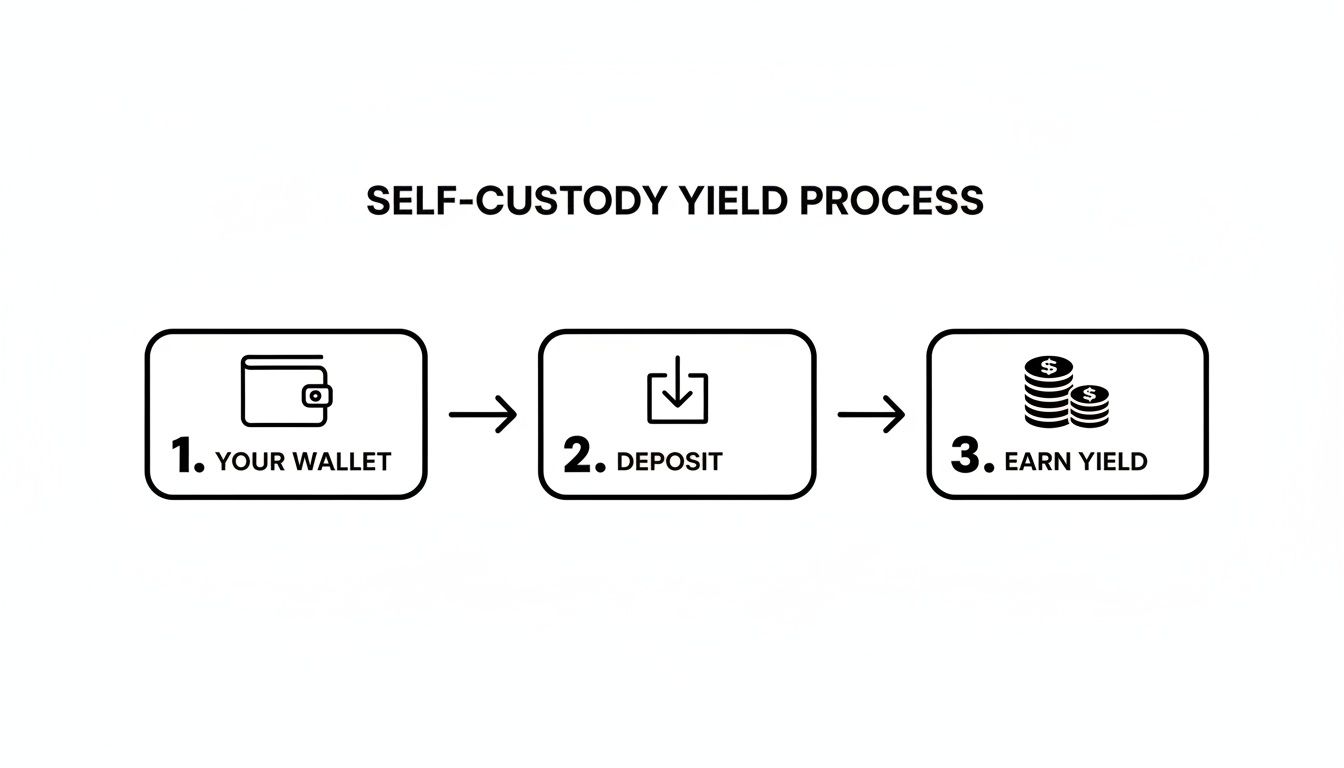
As you can see, it's a straightforward journey: your funds go from your wallet, into a secure protocol, and start earning. All while you hold the keys.
From Your Wallet to Yield and Back Again
Let's walk through a real-world example of how your stablecoins actually generate a return. It's a simple loop that always starts and ends with you in the driver's seat.
Connect Your Wallet: You head over to a self-custody yield platform and connect a wallet like MetaMask. This doesn't hand over your keys; it just opens a secure line for communication.
Deposit Your Funds: You decide to deposit 1,000 USDC. You'll sign a transaction that sends these funds to an audited smart contract, which holds a lending pool.
Funds Are Lent Out: Your 1,000 USDC joins a pool with funds from other users. Borrowers can then take loans from this pool, but only after they’ve locked up their own oversized collateral.
You Earn Interest: The interest paid by borrowers is then split among everyone who supplied funds to the pool. You start earning your share in real-time and can watch it grow on your dashboard.
Withdraw Anytime: When you're ready to take your money back, you just hit withdraw. The smart contract instantly sends your original deposit, plus all the yield you've earned, right back to your personal wallet.
This whole thing runs on its own, is completely transparent, and works 24/7 without needing anyone's permission. While lending is a major source of yield, you can also learn more about liquidity pools and how they function in DeFi, as they're another key way to earn. The main principle is always the same: your assets are put to work by code, not by trusting a company.
How to Choose a Safe Self-Custody Platform
So you've seen the eye-popping APYs on self-custody yield platforms, but a nagging question remains: is it safe? High returns are great, but they’re worthless if your funds vanish overnight. Figuring out which platforms are legit and which are just plain sketchy requires you to look past the marketing noise and do a bit of your own detective work.
This isn’t about random guessing. It's about having a solid framework to check a platform's security fundamentals. Think of it like buying a house. You don't just admire the new paint; you get an inspector to check the foundations, the wiring, and the plumbing. In DeFi, a platform's foundation is its code, its transparency, and its real-world track record.

Before you even think about depositing, you need to put on your inspector's hat. To make it easier, I've put together a checklist of the most important things to look for.
| Your 7-Point Security Checklist for Self-Custody Platforms |
| :--- | :--- | :--- |
| Security Check | What to Look For | Red Flag | | 1. Smart Contract Audits | Multiple audits from well-known firms (e.g., Trail of Bits, CertiK). Check if critical issues were found and fixed. | No audits, audits from unknown firms, or critical issues that were ignored by the team. | | 2. Platform Track Record | Has it operated for 1-2+ years without any major security breaches or exploits? | A brand-new platform with no history, or a history of hacks and lost user funds. | | 3. Underlying Protocols | Does it integrate with battle-tested protocols like Aave or Compound that have secured billions for years? | Relies exclusively on new, unaudited, or experimental protocols for its yield sources. | | 4. Team Transparency | A public team with real names, faces, and verifiable experience in crypto/tech. | Anonymous or pseudo-anonymous founders who are hard to hold accountable. | | 5. On-Chain Transparency | Clear documentation on how yield is generated. A dashboard to track your funds on-chain. | Vague explanations about "secret strategies" or an inability to verify your funds on a block explorer. | | 6. Emergency Measures | Does the platform or its underlying protocols have a safety module or insurance fund? | No plan or mechanism in place to protect users in a black swan event. | | 7. Community & Communication | An active, engaged community (Discord, Twitter) and a team that communicates openly, especially during issues. | A ghost town community, or a team that deletes critical questions and bans users. |
Walking through this checklist gives you a systematic way to gauge risk, helping you steer clear of platforms that are all sizzle and no steak.
Start with Smart Contract Audits
First things first: the audits. Smart contracts are the engines that run everything, holding and moving your funds automatically. If there's a flaw in the code, your money is at risk, so professional security audits are completely non-negotiable.
Look for audits from reputable, third-party security firms. But don't just stop at seeing a "passed" checkmark. You need to dig into the report itself. See what kind of issues were found (critical, high, medium, etc.) and, more importantly, whether the dev team actually fixed them. A platform that shrugs off a critical vulnerability is waving a giant red flag.
Evaluate the Platform's Track Record
A platform's history tells you a lot. How long has it been running without getting hacked? In crypto, time is measured in dog years, so a platform that's been operating safely for even a year or two is a huge green flag.
This is also where using battle-tested protocols like Aave and Compound really matters. When a platform builds on top of protocols that have securely managed billions over many years, it inherits a lot of that resilience. New, shiny protocols can be tempting, but they carry a much higher risk profile. For the core of your portfolio, you want reliability over novelty.
A platform's security is only as strong as its weakest link. A history of safe operation, combined with a transparent response to any past incidents, demonstrates a team's commitment to protecting user funds above all else.
On top of that, check if the underlying protocols have any insurance funds or safety modules. These are designed to be a backstop and can provide an extra layer of protection if the worst happens.
Assess Team and Protocol Transparency
In the self-custody world, anonymous teams are a massive risk. You want to see platforms run by public-facing founders and developers who have a real, verifiable track record in the industry. When a team puts their names and reputations on the line, they're far more likely to be accountable.
This transparency needs to extend to the protocol itself. Does the platform clearly explain where the yield comes from? Can you easily hop on a block explorer and see exactly where your funds are? The best platforms give you dashboards and tools that provide a clear window into your investment, without hiding behind a wall of confusing jargon.
This level of openness is what builds real trust. It lets you verify for yourself that everything is running as it should. If you're ready to go even deeper, our guide to DeFi protocol safety analysis covers more advanced techniques for doing your own research.
An AI-First Approach to Self-Custody Yield
While self-custody is great for security, let's be honest—the reality of managing investments in DeFi can be a real grind. You're constantly hunting for the best yields, trying to vet brand-new protocols, and shifting funds around to catch the latest opportunity. For most busy professionals, that’s practically a full-time job.
This is exactly where a new breed of self-custody yield platforms is starting to make waves by bringing AI into the mix.
Instead of just being a simple gateway to DeFi, these AI-first platforms are more like your own personal, automated portfolio manager. They do all the heavy lifting—the research, the risk assessment, the execution—so you can tap into DeFi's potential without all the manual effort. Platforms like Yield Seeker really nail this "smarter, not harder" approach.
Yield Seeker gives you a personalized AI Agent that keeps a constant eye on the DeFi world, specifically on the Base chain. It sifts through top-tier protocols, weighs their risks, and automatically moves your capital to chase competitive, risk-adjusted returns. It takes all the guesswork and obsessive chart-watching off your plate.
How AI Makes Yield Generation Simple
The real magic of an AI-driven platform is its ability to crunch massive amounts of data and act on it way faster than any human could. It's like having an expert analyst working for you around the clock, 24/7.
For anyone using Yield Seeker, this boils down to a few key benefits:
Painless Onboarding: You can connect your wallet and get going with as little as $10 USDC. The low barrier to entry means pretty much anyone can start earning.
Automatic Optimization: Your AI Agent is always on the move, dynamically shifting your funds between vetted protocols to make sure your capital is always put to its best use.
Total Transparency: You're always in the driver's seat. Every action is tracked, and you can pull your funds out instantly, with no fees or annoying lock-up periods.
This model is starting to get serious attention, especially with big institutional players finally dipping their toes into DeFi. Their move into self-custody yield platforms by 2026 is a huge deal, with a predicted 57% of institutional wallets adopting non-custodial or hybrid setups. This whole shift is fueled by a demand for segregated custody and proper audits, pushing aside earlier regulatory jitters and opening the door for easy-to-use, AI-powered products that can deliver 4-7% APYs. You can discover more about the rise of institutional self-custody.
A Clean and Clear User Experience
True self-custody runs on trust, and you can't have trust without transparency. Sure, an AI might be pulling the levers, but you should always have a crystal-clear view of what it’s doing and why. A well-designed dashboard is non-negotiable here.
The screenshot from Yield Seeker above shows exactly what I mean. A clean interface gives you a quick summary of your balance, total earnings, and current APY. This clarity keeps you in the loop without drowning you in data. And for those who like to get into the weeds, there's even a built-in terminal that logs every single action your AI Agent takes.
By combining AI-powered automation with a transparent, user-controlled interface, platforms like Yield Seeker make sophisticated DeFi strategies accessible to everyone from beginners to seasoned crypto natives.
This approach gives you a powerful trio: the security of self-custody, the returns of DeFi, and the simplicity of modern tech. To see how else AI is being applied to financial management, you might want to check out services like an AI Assistant.
At the end of the day, the goal is to create a seamless experience where you can confidently put your stablecoins to work. For those curious about the nuts and bolts of how these AI systems operate, you can learn more about how to use AI agents in our guide. This next wave of platforms is proving that earning yield in crypto doesn't have to be a full-time job.
Reading about something is one thing, but there's nothing like seeing it work with your own money. Let's walk through getting you from zero to earning your first bit of yield. I'll show you just how quick and easy it is to get started with a platform like Yield Seeker.
We'll connect a wallet, pop in a small deposit, and watch the earnings roll in on the dashboard. It’s the best way to really get comfortable and see for yourself how simple modern DeFi can be.
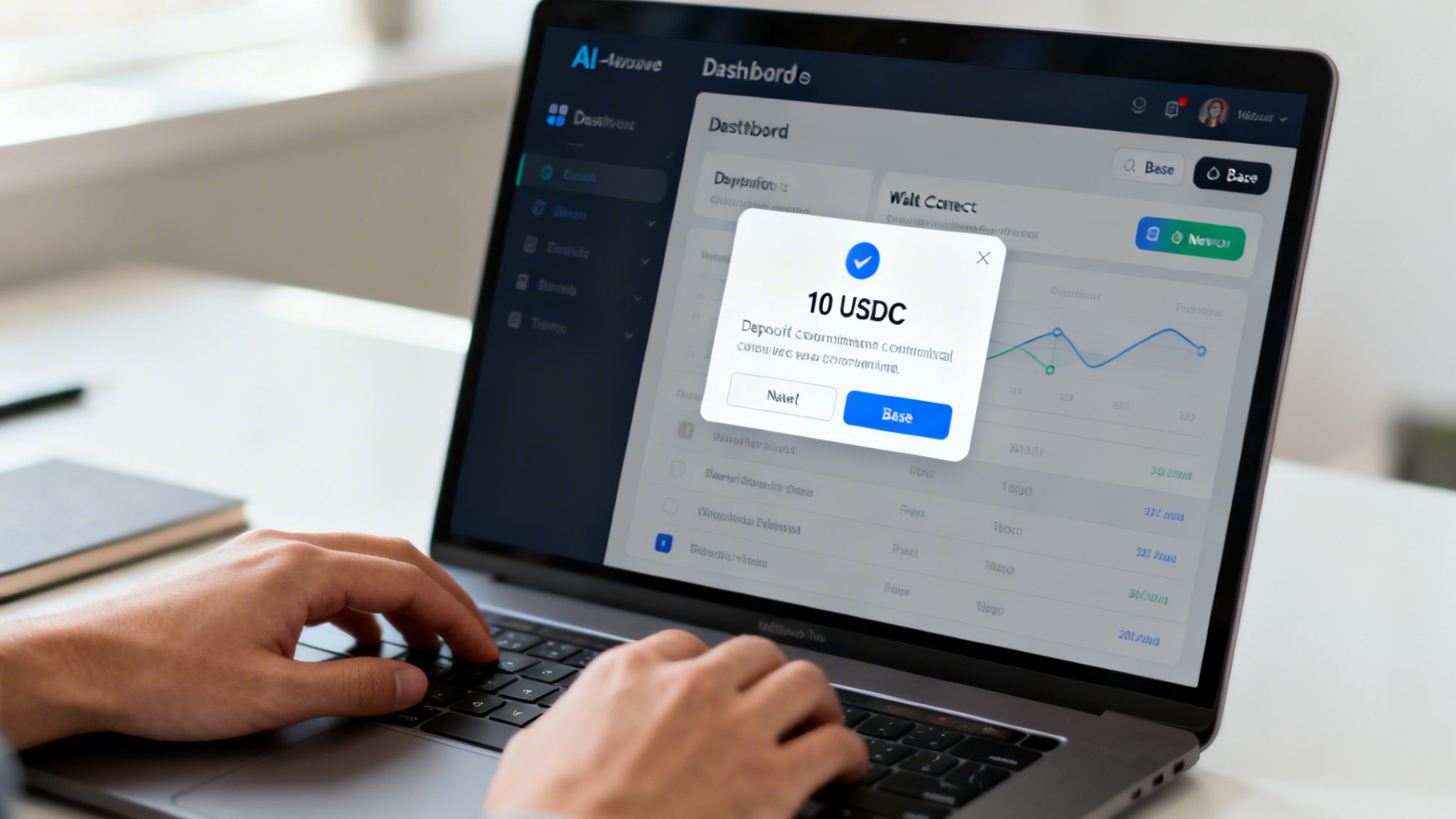
Step 1: Connect Your Self-Custody Wallet
First up, you need to connect your personal wallet. This is just a digital handshake; you’re not giving away your private keys or any control. It simply builds a secure bridge so the platform can talk to your wallet. Yield Seeker works with popular choices like MetaMask and Coinbase Wallet, so getting connected is a breeze.
Your wallet will pop up and ask you to approve the connection. This is totally standard and safe. All it does is let the app see your public wallet address and what tokens you hold—it can't move anything on its own.
Step 2: Make Your First USDC Deposit
With your wallet connected, it’s time to put some capital to work. The great thing about Yield Seeker is that you can start small. You can begin with as little as $10 in USDC on the Base network, which is perfect for just dipping your toes in the water without any big commitment.
Depositing is a two-step dance, which is a core security feature in DeFi:
Approve USDC: First, you’ll sign a transaction that gives the Yield Seeker smart contract permission to use your USDC. Think of it like setting a spending limit on a credit card—you’re telling the contract exactly how much it's allowed to touch.
Confirm Deposit: With the approval set, you'll sign one more transaction to actually deposit your USDC. This moves the funds from your wallet into Yield Seeker’s audited smart contract, where its AI Agent can start putting it to work for you.
This two-step process is designed to keep you in the driver's seat, with full control over your funds every step of the way.
Step 3: Track Your Earnings on the Dashboard
And just like that, you’re earning yield! The moment your deposit is confirmed, you can head over to the Yield Seeker dashboard. You’ll get a clean, real-time look at your investment, seeing your total balance and watching your earnings start to tick up.
This is where the magic happens. Behind the scenes, the AI Agent is busy scanning the market and moving your USDC between vetted protocols to find the best returns. You don’t have to do any of the heavy lifting, research, or manual trades—the system handles all that for you.
One of the most important things to know is there's total liquidity. Your funds are never locked. You can pull out your initial deposit and any yield you've earned whenever you want, with no withdrawal fees or annoying waiting periods. It’s a perfect example of the self-custody principle: it’s your money, always.
This simple three-step process really pulls back the curtain on DeFi, proving you don't need to be a crypto wizard to start earning passive income safely.
Frequently Asked Questions About Self-Custody Yield
Whenever I talk about self-custody yield, a few common questions always pop up. It makes sense—when your own money is on the line, you want to be sure about the risks, how accessible your funds are, and whether you need to be a DeFi wizard to make it work.
Let's tackle those questions head-on so you know exactly what you're getting into.
What Are the Main Risks with Self-Custody Yield Platforms
While keeping your funds in your own wallet gets rid of the risk of an exchange going bust (goodbye, counterparty risk!), it doesn’t mean you’re completely in the clear. There are really two main things you need to keep an eye on: smart contract risk and market risk.
Smart contract risk is the big one. It’s the chance that a bug or a sneaky vulnerability exists in the code of the DeFi protocols where your money is actually working. This is exactly why you should only use platforms that stick to battle-tested, heavily audited protocols like Aave and Compound. The best platforms take this seriously, choosing protocols with long security track records and, in some cases, even insurance funds.
Market risk is just the natural ebb and flow of interest rates in DeFi. The APY you see isn't set in stone; it moves up and down based on how many people want to lend versus borrow. While it's a risk, it’s also a totally transparent reflection of the market—a far cry from the black-box rates your traditional bank gives you.
Are My Funds Locked Up on These Platforms
This is a huge misconception I see all the time, probably because people are used to traditional staking where you have to lock up your crypto for a fixed period. With the leading self-custody yield platforms, that’s just not how it works.
Flexibility is a core principle. Modern platforms like Yield Seeker are designed for instant liquidity. Your funds are never locked up. You can pull out your initial deposit and all the yield you’ve earned at any time, with no penalties or silly withdrawal fees.
This on-demand access means you're always in complete control. You can react to market moves or just pull cash for personal needs without waiting, which is what real self-custody is all about.
Do I Need to Be a Crypto Expert to Use These Platforms
Absolutely not. I get it—the tech behind blockchain and smart contracts can sound incredibly complex. But the whole point of modern platforms is to hide that complexity from you.
Think of it like driving a car. You don’t need to be a mechanical engineer to get behind the wheel and go for a drive. Platforms like Yield Seeker use AI and clean interfaces to handle all the heavy lifting for you.
AI-Driven Automation: An AI agent is constantly watching the markets and moving your funds to the best spots, so you don't have to spend your days doing research.
Intuitive Dashboards: You get a simple, clean dashboard showing your earnings in real-time, without a bunch of confusing crypto jargon.
Simple Onboarding: Getting started is usually just a few clicks. Connect your wallet, drop in a small deposit, and you're off.
These platforms are built for beginners and busy professionals who want to tap into DeFi's benefits without the massive learning curve.
Ready to put your stablecoins to work without sacrificing control? With Yield Seeker, you can start earning automated, AI-driven yield in minutes. Connect your wallet, deposit as little as $10 USDC, and let our platform handle the rest. Start your journey with Yield Seeker today.