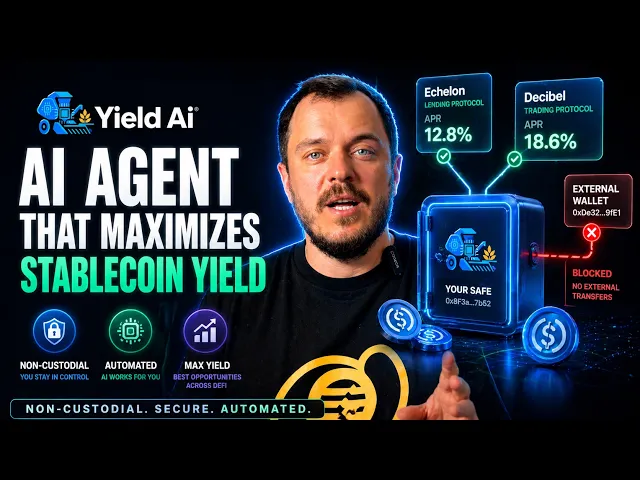

The most popular advice about stablecoin returns is also the least useful: find the highest APY and let the money sit. Stablecoins don't generate free income just because they're pegged to the dollar. Every return comes from somewhere, and that source determines the risk you're taking.
A deposit in a wallet is idle capital. A deposit in a lending market earns from borrower demand. A position in a liquidity pool earns trading fees, incentives, or both. The difference matters because a headline rate can disappear when borrowing demand falls, token rewards lose value, or a smart contract fails. Sustainable yield starts with tracing the cash flow, not comparing the largest number on a dashboard.
Understanding the True Source of Stablecoin Returns
Holding USDC, USDT, or another dollar-pegged token normally doesn't resemble holding money in an interest-bearing savings account. The token represents a claim or asset designed to maintain a stable value, but the wallet balance itself doesn't automatically produce interest. The European Central Bank's explanation of stablecoin returns makes the distinction clearly: returns generally come from lending, liquidity provision, or yield farming, all of which carry risks that a traditional deposit account may not.
That means stablecoin returns are payments for deploying capital, not a native feature of the coin. You must place the asset into a mechanism where another participant pays for access to liquidity, trading, borrowing, or a financial service.
Idle tokens versus productive capital
Consider two identical USDC balances. The first remains in a self-custody wallet. It has exposure to the stablecoin, its issuer, and the broader ability of the token to maintain its intended value, but it has no separate yield position. The second enters a lending protocol. Borrowers supply collateral and pay interest, while the protocol distributes part of that interest to lenders.
The second balance may show an APY, but it also introduces another layer of exposure. You're relying on contract logic, market liquidity, collateral rules, oracle design, and the protocol's ability to manage withdrawals. A liquidity pool adds another consideration, the changing relationship between the assets in the pool and the possibility of impermanent loss.
Practical rule: Never ask only, “What's the APY?” Ask, “Who is paying it, from what cash flow, and what can stop that payment?”
The same nominal return can therefore describe very different economic arrangements. Borrower interest is tied to utilization and demand. Trading-fee income depends on volume. Governance-token incentives depend on an emissions schedule and the market value of the reward token. None of these should be treated as interest that the stablecoin is designed to owe you.
This framing also changes how you compare opportunities. A static holding has limited operational complexity but no protocol yield. An active position may create income, but the extra return compensates you for risks that must be identified individually. If you can't explain the mechanism in plain English, you don't yet know what you're buying.
How DeFi Protocols Generate Stablecoin Yield
DeFi yield usually comes from one of three engines. Lending markets charge borrowers interest. Automated market makers pay liquidity providers a share of trading fees. Liquidity-mining programs add token incentives to attract deposits or borrowing activity.
Lending is the cleanest mechanism to analyze. A protocol such as Aave matches supplied assets with borrowers, subject to collateral and risk parameters. Your return rises when borrowers compete for stablecoin liquidity and falls when utilization declines. Before using any lending protocol research, check the asset's utilization, collateral composition, liquidation process, oracle dependencies, and withdrawal liquidity.
Liquidity pools work differently. You deposit assets into an automated market maker, and traders pay fees when they swap against the pool. A stablecoin-only or closely correlated pool can reduce price divergence between deposited assets, but it isn't risk-free. Contract vulnerabilities, pool imbalance, low volume, and changing fee revenue can all reduce realized returns.
Liquidity mining adds a second source of income, usually a governance token. This can make the advertised APY look attractive while hiding the fact that part of the return depends on token emissions. If many participants sell the reward token, the nominal rate may remain visible while the economic value of the payout deteriorates.
Separate revenue from subsidies
The distinction between fee-based yield and emissions-based yield is central. A fee-only stablecoin pool generally offers about 0.5% to 2% APY, while adding CRV or CVX-style incentives can expand the conservative range to roughly 2% to 6% APY, according to Galaxy's 2026 on-chain yield study. The same study found that 83.33% of yield-bearing stablecoins exceeded 4.25% APY, but that figure doesn't make every yield source equally durable.
A useful analysis separates the components:
Mechanism | Yield source | Risk profile |
|---|---|---|
Lending | Borrower interest | Utilization, collateral, liquidation, oracle, and smart contract risk |
Stablecoin liquidity pool | Trading fees | Pool imbalance, low volume, contract risk, and possible asset divergence |
Incentivized pool | Trading fees plus reward tokens | All pool risks, plus emissions, reward-token price, and governance risk |
Protocol revenue strategy | Fees, lending income, or other documented cash flows | Strategy execution, custody, contract, and liquidity risk |
A 5% return funded by actual borrower interest has a different sustainability profile from a 5% return funded mainly by newly distributed tokens. The first can shrink when demand weakens. The second can shrink for the same reason and may also lose value when incentives change.
Look for transparent reporting of gross yield, fees, reward assets, withdrawal conditions, and net realized return. A dashboard that shows one blended APY without identifying the components makes risk assessment harder. The best workflow is to treat the APY as a starting estimate, then verify which cash flows produced it and whether those cash flows can persist.
The Macro Connection Between Stablecoins and Treasury Yields
Stablecoin returns don't operate in a crypto vacuum. Issuers of major stablecoins commonly place reserve assets in very short-dated government debt and similar cash-equivalent instruments, while DeFi borrowers respond to the same global funding conditions that influence traditional money markets.
The Bank for International Settlements reported that stablecoin issuers purchased nearly $35 billion of U.S. Treasury bills in 2025, according to State Street's summary of the stablecoin market. The same analysis found that a $3.5 billion stablecoin inflow lowered three-month Treasury bill yields by 0.71 basis points on impact and by about 4 basis points within 10 days, with the trough around 13 days. The effect was concentrated at the short end of the curve, which is precisely where many stablecoin reserves are invested.

A separate Federal Reserve analysis cited in the same summary said Treasury holdings of major issuers such as Tether and Circle had grown more than tenfold over the past five years. As stablecoin supply expands, issuers can become a meaningful source of demand for short-duration sovereign debt. That demand can compress the baseline return available on the assets backing the tokens.
What this means for DeFi users
The connection reaches beyond issuer reserves. Research found that a 0.25 percentage-point move in the U.S. 10-year Treasury yield was associated with about a 1 percentage-point move in stablecoin borrowing rates, as reported in research on stablecoin borrowing-rate sensitivity. When traditional yields rise, on-chain borrowing and deposit rates can rise as funding becomes more expensive. When Treasury yields fall, DeFi returns can compress even if a protocol's design hasn't changed.
The relationship isn't perfectly mechanical for every pool or chain. Protocol utilization, incentives, liquidity, and risk appetite still matter. But a broad decline in stablecoin APY may reflect a lower-rate environment rather than a protocol-specific failure.
The BIS also modeled a scenario in which a stablecoin sector sized at $2 trillion could push U.S. Treasury bill yields down by almost 25 basis points. Its empirical companion estimate associated a 1% increase in combined USDC and USDT market capitalization with decreases in one-month and three-month Treasury yields of 0.423 and 0.498 basis points, respectively, as detailed in the BIS working paper on stablecoins and safe-asset prices. The practical conclusion is simple: stablecoin returns increasingly share their foundation with the short-duration government debt market.
For a broader comparison of on-chain income and traditional fixed-income alternatives, see Treasury yield alternatives.
Evaluating Risk Factors and Capital Preservation
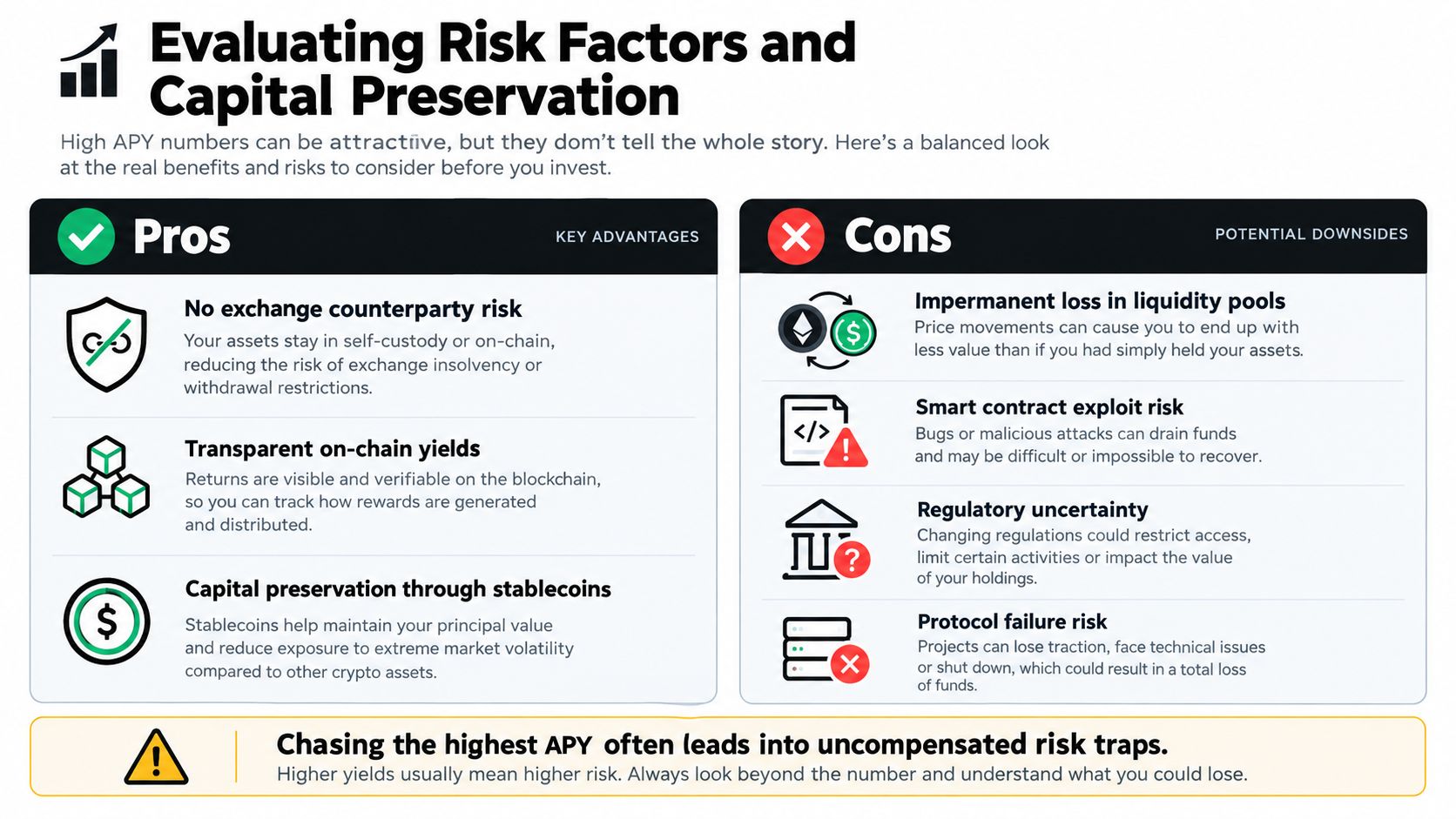
A high APY isn't automatically attractive. It may be payment for taking smart contract, liquidity, depeg, counterparty, incentive, or regulatory risk. The right comparison is the expected net return after those risks, not the largest number shown before withdrawal costs and losses.
Identify the layers of exposure
Base stablecoin risk comes first. A stablecoin can face reserve, redemption, custody, devaluation, or run risk. A token that usually trades near its intended peg can still experience stress when holders rush to exit or when confidence in reserves weakens.
Protocol risk sits on top of that exposure. Audits can reduce uncertainty, but they don't guarantee safety. Examine upgrade permissions, administrator controls, oracle providers, liquidation logic, historical incidents, and the length of time the deployed contracts have operated.
Liquidity risk determines whether you can exit when you need the money. A strategy may quote an attractive rate while relying on a pool with limited depth or a withdrawal queue. Test the path from your position back to the stablecoin, and from the stablecoin to your preferred off-ramp.
Incentive risk affects returns rather than just principal. Rewards can be reduced, redirected, or rendered uneconomic by token price declines. A strategy that requires constant emissions to remain competitive shouldn't be evaluated like a cash account.
Capital preservation comes before APY optimization. A small spread over a traditional cash benchmark may not compensate for multiple new failure points.
Recent industry data noted that 58% of stablecoin TVL earned below 3% annually, while average USDC supply yields were near 2%, often below Treasury and SOFR levels, according to the ECB's financial stability analysis. That finding challenges the assumption that DeFi automatically pays more for comparable risk.
A sensible stress test asks what happens if the reward token falls, utilization drops, withdrawals become congested, the stablecoin trades away from its target, or the protocol pauses activity. If the answer is unclear, reduce the position or choose a simpler mechanism. Diversification can help, but spreading money across several unaudited contracts doesn't create genuine safety. It can multiply the number of ways capital can fail.
Navigating Tax and Regulatory Considerations
Stablecoin yield creates records that ordinary wallet holding may not. Tax treatment depends on your jurisdiction and the exact transaction, so treat this as a workflow for preparation, not legal or tax advice.
Start by separating the transaction types. Interest from lending may be treated differently from governance tokens received as incentives. Liquidity-pool activity can create disposal, exchange, or income questions depending on local rules. Moving assets across chains, swapping reward tokens, withdrawing from a vault, or converting rewards back into USDC may each require separate records.
Build an audit trail
Keep the following information for every position:
Transaction identity: Save the wallet address, transaction hash, chain, timestamp, and protocol.
Asset values: Record the units received, the asset's value under your local reporting method, and the value of any fees paid.
Position changes: Note deposits, withdrawals, swaps, reward claims, and bridge transactions.
Strategy context: Keep screenshots or exported statements showing the advertised rate, reward structure, and terms at the time of entry.
Crypto tax software can import wallet activity and classify many transactions, but automated labels aren't infallible. Review unusual liquidity-pool events, wrapped assets, bridge transfers, and reward distributions manually. Keep the original transaction data even if the software produces a clean summary.
Regulatory exposure affects availability as well as reporting. Issuer reserve requirements, restrictions on interest-like rewards, platform licensing, geographic access, and protocol governance can change how a strategy operates. A venue that is accessible today may limit deposits, alter its reward program, or require additional verification later.
Before deploying meaningful capital, confirm the rules that apply to your residence, entity structure, and activity. A qualified local professional can help distinguish lending income, token compensation, capital gains, and business activity. Good records won't eliminate tax, but poor records can make an otherwise manageable position unnecessarily expensive to explain.
Automating Yield Strategies with AI Agents
Manual DeFi yield hunting creates a research problem before it creates an investment problem. Rates move, incentives expire, utilization changes, contracts are upgraded, and liquidity migrates across chains. Checking several dashboards by hand can turn a supposedly passive strategy into a recurring operations task.

An AI agent can centralize that monitoring and apply a consistent decision process. Instead of asking a user to compare disconnected APYs, an agent can evaluate available venues, consider the source of the return, track changes, and allocate according to defined constraints. The important distinction is that automation should reduce research friction, not remove risk assessment.
Yield Seeker provides one example of this workflow. Users deposit USDC on Base, and its personalized AI Agent monitors and allocates capital across DeFi protocols for competitive, risk-aware yield. The platform is designed around accessible funds, with no lockups or withdrawal fees described in the publisher's product information, while its documentation says rewards are converted to USDC so displayed earnings reflect the stablecoin value of the return.
What an automated workflow should contain
A practical agent needs more than a rate scraper. It should record the underlying protocol, distinguish fee income from token incentives, watch liquidity and utilization, and flag material changes. It should also preserve user control through deposit limits, withdrawal access, and clear transaction approval.
The workflow can be simple:
Deposit the chosen stablecoin.
Define risk and liquidity preferences.
Let the agent compare eligible strategies.
Approve allocation or rebalancing transactions.
Review the source of earnings and any alerts.
Automation is most useful when it makes these checks repeatable. It can't guarantee a peg, prevent every exploit, or turn an incentive into organic revenue. It can, however, reduce the chance that a user misses a changing rate or leaves capital in a strategy whose economics have deteriorated.
For a practical guide to the operating model, see how to use AI agents for yield management.
The strongest setup combines automation with explicit guardrails. Set acceptable protocols, maximum position sizes, liquidity requirements, and notification rules before allocating. An agent should make your process more disciplined, not encourage you to chase whatever APY changed most recently.
Building Your Stablecoin Return Framework
A durable stablecoin strategy starts with a written decision rule. Don't begin with a target APY. Begin with the cash-flow engine, the risks required to access it, and the conditions that would make you exit.
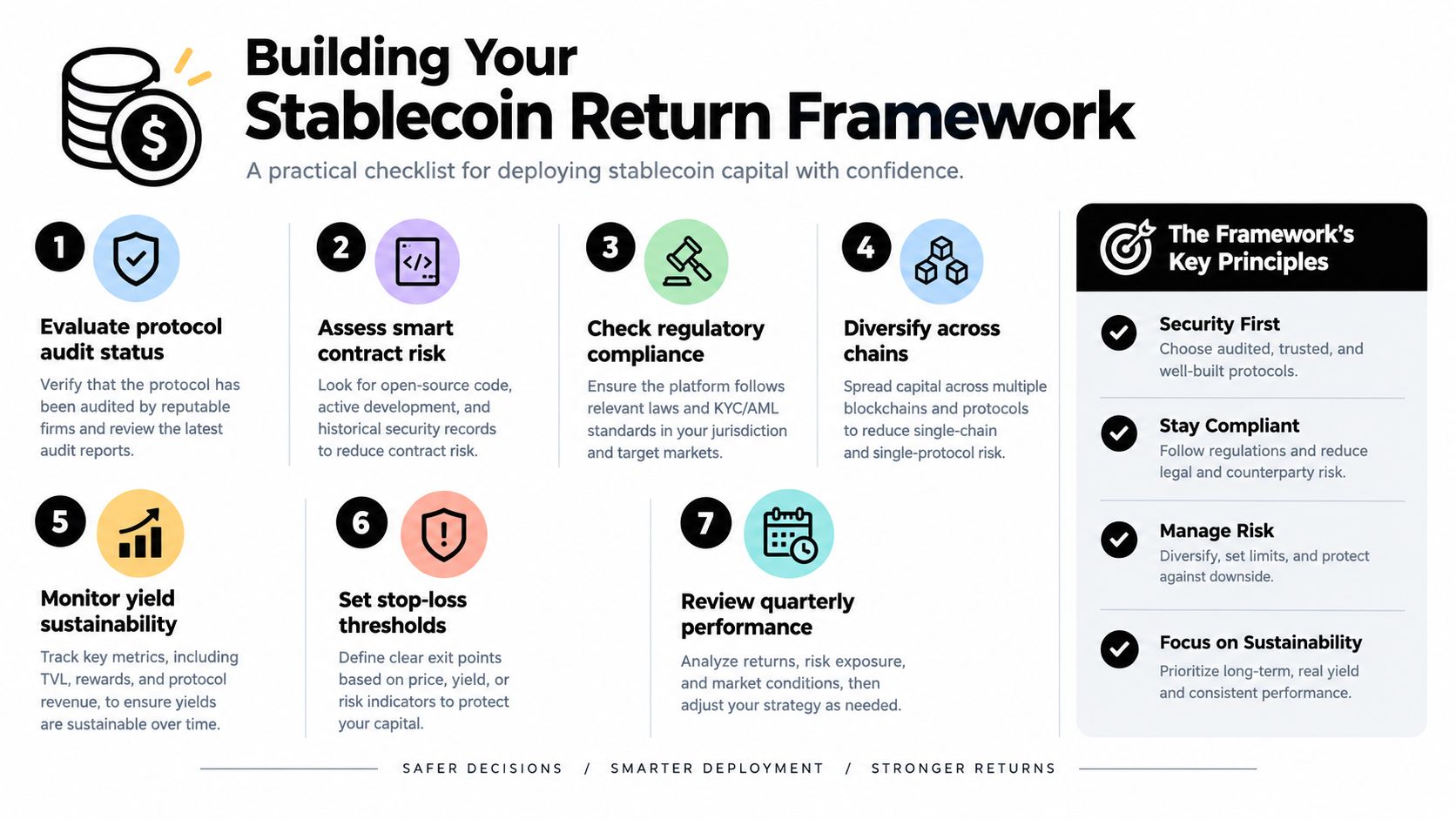
Use this sequence before funding a new strategy:
Name the payer. Is the return coming from borrowers, swap fees, protocol revenue, or token emissions?
Separate gross from net. Deduct protocol fees, gas, execution costs, and the economic cost of reward-token volatility.
Check the exit. Confirm how quickly you can withdraw, swap, bridge, or redeem the position under normal and stressed conditions.
Map every dependency. List the stablecoin issuer, protocol contracts, oracle, chain, bridge, custodian, and governance controls.
Size for failure. Allocate an amount you can afford to keep exposed while a position is reviewed, rather than treating one venue as a cash substitute.
Monitor sustainability. Watch utilization, fee revenue, incentives, liquidity, contract changes, and realized rather than advertised returns.
Set an exit rule. Decide in advance which changes trigger withdrawal, such as a depeg, a material contract upgrade, reduced liquidity, or an unattractive net spread.
The framework also helps with diversification. Spread exposure across genuinely different risk sources, not merely several interfaces pointing to the same underlying protocol. Keep liquidity for near-term needs outside experimental strategies, and use automation to monitor conditions rather than to override your constraints.
Stablecoin returns become easier to evaluate once you stop treating APY as the product. The product is a bundle of cash flows, permissions, liquidity, counterparties, and software. Your job is to decide whether the return adequately compensates you for that bundle.
Review performance on a regular schedule and compare realized income with a relevant traditional benchmark. If the spread is small, the additional DeFi risk may not be worth carrying. If the spread is meaningful, document why it exists and which assumption would invalidate the strategy.
Yield Seeker helps automate USDC yield allocation on Base by using an AI agent to monitor DeFi opportunities and manage capital without lockups. Visit Yield Seeker to explore a more structured way to pursue stablecoin returns while keeping the mechanics and risks visible.