
A lot of teams already have a stablecoin treasury. They just do not manage it like one.
The pattern is familiar. A protocol raises capital, a DAO finishes a token sale, an agency serving crypto clients gets paid in USDC, or a creator business closes a strong mint. The funds land in a wallet, everyone feels relieved, and the balance sits there. Safe enough. Liquid enough. Forgotten.
That is where value leaks.
Idle stablecoins are not neutral. They create an opportunity cost every day they sit untouched. In Web3, treasury is not only about custody and approvals. It is about keeping reserves accessible, controlling downside, and making cash productive without turning the treasury into a prop desk.
Good stablecoin treasury management looks more like running an operating system than parking cash. You need rules, tooling, review loops, and clear boundaries. You also need to decide what kind of treasury you are building. One that only survives. One that compounds. Or one that does both.
Your Treasury Is Idle Is It Working For You
A treasury wallet can look healthy and still be underperforming.
Teams typically treat stablecoins like digital checking accounts. They hold USDC in a multisig, maybe spread some balances across exchanges, and call it prudence. That protects against some obvious mistakes, but it leaves a lot of capital dormant. In a market that runs every hour of every day, a passive treasury is usually a sign that no operating model exists.

The bigger point is that stablecoins are no longer a niche settlement tool. Stablecoin trading volume and market cap have grown significantly, reaching substantial figures by recent estimates. That scale shows how integral they now are to treasury workflows, especially for teams that need always-on movement of funds across markets and time zones, as Stripe’s overview of stablecoin treasury management explains.
Idle feels safe until you need more from it
A founder typically notices the problem in one of three moments:
Runway review: Finance asks whether the treasury can offset burn without locking capital away.
Payment friction: Ops needs to pay contributors, market makers, or vendors across jurisdictions without waiting on banks.
Missed yield: Someone realizes the treasury has spent months sitting in a wallet while approved, liquid onchain venues existed the whole time.
None of those are edge cases. They are normal treasury moments.
Stablecoin treasury management matters because Web3 teams do not operate on banker hours. They need capital that can move fast, earn while idle, and remain visible to the people responsible for risk.
The right question is not custody alone
The first question should not be “where do we store the USDC?”
It should be “what portion must remain instantly spendable, what portion can work, and what controls decide the difference?” That framing turns treasury from a cold-storage habit into a capital allocation function.
A strong treasury does not chase the highest rate. It decides, in advance, which balances are operational cash and which balances are allowed to earn.
That distinction sounds simple. In practice, it is what separates disciplined teams from those making ad hoc transfers every time yields move.
Defining Treasury Objectives and Key Constraints
Many treasury mistakes start before the first deposit into a protocol. They start when the team never defines what the treasury is meant to do.
Some teams need pure resilience. Others need operating liquidity plus modest yield. A few can support a more active mandate because they have deep DeFi experience and formal oversight. Those are different jobs. They should not share the same playbook.

The treasury management triangle
I use a simple model for stablecoin treasury management. Think of it as a triangle with three competing goals:
Corner | What it means in practice | What usually hurts when you over-optimize it |
|---|---|---|
Capital preservation | Minimize loss risk and keep assets in the safest approved forms | Yield falls, and flexibility can drop if policy gets too rigid |
Liquidity | Keep funds easy to access for payroll, market operations, grants, and emergencies | Idle balances grow, and returns disappear |
Yield | Put approved balances to work in DeFi or treasury-friendly strategies | Risk, monitoring burden, and complexity increase |
You cannot maximize all three at once. Every treasury policy is a trade.
A team that says it wants maximum safety, instant access, and the highest possible return is not describing a strategy. It is describing a wish list.
Start with the liabilities, not the assets
Treasury planning works better when you map out obligations first.
Ask:
What must be paid from this treasury? Contributor comp, vendor invoices, grants, legal fees, market-making support, tax reserves.
How quickly might funds be needed? Same day, within a week, or only if a market event hits.
Who approves movements? Founder only, finance lead plus ops, or a committee with multisig thresholds.
What level of drawdown is unacceptable? For most operating treasuries, the right answer is “very little.”
That gives you a practical split between operating cash and reserve capital.
Constraints matter more than ambitions
Teams like to discuss strategy in terms of upside. Treasury should be built around constraints.
A few that matter immediately:
Human bandwidth: If no one can monitor protocol changes, avoid allocations that require active babysitting.
Technical competence: If the team cannot evaluate contract risk or bridge mechanics, keep the stack narrow.
Governance speed: If every transaction needs broad signoff, the treasury must rely more on pre-approved rules than manual reactions.
Jurisdiction and accounting requirements: Treasury activity has reporting consequences. If the finance side is immature, complexity becomes its own risk.
Treasury design should match the team that has to run it on a normal Tuesday, not the team you hope to have six months from now.
A workable objective statement
Many teams benefit from writing one short mandate that everyone can repeat.
For example:
Preserve principal for operating needs
Keep a defined liquidity buffer immediately accessible
Deploy only approved excess balances into liquid, observable yield strategies
Use automation only inside policy limits
That kind of statement makes later decisions easier. It tells you when to hold, when to allocate, and when to say no.
A Practical Risk Framework for Stablecoins
A treasury loss rarely starts as one dramatic failure. It usually starts with a false assumption. The coin will redeem at par. The protocol will stay solvent. Liquidity will still be there on a bad weekend. No one will use admin powers in a way that changes your exit path.
That is why stablecoin risk needs to be broken down by failure mode. Treasury teams need to ask three practical questions. What can fail, how quickly can it fail, and what action is possible before the problem reaches operating cash.
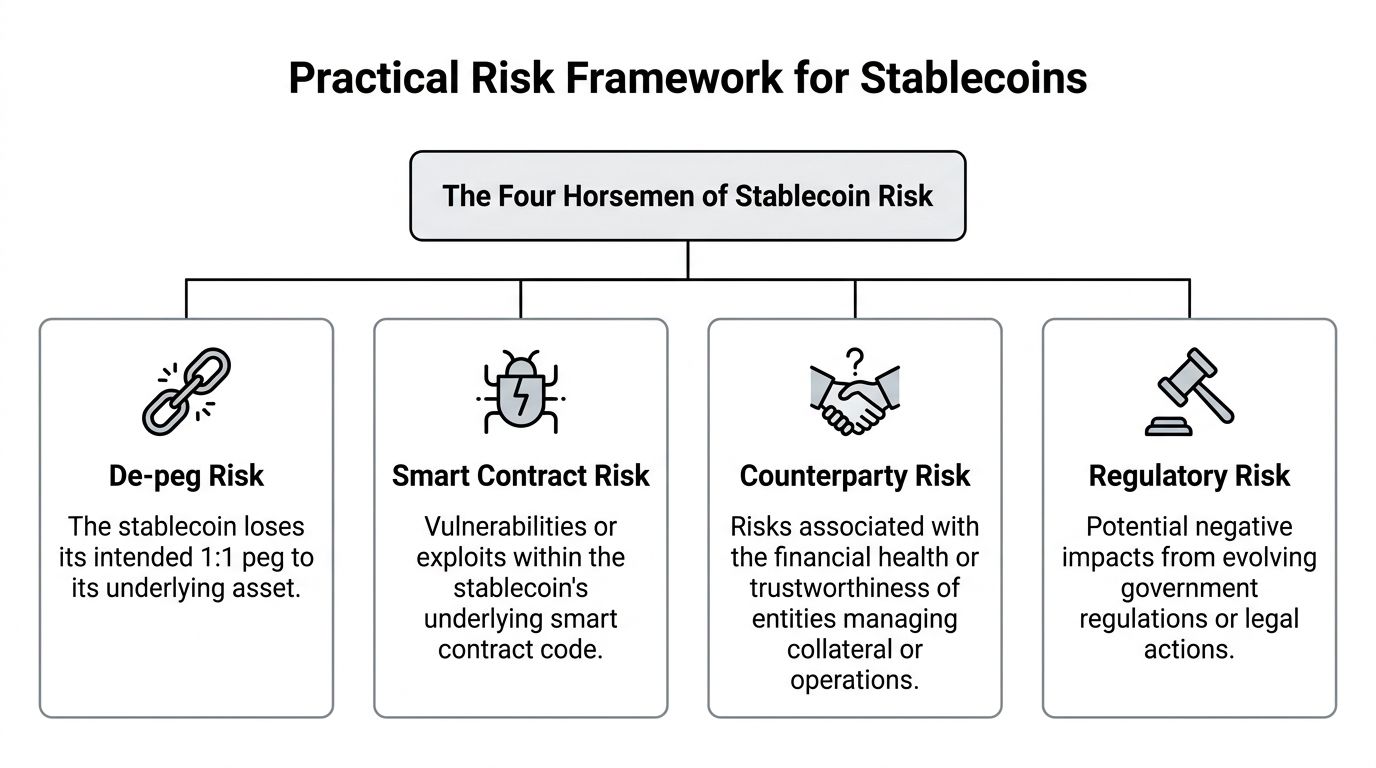
Counterparty risk
Every stablecoin wraps some form of institutional dependency. For fiat-backed assets, that means issuer governance, reserve composition, banking partners, redemption mechanics, and basic operational discipline.
The March 2023 USDC de-peg made that visible to every treasury team. A stablecoin can look liquid onchain and still depend on offchain institutions that create concentrated exposure. If the reserve structure or banking path has a weak point, the peg becomes a market referendum on that weak point.
The same logic applies inside DeFi. If a protocol relies on a small admin group, unclear treasury backing, or broad upgrade rights, the exposure is partly legal and operational, not just technical. Treasury should treat those human control points like any other counterparty exposure.
Smart contract risk
Code risk is not only about exploits. It includes upgrade mistakes, oracle failures, paused withdrawals, broken integrations, and governance actions that change the rules while funds are already deployed.
A good screening process stays narrow and repetitive. Ask the same questions every time:
Is the contract upgradeable?
Who can change logic or parameters?
Is there a timelock before changes take effect?
Can deposits or withdrawals be paused?
What external protocols, bridges, or oracles does the system depend on?
Treasury capital should sit inside a small approved surface area that the team can monitor. If no one can explain a protocol’s dependencies on one page, it is already too complex for operating funds.
For teams writing policy around exposure limits, this guide on understanding stablecoin risks is a useful reference model.
Liquidity risk
Liquidity risk is where many treasury policies fail.
An asset can be fully reserved and still be hard to exit in the moment that matters. A protocol can have healthy TVL and still force you through thin pools, delayed redemptions, or bridge routes that become unreliable under stress. What matters is not average liquidity. What matters is exit liquidity during a crowded door scenario.
Oxford researchers highlighted a core structural issue in their academic analysis of stablecoin reserve liquidity. Stablecoin activity runs nonstop, while the underlying reserve and funding markets often do not. During stress, that timing mismatch can turn a reserve asset that looks safe on paper into conditional liquidity in practice.
Treasury teams should model liquidity in layers. Can funds be used immediately onchain. Can they be redeemed directly with the issuer. Can they only be exited through secondary markets. Each layer has a different failure pattern, and automation helps here because monitoring pool depth, redemption status, and cross-chain fragmentation manually is slow work that usually breaks at the worst time.
Peg risk
Peg risk is the visible symptom of everything above.
A stablecoin can trade below par because of issuer stress, redemption bottlenecks, fragmented liquidity, market panic, or technical issues at the protocol layer. Some de-pegs recover quickly. Treasury policy still has to survive the period before recovery.
The practical question is simple. If a stablecoin trades below par for 6 hours, 24 hours, or 72 hours, are you forced to sell, post collateral, or halt operations. If the answer is yes, the problem is not only the asset. It is the treasury design around the asset.
Regulatory risk
Regulatory risk changes what a stablecoin can be used for, who can hold it, and how quickly an issuer or venue can respond to enforcement pressure.
That includes reserve rules, sanctions controls, disclosure requirements, redemption access, and jurisdiction-specific treatment by finance and accounting teams. Treasury does not need to predict every rule change. It does need a review process that updates approved assets, custody routes, and operational playbooks when legal conditions change.
Write those triggers in plain language. If redemptions are restricted, if admin powers expand, or if a stablecoin loses support from a key venue, who decides, what gets paused, and which balances must be rotated first.
A usable four-part screen
Before funds leave the treasury wallet, run this screen:
Risk area | What to inspect | What should make you pause |
|---|---|---|
Counterparty | Issuer reserves, governance, custody model, redemption path | Opaque reserve reporting, concentrated banking exposure, unclear operational controls |
Contract | Audits, upgradeability, admin roles, dependencies | Fast upgrade powers, hidden dependencies, weak emergency procedures |
Liquidity | Exit routes, venue depth, chain-specific liquidity, unwind process | Thin routes, long redemption path, bridge dependence during stress |
Peg | Historical behavior under pressure, market confidence, arbitrage incentives | Repeated instability, fragmented liquidity, weak redemption trust |
The goal is not to find a perfect stablecoin. The goal is to approve structures your team can understand, monitor, and unwind under pressure. That is also where automation starts to matter. A written policy is only useful if balances, protocol settings, and market conditions are checked continuously rather than after the risk event.
Developing Your Allocation Strategy
Once the mandate and risk screen are clear, allocation becomes much easier. The job is not to find one magical protocol. The job is to split capital by purpose.
That is where many treasury guides stop too early. They explain wallets, payments, and custody, but ignore the part that improves capital efficiency. Existing treasury guidance often ignores automated yield generation. Meanwhile, DeFi TVL for stablecoins surged to over $150B in 2025, yet corporate adoption lags because teams have to manage fragmented protocols manually, as discussed in PwC’s stablecoin guidance for treasurers.
Three Common Operating Models
Use these as templates, not as fixed recipes. The percentages below are directional because treasury policy should reflect your own liabilities, approvals, and technical ability.
Model | Risk Profile | Target Blended APY | Primary Assets | Example Protocols / Tools |
|---|---|---|---|---|
Bedrock | Conservative | Low but steady | Majority in top-tier fiat-backed stablecoins held in multisig custody, small approved yield sleeve | Gnosis Safe, direct wallet custody, Aave |
Core satellite | Balanced | Moderate | Core operational balance in reserve wallets, smaller slices across a few approved venues | Gnosis Safe, Aave, Compound, monitored swaps across approved chains |
Yield optimized | Higher but controlled | Higher, variable | Smaller immediate-cash bucket, larger actively managed sleeve across approved protocols and chains | Safe plus alerting, routing tools, policy-based automation |
The exact APY target should come from your own investment policy. Do not pick a number first and force the strategy to chase it.
Bedrock model
This works for teams that treat treasury as operating cash first.
Hold the majority in a small set of approved stablecoins. Keep it in a multisig with clear signer rules. Use only a modest sleeve for yield, and only in venues your team can explain line by line. If contributor payroll, vendor settlements, or legal obligations depend on the wallet, simplicity wins.
This model also fits DAOs where governance is slow. Fewer moving parts means fewer emergency votes.
Core satellite model
This is the model many mature Web3 teams should start with.
The core portion handles runway and near-term obligations. The satellite portion goes into a small basket of liquid strategies that remain easy to unwind. The point is not broad diversification for its own sake. It is controlled diversification across exposure types.
For example, one sleeve might be a lending market, another might be a conservative yield-bearing position, and another might remain chain-local for fast operations. If you use this model, protocol concentration limits matter. So does chain concentration. A diversified treasury can still fail if every position depends on the same infrastructure path. A useful planning reference is this post on protocol diversification.
Yield optimized model
This is for teams with stronger process discipline.
A larger share of capital is deployed, but only with firm constraints. The treasury should maintain pre-approved exit routes, automated alerts, and rebalancing rules. Human oversight still matters. The difference is that approved capital works harder and the movement between opportunities happens through policy, not impulse.
Here, automation starts to make sense. Yield Seeker is one example of a tool that uses an AI agent to monitor and allocate USDC across DeFi protocols in real time on Base within a more hands-off workflow. That is useful when the team wants active management without assigning someone to watch dashboards all day.
The right allocation model is the one your team can maintain under stress. If a strategy only works when everyone is calm and online, it is not treasury grade.
Two practical rules
Separate operating cash from deployable cash: Never make one wallet do both jobs without a clear ledger and policy boundary.
Write exit logic before entry logic: Treasury teams should know when a position gets reduced long before they debate when to add more.
A stablecoin treasury should not be fully idle. It also should not behave like a yield farm with payroll attached.
Implementing Your Operational Workflow
A good allocation plan still fails if the daily workflow is sloppy.
Many treasury losses do not come from elegant thesis mistakes. They come from rushed approvals, unclear ownership, stale allowlists, signer confusion, and no one knowing whether a position drifted outside policy. Stablecoin treasury management becomes durable when the process is boring, repeatable, and documented.
Onboard assets and protocols with a written gate
No protocol should enter treasury operations because a contributor dropped it in Telegram.
Create an approval checklist that includes:
Asset review: Issuer type, redemption model, chain support, known dependencies.
Protocol review: Core function, upgrade model, admin powers, audit history, shutdown paths.
Operational review: Wallet compatibility, accounting treatment, internal reporting impact.
Exit review: How fast can the team unwind under normal and stressed conditions?
The output should be simple. Approved, approved with limits, or rejected.
Tighten access controls early
Multisig is not enough by itself. Teams need role clarity.
A practical setup typically separates people who propose transactions from people who approve them, and separates treasury operations from engineering admin rights. If one signer can both initiate and authorize a meaningful movement of treasury funds, the control is weaker than it looks.
Use role-based access, whitelists, and transaction templates whenever possible. Stablecoin treasury work improves when routine actions become constrained by design.
Use threshold-based rebalancing
Calendar-only rebalancing is too slow for some treasuries and too noisy for others.
A better operating model combines a regular review cadence with threshold triggers. If an allocation drifts outside policy, if a yield spread changes enough to matter, or if liquidity conditions shift, the treasury rebalances. If nothing material changes, the team does less.
This mirrors how top stablecoin issuers handle liquidity across chains. Automated burn-and-mint functions via interoperability protocols can cut rebalancing times from over 24 hours to under 5 minutes, reducing chain-specific peg deviation risks by up to 70%, as outlined in Axelar’s discussion of stablecoin treasury management across chains.
Corporate and DAO treasuries do not need issuer-scale infrastructure, but they should copy the principle. Rebalancing should be policy-driven, not manually improvised.
Keep reporting simple and decision-focused
Treasury reports frequently fail because they contain balances but not meaning.
A useful report answers four questions:
Question | What to track |
|---|---|
What do we hold | Asset balances, chain location, protocol exposure |
Why do we hold it | Operating reserve, yield sleeve, strategic buffer |
Is it within policy | Allocation limits, signer compliance, approved venue status |
What changed | Net yield earned, material risk events, rebalances executed |
Reporting should help a signer say yes or no quickly. If the document cannot support a decision, it is not a treasury report. It is an archive.
A workable weekly cadence
Some teams benefit from a lightweight weekly loop:
Review balances by wallet and chain.
Check policy drift.
Review protocol alerts and governance changes.
Compare actual yield against expected range.
Queue rebalances if triggers were hit.
Record decisions and exceptions.
That cadence is mundane. It is supposed to be. Good treasury operations feel less like trading and more like disciplined maintenance.
The Modern Treasury Tech Stack
Manual treasury management breaks at the point where the team has too many wallets, too many approved venues, and too many small decisions competing for attention.
That is why the modern stack matters. Not because more software is necessarily better, but because treasury needs a system that can see changes fast, surface what matters, and reduce the number of manual decisions humans make under pressure.
Monitoring should go beyond wallet balance
Many teams start by tracking balances. That is not enough.
A treasury stack should also track:
Blended yield by sleeve: Not just total earnings, but where they come from.
Exposure by protocol and chain: This tells you whether your diversification is real.
Peg behavior: Small deviations matter when policy requires same-day liquidity.
Cash readiness: Which balances are immediately spendable versus deployed.
If your dashboard cannot answer those questions without opening several tabs, the tooling is too fragmented.
Alerts are part of risk control
A strong treasury stack watches for events that require human review before they become losses.
Useful alert categories include:
Alert type | Why it matters |
|---|---|
Contract upgrade alert | Treasury may be exposed to new code without policy review |
Admin action alert | Pause functions, parameter changes, or governance interventions can alter exit risk |
Large fund movement alert | Sudden outflows or inflows can signal stress, incentives, or strategy shifts |
APY change alert | Yield compression or spikes can indicate changing utilization or hidden risk |
Peg deviation alert | Treasury may need to reduce exposure or switch liquidity routes |
Tools such as Tenderly and OpenZeppelin Defender are useful for event monitoring and operational alerting. Even a conservative treasury benefits from being notified before a signer finds out through Crypto Twitter.
Automation: The Efficiency Layer
In this area, stablecoin treasury management starts to look modern instead of manual.
The best use of automation is not blind optimization. It is constrained execution inside approved limits. A treasury defines the venues, assets, exposure caps, and alert thresholds. The system handles the monitor-decide-act loop within those boundaries.
That changes the operating model in three ways:
Fewer decisions happen reactively.
Rebalances follow policy, not memory.
Teams spend more time reviewing exceptions and less time watching dashboards.
For teams evaluating tooling, institutional-grade DeFi tools are worth studying through this lens. The question is not whether a platform has many features. The question is whether it reduces operational drag while preserving control and auditability.
The right automation removes repetitive judgment calls. It does not remove governance.
A Practical Tech Stack
A treasury stack does not need to be exotic.
A strong baseline typically includes:
Multisig custody: Gnosis Safe or similar
Portfolio visibility: A dashboard that groups balances by wallet, chain, and protocol
Alerting layer: Tenderly, OpenZeppelin Defender, or similar event-based systems
Policy documentation: Internal wiki, approval matrix, and emergency contacts
Execution layer: Manual routing for conservative setups, policy-based automation for active ones
A true upgrade is not any single tool; it is getting all of them to support one operating model.
Essential Governance and Compliance Checklist
A treasury incident rarely starts with a bad yield decision. It starts with a missing approval path, an unclear wallet owner, or a finance team that finds out after funds have already moved.
That is why governance is part of yield generation, not a separate admin layer. If a team wants stablecoins to be productive assets, it needs rules that let capital move quickly inside defined limits and stop moving when a risk threshold is hit.
Governance starts with written policy
A treasury policy should answer three practical questions. Who is allowed to act. What limits apply. What happens when an approved position stops being safe.
Stablecoins make this harder because the risk sits in multiple places at once. The token can hold its peg while the issuer faces stress. The protocol can keep operating while liquidity gets thin. The transaction can settle onchain while accounting still lacks the records to classify it correctly. Good policy closes those gaps before money is deployed.
Earlier in the article, we covered how issuer-level stress can hit stablecoin holders fast. The lesson for governance is simple. If the policy does not specify what happens during an issuer scare, a de-peg, or a protocol exploit, the treasury is relying on improvisation.
Sample treasury policy checklist
Use this as a working template, then adapt it with legal, finance, and security input.
Approved assets
List approved stablecoins: Specify issuers, token contracts, and chains.
Define prohibited assets: Exclude wrappers, synthetics, bridged variants, or newly launched assets outside mandate.
Document issuer review criteria: Reserve disclosures, redemption mechanics, legal entity review, jurisdiction, and operational history.
Allocation controls
Assign wallet purposes: Separate operating cash, reserve capital, and yield deployment wallets.
Set concentration caps: Define maximum exposure per issuer, protocol, chain, and strategy type.
Require approval for new venues: No deployment to a new protocol until review is documented and signed off.
Access and execution
Use multisig approvals: Treasury transfers should require multiple reviewers.
Maintain signer records: Track signer identity, role, device policy, and any changes in authority.
Whitelist routine addresses: Reduce transfer risk on recurring movements between approved wallets and counterparties.
Risk response
Define de-peg actions: Set review triggers, escalation owners, and approved reduction paths.
Define protocol incident actions: Pause new deposits, review current exposure, and confirm exit routes.
Define issuer event actions: Review reserve updates, redemption options, banking exposure, and concentration limits.
Reporting and records
Track basis and yield events: Finance needs transaction-level records for accounting and tax treatment.
Archive approvals and exceptions: Keep signer evidence, policy exceptions, and incident decisions.
Review policy on a set cadence: Update limits and approved venues as the market and business needs change.
Keep accounting and tax in the operating loop
Teams often treat finance as the group that reconciles treasury activity after the fact. That creates avoidable mess.
Onchain yield produces a stream of deposits, redemptions, rewards, swaps, and bridge movements that may be operationally sensible but hard to classify later if records are incomplete. A treasury can look efficient onchain and still create month-end pain if wallet labels, transaction memos, and approval logs are inconsistent.
The fix is procedural. Every wallet should have a defined purpose. Every strategy should map to an internal accounting treatment. Every automated action should leave an audit trail that finance can review without reverse engineering a block explorer.
Build emergency procedures before you need them
Emergency playbooks should be short enough to use under pressure.
Document the trigger. Name the reviewers. Name the approvers. Specify which wallets get reduced first. Specify how leadership is notified. If redemptions are part of the response, state who owns that operational step and what fallback path exists if normal routing fails. Automation demonstrates its value in governance in such situations. The goal is not to automate judgment. The goal is to automate the first safe response.
A professional treasury does not need to predict every failure mode. It needs clear authority, clean records, and an operating model that keeps stablecoins productive without leaving control to chance.
If your team wants active stablecoin treasury management without manually monitoring fragmented DeFi venues all day, Yield Seeker offers an AI-powered workflow for allocating USDC on Base across approved yield opportunities while keeping funds accessible. It fits teams and individuals who want a more automated way to keep stablecoins productive without building the full monitoring and rebalancing stack from scratch.