
A widely cited 2026 benchmark found that 67% of well-formulated strategies fail because of poor execution, while only 12% of companies fully deliver on the ambitions they set. Executives also estimate that about 40% of strategy value is lost through execution breakdowns (Perdoo's strategy execution benchmark). For a stablecoin holder, that gap isn't abstract. It looks like choosing a sensible yield plan, then leaving funds in the wrong pool because monitoring, rebalancing, and risk checks never happen.
In DeFi, strategy decides what your capital should pursue. Execution determines whether that decision survives changing rates, protocol conditions, liquidity, and your own need for access. The most useful way to think about strategy vs execution isn't as planning versus action, but as a continuous feedback loop that turns intent into monitored, reversible decisions.
Why Strategy vs Execution Matters for Yield Seekers
A stablecoin holder named Maya has a familiar plan. She wants to keep her principal in stablecoins, avoid long lockups, and earn yield without spending every evening comparing protocols. She identifies a few lending markets, checks the stated APYs, and decides to allocate gradually. The plan is reasonable.
A week later, nothing has moved. One opportunity has changed, another requires a bridge and token approval, and a third has become less attractive after its incentives shifted. Maya still has a strategy, but she hasn't executed it. Her capital remains idle or sits in an allocation that no longer matches her original risk and liquidity preferences.
That distinction matters because yield is captured through repeated operational decisions, not through a one-time forecast. A strategy can specify stablecoin exposure, acceptable protocol risk, preferred chain, liquidity requirements, and a reallocation rule. Execution must then handle wallet interactions, transaction routing, position checks, monitoring, and movement of funds when conditions change.
The cost of a plan that never runs
The failure isn't always dramatic. A user may miss a better risk-adjusted opportunity, fail to notice a deteriorating position, or postpone a rebalance until the original assumptions no longer apply. In each case, the problem is less about finding an intelligent thesis and more about maintaining disciplined follow-through.
For beginners, this creates friction at every step. For experienced users, it creates operational drag across dashboards, wallets, bridges, approvals, and spreadsheets. Busy professionals and treasury managers face a different constraint: they may understand the opportunity but can't provide constant attention.
Practical rule: A yield strategy isn't complete until it defines what happens when market conditions, risk signals, or liquidity needs change.
Investors evaluating broader approaches can also benefit from exploring investment models, especially when comparing passive allocation, active management, and rules-based systems. In DeFi, that comparison should include not only expected return, but also the time and operational burden required to keep the plan current.
From static allocation to monitored allocation
Real-time visibility changes the operating model. Instead of asking only where funds should go, the investor asks what signals should trigger review, who or what will act on them, and how quickly capital can be moved. The practical value of real-time monitoring for yield strategies lies in closing that loop before a stale allocation becomes an unnoticed risk.
Yield Seeker is designed around that problem. Its AI Agent can monitor opportunities and handle allocation activity, while the user retains visibility into balances, earnings, and access to funds. The broader lesson applies even if you use another tool: strategy creates direction, execution preserves alignment.
Understanding Strategy and Execution in Investing and DeFi
Strategy is the high-level decision framework behind an investment. It answers questions such as:
What is the purpose of the capital?
Which assets are acceptable?
How much volatility or smart contract risk is tolerable?
How important are liquidity and simplicity?
What conditions justify reallocating funds?
For a stablecoin holder, a strategy might be: keep exposure in major stablecoins, use liquid lending markets, avoid lockups, diversify protocol exposure, and review allocations when yield or risk changes materially. The strategy doesn't need to predict every market move. It needs to define the boundaries within which decisions can be made.
Execution is the sequence of actions that turns those boundaries into a live position. On Base, that may involve connecting a wallet, bridging funds, approving a token, supplying USDC to a protocol, checking the resulting position, and later withdrawing or reallocating capital. Each action introduces operational considerations, including gas, transaction status, contract permissions, liquidity, and the possibility of user error.

What and why versus how and when
A useful mental model separates four questions:
What should happen? The strategy defines the target allocation or decision rule.
Why should it happen? The strategy explains the objective, risk tolerance, and trade-offs.
How does it happen? Execution determines the on-chain transaction path.
When should it happen? Execution responds to monitoring signals, portfolio drift, and user needs.
Confusion appears when investors treat a strategy document as if it were an operating system. A written allocation doesn't approve tokens, route transactions, detect a changed rate, or move capital. Conversely, automated actions without a clear strategy can optimize a narrow metric while violating the user's actual preferences.
The distinction becomes clearer through the idea of an optimal strategy for yield. An optimal approach isn't the one showing the highest advertised rate. It must account for risk, liquidity, costs, concentration, and the reliability of the process that keeps the allocation aligned.
Why both must evolve
DeFi conditions move faster than most manual review habits. A strategy therefore needs explicit feedback inputs, while execution needs permission to pause, escalate, or reallocate within defined limits. The strongest systems don't separate planning from action completely. They connect user intent to controlled automation, with enough transparency for the user to understand what the system is doing.
Strategy vs Execution Compared Across Key Criteria
Strategy and execution fail in different ways, so diagnosis starts with the right question. If the target allocation makes no sense for the investor, better automation won't fix the problem. If the target is sensible but nobody monitors or maintains it, rewriting the strategy may only disguise an operational failure.
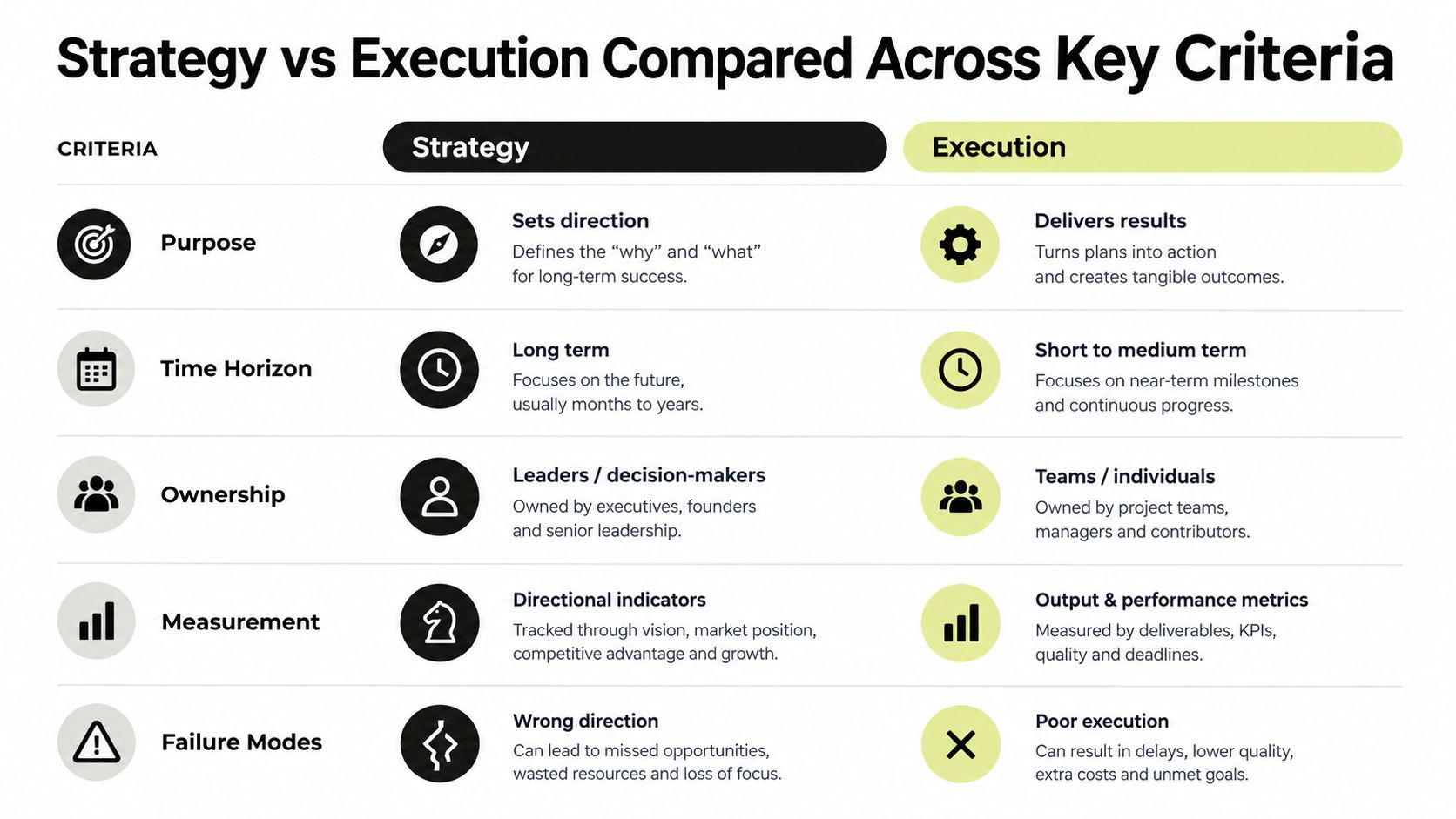
Side-by-side comparison
Criteria | Strategy | Execution |
|---|---|---|
Purpose | Sets direction by defining goals, constraints, and allocation logic | Delivers the intended result through concrete actions |
Time horizon | Usually considers a broader horizon and planned review points | Operates continuously as conditions and signals change |
Ownership | Belongs to the investor or decision-maker who sets priorities | Belongs to the person, system, or agent responsible for acting |
Measurement | Tests whether the chosen approach fits the objective and risk profile | Tests whether actions occurred correctly and produced the intended outcome |
Failure modes | Poor assumptions, unsuitable risk limits, unclear priorities, or excessive complexity | Missed transactions, stale positions, weak monitoring, unresolved drift, or operational error |
The time distinction deserves attention. Strategy shouldn't become a one-time annual statement, but it usually changes more deliberately than individual allocations. Execution runs at a faster cadence because rates, liquidity, and protocol conditions can change while the investor's broad objective remains stable.
The same yield problem can have two causes
Suppose a portfolio earns less than expected. A strategy issue may be that the investor selected a pool based on headline APY without considering smart contract exposure or liquidity. An execution issue may be that the portfolio stayed in that pool after its conditions changed, even though the user's rules called for review.
The remedy depends on the diagnosis. Strategy refinement changes the decision rules. Execution automation improves monitoring, routing, rebalancing, and follow-through. Tools that focus on risk-adjusted APY help investors evaluate whether an apparent yield opportunity makes sense after considering the risk taken to pursue it.
The key distinction: Strategy chooses the conditions for action. Execution makes sure those conditions are observed and acted on.
This framework also clarifies accountability. A human may own the objective and limits, while an automated system handles repetitive actions within those limits. That division can reduce workload without pretending that automation removes the need for judgment.
Why Great Strategies Fail in Practice
A strategy can be sound and still produce weak results. In stablecoin yield, execution fails when the operating system around the strategy loses visibility, ownership, or a clear way to resolve exceptions.
A strategic-planning dataset covering more than 20,000 plans built between 2017 and 2024 found that 84.5% of strategic projects never reached completion, while only 12.5% were completed (ClearPoint's strategic planning analysis). The same analysis found that the median number of milestones rose from 15 in 2017 to 17 in 2024, while the average nearly doubled from 32.87 to 56.11.
For DeFi, that average matters operationally. A plan with 56.11 milestones is not just more ambitious. It may require more approvals, wallet actions, bridge checks, rate reviews, and records of completed transactions. Each dependency increases the chance that a yield decision remains unfinished or becomes outdated before the next step occurs.
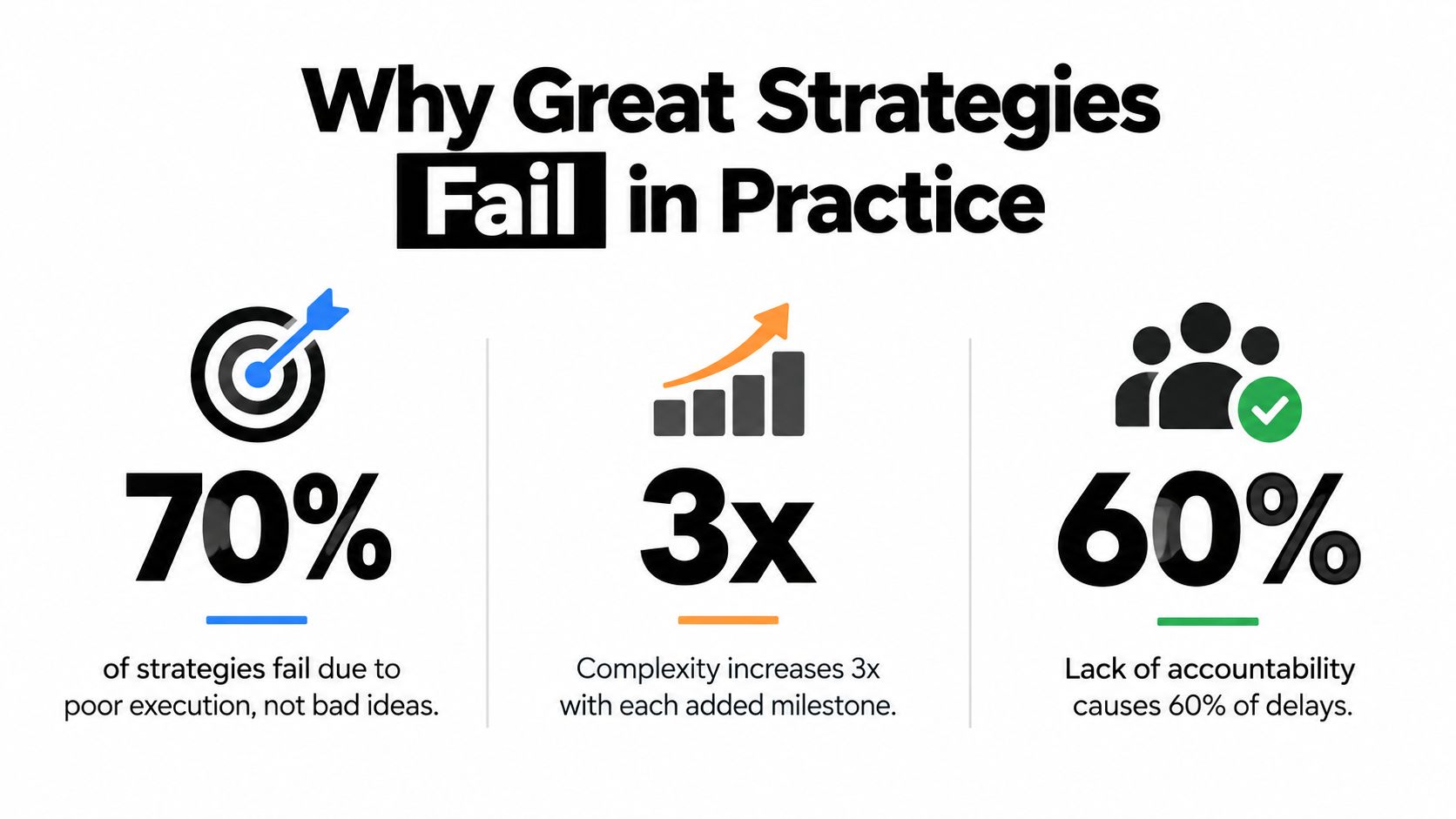
The figures in that visual do not match the verified benchmark above. The defensible conclusion is narrower: execution becomes harder as plans accumulate dependencies and milestones. In DeFi, a manual workflow can stall at any protocol, chain, approval, bridge, or monitoring step.
Complexity creates silent failure
A stablecoin allocation may start with a clear thesis, then collect operational baggage. The user checks rates in one dashboard, wallet balances in another, protocol risk in a third, and transaction history elsewhere. No single view confirms whether the live portfolio still matches the intended rules.
Small failures then become difficult to resolve. A missed rebalance may not appear urgent. A transaction may remain pending. A pool may continue displaying an attractive rate after its liquidity or risk conditions change. By the time the user notices, the original allocation decision is only part of the explanation.
The practical fix is shared visibility. A monitoring layer should show current exposure, yield, liquidity, protocol status, pending actions, and rule drift in one place. Drift alerts then turn a hidden mismatch into a defined task, rather than leaving the holder to discover it during a later portfolio review.
Drift needs a resolution path
Monitoring alone does not complete execution. An alert that nobody reviews is another unclosed task. The workflow needs a defined path from signal to decision, approved action, confirmation, and escalation.
A 2026 benchmark of strategy and operations leaders found that 83% reported receiving no automatic signal when a priority drifted, while 60% of failing priorities were never cleanly resolved (OKR's strategy execution benchmark). The findings describe a familiar DeFi failure mode: users may detect a problem late, or lack a safe action once they detect it.
For a yield portfolio, closed-loop execution means the system identifies drift, compares it with the holder's rules, performs an approved action, and records the result. If the condition falls outside those rules, it should surface the decision for review instead of improvising on-chain.
Building a Feedback Loop That Keeps Strategy and Execution Aligned
A durable yield process treats strategy as a live set of rules. On-chain execution then tests those rules against changing yields, liquidity, protocol conditions, and personal cash needs. The result should feed the next decision, so a portfolio does not keep following assumptions that no longer hold.
Recent benchmark research found that 90% of organizations struggle to adapt to rapid market changes, while 95% say strategic agility is essential. Only 51% effectively feed lessons from execution back into strategy development, and organizations have realized about 60% of their strategic objectives over the past two years (Quantive's Global State of Strategy research).
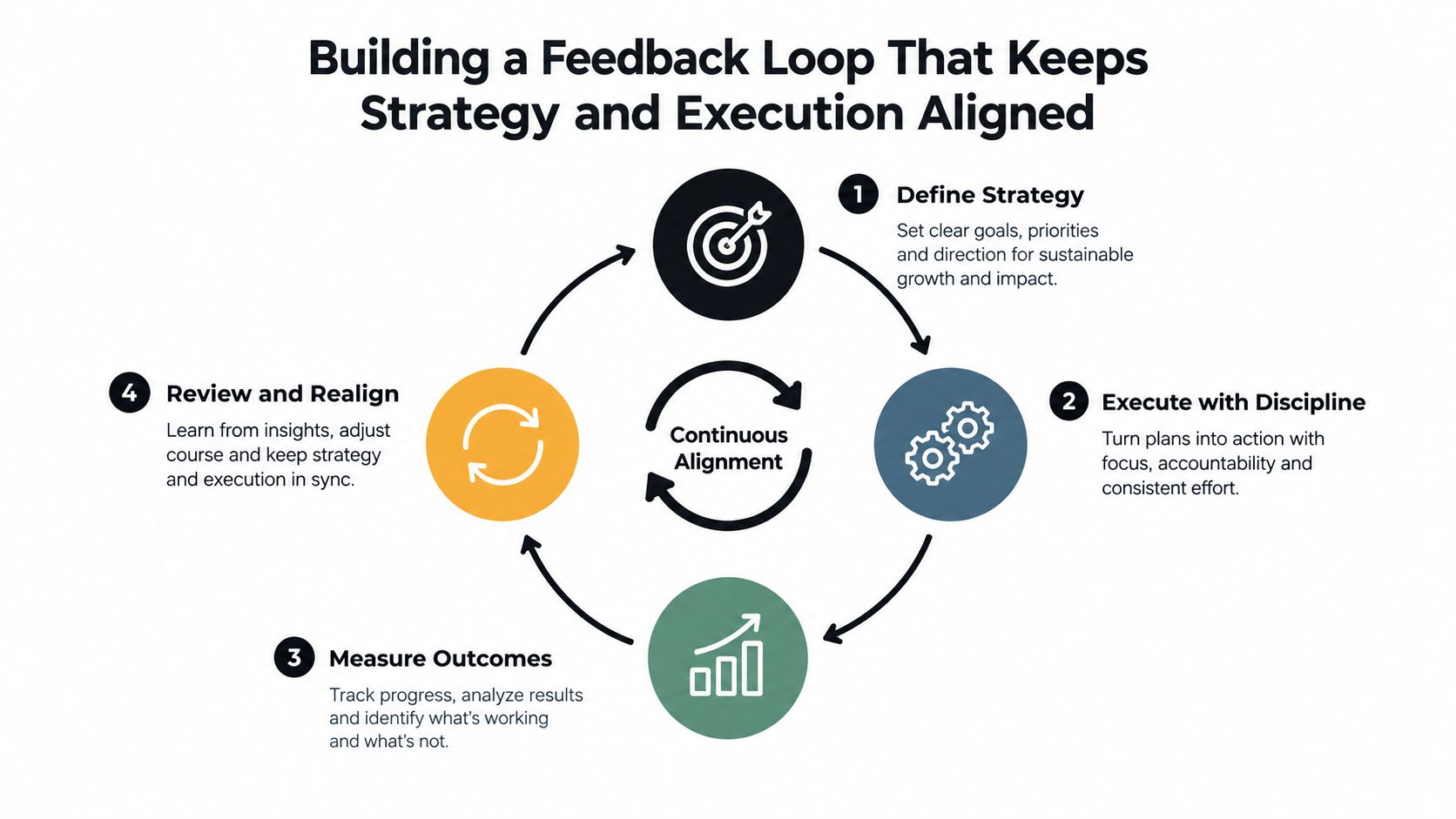
Define strategy as operating constraints
Write a short set of rules before allocating capital. A stablecoin holder might specify accepted assets, minimum liquidity, preferred protocols, concentration limits, and conditions that trigger a pause or review. Each rule should be precise enough for an operator or automated agent to apply without guessing.
A single headline yield cannot define the strategy. Higher displayed returns may carry more contract, liquidity, or incentive risk. A usable plan balances the return target with access requirements, acceptable complexity, and the holder's ability to review exceptions.
Execute with controlled automation
Execution needs clear boundaries. The system should know which transactions it may submit, which routes it may use, what data must be checked first, and when a human must approve the next step. Monitoring, drift alerts, and visible transaction status make those boundaries practical rather than theoretical.
Yield Seeker's AI Agent illustrates this approach. It monitors yield opportunities, allocates and reallocates capital across DeFi protocols, and is designed to keep funds accessible instead of placing them in lockups. The useful feature is the link between stated preferences, live signals, and permitted actions. Automation can handle routine changes, while unusual contract events or rule conflicts remain subject to review.
Measure outcomes, not activity
A portfolio dashboard should show more than a completed transaction. It should make clear whether the allocation still matches the intended risk profile, whether capital remains available, and whether the resulting yield justifies the added operational and smart contract exposure.
Data visibility remains a practical constraint. A 2026 strategy report found that 74% of leaders couldn't access the data needed for strategic decisions, 81% said departments pulled in different directions, and 77% lacked effective and consistent strategy reporting (Cascade's State of Strategy Report 2026). Stablecoin holders face a similar problem when balances, net yield, liquidity, protocol health, and exposure limits sit across separate tools. Without a current view, a strategy can drift while every individual transaction appears reasonable.
Review and realign
The loop closes when monitoring changes a decision, and that decision changes an allocation or rule. Review whether liquidity needs have changed, whether the protocol still fits the risk limits, and whether a new opportunity warrants additional contract exposure. Execution data informs those judgments. It does not replace them.
A feedback loop is complete only when monitoring changes a decision, and the decision changes the allocation or the rule.
Real World Use Cases for Different Investor Types
A DeFi beginner usually needs help with execution before optimization. The strategy may be simple, such as keeping funds in liquid stablecoin markets and avoiding unfamiliar transaction paths. A guided interface, clear transaction explanations, and visible balances can remove enough friction for the user to act without turning every step into a research project.
A time-constrained professional faces the opposite problem. They may understand allocation logic but can't monitor fragmented opportunities throughout the day. For them, the priority is a defined strategy paired with automated observation, drift detection, and a clear way to intervene when conditions fall outside the rules.
Experienced users
An experienced crypto user may already have preferred protocols, chains, and risk filters. Their bottleneck is often repetitive maintenance. They can use automation to monitor positions, compare opportunities, and handle routine reallocations, while reserving manual judgment for unusual contract events, governance changes, or major changes in market structure.
That user shouldn't automate everything blindly. The strategy must specify what the system can do independently and what requires confirmation. Automation is valuable when it reduces repeated work without hiding the assumptions behind each action.
Treasury managers
A Web3 team or creator managing stablecoin reserves has a more constrained mandate. The treasury may need liquidity for payroll, grants, operating expenses, or user withdrawals, so yield cannot be evaluated separately from access and reporting.
The right execution setup should make ownership visible. Team members need to know which funds are allocated, what conditions trigger movement, and how to verify that transactions match the treasury policy. A conservative strategy with reliable monitoring can be more useful than a complex rotation that requires constant manual oversight.
Across these cases, success means different things. For a beginner, it may mean completing the first allocation safely. For a professional, it may mean reducing monitoring burden. For an experienced user, it may mean automating routine rotations. For a treasury, it may mean preserving control and liquidity while making the policy easier to follow.
How to Balance Strategy and Execution for Smarter Yield
Begin with the wallet, not another dashboard. Compare the live position with the rules you intended to follow. Write down the stablecoin objective, acceptable risks, liquidity needs, and conditions that justify a move. This turns strategy into something you can test against on-chain reality.
Ask five practical questions:
Goal: Does the allocation serve a defined purpose, or is it following the most visible rate?
Risk: Are protocol, asset, chain, and concentration limits explicit?
Liquidity: Can you access the funds without relying on an optimistic exit assumption?
Visibility: Can you review balances, earnings, allocation changes, and relevant signals in one reliable view?
Resolution: When a position drifts, does a person or an automated system have authority to act?
The answers show where to focus. Refine the strategy when the objective is unclear, risk tolerance has changed, or the portfolio contains exposures you cannot explain. Improve execution when the rules are sound but monitoring, transaction handling, or rebalancing keeps falling behind.
The same Cascade research noted that only 27% of leaders said all teams understood priorities and how they contributed (Cascade's State of Strategy Report 2026). For a stablecoin holder, the equivalent failure is a gap between the intended allocation and the balances, positions, and risks visible in the wallet. Data visibility matters because it lets execution correct drift instead of hiding it.
Use a feedback loop with clear boundaries. Record the target allocation, set alerts for material changes, review the reason for each alert, and define which actions can run automatically. Pause or withdraw when market conditions, liquidity needs, or personal circumstances change. The process should produce new information for the next strategy decision, not just execute the original plan indefinitely.
A Yield Seeker user can start with as little as $10 USDC on Base to test that workflow before committing more capital. Its AI Agent monitors and reallocates across DeFi opportunities while keeping funds accessible.
The right balance is a continuous loop: set the purpose and limits, observe live data, detect drift, act within authorization, and revise the rules when evidence changes.
Yield Seeker connects stablecoin strategy with automated execution by monitoring DeFi opportunities, routing transactions, and rebalancing capital within an accessible portfolio. Visit Yield Seeker to create an account and explore the Base workflow.