

You're reviewing cash across bank portals, ERP exports, payment providers, and perhaps a few crypto wallets. The balances rarely line up at the same moment. A payment is waiting for approval, a forecast still lives in a spreadsheet, and someone has to explain why the ledger doesn't match the bank statement.
That workflow is exactly why treasury management software matters. The useful systems don't just store balances or produce another reporting dashboard. They connect fragmented financial activity, apply controls to money movement, and help treasury teams decide where cash should sit, when it should move, and how confidently they can act. The same operating logic now applies to corporate cash, stablecoins, decentralized finance, and automated yield strategies.
What Treasury Management Software Actually Does
At 9:00 a.m., a treasury operator might need to answer a deceptively simple question: how much cash is available, where is it held, and what can be moved today? The answer may depend on several bank accounts, pending wires, accounts receivable, accounts payable, foreign exchange exposure, and funds held by entities with different approval rules. For a Web3 treasury, the same question extends to wallet balances, stablecoins, protocol positions, bridge activity, and pending blockchain transactions.
A useful treasury system acts as the orchestration layer between those sources. It pulls balances, transaction data, AR and AP information, and market rates through APIs or secure file transfer. It then turns those inputs into cash positions, forecasts, reconciliation records, approval queues, and accounting outputs instead of leaving the operator to assemble them manually. This operating model is described in more detail by this overview of treasury management systems.
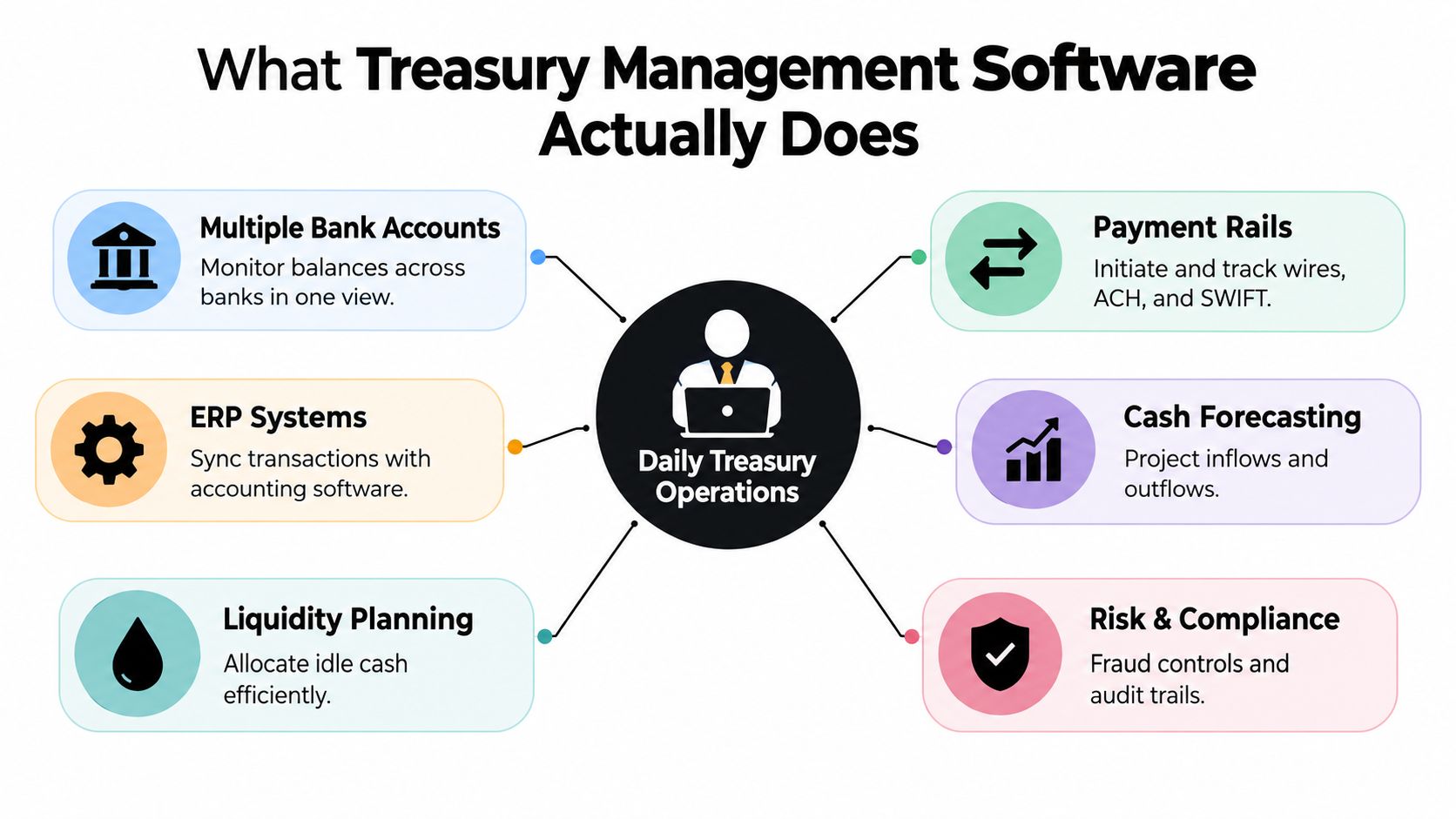
From recordkeeping to coordinated execution
The distinction matters because a ledger tells you what happened. Treasury software should also help you understand what is happening now and what needs to happen next. It can consolidate balances across banks, map transactions to entities, refresh a liquidity forecast, route a payment for approval, and prepare a journal entry under defined controls.
This shift has moved treasury systems closer to core financial infrastructure. PwC's 2025 Global Treasury Survey found that 94% of respondents operated a dedicated treasury management system, with adoption especially high among very large organizations. The survey also identified Kyriba, SAP Treasury, and FIS Quantum among leading platforms, as reported in the market summary of the survey findings.
That doesn't mean every organization needs a large enterprise platform. A company with a small number of accounts may need dependable balance aggregation, payment approval, and reconciliation without a complex implementation. A multinational may need entity-level forecasting, bank connectivity, intercompany funding, risk management, and audit-ready reporting. A crypto team may need wallet permissions and protocol monitoring more than traditional debt administration.
Practical rule: Choose the system around the decisions your operators make every day, not around the longest feature list in a vendor presentation.
The same principle applies when assessing adjacent tooling. Teams dealing with high payment volume may benefit from reviewing payment reconciliation software for 2026 to understand where payment matching ends and broader treasury orchestration begins. For a broader conceptual foundation, what treasury management means provides useful context on the relationship between liquidity, control, and allocation.
Core Features That Make Treasury Software Useful
At 9 a.m., the treasury operator needs to know whether today's payment run can proceed, which entity has spare cash, and whether a reported surplus is already committed. Useful software answers those questions from current records, supports the decision, and preserves the approvals and accounting evidence behind it. The same operating test applies to a corporate treasury, a stablecoin reserve, or a DeFi team managing several controlled wallets.
Evaluate the platform by testing its behavior, not its feature catalogue. Does it refresh positions from live bank and ERP feeds without manual file handling? Can it create journal entries under approval controls? Can operators trace each figure to its source and correct a broken mapping without waiting for a vendor? These details determine whether the system reduces work or presents a polished view of disconnected data.
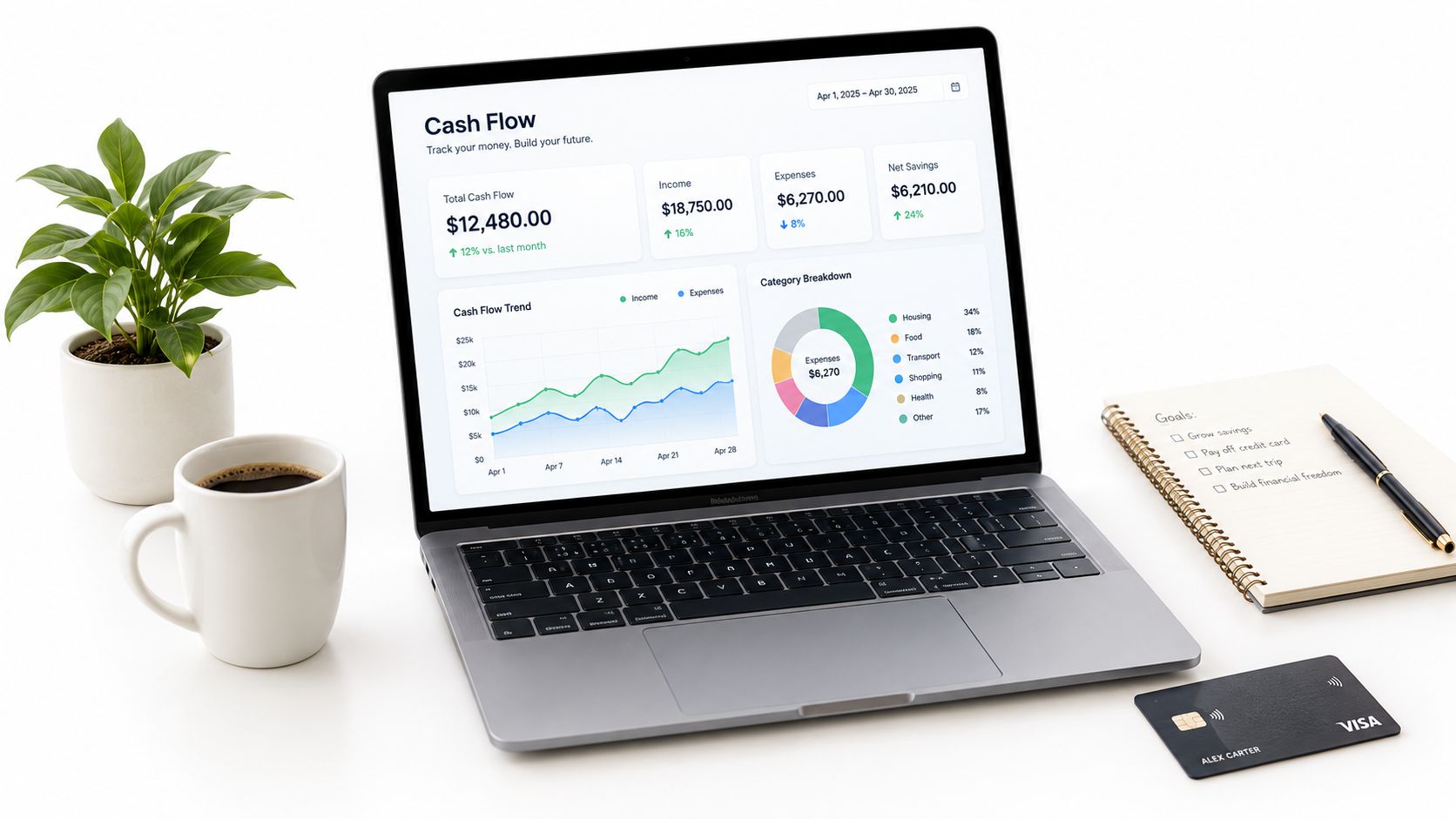
Features that reduce operational friction
Real-time cash positioning should show available balances, pending activity, and expected movements in one operating view. The useful question is not whether the dashboard looks impressive. It is whether an operator can confirm funding for a payment, identify cash stranded in the wrong entity, and distinguish free cash from money already committed. For digital assets, the same view may need clear separation by wallet, custody account, chain, or protocol.
Liquidity forecasting works better when the system separates entities, currencies, inflow categories, and outflow categories. Forecasts that refresh from current bank and ERP records reveal changes sooner than manually maintained spreadsheets. They also let finance teams compare expected and actual movements, investigate recurring variances, and adjust assumptions instead of carrying unexplained differences into the next forecast.
Payment initiation and approval should connect execution to policy. The workflow may require multiple approvers, role-based limits, separation between preparation and release, and a complete audit trail. Those controls should apply to bank payments and, where supported, digital-asset transfers. Treasury software earns its place when approvals, execution, and evidence stay together rather than moving through email and separate signing tools.
Reconciliation at scale separates a useful system from a reporting surface. It should match transactions across accounts and ledgers, identify exceptions, and record the outcome in a form auditors can review. Payment initiation, bank reconciliation, and exception handling can be automated across several rails when the rules and mappings are maintained correctly, as described in this explanation of treasury reconciliation capabilities.
The exception queue is where value becomes visible
Automation should send uncertain items to people, not conceal them. Unmatched deposits, duplicate payments, unexpected fees, stale balances, and differences between bank and ERP records need named exceptions, owners, statuses, and escalation rules.
A clean headline number means little if unresolved transactions sit outside the workflow. The operator needs to see why a match failed, what evidence is missing, and which action will close the item.
Ask vendors to demonstrate one payment from source record through approval, bank submission, reconciliation, exception handling, and accounting entry. If the demonstration skips those control points, the product may be optimizing presentation instead of treasury work.
Treasury Software for Crypto and Stablecoin Operations
Crypto treasuries don't escape traditional treasury problems. They inherit them and add new ones. A Web3 team may hold stablecoins across wallets, custody providers, liquidity pools, and operating accounts, while contributors expect quick access to funds and governance participants expect transparent approvals.
The familiar treasury questions remain: what do we hold, where is it held, what is available, what is committed, and what action should happen next? The difference is that balances may change through smart-contract interactions rather than bank transfers, and allocation decisions may depend on protocol conditions that shift continuously.

Stablecoin allocation needs treasury discipline
A stablecoin treasury workflow should combine visibility, policy, execution, and review. Visibility means tracking balances by wallet, chain, token, and protocol. Policy means defining which assets and strategies are permitted, how much capital can be allocated, and who can approve a change. Execution means carrying out the transaction through controlled wallets or contracts. Review means recording the rationale, result, and remaining exposure.
AI agents can support this workflow by monitoring available opportunities, filtering them against defined conditions, and proposing or executing allocations. That doesn't remove the need for risk controls. It changes the operator's job from manually searching across fragmented interfaces to supervising strategy rules and investigating exceptions.
The most useful design keeps funds accessible and makes the strategy legible. A busy investor may want automated monitoring and allocation without spending the day comparing protocol dashboards. An experienced crypto user may want the same automation but also require transparent execution steps, position-level visibility, and the ability to inspect the strategy.
This guide to stablecoin treasury management provides a useful reference for thinking about stablecoins as managed treasury assets rather than idle balances.
An automated strategy should answer questions that corporate treasury teams already recognize:
What is the source balance? Identify the wallet, chain, token, and available amount.
What is the destination? Record the protocol, position, and expected use of the capital.
What is the control path? Show whether the allocation was approved, rule-based, or manually initiated.
What can interrupt the plan? Surface liquidity conditions, contract concerns, transaction failures, or changes in strategy eligibility.
How can funds return to operations? Make withdrawal and reallocation paths clear before capital is deployed.
The connection between enterprise treasury and DeFi is therefore practical, not conceptual. Both environments need a reliable data layer, clear permissions, reconciled balances, and allocation decisions that can be reviewed after execution. The assets and rails differ, but the operating discipline is surprisingly similar.
A short visual walkthrough can help teams understand how an AI-assisted allocation process fits into that model.
How Organizations Choose Treasury Management Software
Choosing a treasury platform starts with operational complexity, not market reputation. A company with a limited banking footprint may prioritize reliable aggregation and approval workflows. A global group may need multi-entity forecasting, extensive bank connectivity, payment controls, and accounting integration. A Web3 organization may need wallet governance and protocol visibility alongside conventional fiat operations.
Deployment model is the first meaningful comparison. Cloud software can simplify access and reduce dependence on local infrastructure, while an ERP-driven deployment may appeal to organizations that want treasury activity close to their existing accounting controls. A standalone platform can offer deeper treasury functionality, but it also creates another integration surface to maintain.
Deployment model | Typical fit | Key trade-off |
|---|---|---|
Cloud treasury platform | Organizations that need centralized access, bank connectivity, and specialized treasury workflows | Faster operational access can come with more dependence on vendor integrations and configuration |
ERP-driven treasury | Finance teams that want treasury activity embedded in an existing enterprise finance stack | Familiarity and shared data can be offset by narrower specialist functionality |
Hybrid architecture | Groups combining an ERP with specialized treasury, payment, or risk systems | Greater flexibility requires careful ownership of data mappings and workflow boundaries |
Match automation maturity to the real bottleneck
A platform shouldn't automate a process that the team can't define. If the main problem is scattered balances, start with connectivity and cash positioning. If the problem is late close caused by unmatched transactions, prioritize reconciliation and exception management. If the organization is making poor allocation decisions, improve forecast inputs and approval policies before adding advanced scenario tools.
The broader category is still growing. One market estimate projects the global treasury management software market from around $301 million in 2026 to roughly $577 million by 2035, at a compound annual growth rate of about 6.1%, with digitization, compliance, and multi-bank cash management identified as adoption drivers in the market estimate. That momentum indicates sustained demand, but it doesn't make a particular product suitable for every treasury.
Run a proof of concept using your own difficult workflows. Give the vendor a messy reconciliation, a multi-entity cash position, an approval scenario, and an exception that requires manual resolution. The right system will make those cases understandable. It won't only make the clean demo data look impressive.
Why Treasury Software Alone Rarely Fixes Forecasting
Buying a treasury management system doesn't automatically produce a reliable forecast. The software can aggregate data, but it can't decide whether a business unit submitted a complete estimate, whether an ERP field is consistently populated, or whether an owner has a reason to correct a stale assumption.
PwC's 2025 Global Treasury Survey found that many large organizations with treasury systems still manually collect and consolidate forecasting data. Forecasting satisfaction was also lower when teams had to assemble data manually than when they used integrated or system-based methods, as summarized in the survey findings on treasury systems and forecasting.
The missing layer is usually governance
Forecasting breaks for operational reasons:
Poor data quality creates unreliable starting points. A system can process an incorrect payment date perfectly.
Weak tool adoption leaves teams working in side spreadsheets that never return to the central workflow.
Unclear ownership means business units treat forecast submissions as optional.
Inconsistent definitions make one entity's “available cash” different from another's.
No feedback loop prevents teams from learning why forecast and actual results diverged.
These problems are especially visible in crypto and stablecoin operations. A strategy engine may see a wallet balance, but that balance can still be unsuitable for allocation if it is reserved for payroll, a token launch, a liquidity commitment, or a pending governance decision. Automated yield decisions fail when the system can't distinguish operational cash from deployable cash.
A faster forecast built on incomplete inputs is still an unreliable forecast.
The fix begins with ownership. Define which team supplies each input, what “available” and “committed” mean, when data is refreshed, and who resolves exceptions. Then configure the software to enforce those definitions. The organization should be able to trace a forecast figure back to a source, an owner, and an assumption.
Measure trust, not just automation
A treasury team should review forecast variances and classify the reason for each material miss. Was the bank data late? Did AR change its expected receipt date? Did a business unit omit a payment? Did a stablecoin position move into a protocol without being marked as committed?
That review creates the information needed to improve the process. Software becomes more effective as the team fixes source data, aligns incentives, and removes duplicate workflows. Without that work, the platform becomes an expensive display layer over the same fragmented process.
Implementation and Security Considerations
Implementation should start with the money flows carrying the greatest operational risk. Map every bank, ERP, payment rail, wallet, custody account, and protocol connection. For each source, record what data enters the system, how often it refreshes, which team owns it, and what happens when the connection fails. This map should include stablecoin movements and AI-driven yield strategies, not only corporate bank accounts.
APIs provide current, structured data, while secure file transfer remains necessary when banks or counterparties send controlled files instead of offering modern interfaces. Neither method resolves inconsistent definitions. The implementation team must still set entity codes, account relationships, transaction categories, currencies, approval thresholds, and reconciliation tolerances before production use.

Build controls into the workflow
Use role-based access so preparation, approval, release, and reconciliation do not sit with one account. Maintain an audit trail for changes to payment instructions, forecast assumptions, user permissions, and allocation rules. Test rejected payments, expired credentials, broken connections, and incomplete files, rather than checking only successful transactions.
During the pilot, verify that matching rules produce audit-ready results and that exceptions route to a named owner. Test whether the system preserves the reason for each override and whether reviewers can reconstruct the approval path. Faster processing does not establish control by itself.
Teams formalizing ownership and definitions can use a finance data governance framework to organize policies for data quality, stewardship, access, and accountability. Treasury software should enforce those policies through permissions, validation rules, and clear exception states. A dashboard remains unreliable when source records lack an owner or consistent meaning.
Web3 deployments add another security layer. Wallets need multisignature controls, transaction policies, and separation of duties suited to the assets and risk limits involved. Document approved strategies, monitor protocol exposure, and record every allocation and withdrawal in a format reviewers can understand. Smart-contract risk requires a separate review process, and this guide to smart-contract security audits provides background for teams assessing contract-dependent strategies.
Start with a controlled pilot covering a defined set of accounts and wallets. Compare system outputs with existing records, test approval paths, and run exception scenarios before expanding coverage. Verified mappings and documented fallbacks provide a safer foundation than a broad launch with impressive dashboards but uncertain balances.
Best-Practice Treasury Workflows That Actually Scale
Scalable treasury operations rely on a repeatable rhythm. The team checks positions, validates new activity, refreshes the forecast, executes approved movements, and reviews exceptions. The exact schedule depends on the organization, but the sequence should remain visible and owned.
A daily operating rhythm
Begin with the cash position. Confirm that bank, ERP, payment, custody, and wallet data arrived successfully. Review changes from the previous position and investigate anything that doesn't reconcile with expected activity.
Next, separate available cash from committed cash. A balance may be visible but unavailable because it is reserved for payroll, vendor payments, collateral, governance obligations, or a planned investment. Stablecoin operators should make the same distinction before routing capital into a yield strategy.
Then review the exception queue. Prioritize failed connections, unmatched transactions, duplicate payment warnings, unexpected balance changes, and allocations outside policy. Every exception needs an owner and a resolution state, not just a note in a shared spreadsheet.
A controlled allocation cycle
Forecasts should refresh from current data and retain the assumptions that shaped them. Treasury teams can compare expected inflows and outflows with actual results, then adjust categories or ownership when the variance comes from a repeatable process failure.
Payment execution should follow the same principle. Prepare the payment, apply policy checks, obtain the required approvals, release it through the correct rail, and reconcile the result. For crypto operations, replace the bank rail with the appropriate wallet or protocol transaction, while keeping the approval and recordkeeping discipline intact.
Operator habit: Review the exception queue before celebrating a clean top-line balance.
Automation should reduce repetitive handling, not remove review from high-impact decisions. Keep a human approval point for unusual payments, material allocation changes, new counterparties, and strategies that fall outside established parameters. Let the system handle matching, routing, alerts, and recurring records where the rules are clear.
Finally, audit the workflow itself. Remove unused bank connections, review permissions, test recovery procedures, verify strategy logs, and update the definition of deployable cash as the business changes. Treasury complexity grows through small additions, and governance has to grow with it.
Yield Seeker provides an AI-powered workflow for monitoring and allocating stablecoin capital across DeFi protocols, with dashboards for balances and earnings and access to funds without lockups or withdrawal fees. Visit Yield Seeker to evaluate whether that treasury-style approach fits your stablecoin operations and allocation process.