

If your USDC is just sitting in a wallet, you're doing it wrong.
Think of it this way: holding USDC feels safe, sure. But it's a fundamentally passive move. Every second those stablecoins are idle, you're leaving potential earnings on the table. In the world of DeFi, capital is always in demand for borrowing, trading, and all sorts of other financial gymnastics, creating a natural market for yield.
Just like a static website is a major missed opportunity for engaging with customers, a static stablecoin is a major missed opportunity for your portfolio. The entire digital asset ecosystem is built on active participation, and your USDC can be out there working for you 24/7.
What drives these returns? It's classic supply and demand. Traders need to borrow stablecoins to long or short other crypto assets, which creates a huge demand for lending. Decentralized exchanges need deep liquidity pools to make sure trades go through with minimal slippage, and they'll gladly reward you for providing that liquidity.
By not participating, you are essentially leaving money on the table. The difference between a 0% return in a private wallet and even a conservative 5% APY from a lending protocol is significant, especially when compounded over time.
The Shift from Idle Asset to Active Earner
The first step is a mental one: stop thinking of your USDC as digital cash and start seeing it as a dynamic financial tool. This simple shift opens up a world of possibilities that just don't exist for cash holders in traditional finance.
The opportunities out there are surprisingly diverse and can fit just about any risk appetite. Here are the main ways you can turn that idle USDC into an income source:
Direct Lending: This is often the most straightforward entry point. You deposit your USDC into protocols like Aave or Morpho, and borrowers pay you interest. Simple as that.
Liquidity Provision: Here, you add your USDC to a liquidity pool on a decentralized exchange (DEX) like Uniswap or Curve. In return, you get a slice of the trading fees generated by that pool.
Automated Yield Vaults: For those who want a more hands-off approach, these platforms automatically hunt for and allocate your funds to the best-yielding opportunities, saving you a ton of time and research.
This guide is all about turning these concepts into a concrete, actionable playbook. We're going to dive into the real-world mechanics of each strategy, from the simple to the seriously complex, giving you the foundation you need to kickstart your USDC yield optimization journey. Once you understand the core drivers of yield, you can start making informed decisions that actually align with your financial goals.
The era of just holding on is over. Active, intelligent earning is the new standard.
Exploring Core USDC Yield Strategies
Alright, let's get into the nitty-gritty of putting your USDC to work. To get started on optimizing your yield, you first need to understand the main ways you can earn. These are the foundational strategies in DeFi, each with its own mix of risk, potential reward, and hands-on effort.
Think of it this way: instead of just letting your USDC sit there doing nothing, you’re giving it a job. And just like in the real world, different jobs have different pay and different dangers.
Lending Protocols: The DeFi Savings Account
The most straightforward way to start earning is through lending protocols. Platforms like Aave are essentially decentralized banks. You deposit your USDC, it gets pooled with funds from other users, and then it’s lent out to borrowers who pay interest.
You get a slice of that interest, which is your APY. It's a living number, constantly shifting based on how much USDC is available versus how much is being borrowed. It’s a popular first step for a reason—it’s simple, the risks are relatively low (these protocols are heavily audited and have been around for years), and you start earning almost immediately.
Providing Liquidity: Becoming the Market
A step up in complexity and potential return is liquidity provision. This means you deposit your USDC into a liquidity pool on a decentralized exchange (DEX) like Curve or Uniswap. These pools are the lifeblood of DEXs, allowing users to swap tokens.
By contributing, you become a market maker. Every time someone uses your pool to trade, they pay a small fee, and you earn a piece of it.
This usually pays better than simple lending because you're taking on more responsibility and a bit more risk. If you're in a pool with two stablecoins (like USDC-DAI), your primary risk is the smart contract itself. But if you pair USDC with a volatile asset like ETH, you open yourself up to something called impermanent loss. This happens when the prices of the two assets diverge, and it can eat into your profits.
Key Takeaway: Lending is like earning interest from a savings account—it’s passive and lower-risk. Liquidity provision is more like being a market maker—it’s more involved but comes with higher potential rewards and risks.
The difference in returns across the DeFi landscape is huge. On Aave, you might see a USDC APY between 4-7%, a solid and accessible starting point. But more advanced strategies can push that much higher. Curve often offers 5-20% APY on USDC pools, managing a massive $2.73 billion in total value locked (TVL). And on the higher end, protocols like Pendle have hit 14.5% on DAI pools with an eye-watering $8.27 billion in TVL.
Automated Yield Vaults: Set It and Forget It
If you don't have the time or energy to constantly chase the best rates, automated yield vaults are a godsend. Platforms like Yearn Finance or Beefy offer smart contracts that automatically run complex yield farming strategies for you.
You just deposit your USDC, and the vault handles the rest—shifting funds, compounding earnings, and hunting for the best opportunities.
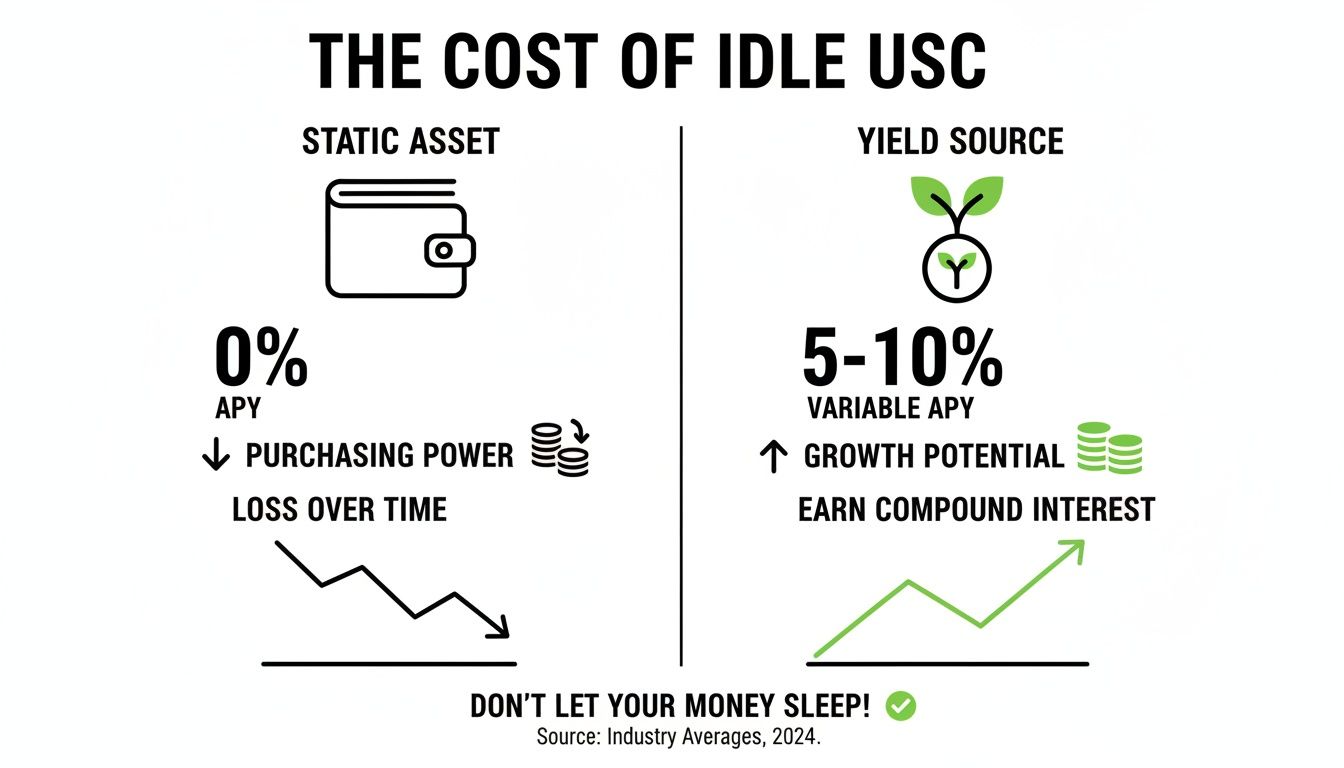
As the infographic shows, the difference is stark. A static asset gets you 0% APY. An active yield source, on the other hand, can unlock 5-10% returns or even more, letting your capital actually grow.
Vaults are perfect for passive investors, but you still need to do your homework. Know what strategy the vault is running. Is it just lending on Aave? Or is it a multi-step strategy hopping between different protocols? The convenience comes with an extra layer of smart contract risk and usually a performance fee on your profits.
If you want to go deeper on finding the most competitive rates out there, our guide on the best stablecoin yields is a great place to start.
Comparing Core USDC Yield Strategies
To really wrap your head around the options, it helps to see them side-by-side. Each strategy fits a different investor profile, depending on your goals and how much risk you're comfortable with.
Strategy | Typical APY Range | Risk Level | Complexity |
|---|---|---|---|
Lending Protocols | 3% - 7% | Low | Low |
Stablecoin Liquidity Pools | 5% - 12% | Medium | Medium |
Automated Yield Vaults | 5% - 15%+ | Medium-High | Low |
Market-Neutral Strategies | 8% - 20%+ | High | High |
This table lays out the fundamental trade-off pretty clearly: higher potential APY almost always means more risk and complexity. A conservative investor might stick to lending, while someone more comfortable in the DeFi weeds might allocate a chunk of their portfolio to a yield vault or a stablecoin pool to juice their returns.
Building a Practical Risk Management Framework
Chasing higher returns with your USDC means you’re going to have to get comfortable with more risk. It’s unavoidable. The trick isn't to dodge risk entirely—that’s a surefire way to earn nothing—but to really understand it, size it up, and manage it like a pro. A solid framework is your best line of defense against the chaos that DeFi can throw at you.
This goes way beyond just checking a box for a security audit. A truly durable portfolio is built on a layered approach to risk, because threats often pop up from the places you least expect.
Deconstructing DeFi Risks
To get good at optimizing USDC yield, you need to look at risk from a few different angles. A lot of beginners get fixated on smart contract hacks, but the real landmines are often more subtle. A protocol can have Fort Knox-level security and still lose you money if its financial logic is broken.
Here are the main risk categories you absolutely have to keep on your radar:
Smart Contract Risk: This is the one everyone knows about. It's the chance that a bug or a vulnerability in a protocol's code gets exploited, and poof, the funds are gone. A history of audits from reputable firms is the bare minimum you should look for, not a golden ticket guaranteeing safety.
Protocol Dependency Risk: Many of the best yield strategies are like a Jenga tower—they stack multiple protocols on top of each other. If one block gets pulled out, the whole thing can come crashing down. Think about a yield vault that deposits into a lending protocol; if that lending protocol gets hit, the vault’s funds are toast.
Stablecoin De-Peg Risk: While USDC has a stellar track record, no stablecoin is completely bulletproof. It's not impossible for it to lose its 1:1 peg to the dollar. In moments of extreme market panic or if something funky happens with its reserves, its value could wobble, and that directly hits your principal.
Impermanent Loss: This one's a classic headache for liquidity providers. It only comes into play when you're in a pool with a non-stablecoin asset, like USDC-ETH. If the price of ETH skyrockets or tanks, the total value of your slice of the pool could end up being less than if you'd just held your USDC and ETH separately.
One of the biggest rookie mistakes is blindly chasing the highest APY without asking why it's so high. More often than not, an insane yield is just compensation for taking on an equally insane, and often hidden, risk.
Creating Your Personal Safety Net
Once you get a handle on the threats out there, you can start building your own personal framework to navigate the space. This isn't about needing a PhD in financial modeling. It's about setting simple, clear rules for yourself and actually sticking to them. The ultimate goal is to make sure no single disaster can kneecap your portfolio.
This is where having a disciplined strategy for your USDC really shines. You can dive deeper into these habits in our complete guide covering best practices for risk management.
Actionable Rules for Capital Allocation
To put this into practice, you need to write down your own rules of engagement. These rules will be your guardrails, dictating how and where you put your capital to work, and stopping you from making emotional decisions when the next shiny object comes along.
Here’s a simple but powerful template you can steal and adapt:
Define Maximum Allocation per Protocol: Don't be a hero. A smart rule of thumb is to never put more than 20-25% of your total USDC yield portfolio into a single protocol, no matter how much you love it.
Vet Security Audits Properly: Don't just glance at the audit report. Look at who did it. An audit from a top firm like Trail of Bits or OpenZeppelin means a lot more. Then, read the findings. Did they find critical issues? More importantly, did the team actually fix them?
Diversify Across Strategy Types: Mix it up. Don't just stick to one type of strategy. For instance, you could put 50% into low-risk lending on Aave or Compound, 30% into stablecoin-only liquidity pools, and maybe 20% into more advanced automated yield vaults. This protects you if a risk event hits just one corner of the market.
Set a "Cool-Down" Period for New Protocols: It's super tempting to ape into brand-new protocols offering eye-popping yields. The smarter play is to let them battle-test in the wild for a few months. See how they hold up under real market pressure before you commit any serious capital.
By building out this framework, you shift from being a passive yield farmer to an active risk manager. And believe me, that discipline is the secret to winning the long game in USDC yield optimization.
Putting Your Yield on Autopilot with Automation and AI
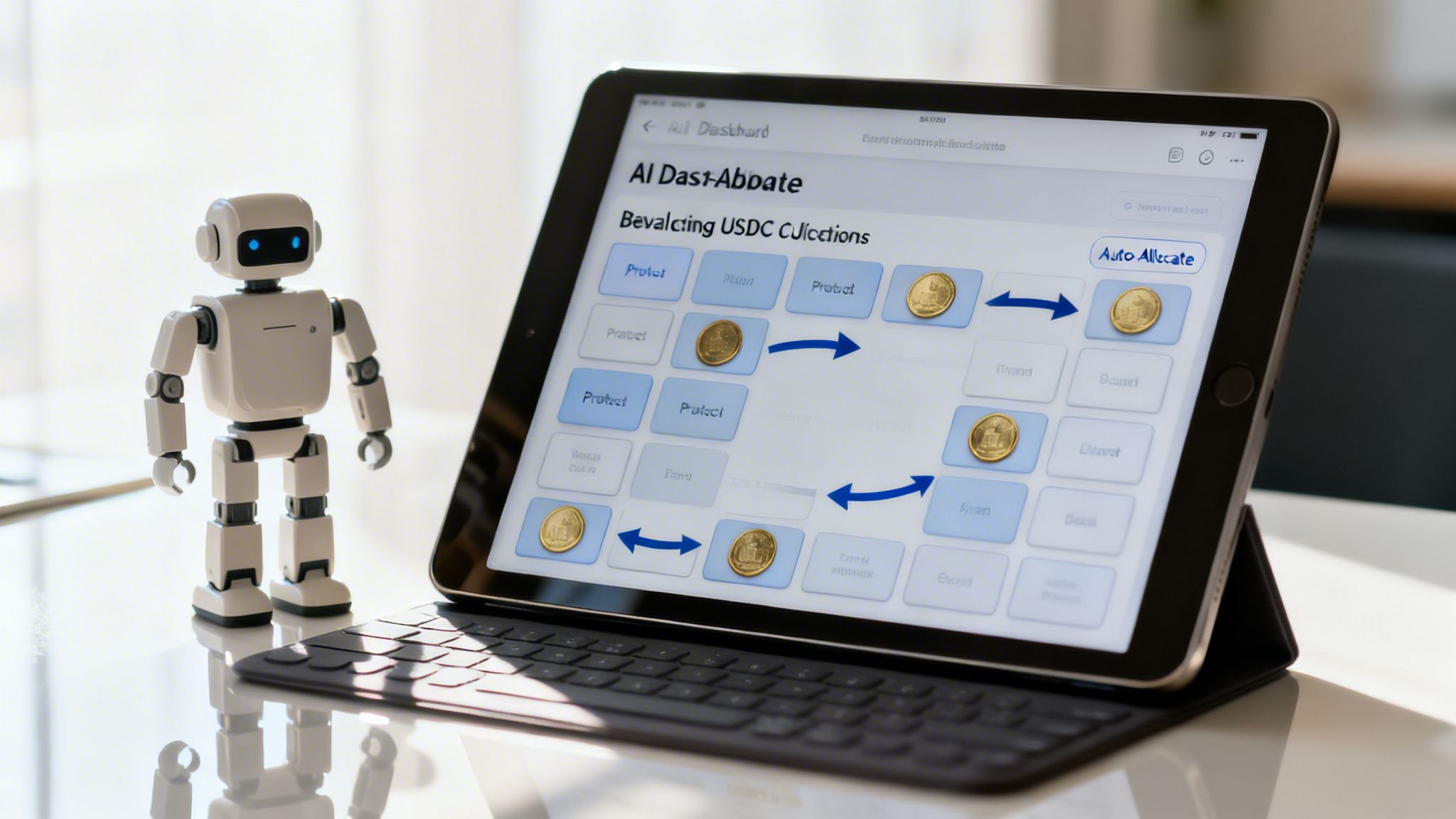
Let's be real: manually hunting for the best USDC yields across dozens of DeFi protocols is a full-time job. Rates change in a flash, gas fees can gut your profits, and making decisions based on FOMO is a recipe for disaster. This is exactly why automation and AI are becoming total game-changers for yield farming.
Imagine a system that never sleeps. It's constantly scanning the DeFi market, sniffing out the best risk-adjusted opportunities, and pouncing on them for you. This isn't some far-off sci-fi concept; it's how smart investors are earning yield right now.
The Power of Automated Execution
AI-powered platforms like Yield Seeker basically act as your personal DeFi analyst and portfolio manager, all rolled into one. They plug into countless protocols—from lending markets to liquidity pools—and use sharp algorithms to figure out where your capital will work hardest at any given moment.
Here’s a practical example. Say your USDC is sitting in a Morpho lending pool, earning a respectable 5% APY. Out of nowhere, a new, audited vault pops up offering a risk-adjusted 7% APY. An automated system will spot this, run the numbers on transaction costs, and shift your funds to capture that higher yield. All without you lifting a finger.
This instantly solves two massive headaches:
Time Sink: You're no longer forced to spend hours every week digging through protocol dashboards and analytics sites.
Emotional Trades: The system operates purely on data and your predefined risk settings, steering clear of the "fear of missing out" that leads people to chase dodgy, unsustainable yields.
This whole "set it and forget it" approach is going mainstream. We’re even seeing big players like Coinbase team up with DeFi protocols like Morpho to give users automated, competitive yields right inside their app. It's a "DeFi Mullet" model—simple on the outside, complex DeFi machinery on the inside—and it shows where the industry is heading.
How AI Finds Smarter Yield
An AI agent takes things a step further than simple automation. It learns and adapts, bringing a much more nuanced strategy to the table. Instead of just blindly chasing the highest number, these systems run a multi-factor analysis to find the best opportunity, not just the biggest one.
The real magic of AI is its ability to crunch massive amounts of data to make lightning-fast, unemotional decisions. It can analyze a protocol's entire history, current liquidity, and smart contract dependencies to build a full risk profile before ever putting your capital on the line.
A huge part of this is balancing multiple variables at once. For example, an AI can:
Analyze Gas Fees: It figures out if moving your funds is actually profitable after factoring in network costs.
Assess Risk Signals: The system can flag protocols with shaky liquidity or weird on-chain activity, helping you sidestep potential landmines.
Optimize Compounding: It can auto-compound your earnings at the perfect intervals to maximize those returns.
At the end of the day, this data-first process builds a much more consistent and resilient yield strategy. Of course, you need to track how well your automated strategies are working; solutions offering robust AI Automation ROI Tracking are essential for this.
By offloading all the tedious, complex work to a specialized system, you can focus on your bigger financial picture while your capital works more efficiently. If you want to get into the nitty-gritty of how these systems tick, our post on choosing a yield optimization protocol is a great next step. The future of earning on stablecoins isn’t just about finding yield; it’s about optimizing it intelligently.
Designing Your Personal USDC Yield Portfolio
Alright, you’ve got the lay of the land on strategies and risk. Now it’s time for the fun part: actually building your USDC yield portfolio. A good portfolio isn’t just a random basket of positions. It’s a thoughtful allocation of your capital that lines up with your financial goals and how much risk you’re actually comfortable with.
Let’s walk through three different models. Think of these less as rigid rules and more as starting templates you can tweak. Whether you're all about slow-and-steady growth or you're chasing those higher APYs, these examples will give you a solid foundation.

The Conservative Accumulator Portfolio
This one’s all about capital preservation and stability. The goal here isn't to hit home runs; it's to consistently beat just holding USDC in your wallet while taking on minimal, well-understood risks. It’s perfect if you're new to DeFi or if protecting your principal is your absolute top priority.
The allocation is heavily skewed toward the most battle-tested protocols in DeFi.
Lending on Blue-Chip Protocols (75%): The lion's share of your capital goes into the biggest, most established lending markets like Aave and Morpho. These platforms have survived multiple market cycles, hold billions in liquidity, and have been audited to death.
Stablecoin-Only Liquidity Pools (25%): The rest is dedicated to liquidity pools that only contain stablecoins, like a USDC-DAI pool on Curve. This gives you a nice little yield boost from trading fees without exposing you to the wild swings of impermanent loss.
Portfolio Logic: This structure is designed to minimize smart contract risk by sticking with the household names of DeFi. By completely avoiding volatile assets and complicated strategies, it sidesteps market volatility and impermanent loss, making it a rock-solid foundation for any yield strategy.
Estimated Risk-Adjusted APY: 4% – 7%
The Balanced Optimizer Portfolio
Ready to step a little further out on the risk curve? The Balanced Optimizer is for you. It mixes the stability of conservative plays with some higher-growth opportunities. This model aims for a juicier yield by bringing in strategies with moderate risk. It’s a great fit if you've been around the DeFi block a few times and want to boost your returns without going full degen.
Here, we start introducing automated vaults to tap into more complex yield sources.
Lending on Blue-Chip Protocols (40%): A still-significant chunk stays in top-tier lending protocols, acting as the portfolio’s stable anchor.
Stablecoin Liquidity Pools (30%): A similar slice goes to stablecoin pools on reputable DEXs, providing a solid middle ground of risk and reward.
Automated Yield Vaults (30%): This is where we hunt for higher returns. Capital is placed into well-vetted, automated vaults that run more complex strategies across multiple protocols. The key is picking vaults with a proven track record and transparent game plan.
Portfolio Logic: Diversification is the name of the game. By spreading your USDC across simple lending, liquidity provision, and automated farming, the portfolio isn't overly exposed to any single point of failure. It captures upside from more dynamic strategies while being held down by its conservative base.
Estimated Risk-Adjusted APY: 7% – 12%
The Aggressive Seeker Portfolio
This portfolio is for the seasoned DeFi native who understands the risks and is actively chasing the highest returns possible. It puts a meaningful slice of capital into newer, higher-risk, and potentially much higher-reward strategies. Just know, this is not a "set it and forget it" setup; it requires more hands-on monitoring.
Lending & Stablecoin LPs (50%): Half the portfolio remains in foundational, lower-risk strategies. This is crucial—it ensures your entire stack isn't exposed to high-risk gambles.
Established Automated Vaults (30%): This portion goes after higher-yield vaults that have been running securely for a decent amount of time.
Experimental Strategies (20%): Here’s the high-octane part. This could mean providing liquidity for a brand-new token, jumping into a new yield protocol, or running a complex market-neutral strategy. You should consider this 20% as capital you're willing to lose.
The world of USDC yield is incredibly diverse. You might see Maple Finance offering a 5.08% APY on USDC, while Jito Liquid Staking is at 5.96%. Then you'll see something like Merkl offering a 0.08% yield, which really shows how much rates can vary. It's worth a deeper look at platform-specific rates to see how these sustainable yields are actually found.
Portfolio Logic: The Aggressive Seeker employs a "barbell" strategy, combining a large, safe base with a small, high-risk allocation. This structure lets you swing for the fences with emerging opportunities while shielding the majority of your principal from a catastrophic wipeout.
Estimated Risk-Adjusted APY: 12% – 20%+
Got Questions About USDC Yield?
When you start digging into USDC yield strategies, a few key questions always pop up. It makes sense—whether you're a DeFi veteran or just getting your feet wet, you want to know what you're getting into. Let's break down some of the most common ones I hear.
What’s a Realistic APY for My USDC?
Honestly, the real answer is: it depends entirely on your strategy and how much risk you're willing to stomach. There's no single magic number, but we can definitely map out some realistic goalposts.
For the most conservative plays, think about parking your USDC in massive, battle-tested lending protocols like Aave or Morpho. Here, you’re typically looking at returns somewhere in the 3% to 7% range. This is the bread and butter of many stablecoin portfolios.
If you’re okay with a little more action, a balanced approach mixing lending with providing liquidity to stable-on-stable pools can nudge your returns into the 5% to 12% zone. The really aggressive stuff—jumping into brand-new protocols or dabbling in complex derivatives—can spike way past 15-20%, but that comes with a much bigger dose of risk.
My biggest piece of advice? Be super skeptical of those crazy, unsustainable APYs. A steady 6-8% from a protocol with a solid reputation is infinitely better than a flashy 50% from a project that just launched last week. This is exactly what automated tools are built for—finding that sweet spot of competitive, risk-adjusted returns for you.
Can I Actually Lose My USDC When Yield Farming?
Yes, you absolutely can. Let’s be crystal clear about this. While USDC is designed to hold its peg, the DeFi protocols where you put it to work are not risk-free. Yield farming isn't a high-interest savings account at your local bank.
Several things can go wrong and lead to a loss of your initial funds:
Smart Contract Exploits: This is the classic DeFi horror story. A bug in a protocol's code gets found by a hacker, and poof—the funds are drained.
Protocol Failure: The project itself could just fail. Maybe it's bad management, a flawed economic model, or it simply becomes insolvent, leaving you unable to get your funds back.
Stablecoin De-Pegging: It's rare, but under extreme market stress, USDC could lose its 1:1 peg to the dollar.
Impermanent Loss: This one's specific to liquidity pools. If you pair your USDC with a volatile asset (like ETH) and the prices fly in opposite directions, you could end up with less value than if you’d just held the two assets separately.
This is exactly why you can't just "ape in" without a plan. Never put in more than you’re truly okay with losing, stick to audited and time-tested protocols, and spread your capital across a few different platforms. It's the simplest way to avoid the pain of a single point of failure.
What's the Real Difference Between CeFi and DeFi Yield?
It all boils down to two things: custody and transparency.
When you use a CeFi platform, you're handing your funds over to a company. You deposit your USDC, and they become the custodian, lending it out for you. The big risk here is counterparty risk—you're trusting that company not to go bust or run off with your money.
DeFi is the complete opposite. It's non-custodial. You are always in control of your private keys and you interact directly with smart contracts on the blockchain. The whole process is radically transparent; every single transaction is on a public ledger for the world to see. The trade-off? It requires more personal responsibility and a bit of know-how to navigate safely. Automated DeFi tools are designed to bridge that gap, giving you a simple front-end while letting you keep full self-custody of your assets.
Ready to put your USDC to work without spending hours on research? Yield Seeker uses AI to automatically find and manage competitive, risk-aware yields for you. Get started in minutes and let your personalized AI Agent handle the hard work.