
USDT is a US dollar-pegged stablecoin that functions as the primary liquidity and settlement layer for the global cryptocurrency market. As of 2026, it holds a $187 billion market capitalization, controls 58.29% of total stablecoin liquidity, and accounted for approximately 41% of all trading pair transactions globally in 2025.
If you hold crypto today, you've probably already run into usdt everywhere. It's the quote pair on exchanges, the cash leg in a lot of trades, and for many users it's the default asset they park in while waiting for the next move.
For yield seekers, that's exactly why usdt matters. It isn't just something you trade through. It's also one of the most common assets used in DeFi lending, liquidity provision, and automated stablecoin strategies. The upside is obvious: deep liquidity and broad support. The catch is less obvious until you've used it for a while: the same centralization that makes usdt easy to integrate also creates risks that passive income users can't ignore.
What Is USDT and Why Does It Dominate Crypto
USDT, also called Tether, is a stablecoin designed to track the value of the US dollar. In plain terms, it's crypto's working cash. Traders use it to move between volatile assets without leaving the crypto system, and protocols use it because almost everyone already recognizes it.
That dominance isn't marketing spin. USDT commands a $187 billion market capitalization and 58.29% of total stablecoin liquidity as of 2026, and it represented approximately 41% of all trading pair transactions globally in 2025, which is why it became the market's default settlement asset, according to Datawallet's USDT market overview.
Why beginners notice it first
A new user usually meets usdt in one of three places:
On centralized exchanges: It's often the pair against BTC, ETH, SOL, and countless smaller tokens.
Inside DeFi apps: Pools, vaults, and lending markets frequently use usdt as a base asset.
During market stress: When traders want to reduce volatility fast, they often rotate into stablecoins.
That last point matters. People don't just use usdt because it's old. They use it because they expect to find liquidity when they need it.
USDT won by being available almost everywhere people already trade.
Why that dominance matters for yield
For passive income strategies, scale changes the experience. A large, widely accepted stablecoin tends to have more integrations, more places to deploy capital, and fewer problems exiting a position. That's practical, not theoretical.
Still, beginners often misunderstand what "stable" means. USDT aims to stay near one dollar, but the reason it matters in DeFi isn't only price stability. It's the combination of liquidity, exchange support, and settlement convenience. That's what makes it useful for both active traders and people trying to earn yield without micromanaging every move.
How USDT Works The Peg Reserves and Issuance
A user deposits cash on an exchange, buys USDT, then sends it into a lending market to earn a few percent. On the surface, that feels simple. Underneath, there is an issuer, a reserve structure, a mint and redemption process, and a central party that can freeze tokens. If you're using USDT for yield, those mechanics matter more than the logo.
How new usdt gets created
Retail users usually buy USDT on the secondary market. They do not mint it directly with one click from a wallet.
New supply enters through approved counterparties that complete compliance checks and fund the issuer's process with fiat or other accepted assets. Tether then issues USDT on the requested network, and that inventory flows into exchanges, OTC desks, payment channels, and sometimes DeFi venues, as described in Klever's breakdown of USDT issuance and redemption.
The flow is straightforward:
An approved participant passes KYC and AML review.
That participant funds the issuance request.
Tether mints USDT on a specific blockchain.
The tokens enter circulation through trading firms, exchanges, and other distribution channels.
That setup explains a point beginners often miss. USDT moves on public blockchains, but supply creation and redemption still depend on a company-controlled process.
How the peg holds
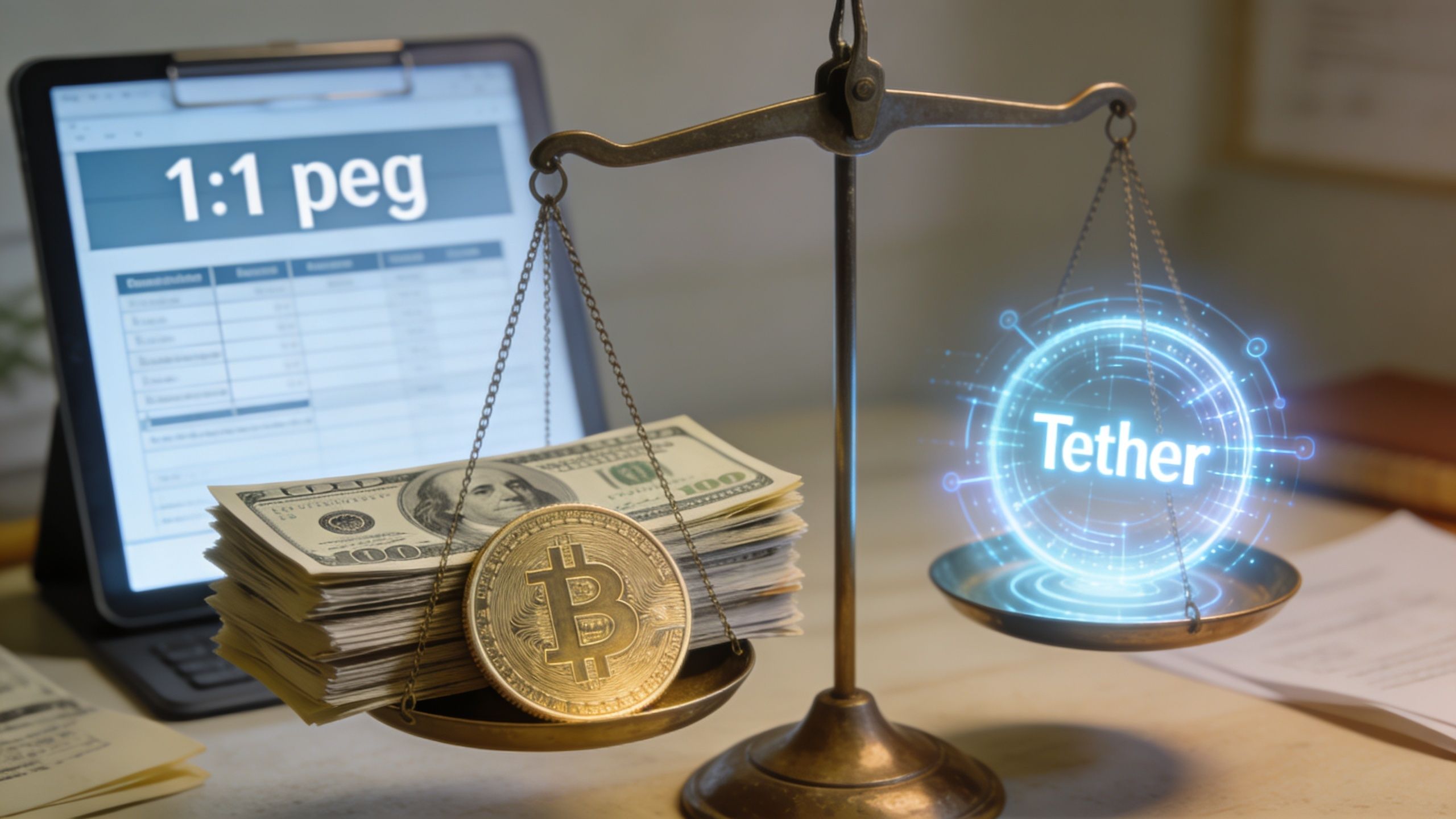
USDT aims to stay close to $1 because large market participants can arbitrage price gaps. If USDT trades below $1, firms with access to redemption can buy discounted tokens and redeem them through the issuer's process. If USDT trades above $1, firms can create new supply and sell into that premium.
That incentive is what keeps the peg working in normal conditions.
For DeFi users, the practical takeaway is simple. A stablecoin is not "safe" just because the chart usually sits near $1. Its stability depends on whether someone can convert market discounts or premiums into profit fast enough to pull the price back toward par.
What reserves mean in practice
The reserve side matters because USDT is not an algorithmic stablecoin. Its backing comes from assets held off-chain, and confidence depends on the quality, liquidity, and transparency of those holdings.
For a yield seeker, this creates a real trade-off. USDT is widely accepted and easy to deploy, but the core credit and operational risk sits with a centralized issuer. If Tether can process redemptions smoothly and the market trusts the reserves, USDT usually behaves the way users expect. If confidence slips, the token can trade below peg, and your exit route may depend more on exchange liquidity than on direct redemption access.
That distinction matters during volatility. Many passive income users hold USDT inside a CEX account, a lending app, or an automated vault. In each case, they own the same asset, but their actual ability to exit depends on the platform, the chain, and whether transfers or withdrawals remain available.
What stress tests actually showed
The market already pushed this system hard during major selloffs. Heavy redemptions during the 2022 panic showed that the mint and redemption framework was more than marketing language. It also showed something less comfortable. Direct redemption is mainly useful to large, approved participants, while smaller holders usually rely on exchanges and pooled liquidity.
That is why experienced users separate peg risk from access risk. The peg can recover while a specific venue still has poor liquidity, delayed withdrawals, or temporary spread blowouts.
The centralized risk many yield articles skip
USDT is useful precisely because it is widely integrated across exchanges and DeFi. The cost of that convenience is central control. Tether can freeze addresses, and protocols that accept USDT inherit part of that risk.
For passive income strategies, this is not a minor footnote. If USDT sits in a wallet or contract tied to sanctions issues, exploits, or compliance actions, the token can become unusable even if it still says "1 USDT" on-chain. Anyone parking funds in pools, vaults, or automated products should understand that yield does not remove issuer risk. It adds protocol risk on top of it.
That does not make USDT unusable. It makes position sizing, platform selection, and exit planning part of the job.
USDT Performance Across Different Blockchains
Send 500 USDT on the wrong network and the problem is immediate. The token is still called USDT, but the chain you choose affects fees, confirmation time, wallet support, exchange deposits, and whether a yield strategy is even practical.

Ethereum usdt versus Tron usdt
The difference shows up fast in real use. Ethereum USDT usually gives you the widest DeFi compatibility. Tron USDT usually gives you lower transfer costs and faster, cheaper movement between exchanges and wallets. As MEXC explains in its overview of how USDT works across blockchains, those trade-offs come from the underlying network design, not the token itself.
For practical use, the split looks like this:
Network | What it feels like in practice | Best use case |
|---|---|---|
Ethereum L1 | Broad app support and deep DeFi liquidity, but transfers can be expensive | Larger positions, lending markets, and strategies that need Ethereum-native liquidity |
Tron | Cheap, fast transfers with wide exchange support | Exchange deposits, withdrawals, payroll-style transfers, and smaller balances |
Polygon and other supported chains | Lower costs than Ethereum with decent app support, but availability varies by platform | Users who want lower fees without giving up too much DeFi access |
Cheap transfers help, but support matters more. A protocol offering 9% on USDT is irrelevant if it only accepts Ethereum USDT and your funds are sitting on Tron.
Why chain selection matters for yield
A common issue is that a lot of passive-income content gets too abstract. USDT is not just a stablecoin you hold. It is a routing decision.
If you're earning yield manually, every deposit, withdrawal, harvest, rebalance, and exit has a network cost attached to it. On Ethereum, those costs can be fine for a larger position and completely irrational for a small one. On Tron, movement is cheaper, but your DeFi options are narrower and often more centralized around exchange flows than native on-chain yield products.
That changes net return.
A vault promising a decent APY on one chain can still underperform a simpler strategy on another if you have to bridge in, bridge out, and pay extra gas each time you adjust the position. Automated platforms such as Yield Seeker only help if the underlying route still makes economic sense after fees and chain constraints.
A practical way to choose the right USDT network
Use the destination first, not the token name, as your starting point.
Confirm exact chain support: Check whether the exchange, wallet, or protocol accepts ERC-20 USDT, TRC-20 USDT, or another version.
Estimate the full round trip: Include deposit, future withdrawals, rebalancing, and any claim transactions.
Limit bridge exposure: Extra hops add failure points, delay, and smart-contract risk.
Match chain to balance size: Ethereum can work well for larger allocations. Lower-cost chains are usually better for smaller, active balances.
Check liquidity where you plan to exit: A good yield route is less useful if off-ramping on that chain is awkward or expensive.
I treat chain choice as part of risk management, not just convenience. For yield seekers, the wrong network can erase returns slowly through fees or all at once through a bad transfer path.
What usually works
The reliable approach is simple. Send USDT on the network the receiving platform explicitly lists, test with a small amount if there is any doubt, and judge the strategy on net yield after movement costs.
That discipline matters more than chasing a slightly higher APY. In practice, chain mismatch, unnecessary bridging, and weak app support lose more money than a lower headline return.
The Pros and Cons of Using USDT
USDT is useful because it's accepted almost everywhere that matters in crypto. It's also risky in ways many passive income guides soften or ignore. If you're earning yield with it, both sides matter.
Where usdt is genuinely strong
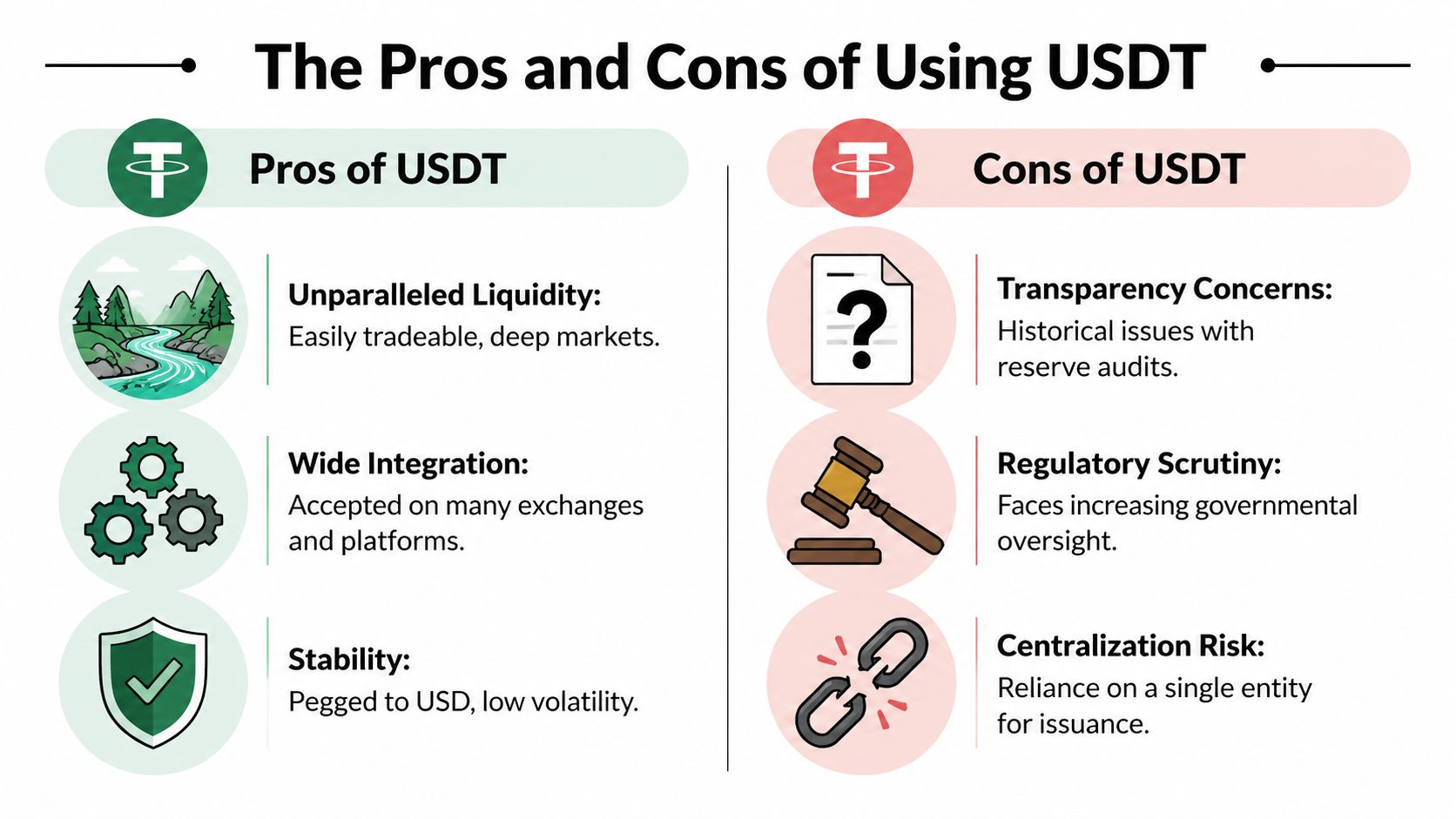
The first advantage is obvious once you've tried alternatives: liquidity. USDT is highly integrated into exchange infrastructure, trading desks, wallets, and DeFi pools. That usually means easier entry, easier exit, and fewer situations where you're stuck holding a stablecoin no one wants.
It also benefits from habit. Traders already think in usdt pairs. Teams already support it. Protocols already build around it. That kind of installed base matters because convenience compounds.
A few practical strengths stand out:
Market access: It's one of the easiest stablecoins to move between centralized and decentralized venues.
Yield availability: You can usually find usdt lending markets, LP opportunities, and vault strategies without much searching.
Cross-border utility: In many markets, users treat it as a workable digital dollar proxy.
The centralization risk is real
The main drawback isn't abstract ideology. It's control. Tether has frozen over $4.4 billion in USDT since 2023 while collaborating with law enforcement, and that blacklist function can create "yield leakage" when funds in a passive strategy become unusable, according to Kenson Investments' discussion of USDT freeze risk and DeFi impact.
For a passive income user, that creates a different risk profile than "my stablecoin stays near a dollar."
The practical issue looks like this:
Your wallet can interact normally until it can't.
A freeze can interrupt a strategy even if you weren't actively trading.
An automated position can stop behaving like a liquid cash alternative.
Don't confuse price stability with permissionlessness. They're not the same thing.
The trade-off most users should accept consciously
I don't treat usdt risk as a reason to avoid it entirely. I treat it as a reason to size it correctly and use it for the jobs it does best.
A balanced approach usually looks like this:
Use case | USDT fit | Main concern |
|---|---|---|
Exchange settlement | Strong | Centralized issuer control |
Short-term parking between trades | Strong | Operational risk across chains |
Passive DeFi income | Useful, but not default-safe | Freeze risk and protocol risk compound |
Treasury diversification | Reasonable as one sleeve | Overconcentration in one issuer |
What doesn't work is pretending usdt is either perfect or toxic. In practice, it's a highly effective stablecoin with a meaningful centralization cost. Mature users price that in.
USDT vs Other Major Stablecoins
Choosing a stablecoin isn't just about ticker recognition. It comes down to what trade-offs you want to accept around issuer control, reserve style, ecosystem support, and how much convenience you're willing to trade for structural differences.
Tether has one argument that deserves attention. It says broad distribution makes USDT the "most decentralized stablecoin." That claim speaks to holder spread and real-world usage, not to whether the issuer can intervene.
What to compare when picking a stablecoin
A useful comparison framework is simple:
Issuer control: Can one company freeze or block funds?
Reserve model: Is the asset backed off-chain, overcollateralized on-chain, or something else?
DeFi integration: Is it easy to deploy in the apps you use?
Liquidity depth: Can you move size without friction?
Regulatory path: Could new rules improve safety while changing yield opportunities?
That last point matters more now. The planned launch of USAT in 2026 to target US institutions could fragment USDT liquidity and affect DeFi yields, which is one reason users should watch the market structure rather than assume today's stablecoin hierarchy stays fixed, as discussed in BingX's coverage of Tether's decentralization claim and USAT plans.
USDT vs competitors at a glance
Feature | USDT (Tether) | USDC (Circle) | DAI (MakerDAO) |
|---|---|---|---|
Core identity | Fiat-backed stablecoin with dominant trading presence | Fiat-backed stablecoin often favored for a more conservative profile | Crypto-native stablecoin used heavily in DeFi |
Issuer control | Centralized issuer with blacklist capability | Centralized issuer model | More decentralized design than fiat-issued stables |
DeFi presence | Extremely broad | Broad | Strong in DeFi-native environments |
Typical appeal | Liquidity and market access | Simplicity and perceived reserve conservatism | Users who want more crypto-native structure |
Main trade-off | Freeze risk | Centralized issuer dependence | More moving parts for newcomers |
If you're comparing live opportunities, a separate review of stablecoin yield options across the market can help frame where each asset tends to fit.
What usually makes sense in practice
For active trading and broad exchange mobility, usdt remains hard to beat. For users who care more about issuer conservatism or a different regulatory posture, some prefer usdc. For users who want a more crypto-native route, dai often enters the conversation.
The mistake is thinking one stablecoin should do every job. A trader, a treasury manager, and a passive DeFi lender don't need the same thing. The best choice is usually the one whose weaknesses you understand before you deposit.
How to Earn Yield with USDT in DeFi
USDT often functions as idle capital. It sits in a wallet, on an exchange, or in a treasury account waiting for the next move. DeFi turns that idle balance into something productive, but only if you understand where the yield comes from and what can interrupt it.
The main ways people use usdt for yield
The two most common paths are lending and liquidity provision.
With lending, you deposit usdt into a money market such as Aave or Morpho-style lending venues where borrowers pay to access that liquidity. This is usually the simplest route for beginners because the position is easier to understand. You deposit, you earn, and the protocol handles the borrower side.
With liquidity provision, you place usdt into a pool on a DEX such as Uniswap paired with another asset. That can earn trading fees, but the risk profile changes because pool composition and pricing dynamics matter.
A simple breakdown:
Lending markets: Easier to explain, often cleaner for conservative stablecoin users.
DEX pools: Can be attractive, but they require more attention to pair selection and pool mechanics.
Vaults and aggregators: Useful for users who don't want to manually rebalance across protocols.
What manual usdt yield farming gets wrong
Manual DeFi can work. Plenty of experienced users still prefer direct control. But the friction adds up fast.
The usual problems are familiar:
You spend too much time comparing rates across protocols.
You underestimate chain costs and transaction timing.
You chase yield without checking contract, pool, or liquidity quality.
You ignore the possibility that usdt-specific issuer controls can affect a passive strategy.
Many beginners confuse visible APY with actual return. Net yield depends on movement costs, failed transactions, redeploy timing, and whether you can exit cleanly when conditions change.
Field note: The best usdt strategy is often the one you'll actually maintain correctly, not the one with the prettiest dashboard.
If you're trying to benchmark what stablecoin lending rates look like before deploying capital, it's useful to compare current stablecoin interest rate ranges and strategy types.
A practical framework for safer deployment
Before depositing usdt into any DeFi strategy, check five things:
Protocol quality: Stick to established venues you understand. If you can't explain how the yield is generated, pause.
Network fit: Use the chain that keeps costs manageable without sacrificing support.
Exit path: Know how you'll unwind the position before you open it.
Asset-specific risk: Remember that usdt carries issuer control risk in addition to protocol risk.
Position sizing: Don't put your entire stablecoin allocation into one protocol or one stablecoin.
That last point matters most for passive users. If your goal is steady income, concentration risk usually hurts more than missing the top headline rate.
A short walkthrough can help if you're newer to the mechanics of on-chain stablecoin strategies:
What works better for busy users
Hands-on strategy management fits some people. It doesn't fit everyone. If you're busy, the biggest challenge isn't access to DeFi. It's monitoring fragmented opportunities across chains and protocols without turning stablecoin yield into a part-time job.
That's why many users move toward automation, managed vault logic, or agent-based allocation systems. The practical benefit isn't magic yield. It's reduced operational load, faster repositioning, and fewer errors caused by fatigue or neglect.
The core lesson with usdt is straightforward. Yield is available, but it isn't free money. You are always balancing opportunity against smart contract risk, chain friction, and the asset's centralized controls. The more passive you want the experience to feel, the more disciplined your setup needs to be.
Your USDT Safety Checklist and FAQ
If you're going to hold or deploy usdt, use a checklist. Most losses don't come from misunderstanding the word "stablecoin." They come from small operational mistakes, overconcentration, or ignoring the difference between protocol risk and issuer risk.
Safety checklist
Verify the network: ERC-20 usdt, TRC-20 usdt, and other chain versions are not interchangeable in practice.
Confirm destination support: Exchanges, wallets, and DeFi apps must support the exact chain you're sending.
Avoid overconcentration: Spread stablecoin exposure across more than one issuer if passive income is your goal.
Check protocol quality first: Don't deposit into a platform just because the displayed yield is higher.
Plan exits in advance: Know how to withdraw, swap, or bridge before you deposit.
Remember freeze risk: USDT can be blacklisted. Treat that as part of position sizing.
Review the broader risk stack: A helpful primer on stablecoin risks in practice is worth reading before committing funds.
FAQ
Is usdt safe?
It's widely used and highly liquid, but "safe" depends on what risk you're talking about. For price stability and market access, it's strong. For censorship resistance, it's weaker because the issuer has centralized control.
Can regular users redeem usdt directly for dollars?
Direct issuance and redemption are built around authorized participants and compliance processes. Most retail users access usdt through exchanges and secondary markets rather than direct issuer redemption.
What happens if usdt slips below one dollar?
The peg mechanism depends on market participants who can buy discounted usdt and redeem it through the issuer path. In practice, your experience will depend on where you're holding it and whether liquidity remains available where you need it.
Is usdt good for passive income?
It can be. But a passive strategy with usdt still requires active judgment at setup. Chain choice, protocol selection, and diversification matter more than most beginners expect.
If you want a simpler way to put stablecoins to work, Yield Seeker is built for exactly that. It helps users automate stablecoin yield with an AI-powered agent that monitors opportunities across DeFi in real time, with a low-friction interface, no lockups, and no withdrawal fees, so you can stay productive without manually tracking every protocol yourself.