Think about the last time you wanted to sell something. If it was a crisp $20 bill, you could swap it for goods or other cash almost instantly, anywhere. But what if it was a rare, first-edition comic book? You'd probably have to wait weeks, maybe even months, to find the right buyer willing to pay what it's truly worth.
That's the difference between a liquid and an illiquid asset, and it’s a concept that’s absolutely critical in crypto.
What Is Crypto Liquidity and Why It Matters
When we talk about liquidity in crypto, we're really asking a simple question: How easily can I buy or sell a token without the price tanking or soaring because of my trade?
High liquidity is like a busy, bustling marketplace. There are tons of buyers and sellers, so trades happen fast and at stable, predictable prices. Low liquidity, on the other hand, is like a deserted market stall in the middle of nowhere. A single large order can completely throw off the price.
A market with plenty of liquidity is a healthy one. Here’s why it matters to you:
Price Stability: With a deep pool of buyers and sellers, even large trades don't cause wild price swings. This keeps the market orderly and predictable.
Faster Transactions: Your orders get filled almost instantly. There's always someone on the other side of the trade ready to transact.
Fairer Pricing: The gap between the highest buy price and the lowest sell price (known as the bid-ask spread) shrinks. This means you aren’t overpaying when you buy or getting fleeced when you sell.
High liquidity is the bedrock of any functioning financial market. It gives everyone—from big-time traders to DeFi yield farmers—the confidence that they can enter and exit their positions at a fair price.
To quickly see the difference, here’s a simple breakdown of the two extremes.
Liquid vs Illiquid Crypto Markets at a Glance
Characteristic | High Liquidity (Good) | Low Liquidity (Bad) |
|---|---|---|
Trading Experience | Smooth and fast | Slow and frustrating |
Price Impact | Minimal price impact from trades | Large price swings from trades |
Bid-Ask Spread | Narrow (low cost to trade) | Wide (high cost to trade) |
Trader Confidence | High | Low |
Example | Bitcoin (BTC) on a major exchange | A new, obscure altcoin |
Ultimately, you always want to be operating in markets with high liquidity. It makes everything from simple swaps to complex yield farming strategies safer and more efficient.
The Fragmented Nature of Crypto Markets
Unlike the stock market, where a stock like Apple primarily trades on one or two major exchanges, crypto is a different beast entirely. Liquidity is scattered all over the place.
A single asset like Ethereum trades on hundreds of different exchanges, both centralized and decentralized, at the same time. This creates a fragmented financial landscape where prices and liquidity can vary wildly from one platform to another.
This isn’t a new problem. A deep dive into trading data from January 2023 to February 2025 confirmed that volume is often spread thinly across countless venues. This makes executing large trades a real challenge compared to the unified world of traditional stocks. You can get the full picture in S&P Global’s special report on crypto liquidity demographics.
At the end of the day, understanding liquidity isn't just for Wall Street quants. It affects anyone earning yield in DeFi or even just buying their first crypto. The people and protocols supplying the assets that make these trades possible are called liquidity providers, and they're the unsung heroes of the entire ecosystem. You can learn more about what liquidity providers are and how they operate in our detailed guide.
How Crypto Liquidity Actually Works
To really get a feel for what liquidity means in crypto, we need to look at the two main ways it's created. They're built differently but both aim for the same thing: making trades quick and painless. One approach is the old-school favorite of big, centralized exchanges, while the other is the beating heart of Decentralized Finance (DeFi).
The Classic: Order Book Liquidity
First, there’s Order Book Liquidity. This is the traditional model you'll find on centralized exchanges (CEXs) like Coinbase. Think of it as a public marketplace noticeboard, but for money.
On one side, you have all the "bids" – people wanting to buy a token at specific prices. On the other, you have all the "asks" – people looking to sell.
The liquidity here is all about how many of these buy and sell orders are packed onto that noticeboard. When it's full of orders at lots of different price points, the market has high market depth. This means you can execute a large trade without causing the price to crash or spike. The tiny price gap between the highest buy order and the lowest sell order is the bid-ask spread, which is basically the fee you pay for the convenience of an instant trade.
The DeFi Way: Automated Market Makers
The second approach, and the one that changed the game for DeFi, is the Automated Market Maker (AMM). This is what powers decentralized exchanges (DEXs) and does away with the old noticeboard model entirely. Instead of matching individual buyers and sellers, AMMs use smart contracts to create giant pools of assets called liquidity pools.
I like to think of it as a community-owned vending machine.
The vending machine is the liquidity pool itself.
The snacks inside are pairs of tokens, like ETH and USDC.
The people who stock it are you and me—the liquidity providers (LPs).
Anyone can walk up to this machine and swap one token for another. A slick algorithm automatically adjusts the prices based on how many of each "snack" are left. To dive into this world, you'll need to get familiar with the difference between custodial vs non custodial wallets, since you'll need a non-custodial one to interact with these DeFi protocols directly.
Total Value Locked (TVL) is a metric you'll see everywhere. It measures the total dollar value of assets people have deposited into a DeFi protocol. While it's a handy shorthand for a project's size, it doesn't actually tell you how liquid its trading pairs are.
This infographic does a great job of showing what happens in high vs. low liquidity situations.
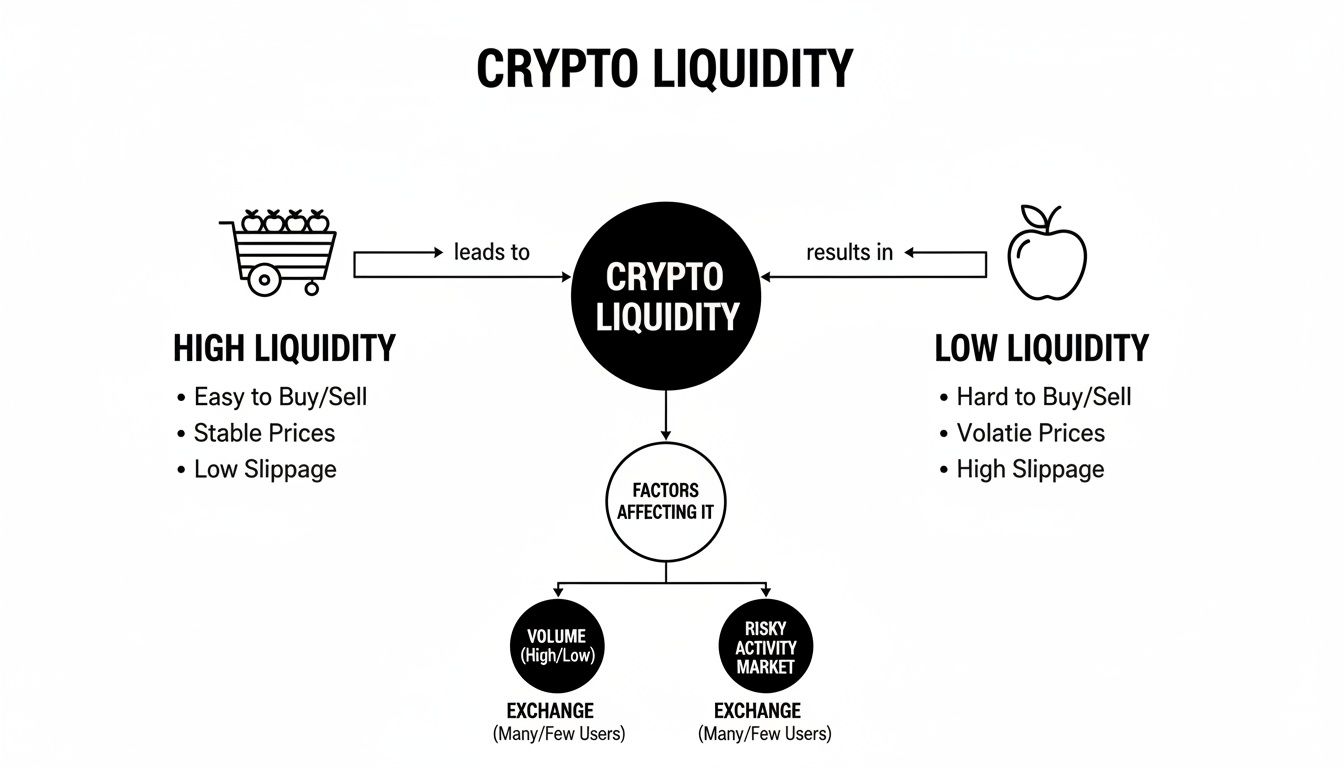
As you can see, a market with deep liquidity is like a full apple cart—it can handle a lot of buying and selling with little price change. But a market with thin liquidity is like a cart with just one apple; a single trade can send the price flying.
How to Measure and Evaluate Crypto Liquidity

Alright, enough with the theory. Let's get practical and learn how to read a market's vital signs before you put a single dollar on the line.
Gauging liquidity isn't some dark art reserved for pro traders. It's a fundamental skill that helps you sidestep hidden costs and simply make smarter moves. By keeping an eye on a few key metrics, you can quickly tell if a market is healthy and ready for trading, or if it’s a minefield waiting to blow up your position.
Think of these metrics as your personal risk assessment toolkit. They tell you a story about how easily you can get in and out of a trade, and just as importantly, how much it's going to cost you.
Core Metrics for Liquidity Analysis
To really get a feel for a market, you need to look beyond just the sticker price. A few key indicators will paint a much fuller picture of its true health.
Here are the big ones you need to track:
Trading Volume: This is the total value of an asset traded over a set time, usually 24 hours. High volume is a great sign; it shows there's strong interest and a flurry of activity, which almost always means better liquidity.
Bid-Ask Spread: This is the tiny gap between the highest price a buyer will pay (the bid) and the lowest price a seller will take (the ask). A narrow spread is what you want to see. It’s a classic sign of a liquid market because it means the immediate cost to trade is low.
Market Depth: This tells you how well a market can handle large orders without the price going haywire. A "deep" market has a fat order book packed with buy and sell orders at all different price levels, ready to absorb big trades.
You’ll find these metrics plastered all over exchange interfaces and data platforms like CoinGecko. When you look at them together, they give you a fantastic snapshot of a market's stability. A high trading volume is good, but if the market depth isn't there, one single large trade could still send the price spiraling.
Understanding Price Impact and Slippage
The most direct—and often painful—way to experience liquidity (or a lack of it) is through slippage. It’s the difference between the price you thought you were getting when you placed your order and the price you actually got when the trade went through.
Here’s how it plays out: in a market with low liquidity, a big buy order can chew through all the available sell orders at the current price in a flash. This forces you to buy at progressively higher and higher prices to fill your order. That upward price movement is your price impact, and the total value you "lose" in the process is the slippage.
Slippage is the hidden fee you pay for trading in an illiquid market. It can turn what looked like a profitable trade into a loser before you've even started.
Many decentralized exchanges (DEXs) will even give you an estimated slippage percentage before you hit confirm. Pay very close attention to that number—it’s one of the simplest ways to protect your capital from getting chipped away.
It's also worth looking at a protocol's Total Value Locked (TVL). While not a direct measure of trade liquidity, it gives you a good sense of its overall scale and user trust. You can dive deeper into our guide to understand what TVL in crypto represents and how it fits into your broader analysis.
The Hidden Dangers of Low Liquidity in DeFi

Shallow liquidity isn't just a minor annoyance—it's a place where your capital can quietly disappear if you're not careful. When a market lacks depth, every trade you make carries more weight, and a few nasty surprises can pop up. These aren't just textbook theories; they hit traders and liquidity providers right in the wallet.
The most common issue is slippage, which we brushed on earlier. It's the price you pay when a market can't handle the size of your trade, pushing your execution price away from what you expected. In an illiquid DeFi pool, a big chunk of slippage can turn what looked like a great trade into an immediate loss.
Impermanent Loss and Rug Pulls
For anyone providing liquidity to Automated Market Makers (AMMs), there's a sneaky risk called impermanent loss that often catches people out.
Let’s say you deposit an equal value of ETH and USDC into a liquidity pool. If ETH suddenly moons, arbitrage traders will swoop in to buy the now-cheaper ETH from your pool. You're left holding more of the stable USDC and less of the asset that's skyrocketing.
The pool rebalances itself, but it means your assets would have been worth more if you'd just held them in your wallet. The trading fees you earn are meant to cover this, but a massive price swing can still leave you with a "loss" compared to just holding. We dive much deeper into this and other hazards in our guide to understanding liquidity pool risks.
But the most devastating danger is the "rug pull." This is a straight-up exit scam where shady developers launch a new token, pair it with a major asset like ETH in a liquidity pool, and hype it to the moon. Once enough investors pile in, the creators dump their own worthless tokens, drain all the valuable ETH, and vanish. Everyone else is left holding a bag of nothing.
Market-Wide Liquidity Crunches
Thin liquidity doesn't just hurt individual tokens; it can spiral into total market chaos. When volatility spikes, you can get a "liquidity crunch" where everyone is trying to sell at once, but there's nobody left to buy. This causes prices to nosedive as forced liquidations steamroll the already thin order books.
This chart from CoinMarketCap shows total liquidations across the crypto market.
Those huge spikes show how forced selling during market stress can wipe out billions in a single day. In one historic event on October 10, 2025, geopolitical news sparked a panic that liquidated a staggering $19.16 billion in positions in just 24 hours. It’s a brutal reminder of how quickly low liquidity can amplify panic and create a massive domino effect.
Alright, theory is one thing, but keeping your capital safe is another. It all comes down to action. I've put together my own pre-flight checklist that I run through before putting any funds into a new token or DeFi protocol.
Think of it as a simple, repeatable framework for doing your own liquidity analysis. Running through these steps will help you spot the red flags and make much smarter decisions.
1. Start with the Bird's-Eye View on Aggregators
My first stop is always a data aggregator like DeFi Llama or CoinGecko. These sites give you a quick, high-level picture of a project's overall health.
Here’s what I’m looking for:
Total Value Locked (TVL): Does the TVL feel substantial? For a smaller project, I’d want to see something above $10 million. More importantly, what's the trend? A steadily growing TVL is a great sign of user trust. If it's plummeting, that's a major warning.
24-Hour Trading Volume: Always check for consistent, healthy volume. If you see a token with a $50 million market cap but it's only trading $50,000 a day, that’s a massive red flag. The liquidity just isn't there.
This whole check takes less than five minutes and it's amazing how many projects you can immediately filter out just based on these two numbers.
2. Fake a Trade to See the Real Slippage
This is where the rubber really meets the road. Head over to a decentralized exchange (DEX) where the token is actively traded, like Uniswap or Curve. You don't actually have to complete the trade, just set it up.
Try entering a reasonably sized swap—let's say $5,000 worth of USDC for the token you're researching. The DEX interface will immediately give you an estimate for "Price Impact" or "Slippage."
If a simple $5,000 trade is showing more than 1-2% slippage, you know the pool is too shallow. This is a critical signal. It tells you the market can't handle even a modest trade without messing up the price, making it a super risky place to park your money.
3. Peek at the Order Book on Centralized Exchanges
If you're looking at a token listed on a centralized exchange (CEX) like Coinbase, the tool you want is the order book depth chart. It’s a visual representation of all the buy and sell orders.
What you want to see are thick "walls" of buy and sell orders packed tightly around the current market price. If you see big gaps between price levels, or the walls look paper-thin, it means one decent-sized market order could blow right through the book, causing some serious slippage.
4. Dig into Who Owns the Tokens
For my final check, I use a block explorer like Etherscan to look at the token's holder distribution. Just find the token and click on the "Holders" tab. This shows you exactly what percentage of the supply is held by the top wallets.
Concentration Risk: If you see the top 10 wallets (ignoring exchange and protocol addresses) holding more than 50% of the supply, that’s a big warning sign for me.
Whale Dumping: All it takes is one of those large holders to decide to sell, and they could completely crash the price and suck all the liquidity out of the pool. Everyone else would be left holding the bag.
This simple, four-step process takes the abstract idea of "liquidity" and turns it into a concrete set of checks you can perform to protect your hard-earned capital.
Finding Safe and Competitive Yield in 2026
Going through a full liquidity checklist for every single opportunity is a solid way to keep your capital safe. But let's be real—the DeFi market moves at a dizzying speed.
With thousands of protocols and pools popping up across countless chains, trying to track them all in real-time is more than a full-time job. For most of us, it's pretty much impossible.
This is exactly why a new wave of tools has surfaced, designed to do the heavy lifting for you. You can finally move past the grind of manual checks and take a smarter, more modern approach to finding good yield.
Adopting a Liquidity-Aware Strategy
Instead of spending hours becoming a DeFi detective, you can now tap into platforms that watch key liquidity metrics across the entire market for you, 24/7.
Think of them as your personal analyst, constantly keeping an eye on things like:
Real-time slippage across thousands of different pools.
Pool depth and whether it can actually handle sizable trades.
24-hour trading volume and where it's trending.
Token holder distribution to sniff out any concentration risks.
This kind of automated analysis is the heart of what we call a liquidity-aware strategy. It’s not just about chasing the highest APY you see advertised. It’s about making sure your funds are flowing into deep, resilient markets that won't crumble at the first sign of volatility.
The real goal here is to find that sweet spot where strong yield and deep liquidity meet. Thankfully, technology now lets us pinpoint these safer, more reliable income streams systematically.
How Yield Seeker Automates Safety and Yield
At Yield Seeker, we’ve built an AI-powered platform to do just that. We became so excited about this vision that we decided to build it ourselves!
Our system automates all the tedious liquidity analysis so you don’t have to. Your personalized AI Agent is constantly evaluating opportunities, automatically shifting your funds to protocols that offer the best balance of competitive returns and genuinely low risk.
This approach ties together everything we've talked about—from slippage to TVL—and puts it into action. It makes sure your stablecoins are always working for you in the smartest, safest way possible, so you can earn passive income with real confidence.
Even after you get the hang of liquidity, there are always a few questions that keep popping up. Let's run through them so you have the full picture.
What’s a “Good” Amount of Liquidity for a Crypto Project?
Honestly, there's no magic number. "Good" is always relative to how big and how old a project is.
That said, a really useful metric to look at is the Total Value Locked (TVL) to Market Cap ratio. If you see a ratio above 0.2, that’s a healthy sign. It tells you a decent chunk of the token's total value is actually being put to work in DeFi, which helps support its liquidity.
For a brand new project, a TVL over $10 million is a good start, and you’ll want to see daily trading volume hitting at least 5-10% of its market cap. For the big, established tokens, you should expect to see much, much higher numbers.
Can a Coin With a High Price Have Low Liquidity?
Absolutely. And this is a trap a lot of people fall into. Price and liquidity are two totally different things. A token could have a $1,000 price tag, but if only a few people are trading it, the liquidity is dangerously low.
Think of it like a rare painting valued at $1 million. The price is high, but finding someone willing to buy it at that exact price could take months. In the same way, a high-priced coin with a thin order book is a recipe for disaster. One large sell order could send the price into a nosedive.
Key Takeaway: Never confuse a high price with a healthy, liquid market. You always need to check the trading volume and market depth to see what’s really going on.
How Does Providing Liquidity Actually Make You Money?
When you deposit your assets into a liquidity pool, you become what’s known as a Liquidity Provider (or LP). Think of it as stocking the shelves of a marketplace.
For doing that, you get a small cut of the trading fees every single time someone uses that pool to swap tokens. These fees are your reward for making the market run more smoothly for everyone else.
Is TVL the Best Way to Judge Liquidity?
TVL is a great starting point, but it's not the whole story. A high TVL is a strong signal of user trust and shows there's a lot of capital behind a protocol. That’s good.
But, it doesn't automatically mean there's good trading liquidity. You could have a pool with a massive TVL where the trading volume is practically zero. The assets are just sitting there, not facilitating trades. For a full picture, you always need to look at TVL alongside trading volume and even run a few slippage tests yourself.
Ready to stop hunting for yield and start earning smarter? Yield Seeker uses AI to automatically find and manage the best risk-aware stablecoin yields for you. Get started with your AI Agent today.