If you're diving into decentralized finance (DeFi), the very first thing you need is a DeFi wallet. Think of it as your personal, digital key to this new financial world. Unlike a traditional bank account, where someone else holds your funds, a DeFi wallet gives you sole ownership and control over your own crypto assets.
Your Digital Passport to Decentralized Finance
Imagine a financial world without the banks, brokers, and middlemen we’re all used to. That's the big idea behind DeFi, and your wallet is the tool that lets you step inside and interact with it directly. It’s way more than just a place to stash your crypto—it's your connection to the blockchain networks that power it all.
The best way to think about it is by comparing it to something you already know. Your bank account is like renting an apartment. Sure, you live there, but the landlord (the bank) has the master key and sets the rules. They can lock you out or limit what you do.
A DeFi wallet is like owning your own home. You have the only set of keys. This gives you complete freedom, but it also means you're entirely responsible for keeping those keys safe. If you want to dig a bit deeper into this, check out our guide on what a crypto wallet is.
To really grasp the difference, let's put them side-by-side.
DeFi Wallet vs Traditional Bank Account
Feature | DeFi Wallet (Non-Custodial) | Traditional Bank Account |
|---|---|---|
Custody | You hold your own private keys. You are your own bank. | The bank holds your funds on your behalf. |
Control | Full control over your assets. No one can freeze your funds. | The bank can freeze or limit access to your account. |
Accessibility | Accessible 24/7 from anywhere with an internet connection. | Limited by banking hours, national borders, and regulations. |
Security | Your responsibility. "Not your keys, not your crypto." | Insured by government entities (like FDIC), but vulnerable to bank failures. |
Transactions | Peer-to-peer, directly on the blockchain. | Mediated by the bank and other financial institutions. |
This table makes it pretty clear: the shift to a DeFi wallet is a move from trusting an institution to trusting yourself and the underlying technology.
The Gateway to a New Financial System
So what is a DeFi wallet, practically speaking? It's a software app—like the MetaMask browser extension or a mobile app like Trust Wallet—that acts as your main remote control for decentralized applications, or "dApps." These dApps are just programs built on smart contracts, which are self-running bits of code on a blockchain that handle everything from lending to trading.
With your wallet, you can do all the core activities that make DeFi tick:
Sign Transactions: This is like giving your digital signature to approve an action, whether it's sending money or using a dApp.
Swap Tokens: Directly trade one crypto for another without needing a centralized exchange like Coinbase or Binance.
Earn Yield: Put your assets to work by lending them out or providing liquidity to different protocols to earn rewards.
Interact with dApps: Connect to platforms like Uniswap for trading or Aave for lending, all from your wallet.
The entire system is built on one crucial concept: self-custody. It means you, and only you, hold the private keys that prove ownership of your funds. This idea of financial freedom is what truly sets DeFi apart from the old-school financial system.
This direct-access model is catching on. Back in late 2021, there were about 7.5 million unique DeFi wallet addresses. As the space grew, that number exploded to 27.7 million users by 2025, a clear signal that people want more open and direct control over their money.
How DeFi Wallets Actually Work Under the Hood
So how does a DeFi wallet actually keep your crypto safe while letting you interact with apps? It all comes down to a clever bit of tech called public-key cryptography. This might sound complicated, but the idea is actually quite simple. It creates a matched pair of digital keys that give you total control over your assets on the blockchain.
Every wallet you create comes with two keys that work together: a public key and a private key.
Your public key creates the address you use to receive funds. Think of it like your home address or your bank account number—it’s a string of characters you can safely share with anyone who wants to send you crypto.
Your private key, on the other hand, is the master key to your digital vault. It's a secret string of characters that lets you—and only you—access and spend the funds at your address. You should never, ever share your private key with anyone. It's the one thing that proves you own your crypto.
The Master Key to Your Digital Life
When you first set up a wallet, it generates something even more important: a seed phrase (often called a recovery phrase). This is usually a list of 12 or 24 simple words that acts as the master backup for your entire wallet.
This is the real magic of self-custody. It puts you in the driver's seat.
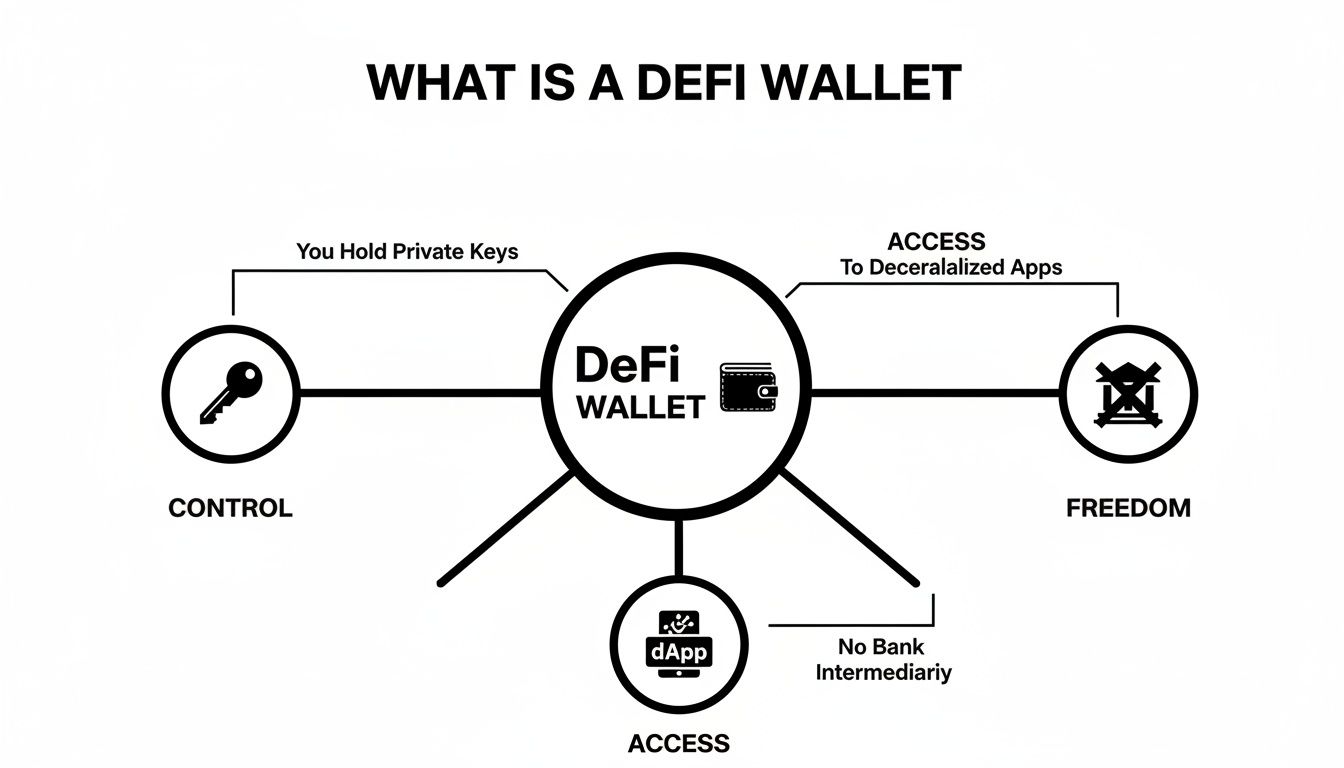
As you can see, a DeFi wallet is all about combining personal control over your keys with direct access to dApps, cutting out the traditional bank as a middleman.
Your seed phrase is your ultimate safety net. If you lose your phone, your computer dies, or you forget your password, this phrase lets you restore your entire wallet and all your assets on a brand new device. This is why keeping it safe—and offline—is the single most important rule in crypto security.
Signing Transactions: Your Digital Handshake
So, how do these keys work when you want to do something, like send USDC to a platform like Yield Seeker? When you start a transaction, the app will pop up a request asking you to "sign" it.
"Signing" is just you using your private key to create a unique digital signature. This signature is a cryptographic seal of approval, proving you authorized the transaction. It gets sent to the blockchain, where anyone can check that the signature matches your public key. The best part? This all happens without your private key ever being revealed.
This process is the very heart of self-custody. It allows you to prove ownership and give consent without ever handing your keys to someone else. It's the technology that makes true financial self-sovereignty a reality.
Exploring the Different Types of DeFi Wallets
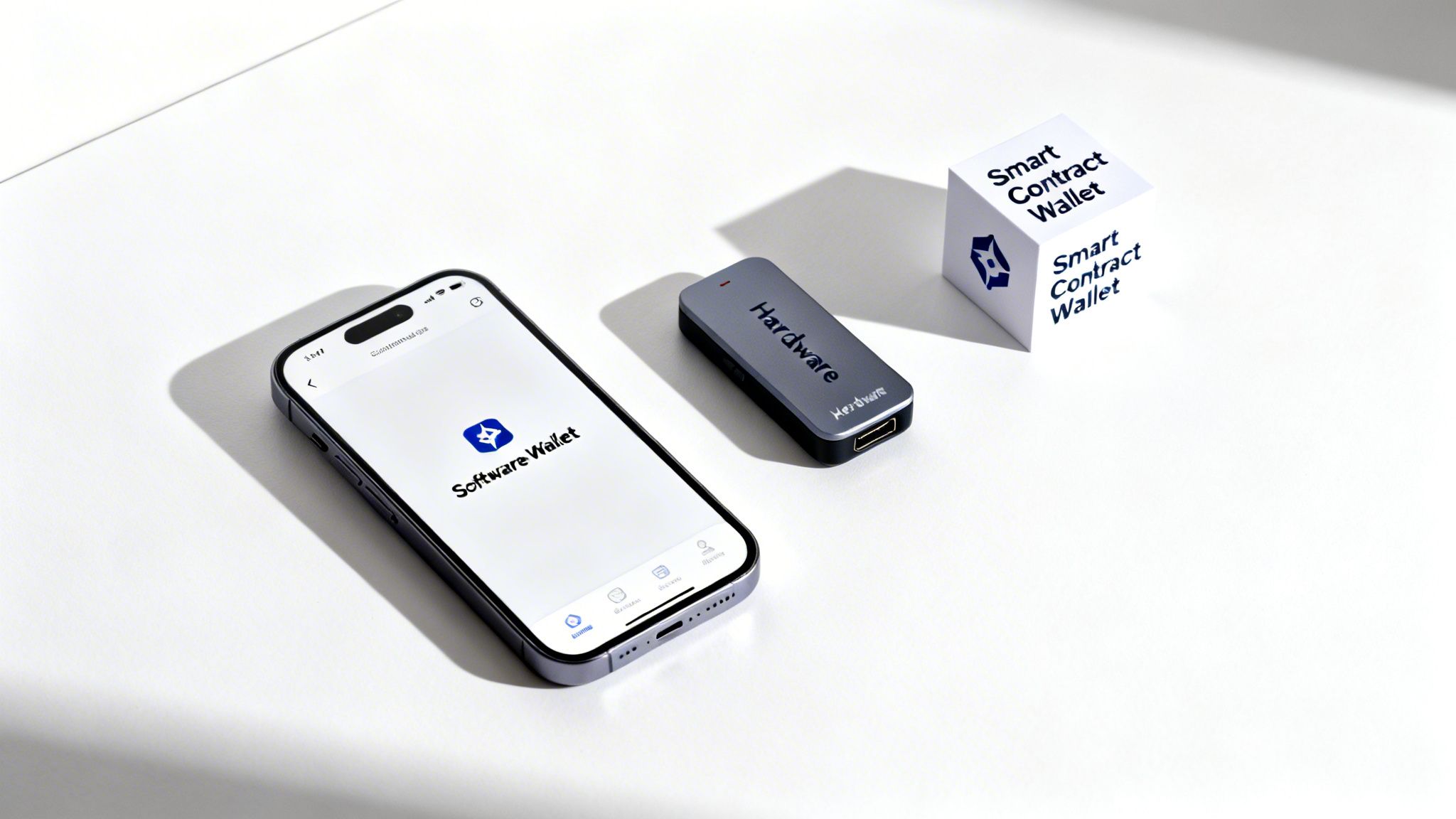
Alright, so you get the basics of how a DeFi wallet works. Now for the important part: picking the right one for you. Not all wallets are built the same; they all make a trade-off between everyday convenience and iron-clad security.
Getting this balance right is the key to a smooth and safe DeFi experience. The three main players you'll come across are software wallets, hardware wallets, and a newer breed called smart contract wallets. Most seasoned DeFi users actually use a combination of these, and here’s why.
Software Wallets: The Hot and Convenient Option
First up are software wallets, which you'll often hear called "hot wallets." These are just apps that run on your computer or phone—think browser extensions like MetaMask or mobile apps like Trust Wallet.
Their main feature is that they're always connected to the internet. This makes them incredibly easy to use for daily DeFi tasks like connecting to apps, swapping some tokens, or zipping funds around. But that constant online connection is also their Achilles' heel, as it exposes your private keys to potential online nasties like malware and phishing scams.
A software wallet is your best bet when you're:
Actively trading on decentralized exchanges and need to move fast.
Exploring new dApps and just trying things out.
Holding small amounts of crypto for regular use, kind of like the cash you'd keep in your physical wallet.
The philosophy behind a hot wallet is access over armor. You're choosing speed and ease of use, which is exactly what you need for active participation in the DeFi world.
Hardware Wallets: The Cold and Secure Vault
On the complete opposite end of the spectrum, you have hardware wallets. These are physical devices, like a Ledger or a Trezor, that store your private keys entirely offline. That’s why we call them "cold wallets."
They create a physical "air gap" between your keys and the internet. When you want to make a transaction, the request gets sent to the device, and you have to physically press a button on it to give your approval. Your private keys never, ever leave that secure little device, making them virtually untouchable by online hackers. This is the gold standard for protecting serious amounts of crypto.
Smart Contract Wallets: The Next Generation
Then there's the new kid on the block: the smart contract wallet. Instead of just being a set of keys, the wallet itself is a smart contract living on the blockchain. This might sound a bit abstract, but it unlocks some seriously powerful features that traditional wallets just can't match.
For instance, they can enable things like social recovery. You can designate trusted friends or other wallets to help you get back into your account if you lose your main device—no more panicking over a lost seed phrase! They can also set up "gasless" transactions, where another service pays your network fees for you. These wallets are really paving the way for a much more user-friendly and forgiving version of DeFi.
Choosing Your DeFi Wallet Type
To help you decide, let's break down the key differences in a simple table. Think about what you'll be doing most often and how much risk you're comfortable with.
Wallet Type | Primary Use Case | Security Level | Convenience |
|---|---|---|---|
Software Wallet | Frequent trading, exploring dApps, small balances | Lower | Highest |
Hardware Wallet | Long-term holding, securing large amounts | Highest | Lower |
Smart Contract Wallet | Advanced features, enhanced security, ease of use | High | High |
Ultimately, there's no single "best" wallet—only the best wallet for a specific job. Many people use a software wallet for their daily "degen" activities and a hardware wallet to sleep soundly at night, knowing their main stash is secure.
A Step-By-Step Guide to Securing Your DeFi Wallet
Alright, let's talk security. Your DeFi wallet is the foundation for everything you do in this space, so making sure it's built on solid ground is something you just can't skip. Getting your first wallet set up is exciting, but it comes with a huge responsibility: keeping your funds safe.
The single most important moment is right at the very beginning. When you create a new wallet, you'll be handed a seed phrase, which is usually a list of 12 or 24 words. This isn't just a backup; it's the master key to your entire crypto life.
Your seed phrase is your ultimate safety net. If you lose your phone or your computer dies, this phrase is the only thing that lets you recover your wallet and all your assets on a new device. You need to treat it like the most valuable secret you own.
Guarding Your Master Key
The absolute golden rule here is to keep your seed phrase offline. I can't stress this enough. Never, ever store it on your computer, in a cloud service like Google Drive, or even in a password manager. As soon as it’s digital, it's a potential target for hackers.
Instead, you need to go old-school and write it down physically.
Write It Down: Grab a pen and paper. Even better, consider getting a metal plate specifically designed for storing seed phrases—they’re made to survive fires and floods.
Store It Securely: Lock your written phrase away in a personal safe, a bank's safety deposit box, or another secure location that only you can get to.
Create Redundancy: I’d even suggest making two physical copies and storing them in two different secure places. You can never be too careful.

Essential Day-to-Day Security Habits
Beyond just locking down your seed phrase, building smart daily habits is what will keep you safe in the long run. In DeFi, the biggest risk is often just getting complacent.
First off, always use a strong, unique password for the wallet app itself. This acts as a first line of defense on your phone or computer, stopping someone from getting in if they happen to get their hands on your device.
Second, be relentlessly skeptical. Scammers are constantly sending unsolicited messages, emails, and creating fake pop-ups. They often use phishing tactics to trick you into giving up your private keys or seed phrase, usually by sending you to a convincing-but-fake website. It's well worth your time to get familiar with the 10 Key Types of Social Engineering Attack so you can spot these traps from a mile away.
And this threat is very real. In the first quarter of 2026 alone, a staggering $137 million was stolen across 15 different platforms, which included a nasty $27.3M private key breach. Security isn't just a suggestion; it's a necessity.
Investing in a Hardware Wallet
As your crypto portfolio grows, your security setup needs to grow with it. Software wallets are fantastic for convenience and everyday use, but they aren't the best place for storing a significant amount of value. This is where a hardware wallet becomes a must-have.
These are small, physical devices that keep your private keys completely offline, creating a physical barrier that online hackers simply can't cross. For anyone serious about protecting their assets, pairing a hardware wallet with your day-to-day software wallet gives you the perfect mix of security and convenience.
If you’re ready to take that next step, we have a whole guide on how to use a hardware wallet that dives into the specifics.
How to Connect Your Wallet to the DeFi Ecosystem
Alright, you’ve got your wallet set up and secured. Now for the fun part: plugging into the world of DeFi and putting your crypto to work. Connecting your wallet to a decentralized application (dApp) is the moment it transforms from a simple storage vault into your personal key to a new financial internet.
Think of it like using your Google or Facebook account to log into a new website. Instead of a password, you're using your wallet to identify yourself. Most dApps will have a big "Connect Wallet" button, usually tucked in the top-right corner. Clicking it will pop up your wallet extension (like MetaMask) or show a QR code for your mobile wallet to scan.
And don't worry, this isn't handing over the keys to your house. Connecting to a dApp only lets it see your public address and ask for your permission to sign transactions. Your private keys never leave your wallet.
A Practical Walkthrough Connecting to Base
Let’s make this real. Imagine you want to take some USDC stablecoins you have on the Base blockchain and put them to work on a yield platform. The process is pretty much the same no matter which dApp or chain you're using.
Head to the dApp: First, navigate to the website of the DeFi protocol you want to interact with. For this example, let's say it's a yield platform like Yield Seeker.
Find the "Connect" Button: Once the page loads, look for the "Connect Wallet" button. It's almost always in the top-right of the screen.
Approve the Connection: Your wallet will pop up and ask if you want to connect to the site. Give it a quick review and hit "Approve." You'll now see your wallet address displayed on the dApp, showing you're successfully connected.
Start an Action: Now you're ready to do something. Let's say you want to deposit your USDC. You'll find the deposit area, type in the amount, and click "Deposit."
Sign the Transaction: Your wallet will pop up one last time, asking you to "sign" or "confirm" the transaction. This is you giving explicit permission, using your private key, to move your USDC into the platform's smart contract.
Once you sign, the transaction gets broadcast to the blockchain. After a few moments, it'll be confirmed, and you'll see your new balance right there on the dApp's dashboard. You’re officially earning yield!
If you're using a wallet like MetaMask that supports multiple chains, you might first need to add the network you want to use. The process is straightforward, and you can see a walkthrough in our guide on how to set up Polygon on MetaMask.
DeFi wallets have come a long way, evolving from simple Ethereum tools to multi-chain powerhouses that support networks like Base, Solana, and more. This evolution has been a game-changer for peer-to-peer finance. In 2025, the DeFi market hit $42.56 billion, but the real explosion is yet to come, with projections soaring to $1,834.78 billion by 2035. This isn't just numbers; it's people. User adoption jumped from 7.5 million in 2021 to 27.7 million in 2025. You can dive deeper into these DeFi market trends.
Alright, you’ve got your DeFi wallet set up and funded. Now for the fun part. This is where you go from simply holding crypto to making it work for you, earning yield while you go about your day.
For a long time, the only way to do this was through something called "yield farming." Honestly, it was a total grind. You had to constantly be on the lookout, manually digging through different protocols, trying to figure out which ones had the best rates and which ones were too risky.
It's basically a full-time job. You're constantly checking interest rates, trying to vet smart contracts, and moving your funds around to chase the highest returns. For anyone with a day job or who's just getting their feet wet in DeFi, it’s a massive headache and a huge barrier.
Automated Yield: The Smarter Way to Play
Luckily, things have changed. A new wave of tools has emerged that makes earning DeFi yield way more accessible. Instead of spending hours hunting for opportunities yourself, you can just connect your wallet to an automated platform that does all the heavy lifting. This is where having your own DeFi wallet really pays off—it’s your all-access pass to these powerful systems.
Picture this: you connect your wallet, transfer in some stablecoins like USDC on the Base chain, and an AI-powered system just takes it from there. These modern platforms are built to:
Scan the Market: They're always on, scanning dozens of DeFi protocols to find the most competitive yield opportunities available at any given moment.
Handle the Risk: They automatically analyze the risks tied to every protocol, helping to keep your capital safe.
Optimize Your Funds: The system intelligently shuffles funds between different sources to squeeze out the best possible returns, all without you lifting a finger.
DeFi wallets are much more than just apps; they're the engine powering a whole new financial system. By 2025, blockchain's slice of this market hit 42.54%, and the smart contracts your wallet talks to generated over $6,200 million in revenue. For someone using a platform like Yield Seeker, you’re plugging directly into that growth, minus the manual grind. You can dig into more of these trends and DeFi market insights if you're curious.
With an automated platform, the experience is simple. You deposit your stablecoins and just watch your balance grow through a clean dashboard. Even better, platforms like Yield Seeker don’t have lockups or withdrawal fees, so you have complete freedom to get your funds whenever you need them. It’s an approach that finally makes earning solid, risk-adjusted yield a real possibility for everyone, not just the full-time DeFi degens.
Frequently Asked Questions About DeFi Wallets
As you start wrapping your head around DeFi wallets, a few practical questions always pop up. Let's tackle some of the most common ones so you can get started with confidence.
Can I Have More Than One DeFi Wallet?
Yes, and honestly, you absolutely should. Most experienced DeFi users run multiple wallets as a basic security measure. The common setup is to have at least two:
A "Hot" Software Wallet: Think of this as your daily driver. It's for connecting to dApps, making trades, and holding smaller amounts of crypto you need quick access to.
A "Cold" Hardware Wallet: This is your vault. It’s where you store your long-term savings and significant assets. Because it keeps your keys completely offline, it’s much more secure.
Splitting your funds this way is smart. If your active software wallet ever gets compromised, your main stash remains safe and sound.
What Happens If I Lose My Phone or Computer?
Losing a device is a nightmare, but it doesn't have to mean losing your crypto. The key thing to remember is your funds aren't actually on your phone or computer—they live on the blockchain.
As long as you have your secret recovery phrase (also called a seed phrase) backed up safely, you can restore your entire wallet on a new device. This phrase is the master key that regenerates your private keys, giving you back full control. This is exactly why writing down your seed phrase and storing it offline is the single most important security step you can take.
Are DeFi Wallets Completely Anonymous?
Not quite. It's more accurate to think of them as pseudonymous. While your real-world identity—like your name and address—isn't directly tied to your wallet, every single transaction is public knowledge on the blockchain. Anyone can look up your wallet address and see all of its activity.
This transparency is actually a big reason why institutions are getting more comfortable with DeFi. In fact, trading on decentralized exchanges through wallets is projected to account for 21% of all crypto volume by late 2025. You can dig deeper into this trend and its impact on the global financial landscape if you're curious.
Ready to put your stablecoins to work without all the hassle? With Yield Seeker, you just connect your wallet, deposit USDC, and let our AI-powered platform automatically find competitive, risk-aware yields for you. Start earning smarter today.