
A treasury money market is a short-duration cash vehicle built mainly on U.S. Treasury bills and Treasury-backed repo. If you've got idle stablecoins, corporate cash, or a treasury balance that needs to sit somewhere safer than a volatile asset, it acts as a very high-quality parking garage for cash, where the goal is to keep money moving, available, and earning something without taking much credit risk.
That's why this corner of finance matters. It sits between “leave it idle” and “reach for yield,” and for founders, finance teams, and crypto treasuries, that trade-off shows up every time cash starts to pile up.
A Simple Way to Picture a Treasury Money Market
A founder closes a funding round and suddenly the operating wallet is full. A finance lead sees payroll, vendor payments, and tax bills all coming due on different dates. A stablecoin holder has capital sitting still and wants it to do something useful without turning into a speculative position.
A treasury money market exists for that exact problem. It's a short-duration cash-management vehicle that invests primarily in U.S. Treasury securities and Treasury-backed repurchase agreements, which makes it a government money market subtype rather than a broad corporate-credit fund. The broader money market itself is the part of finance where highly liquid short-term instruments with maturities of one year or less are traded, and U.S. Treasuries sit near the center because they're widely used for cash management and collateral. Money market definition and Treasury role
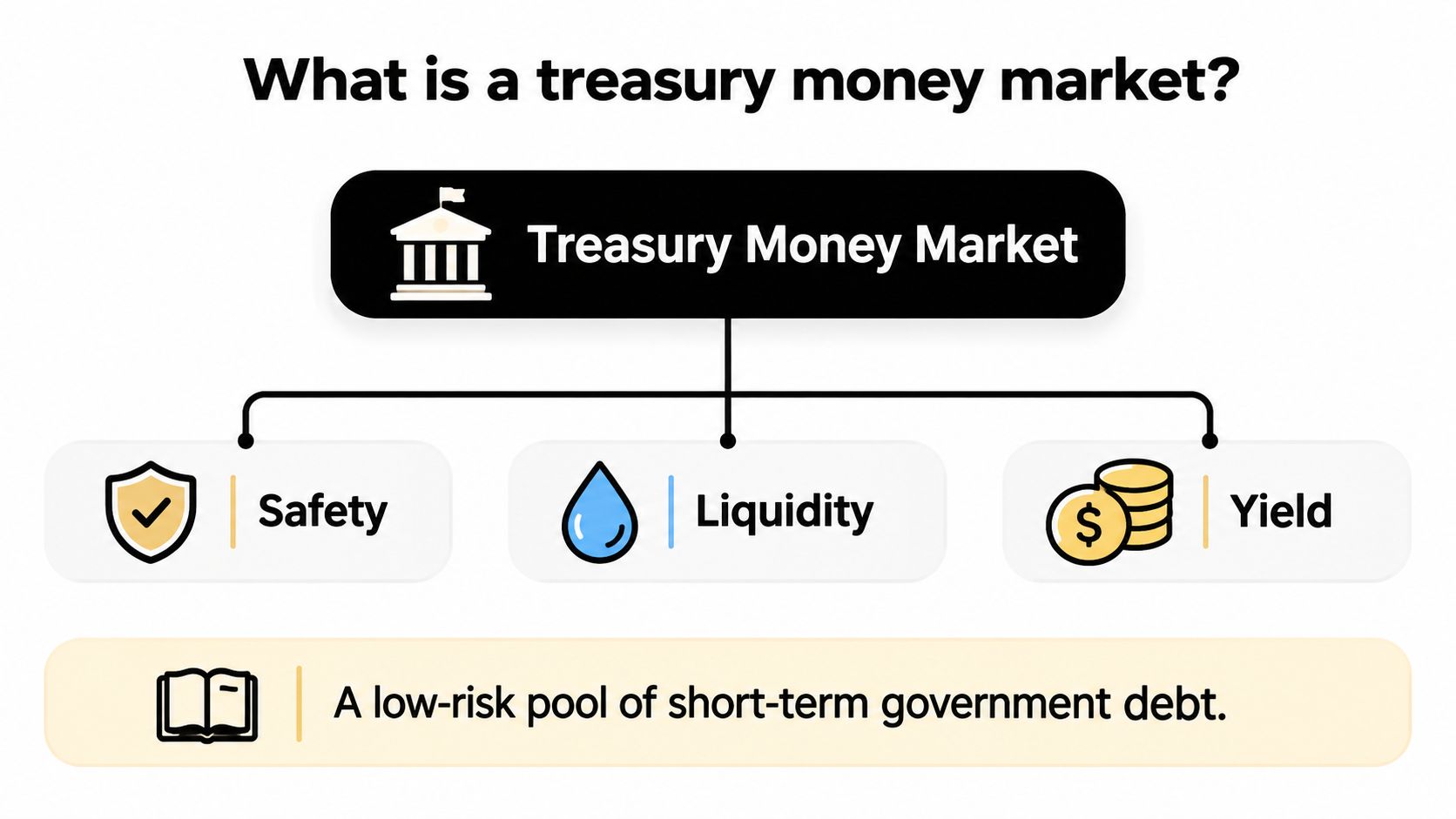
The easiest mental model is a parking garage for cash. You want it close to the exit, not in a distant lot, and you want the structure to be dependable enough that you don't worry about the car while it's inside. Treasury money markets aim to do that with government-backed, very short-dated assets, which is why they appeal to people who care more about liquidity and principal stability than about squeezing out long-term returns.
That framing also helps crypto-native readers. Stablecoins and treasury balances can feel “cash-like,” but cash-like doesn't automatically mean cash-safe, or cash-available on your timeline. The rest of the piece is about what sits inside the vehicle, why its rules are so strict, and where the trade-offs show up when you compare it with bank products or on-chain yield.
The Instruments That Live Inside It
A Treasury money market is built from a narrow set of instruments that can turn back into cash quickly and do not ask the investor to take on much maturity risk. The mix matters because it tells you whether the vehicle is behaving like a short-term cash tool or drifting toward something that tries to earn more by stretching time.
Treasury bills, or T-bills, are the clearest starting point. They are sold at a discount and redeemed at face value, so the return comes from the gap between the purchase price and the amount paid at maturity. A four-week T-bill bought below par and paid back at par is easy to follow because the cash flow is visible from start to finish.
Short-dated Treasury notes still belong to the government debt family, but they play a smaller role in a pure cash-parking setup. They matter more as a reference point for investors who are comparing very short government exposure with instruments that have a little more rate movement built in.
Repurchase agreements, or repo, are the plumbing that keeps the structure moving. One party lends cash, another posts Treasuries as collateral and agrees to buy them back later. Overnight repo is the simplest version, and it lets the fund stay liquid while still resting on government collateral.
Commercial paper and certificates of deposit sit nearby in the broader money market, but they do not define a Treasury-focused vehicle. Those instruments introduce corporate credit or bank credit exposure, which makes them better suited to broader money market structures that are willing to step outside the government-only core. For a wider view of how those pieces fit together, see further reading on broader money market structure.
Practical rule: If the instrument depends on a corporate borrower or a bank borrower, you are already moving away from the pure Treasury cash box and toward a different risk profile.

The scale behind this market is large. U.S. Treasury securities outstanding reached $28.1 trillion in December 2024, up from $20.9 trillion in December 2020. That helps explain why Treasury-backed cash management has become such a big reference point for anyone comparing idle capital, whether they hold dollars in a fund, keep reserves on a balance sheet, or think about stablecoin treasury management in crypto. U.S. Treasury market size and foreign holdings
That is the key point. A Treasury money market is not a grab bag of short-term assets. It is a deliberate choice to sit close to the safest and most liquid government instruments, then use repo as a liquidity tool instead of leaning on private credit.
The Rules That Shape the Vehicle
A Treasury money market fund feels simple from the outside, but inside it's really a shoebox full of rules. Those rules exist to keep the fund short, liquid, and close to government credit, so managers don't drift into products that look safe but behave very differently under stress.
The guardrails that matter
The first guardrail is the 99.5% government-and-repo asset rule. U.S. Treasury money market funds are expected to hold at least 99.5% of total assets in cash, U.S. Treasury securities, and repos backed by Treasuries. That keeps the portfolio's center of gravity fixed on government collateral rather than issuer credit. Treasury fund structural rules
The second guardrail is maturity. Money market fund rules cap any individual security at 397 days and require a weighted average maturity of 60 days or less. That's the part people miss when they think the fund is just “safe cash.” It's not built to hold long enough for yield to compound over time, it's built to keep maturities rolling over fast.
Why those rules change the risk
Those limits shift the risk profile away from issuer default risk and toward rate dynamics and spread dynamics. If the fund owns only very short paper, it can't hide from changing short-term rates. It also can't stretch duration to lock in yield the way a longer bond fund might.
That's why the stable $1 share price matters psychologically and operationally. It keeps the vehicle usable as a cash-management tool, not a fluctuating investment account. For treasury teams, that means the structure is built to support same-day or next-day liquidity needs, which is the whole point of keeping operating cash in this kind of sleeve.
A Treasury money market works because the portfolio is constrained before it's clever. The rules are the product.
For finance teams and crypto treasuries, that's the key lesson. The appeal isn't sophistication, it's the way the rule set narrows the things that can go wrong when you're just trying to preserve cash and access it quickly.
How Yield Actually Moves
Treasury money market yield looks stable from far away, but the engine underneath is constantly resetting. That's why it's better to think in terms of discount pricing and roll-down of short maturities than in terms of a fixed return.
Discount pricing and reinvestment
T-bills are sold below par and mature at face value, so the gain is the difference between what you paid and what you receive at maturity. That structure makes the return easy to trace, but it also means the yield is tied tightly to the short end of the rate curve rather than to a long-term coupon stream. How Treasury bill pricing works
Money market funds then keep recycling that process. As holdings mature, the cash gets reinvested into new short-dated securities and repos. That repeated reinvestment is the roll-down effect, and it's why fund income changes quickly when short-term rates move.
What rate changes do to you
When policy rates rise, fund yields tend to adjust relatively quickly as old paper matures and gets replaced at higher prevailing rates. When rates fall, the opposite happens just as fast. That's the point many people miss when they treat Treasury money markets like a set-and-forget yield source.
Practical rule: A Treasury money market is designed to transmit short-term rates to cash holders, not to protect you from rate changes.
The Federal Reserve Bank of New York's discussion of repo market conditions shows how closely money market pricing is tied to policy and funding conditions, especially in secured lending markets where Treasury repo is dominant. Money market conditions and repo pricing
Here's the practical takeaway. If you want a place for operating cash, emergency reserves, or short-term stablecoin balances, a Treasury money market can be useful because it tends to keep liquidity high while tracking the short end of the market. If you want income that stays sticky, this is the wrong tool.
Treasury Money Markets vs Bank Accounts and Stablecoins
The right comparison isn't “safe versus unsafe.” It's which kind of risk you're choosing to hold, and which kind you're trying to avoid. A Treasury money market shifts you toward very short-duration government exposure. A bank product shifts you toward deposit-banking protection and bank balance-sheet risk. A stablecoin or DeFi yield setup shifts you toward protocol, reserve, and smart-contract risk.
Treasury money market vs common alternatives
Instrument | What backs it | Liquidity | Insurance / protection | Main risk being substituted |
|---|---|---|---|---|
Treasury money market | U.S. Treasury securities and Treasury-backed repo | High, often designed for same-day or next-day access | Not FDIC-insured | Short-term rate changes and fund-level operational or liquidity risk |
Bank money market account | Bank deposit relationship | Usually linked to bank transfer timing and account rules | FDIC or similar deposit protection, subject to program limits | Bank credit and deposit-channel constraints |
High-yield savings account | Bank deposit relationship | Generally accessible, but still routed through the bank | FDIC or similar deposit protection, subject to program limits | Bank credit and rate resets |
Stablecoin yield position | Token reserves, protocol design, or DeFi strategy | Varies by chain, wallet, and protocol | No FDIC protection | Reserve quality, smart-contract, and platform risk |
The most important distinction is that a Treasury money market fund is a securities vehicle, not a bank deposit, so it is not FDIC insured. That doesn't make it fragile. It just means the safety story is different. In this context, “safe” means very short-duration government credit exposure plus high liquidity, not a guarantee against every market, fund, or operational stress.
A second difference is how yield gets set. In a bank account, the bank decides the rate inside its own funding model. In a Treasury money market, income tracks short-term market conditions much more directly. For stablecoin holders, that difference matters because a Treasury-style sleeve behaves more like a liquid reserve benchmark than like a fixed-income promise.
The sharpest crypto-native analogy is this. A Treasury money market is closer to a reserve management layer than an alpha strategy. It's the thing you use when you want the balance sheet to stay simple, transparent, and available, even if the yield isn't exciting.
What It Means for Corporate and Crypto Treasuries
Corporate treasury teams and crypto treasuries are solving the same core problem, even if they use different rails. They need to decide which cash is operating cash, which cash is reserve capital, and which balances can afford to take more duration or protocol risk.
The shared logic
A traditional treasury team looks at the next known outflow, then chooses a short-duration bucket that matches that timing. The logic is simple. Don't reach for a long lockup if payroll is close, and don't leave idle cash unassigned if it could be sitting in a low-friction reserve sleeve.
Crypto treasuries can borrow that same mental model. If a DAO, protocol, or stablecoin business keeps balances in stablecoins, those balances still need a cash-equivalent definition that's explicit. Cash-equivalent should mean liquid, short-duration, and reliable enough to fund the next obligation without forcing a rushed trade.
Money market funds are one of the largest institutional buyers of Treasury bills and repo instruments, and U.S. money market fund assets reached $7.90 trillion on June 24, 2026, including $6.52 trillion in government funds. ICI money market fund statistics
That scale matters because it shows how institutional cash managers already think about the problem. They use Treasury-backed short duration to keep money close to the exit while still earning market-based short-term rates.
Where the crypto comparison gets interesting
For a crypto project, parking stablecoins in a Treasury-style short-duration sleeve changes the conversation. You stop asking only, “What yield can I get?” and start asking, “What happens if I need this money tomorrow, or if the market turns sharply?” That's a better balance-sheet question.
A useful companion resource is treasury management insights from Visbanking, especially if you want to compare traditional bank treasury practices with what crypto-native teams are trying to build.
Practical treasury management guidance for teams
The clean takeaway is that Treasury money markets are a mental model, not just a U.S. product. They teach you how to separate cash preservation from yield chasing, which is exactly the distinction crypto treasuries need if they want to avoid turning working capital into a hidden risk position.
How to Evaluate and Implement a Treasury Cash Strategy
A useful treasury strategy starts with purpose, not with product selection. If you don't define what the cash is for, you'll end up choosing an instrument based on yield alone, and that's usually how treasury mistakes get made.
A simple operating framework
Define the cash job. Decide whether the balance is operating runway, reserve capital, or contingency cash. Each one has a different tolerance for timing risk.
Map known outflows. Tie payroll, taxes, vendor payments, redemptions, or protocol obligations to dates.
Match instrument to bucket. Very short-dated government cash for near-term needs, broader short-term tools only if the risk is clearly understood.
Choose transparent counterparties or platforms. You want reporting that tells you what's happening, not just a headline yield number.
Set monitoring triggers. Use a yield floor, concentration limits, and a review cadence for counterparties or protocols.
Write down override rules. Decide in advance when the strategy gets broken, such as during liquidity stress, governance changes, or a major rate shift.
Operational rule: If you can't explain the cash bucket on a one-page memo, you probably haven't separated operating cash from yield-seeking capital yet.
Documentation matters more than many teams expect. Keep an audit trail for every allocation decision, separate who approves from who executes, and make sure the person monitoring risk isn't the same person who benefits from choosing a higher headline yield. That's as true for a small crypto-native team as it is for a finance department.
A planning template like project cash flow for nonprofits can be useful as a model, even if your organization isn't a nonprofit, because it forces the discipline of mapping future cash needs before selecting where balances should sit.
Alternative treasury yield frameworks
The point isn't to build a perfect model. It's to build a repeatable one that keeps you from confusing idle cash with free money, or reserve balance with long-term capital.
Common Misconceptions and Practical Takeaways
A Treasury money market fund is often mistaken for a bank deposit, but it works differently. It is a securities-based cash vehicle, so it is built for liquidity and very short-duration government exposure rather than deposit insurance.
Another common mistake is treating the yield as if it were locked in. It is not. Income from these funds follows short-term rates, so when policy rates move, the yield can reset quickly. That makes the product useful for parking cash, while it is a poor fit for anyone trying to plan steady income from it.
A third mistake is overlooking the concentration risk that can sit inside the word Treasury. The U.S. Treasury market is still the world's largest and most liquid government bond market, and foreign holdings were about $8.5 trillion in December 2024, equal to 30% of publicly held debt. Global Treasury holdings and market context That scale creates depth, but it also means safe-asset flows from across the world can move into the same market at the same time.
The practical takeaways stay simple. Define the cash job first. Match duration to outflow timing. Watch the direction of policy rates. Review platform, fund, and counterparty risk on a fixed cadence. For corporate treasuries and crypto treasuries alike, that discipline turns a Treasury money market into a clear cash-management tool, a place to hold idle balances while keeping optionality intact.
If you want a cleaner way to compare stablecoin yield options, treasury-style cash sleeves, and risk controls in one place, explore Yield Seeker. It is built for people who want smarter stablecoin yield without losing sight of liquidity, transparency, and control.