
So, what exactly is DeFi yield?
Think of it as putting your crypto to work. It’s like a high-interest savings account for your digital assets, but instead of a bank calling the shots, decentralized protocols generate returns for you through activities like lending or staking.
Your Quick Guide to Understanding DeFi Yield
At its core, DeFi yield is all about turning your idle crypto into productive, income-generating assets.
In the old-school banking world, you put money in a savings account, and the bank gives you a tiny sliver of interest. They do this by lending your money out to others at a much higher rate, pocketing the difference. DeFi follows the same basic idea but cuts out the bank entirely.
Instead of a bank, automated programs called smart contracts run the show, connecting users directly. This peer-to-peer system is what makes higher returns possible compared to what you'd get from traditional finance. If you're just getting started, getting your head around the basics of decentralized finance will give you a solid footing.
The big idea with DeFi yield is to transform your digital assets from just sitting there into tools that actively earn for you. You're participating in a new financial system built on code, not on corporate boardrooms.
To give you a clear map of how this actually happens, let's break down the main ways you can earn. While there are some seriously complex strategies out there, almost all of them boil down to one of three core methods. Each one involves contributing your assets to a protocol in a different way and getting paid for it.
Three Core Ways to Earn DeFi Yield
This table neatly summarizes the main ways people generate yield in DeFi. Getting these three pillars down is the first step to finding your way around the DeFi space and spotting opportunities that fit what you're looking for.
Yield Method | How It Works | Common Assets |
|---|---|---|
Lending | You deposit crypto into a pool where others can borrow it. You earn the interest they pay on their loans. | Stablecoins (USDC, DAI), ETH, WBTC |
Staking | You lock up tokens to help secure a blockchain or support a protocol's operations and get rewards in return. | PoS tokens (ETH, SOL), Protocol tokens |
Liquidity Providing | You deposit a pair of assets into a pool to help others trade between them. You earn a cut of the trading fees. | Any pair of tokens (e.g., ETH/USDC) |
Once you understand these fundamental building blocks—lending, staking, and providing liquidity—you're ready to start exploring the specific strategies and platforms where the real action happens.
How DeFi Protocols Actually Generate Yield
So, where does DeFi yield actually come from? It’s not magic internet money being created from thin air; it’s the direct result of real economic activity happening on-chain. When you put your crypto to work, you’re essentially becoming a micro-bank, a mini-market maker, or a network validator.
Let's unpack the three main engines that generate returns in the world of decentralized finance. Each one serves a different, vital purpose within the ecosystem, creating value that is then shared back with users like you.
This diagram breaks down the core concepts of lending, staking, and providing liquidity.
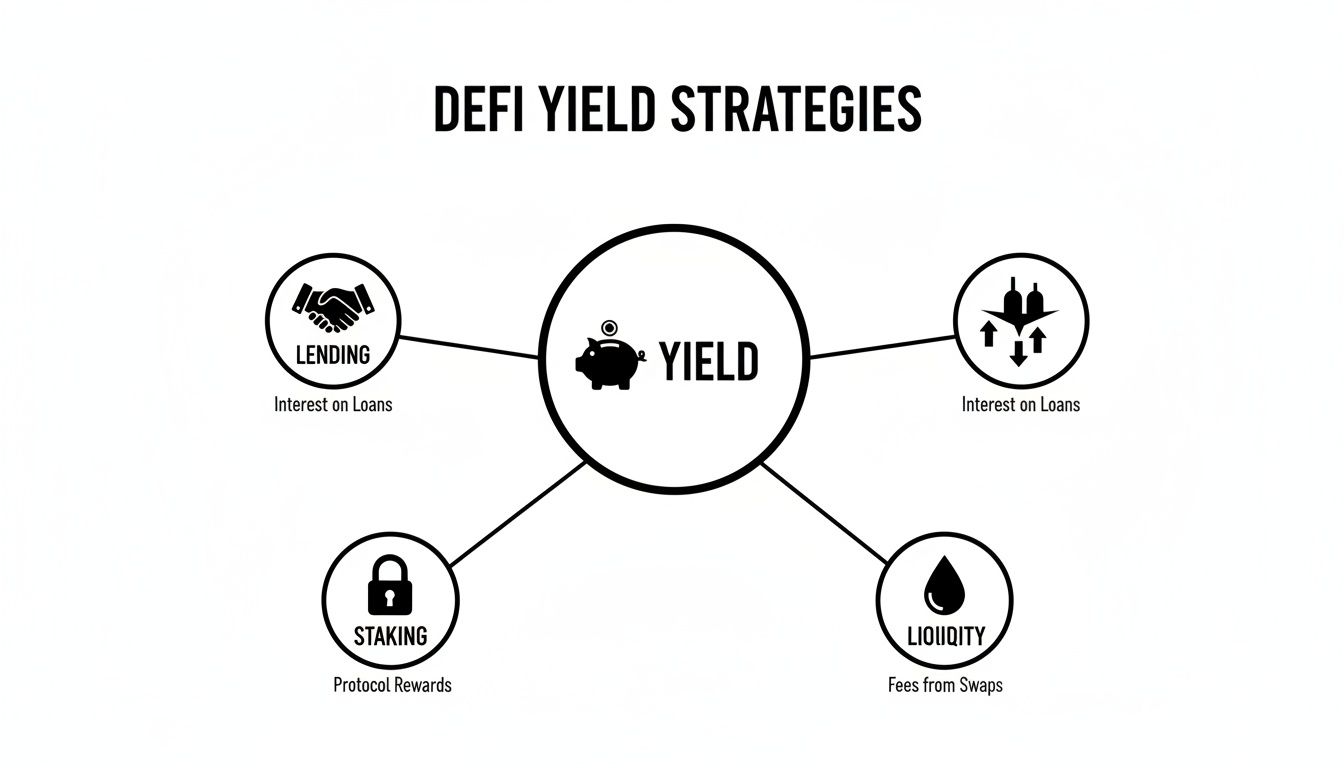
As you can see, each method involves contributing your assets to a protocol, but they generate returns in fundamentally different ways—from interest payments to trading fees.
Lending and Borrowing
The most straightforward way to earn yield is through decentralized lending platforms like Aave or Compound. Think of these as autonomous money markets running entirely on code.
When you deposit your crypto—say, a stablecoin like USDC—it gets pooled together with assets from other lenders. Borrowers can then take loans from this pool, but first, they must provide collateral (usually more crypto) and agree to pay interest. That interest is what generates your yield. The platform’s smart contracts handle everything automatically, from setting the rates to managing the loans and distributing interest payments back to lenders.
In essence, you are lending your money directly to another user. The protocol just acts as the automated middleman, ensuring the whole process is secure and transparent.
Liquidity Providing for Trading
Another major source of DeFi yield comes from providing liquidity to Automated Market Makers (AMMs). You might know them better as decentralized exchanges (DEXs) like Uniswap. These platforms let users trade one token for another without needing a traditional company or order book in the middle.
But for these swaps to happen, the platforms need deep pools of assets. That’s where you come in as a liquidity provider (LP). You deposit a pair of assets (for example, ETH and USDC) into a specific trading pool. In return for providing this service, you earn a cut of the trading fees every single time someone makes a swap using that pool. If you want to go deeper, check out our guide on what are liquidity pools.
Staking for Security and Rewards
Staking can be a bit confusing because the term is used in a couple of different ways.
First, there's Proof-of-Stake (PoS) staking. This is where you lock up a blockchain's native token (like ETH) to help validate transactions and secure the network itself. For providing this crucial service, the network rewards you with newly issued tokens.
The second type involves staking a protocol’s own token to get special perks. For instance, you might stake a token on a lending platform to receive a share of its revenue or to get boosted yields on your deposits. This creates a powerful incentive for users to hold and support the protocol's token, aligning everyone's interests.
The growth potential here is massive. The global DeFi market is forecasted to grow from $35.02 billion in 2024 to over $1.25 trillion by 2034, driven largely by these core yield-generating activities.
Measuring Your Returns With APY and APR
When you start digging into DeFi, you'll see percentages plastered everywhere, promising all sorts of returns. But not all of these numbers are telling you the same story. Two terms you absolutely have to get straight are APR and APY.
Nailing the difference is the key to figuring out what your money might actually earn over time.
Think of Annual Percentage Rate (APR) as the simple, straightforward interest rate. It's the return you get on your initial capital over a year, but it doesn't factor in any compounding. It's the baseline rate, before any of the reinvestment magic kicks in.
On the other hand, Annual Percentage Yield (APY) shows you the true power of compounding. APY calculates the return you earn on both your original money and the interest you've already piled up. Because you’re earning returns on your returns, APY paints a much more realistic picture of your potential growth.
APR vs APY in Action
Let's make this real with a quick example. Imagine you put $1,000 into a DeFi lending protocol that's offering a 10% rate.
With 10% APR: It’s simple. You’d earn a flat $100 for the year. Your total comes to $1,100.
With 10% APY (compounded monthly): Things get more interesting. Your earnings are added back to your principal every month. After month one, you'd start earning interest on $1,008.33, and this keeps rolling. By the end of the year, your total would be around $1,104.71.
The difference might look small at first glance, but with bigger sums of money and longer timelines, it really starts to add up. For DeFi, APY is almost always the metric you want to watch, especially when your rewards are being reinvested frequently.
It's also crucial to remember that most DeFi yields aren't set in stone like they are at a bank. The APY you see on a DeFi protocol is often variable. It can change daily, or even by the hour, based on things like borrowing demand or trading volume. Keeping an eye on these fluctuations will help you set realistic expectations for what you can actually earn.
Understanding the Key Risks in DeFi Yield
Those high yields in DeFi don't just appear out of thin air. They're the other side of the coin to a unique set of risks you absolutely need to get your head around. Knowing what is DeFi yield is one thing, but truly understanding the dangers is how you protect your capital and make smarter, safer moves.

Of course, all investing has risks. It's useful to first have a grasp of the general investment risks that apply everywhere before diving into the deep end. Once you've got that down, the specific hurdles in DeFi will make a lot more sense. Let's break down the most common ones you'll run into.
Smart Contract Risk
Every DeFi protocol runs on smart contracts—bits of code that automatically handle everything. But just like any piece of software, this code can have bugs or security holes. If a hacker finds one, they can exploit it to drain the protocol of all its funds, meaning a total loss for anyone who put their money in.
It’s like stashing your cash in a high-tech vault with a fancy digital lock. If someone finds a hidden flaw in that lock's code, they could swing the door wide open and walk away with everything inside. This is why it’s essential to stick with protocols that have been thoroughly audited by well-known security firms.
Impermanent Loss
This is a tricky one that only applies when you provide liquidity to an Automated Market Maker (AMM). Impermanent loss happens when the value of your assets inside a liquidity pool becomes less than what they would have been if you had just held them in your wallet. This occurs when the prices of the two assets you deposited move significantly apart from each other.
Here’s a quick rundown of how it can happen:
You deposit an equal value of ETH and USDC into a liquidity pool.
Suddenly, the price of ETH skyrockets.
Arbitrage traders jump in to buy the now "cheaper" ETH from your pool, rebalancing it by leaving you with more USDC and less of the high-performing ETH.
If you decide to pull your funds out at this point, you'll have less of the asset that shot up in value.
The "loss" only becomes real—or permanent—when you actually withdraw your liquidity. Often, the trading fees you earn can make up for it, but it's a critical risk to weigh before providing liquidity for volatile crypto pairs.
Liquidation Risk
When you take out a loan on a DeFi lending platform, you have to put up collateral that's worth more than what you're borrowing. If your collateral's value drops below a certain point, the protocol will automatically sell it off to pay back your loan. This is called liquidation, and it results in a permanent loss of your assets.
Imagine you deposit $1,500 of ETH to borrow $1,000 in USDC. If the price of ETH takes a nosedive, your collateral's value might sink to, say, $1,200. To make sure the lenders don't lose money, the protocol will sell your ETH on the market to cover the loan. To add insult to injury, you'll usually get hit with a hefty penalty fee on top. Always keep a close eye on your collateral's health to avoid this painful scenario.
Let’s be honest, the biggest thing stopping most people from diving into DeFi is crypto’s wild price swings. It’s completely understandable to get nervous watching your money bounce around like a yo-yo. The good news? You don’t actually have to ride that rollercoaster to make great returns.
A much smarter—and calmer—way to get started is with stablecoin strategies. These are digital dollars, basically, designed to hold a steady value, usually pegged 1-to-1 with a real-world currency like the US dollar. This makes them the perfect tool for earning predictable income without the heart-in-your-throat stress of a market crash.
By sticking with stablecoins, you get the best of both worlds. You can tap into the awesome high-return opportunities that DeFi offers, but you neatly sidestep the price risk that comes with assets like Bitcoin or Ethereum.
Why Stablecoins Are a Great Starting Point
When you use stablecoins like USDC to generate yield, you simplify the whole game. Since their value doesn't really change, you can laser-focus on what actually matters: the safety of the platform you're using and whether the yield it's paying out is sustainable. This shifts the activity from something that feels like a speculative bet into a more calculated, income-focused strategy.
Two of the most popular and easiest ways to start earning with stablecoins are:
Lending on established platforms: You can deposit your stablecoins into blue-chip lending protocols like Aave and earn interest from people who borrow them. It’s one of the most straightforward ways to get your feet wet.
Providing liquidity to stablecoin pools: You can also add your stablecoins to liquidity pools that only contain other stablecoins (like a USDC/DAI pool). This lets you earn trading fees from swaps between the two, but with almost zero risk of impermanent loss.
The key takeaway here is that you can build a seriously powerful passive income stream without it feeling like a gamble. This focus on stable, high-return opportunities is exactly why so much money has been flooding back into the space.
DeFi's total value locked (TVL) tells a compelling story of yield's magnetic pull, ballooning from a post-FTX nadir of about $50 billion to over $130 billion by early 2024. This surge reflects investor confidence in stable, high-return opportunities.
This massive growth is a huge vote of confidence from the market. The sheer scale of capital flowing into these strategies—like the $4.7 billion TVL on Base, a network known for its efficient stablecoin yields—shows that platforms are getting really good at turning fragmented liquidity into reliable income. You can read more about the growth of DeFi yield strategies and their market impact on mexc.com.
For those of us who are short on time, this scale is what makes automated, diversified yield farming possible. The next step is figuring out how to manage these safer opportunities effectively, without getting stuck doing endless research and constantly checking your positions.
Automate Your DeFi Strategy With AI
Finding and managing the best DeFi yield opportunities is practically a full-time job. The constant research, risk assessment, and manual portfolio adjustments are overwhelming for most people. This is where modern automation completely changes the game for busy investors who want results without the endless grind.
Platforms like Yield Seeker introduce a smarter way to capture yield using personalized AI agents. Instead of you hunting for opportunities, an AI automatically allocates your funds across top-tier, audited protocols to secure competitive, risk-adjusted returns on your stablecoins. It’s the intelligent solution for understanding what is DeFi yield in practice, not just in theory.
This automated approach offers a massive advantage by providing continuous, real-time market monitoring. To streamline operations beyond just trading, exploring how general AI automation tools work can also be a game-changer for optimizing your entire DeFi strategy.
Effortless Yield With Total Control
The whole point of an AI-powered platform is to make earning sophisticated yield feel effortless. A simple, clean dashboard should give you a clear view of your portfolio's performance, showing your balance and earnings at a glance.
Here’s an example of what that real-time dashboard looks like on the Yield Seeker platform.

This kind of setup lets you track earnings and see exactly how your AI agent is performing without needing to juggle a dozen browser tabs or complex spreadsheets.
Crucially, this automation doesn't mean you lose control. A key benefit is maintaining total flexibility with no lockup periods or withdrawal fees. Your funds remain accessible, allowing you to move your capital whenever you need to.
You can learn more about how to use AI agents to build a powerful, hands-off income stream. This is how you intelligently capture competitive stablecoin yield without the complexity or time commitment.
A Few Common Questions
As you start digging into DeFi yield, a few questions always pop up. Let's tackle them head-on to give you a clearer picture of what to expect.
How Much Can I Realistically Earn From DeFi Yield?
This is the big question, and the honest answer is: it varies. A lot. It really depends on your strategy, how much risk you're comfortable with, and what the market is doing.
If you stick to lending stablecoins on big, reputable protocols, you might see somewhere in the 3–8% APY range. That's already a huge improvement over what you’d get from a traditional savings account.
Of course, you’ll see strategies promising sky-high returns, often by using more volatile assets or jumping into brand-new protocols. Just remember, those bigger numbers come with a much higher chance of things going wrong. For a balanced, risk-aware stablecoin strategy, aiming for 5–15% APY is a pretty realistic target. Automated platforms are actually built to do just that—constantly searching for those competitive rates for you.
Is DeFi Yield Taxable?
In a word, yes. Most governments view earnings from DeFi as taxable events. Whether you’re earning interest from lending, fees from providing liquidity, or rewards from staking, it’s all likely to be treated as income or a capital gain.
The nitty-gritty of how it's taxed comes down to your local laws. It is absolutely crucial to keep detailed records of all your DeFi activity and chat with a tax professional. Trust me, you don’t want any surprises come tax season.
While this isn't financial advice, keeping good records from day one will save you a world of headaches later.
What’s the Minimum I Need to Get Started?
One of the best things about DeFi is that you don’t need to be a whale to participate. A few years ago, high transaction fees on networks like Ethereum made it expensive to even get started. But now, with the rise of Layer 2s like Base, the cost of entry has plummeted.
Many platforms are now designed for everyone, not just the wealthy. You can often start earning yield with as little as $10. This low barrier means pretty much anyone can start putting their crypto to work without needing a huge chunk of capital upfront.
Ready to put your stablecoins to work without all the complexity? With Yield Seeker, you can deposit as little as $10 USDC and let a personalized AI Agent automatically find competitive, risk-aware yield for you.