
You check your portfolio after a strong market run and notice something unsettling. The balances look healthy, but the mix no longer resembles the plan you originally chose. Stocks and crypto have grown faster than defensive assets, so your account now depends more heavily on assets that can fall sharply together.
That's the practical reason to ask why rebalance portfolio in the first place. Rebalancing isn't mainly a promise of higher returns. It's a way to pay a manageable cost, through trading, taxes, and attention, to keep unintended risk from taking over.
When a Winning Portfolio Quietly Becomes a Riskier One
You began January 2024 with a balanced plan: 60% stocks, 30% bonds, and 10% cash or crypto. The allocation matched your time horizon and the amount of volatility you believed you could tolerate. After a strong period for risk assets, you open your dashboard in mid-2025 and find a very different portfolio.
The visual supplied for this scenario shows the drift clearly, from 60% stocks, 30% bonds, and 10% cash or crypto toward 72% stocks, 20% bonds, and 8% crypto or cash.
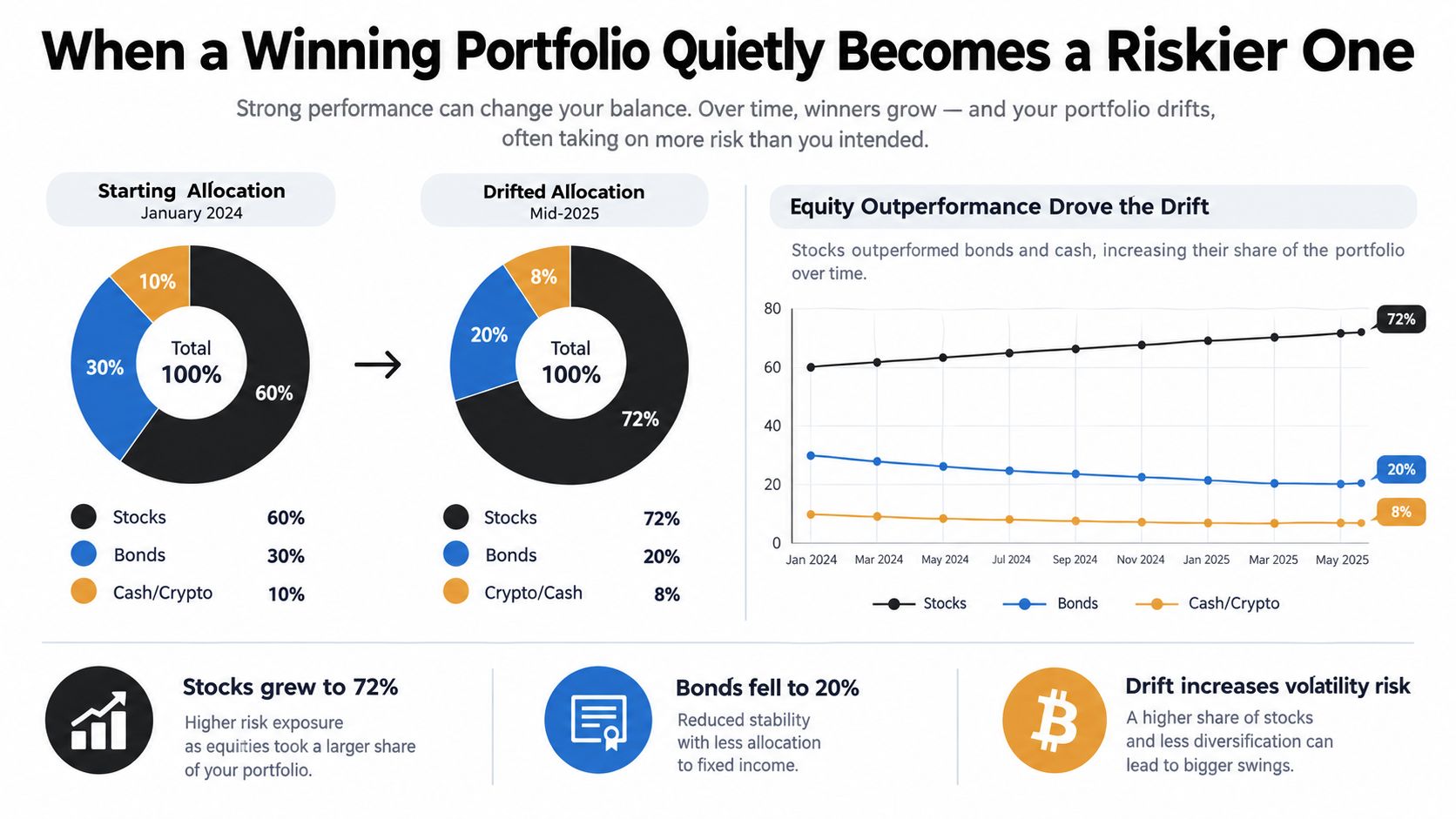
Nothing in that change required an active decision. You didn't consciously decide to become more aggressive, yet your portfolio now carries more equity beta, greater drawdown sensitivity, and less of the stabilizing exposure your original policy required. A decline that once fit your risk budget may now feel much harder to absorb.
Drift changes the strategy, not just the percentages
The problem isn't that stocks performed well. The problem is that their success changed the portfolio's future behavior. A larger stock allocation means each market move has a greater effect on the total account, while the smaller bond allocation has less capacity to cushion stress.
That's concentration without a new investment decision. The portfolio has become riskier because its winners have become larger.
A rebalancing trade restores the intended mix by trimming the oversized exposure and directing the proceeds toward assets that have fallen below target. In a taxable account, an investor might first use new contributions or withdrawals to reduce the need to sell appreciated assets. Someone with a concentrated stock position might also explore risk-management tools, such as hedging a stock position with a collar, before deciding how much exposure to unwind.
The central question isn't “Can the winning asset keep rising?” Nobody knows. It's “Do I still want the risk profile I originally selected?” If the answer is yes, rebalancing is the mechanism that brings the portfolio back into alignment.
What Portfolio Rebalancing Actually Means
Portfolio rebalancing means trading, or redirecting new money, to bring your holdings back toward their intended target weights. It doesn't require a new market forecast. You're correcting the portfolio's composition after price movements, contributions, withdrawals, or income distributions have pushed it away from policy.
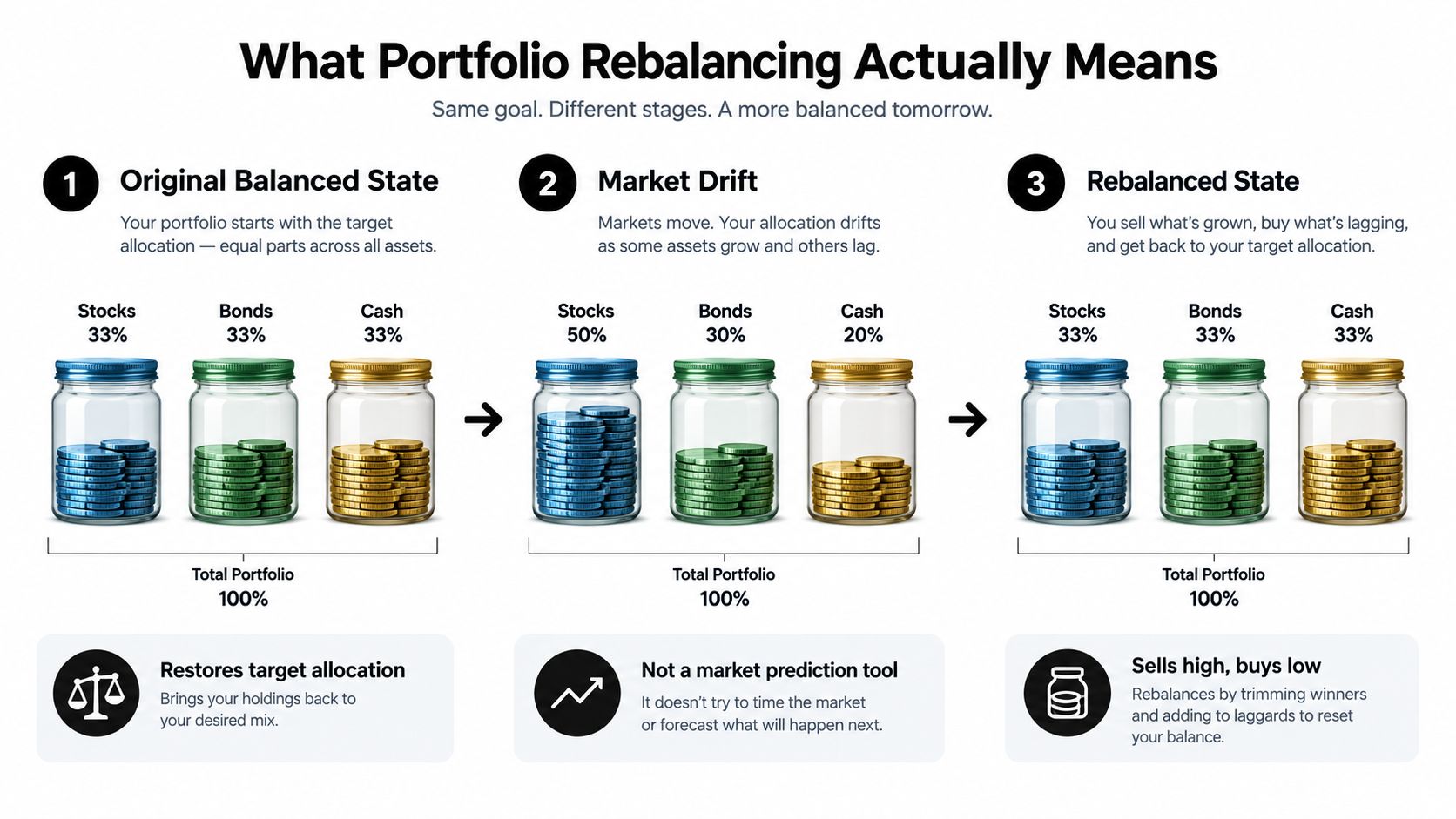
A simple analogy is three jars of coins labeled stocks, bonds, and cash. At the beginning, each jar holds one-third of your savings. Stocks then rise faster than the other two jars. The stock jar overflows, while bonds and cash represent smaller portions of the total, even if their coin counts haven't changed.
Rebalancing moves coins from the oversized jar into the undersized jars until the proportions match the original design again.
What rebalancing does
It restores a chosen allocation and therefore helps keep the portfolio's risk aligned with the plan. The trade may involve selling part of an appreciated asset, buying an underweight asset, or directing new contributions to the lagging category.
The process is mechanical:
Set a target. Decide how much exposure belongs in each asset class.
Measure the drift. Compare current weights with those targets.
Choose the least costly correction. Use contributions, withdrawals, tax-aware account locations, or trades.
Return toward policy. You don't need perfect precision if the remaining difference is immaterial.
What it doesn't do
Rebalancing isn't market timing because it doesn't attempt to predict the next move. It isn't signal-based trading, and it isn't a dependable return booster. Selling a winner may feel uncomfortable, while buying a laggard may feel premature, but the purpose is to restore balance rather than identify the next outperformer.
The silent mechanism is allocation drift. Asset prices move independently, so the portfolio's weights change even when you never trade. Rebalancing gives you a predefined way to respond before those changes become a new strategy by accident.
The Five Core Reasons Investors Rebalance
A portfolio can look successful while becoming harder to live with. One asset rises, its weight expands, and the investor ends up carrying more exposure than the original plan allowed. Rebalancing is best understood as paid risk control. It may involve taxes, fees, slippage, or missed upside, but those costs buy a way to keep the portfolio's risk deliberate.

1. Risk control
Selling part of an appreciated holding limits its influence before a drawdown tests your tolerance. A Norges Bank Investment Management discussion paper examining portfolios over 1970–2011 found that rebalanced portfolios had higher returns and lower risk, including lower volatility and tail risk, than passive portfolios whose weights drifted. It also found relatively small differences among rebalancing rules, supporting the principle of restoring exposure rather than searching for one perfect schedule. The Norges Bank discussion paper is useful because its long historical window includes different market environments.
Risk control does not remove losses. It prevents the portfolio from taking more risk than the investor approved.
2. Return optimization
Rebalancing can create a disciplined pattern of trimming relatively expensive exposures and adding to relatively cheaper ones. That may help when asset classes move differently, but it is not a dependable alpha engine. Its main value is keeping the portfolio from becoming an accidental bet on the recent winner.
Morgan Stanley asset-allocation research reported that annual rebalancing improved return and volatility profiles across broader portfolios, with the largest effect in more diversified allocations. Morningstar's summary of research, however, found that rebalancing between U.S. stocks and bonds, and between U.S. and foreign stocks, produced less than 10 basis points of additional annual returns. The Morgan Stanley research supports a measured conclusion: any return benefit may exist, but it can be small.
3. Volatility harvesting
A portfolio can sometimes benefit from trimming an asset after it expands and adding to another after it contracts. The possible gain depends on dispersion, correlations, fees, and the path of returns.
This is not free income. Assets that move closely together offer less difference to harvest, while frequent trades can consume the potential benefit.
4. Tax and liquidity planning
A rebalance can realize gains in a taxable account. The same adjustment may be easier inside a tax-advantaged wrapper, or through new contributions that buy underweight holdings without selling winners.
Liquidity sets another boundary. An investor who needs cash soon should not treat every dollar as permanently allocated. Stablecoin and DeFi positions add protocol fees, pool-conversion costs, slippage, and possible taxable disposals, depending on the jurisdiction and transaction structure. These costs are part of the price of risk control, not details to review after the trade.
For a broader framework on spreading exposure across assets and strategies, see these investment diversification strategies.
5. Behavioral discipline
A written policy addresses two common failures: allowing a winning position to become emotionally untouchable, or buying aggressively after a dramatic rally. Calendar, band, and event triggers each prevent a different breakdown. A calendar rule prevents indefinite delay, a band rule responds when drift becomes material, and an event rule addresses a lasting change in goals, cash needs, or risk capacity.
Practical rule: Rebalance to follow the risk plan, not to prove that you can predict the next market move.
The strongest case for rebalancing is risk alignment and behavioral consistency. Extra returns are conditional, often modest, and never guaranteed.
What the Evidence Really Says About Returns
A portfolio can rebalance after a strong rally and still finish with lower returns than the drifting version. That outcome does not automatically mean the decision failed. Rebalancing is better understood as paid risk control: you accept trading costs, possible taxes, and sometimes forgone upside to keep the portfolio near its intended risk.
The historical evidence is more consistent for controlling portfolio behavior than for creating excess return. One long-sample analysis found that rebalanced portfolios had higher returns, lower volatility, and lower tail risk than portfolios allowed to drift. It also found relatively small differences among rebalancing rules. The finding supports exposure control, not a promise that every investor will earn more after every trade.
A 2024 Finance Research Letters study reported a strong positive correlation between rebalancing-weighted returns and the Sharpe ratio, with r = 0.6492 and p < 0.001. The cited research discussion points toward better risk-adjusted outcomes. Correlation still does not establish that one rule will outperform after taxes, spreads, slippage, gas, or other trading costs.
Portfolio Type | Likely Risk-Control Benefit | Return Implication |
|---|---|---|
Diversified multi-asset portfolio | Stronger potential because exposure can be brought back toward target | May be positive, but usually modest |
Traditional stock and bond mix | Can limit allocation drift and portfolio volatility | Cited comparisons summarized by Morningstar found less than 10 basis points annually |
Highly correlated equity blend | Limited, because holdings may move together | Any advantage can be difficult to separate from noise and costs |
Cost-sensitive or taxable portfolio | Depends heavily on account type and execution | Fees, spreads, and taxable disposals can offset the expected benefit |
What barely moves the needle
Rebalancing has less room to help when assets are highly correlated, spreads are wide, or the portfolio remains close to target. Frequent trades can turn a small allocation difference into a real cost. That cost deserves extra attention in stablecoin and DeFi allocations, where pool conversion, protocol fees, slippage, and taxable disposals may reduce the value of correcting minor drift.
Research on transaction costs supports threshold-based approaches because proportional costs can outweigh the benefit of constant correction. This evidence-based rebalancing research note describes the trade-off between tracking a target closely and limiting unnecessary turnover.
For investors focused on outcomes rather than headline returns, risk-adjusted returns calculation provides the more useful lens. The question is whether the portfolio delivers its intended return for the risk, tax exposure, and implementation cost being accepted.
Choosing the Right Rebalancing Trigger
A trigger defines the failure you are trying to prevent. Calendar rules guard against neglected drift. Tolerance bands respond when an allocation becomes materially different from its target. Event rules use contributions, withdrawals, or major changes to correct the portfolio when circumstances shift.

Calendar-based triggers
A calendar trigger sets a recurring review, such as quarterly, semi-annually, or annually. Its main benefit is consistency. You do not need to react to every price move, and a scheduled check makes it harder to postpone a decision indefinitely.
The trade-off is that the portfolio can drift substantially before the next date, especially after a concentrated rally or sudden decline. The rule may then fail to prevent prolonged exposure to a risk level you no longer intended to carry. Calendar rebalancing suits investors who want low maintenance and hold relatively liquid, diversified assets. The date can serve as a review point without requiring an automatic trade.
Tolerance-band triggers
A tolerance band waits until an allocation moves far enough from its target. The commonly cited 5/25 rule uses a 5% absolute drift or 25% relative drift threshold. For a target near 20%, a relative move of 25% may prompt attention, while a larger target could breach an absolute five-percentage-point band.
This method targets unintended risk rather than elapsed time. It can limit trades while markets are quiet, but volatile conditions may push an allocation across a band and then back again. That whipsaw can create extra trading, conversion, and tax costs, including in stablecoin or DeFi positions where correcting a small drift may require fees, slippage, or a taxable disposal.
Event-driven triggers
An event trigger acts on a contribution, withdrawal, windfall, corporate action, or major market move. New money can fund underweight positions without selling appreciated assets. A withdrawal can come from an overweight position, producing a natural rebalance and potentially reducing unnecessary disposals.
Its weakness is inactivity between events. Without a contribution or withdrawal, the portfolio can remain outside policy unless the event rule is paired with a periodic review.
A practical design combines a calendar review with tolerance-band overrides. The calendar catches drift that has been ignored, while the band responds to a sharp change before the next scheduled check. Evidence on transaction costs favors conditional discipline over constant correction, because closer tracking can cost more than it adds. The right trigger therefore depends on the failure mode, liquidity, tax treatment, and operational cost you are prepared to accept.
How Rebalancing Works for Stablecoin and DeFi Yield
Stablecoin and DeFi portfolios drift through yield changes, not only token price changes. A lending position can become more attractive or less attractive as borrowing demand changes. Staking and liquidity-provision positions can also alter the effective allocation through changing rewards, utilization, incentives, and smart-contract exposure.
That makes onchain rebalancing different from a conventional stock and bond portfolio. A weekly review may be sufficient for a slow-moving allocation, but a DeFi strategy can change meaningfully between manual checks. Moving capital too often, however, can introduce gas costs, slippage, bridge risk, and additional smart-contract interactions.
Start with risk buckets, not just APY
A stablecoin portfolio should track more than the displayed yield. Record the protocol, chain, asset, liquidity conditions, lockup terms, contract risk, and the share of capital assigned to each strategy. A higher APY doesn't automatically justify moving funds if it comes with materially greater operational or liquidity risk.
The target might therefore be expressed as a range across lending, staking, and liquidity positions rather than as one fixed protocol allocation. The rebalance decision becomes conditional: has the expected improvement justified the cost and the additional risk?
Manual versus automated monitoring
Manual rebalancing breaks down when the opportunity set is fragmented across protocols and the decision requires repeated comparisons. Automation can monitor supported opportunities, evaluate whether a move is worthwhile, and route transactions according to preset preferences.
Automated portfolio rebalancing for DeFi describes this operating model in more detail. Yield Seeker is one example of an AI-powered platform that monitors stablecoin yield opportunities and reallocates across supported DeFi protocols when the expected improvement justifies transaction costs and fits the user's investment profile.
Automation doesn't remove risk. It changes who performs the monitoring and how consistently the rules are applied. You still need to understand the assets, permissions, protocols, and failure conditions before depositing capital.
When Rebalancing Can Hurt and How to Avoid It
Rebalancing is paid risk control, not a guaranteed source of higher returns. A winning position may have grown beyond its intended role, yet correcting it can create costs that outweigh the risk reduction. Selling an appreciated asset in a taxable brokerage account can trigger capital-gains taxes, even when the trade only restores the target allocation. Tax-advantaged or tax-sheltered accounts may reduce that concern, but their account rules still apply.
Trading friction can make a small correction uneconomical. Commissions, spreads, gas, slippage, withdrawal charges, and protocol-specific costs all reduce the benefit of acting. In stablecoin and DeFi allocations, the bill may also include bridge costs, changing pool depth, lockups, and the opportunity cost of leaving one yield strategy for another. A closer match to the target is useful only when the expected risk reduction justifies those costs.
The false-discipline problem
A rule becomes harmful when it serves the schedule instead of the portfolio's purpose. Selling a strong asset before it reaches a meaningful risk limit can create opportunity cost, especially for an investor with a long horizon. Repeated breaches may also indicate that the target no longer fits the investor's circumstances. The policy deserves review before every deviation is treated as a command to trade.
Thinly traded positions require extra care. An order can move the market price, incur slippage, or leave less usable liquidity than expected. Onchain positions face the same problem when pool depth is limited, gas rises, or a transaction cannot execute at the expected price.
Use this decision test:
Estimate risk reduction. Identify the concentration, liquidity exposure, or volatility the trade would remove.
Estimate friction. Include taxes, fees, spreads, gas, slippage, and the value of your time.
Set a minimum trade size. Ignore immaterial deviations unless they can be combined with another transaction.
Use cash flows first. Direct contributions toward underweight assets and withdrawals from overweight assets when practical.
Review the target. If the portfolio repeatedly breaches the same band, reconsider the allocation or the band.
The right response may be a full rebalance, a partial correction, or no trade. That choice is the control decision. The return is uncertain, while the cost of acting is usually easier to estimate.
A Practical Checklist for Your Own Portfolio
Before you decide why rebalance portfolio, write down the risk you're trying to control. A target allocation should reflect your horizon, liquidity needs, loss tolerance, and the role each asset plays. Don't set targets only by copying a model portfolio.
Then run this checklist:
Confirm the target. Define the intended weight for each asset class, protocol group, or risk bucket.
Set individual bands. A broad portfolio-level threshold can hide a dangerous concentration in one asset. Give volatile or illiquid positions their own limits.
Choose a primary trigger. Use a calendar, tolerance band, or event rule. Add a backup so a sharp move or major cash flow doesn't wait for the next review.
Price the transaction first. Estimate taxes, fees, gas, spreads, slippage, and any opportunity cost before placing an order.
Record the reason. Log the current weight, target, trigger, expected risk reduction, and execution cost.
For many retail portfolios, a quarterly review offers a practical balance between oversight and overtrading. Active DeFi yield strategies may require more frequent monitoring, while tolerance-band overrides can act as a safety valve when market moves are unusually large. The cadence should follow how quickly your risk can change, not a slogan.
Before your next trade, answer one question: Is the drift large enough to justify the cost of acting?
Yield Seeker helps stablecoin holders monitor DeFi yield opportunities and automate allocation decisions across supported protocols according to transaction costs and investment preferences. Visit Yield Seeker to explore a more systematic way to manage stablecoin rebalancing without manually tracking every opportunity.