
You've got stablecoins sitting in a wallet, the market's moving elsewhere, and that cash-like balance still isn't doing anything for you. If you're already on Base, the barrier isn't usually capital, it's figuring out which yield is real, which APY is just marketing, and how much friction you're willing to tolerate before the return gets eaten by costs.
Yield farming with stablecoins turns that idle balance into a working asset. By the end of 2024, stablecoins had become the dominant source of DeFi liquidity, with Galaxy reporting that they accounted for roughly $33 billion of the $94 billion total value locked across DeFi, or about 35% of all TVL, which is a good reminder that stablecoins aren't a side quest anymore, they're the base layer for much of onchain yield Galaxy's research on onchain yield.

That matters because stablecoin yield isn't about chasing lottery-ticket tokens. It's about putting digital dollars into lending markets or liquidity pools, then being honest about the trade-off between convenience, risk, and realized return. If you want a broader primer on the mechanics, this stablecoin yield overview is a useful companion, and if your work touches brand or product marketing in Web3, the Web3 creative agency lens from 925 Studios shows how much clearer these products become when the messaging matches the user's job.
Putting Your Idle Stablecoins to Work
Stablecoins can feel safe because they sit close to a dollar peg, but money that sits still still has a cost. Inflation chips away at purchasing power, and a wallet full of USDC that never gets deployed is still just idle capital. Yield farming with stablecoins is about putting that balance to work while staying inside a dollar-denominated risk band.
On Base, that usually means a straightforward setup, bridge or deposit USDC, route it into a lending market, liquidity pool, or vault, then keep an eye on whether the position is paying you after fees. The headline APY is only part of the story. Gas, slippage, and the time you spend rebalancing can all cut into what you really keep, especially if you chase a farm that looks good on paper but is awkward to manage in practice.
Why stablecoins became the default DeFi working capital
Stablecoins are useful across DeFi because they are the unit that most lending markets, trading pools, and routing paths already expect. They hold value well enough for treasury use, but they still move through the same onchain rails as everything else, which makes them the default working capital for a lot of DeFi activity. That is why stablecoin yield often feels more like cash management than speculation, even when the protocol mechanics are still complex.
The return usually comes from borrower interest, swap fees, or protocol activity that has a clear source. That is a different profile from incentive-heavy farming, where rewards can look attractive until emissions drop or liquidity leaves. On Base, the lower transaction cost helps small positions make sense, but it does not change the core math. If a farm needs constant handholding to stay profitable, the actual yield may be much lower than the banner suggests.
Practical rule: if the yield source is hard to explain in one sentence, the position probably depends too much on incentives.
The management burden is where a lot of new users get stuck. You may need to compare pools, watch reward changes, claim fees, and decide when to rotate capital, all while keeping enough ETH on hand for gas. AI agents can reduce that overhead by tracking balances, flagging changes in APY or pool health, and handling routine steps with less manual clicking. A stablecoin setup should feel like a repeatable workflow, not a daily scavenger hunt. If you want a broader primer on the mechanics, this stablecoin yield overview is a useful companion, and the product side matters too, which is why the Web3 creative agency perspective from 925 Studios is relevant when these tools have to be explained clearly to users.
Preparing Your On-Chain Toolkit for Base
Start with a self-custodial wallet that you understand. MetaMask and Rainbow are common choices because they let you control the keys, approve contracts, and connect to Base without handing custody to a third party. Seed phrase security matters more than interface polish, so write it offline, store it somewhere separate from your day-to-day devices, and never paste it into a browser prompt or chat window.
Next, get your USDC onto Base through the official bridge or through a reputable exchange withdrawal that supports the network. If you're moving from another chain, check that the destination is Base before signing anything, because the wrong network is the easiest way to turn a simple transfer into a support headache. A clean setup guide for moving USDC onto Base is available in this USDC on Base walkthrough, and it's worth reading before you bridge sizeably.
What to check before you deposit
You don't need a perfect system, but you do need a disciplined one.
Wallet control: Keep the wallet non-custodial, so you can approve, revoke, and withdraw without asking permission.
Network correctness: Confirm Base in the wallet before any contract interaction.
Gas reserves: Hold a little ETH on Base so you can approve, rebalance, or exit later.
Destination clarity: Send USDC only after you've confirmed the receiving contract or app is the one you intended.
Once the wallet is live and funded, the practical question becomes where the yield should come from. A useful workflow is to prioritize fee- and interest-driven yield over pure incentive emissions, because emissions-heavy incentives fade faster than lending demand or trading activity. If you want a broader list of protocol options on Base, this Base app comparison helps narrow the field without making the choice for you.
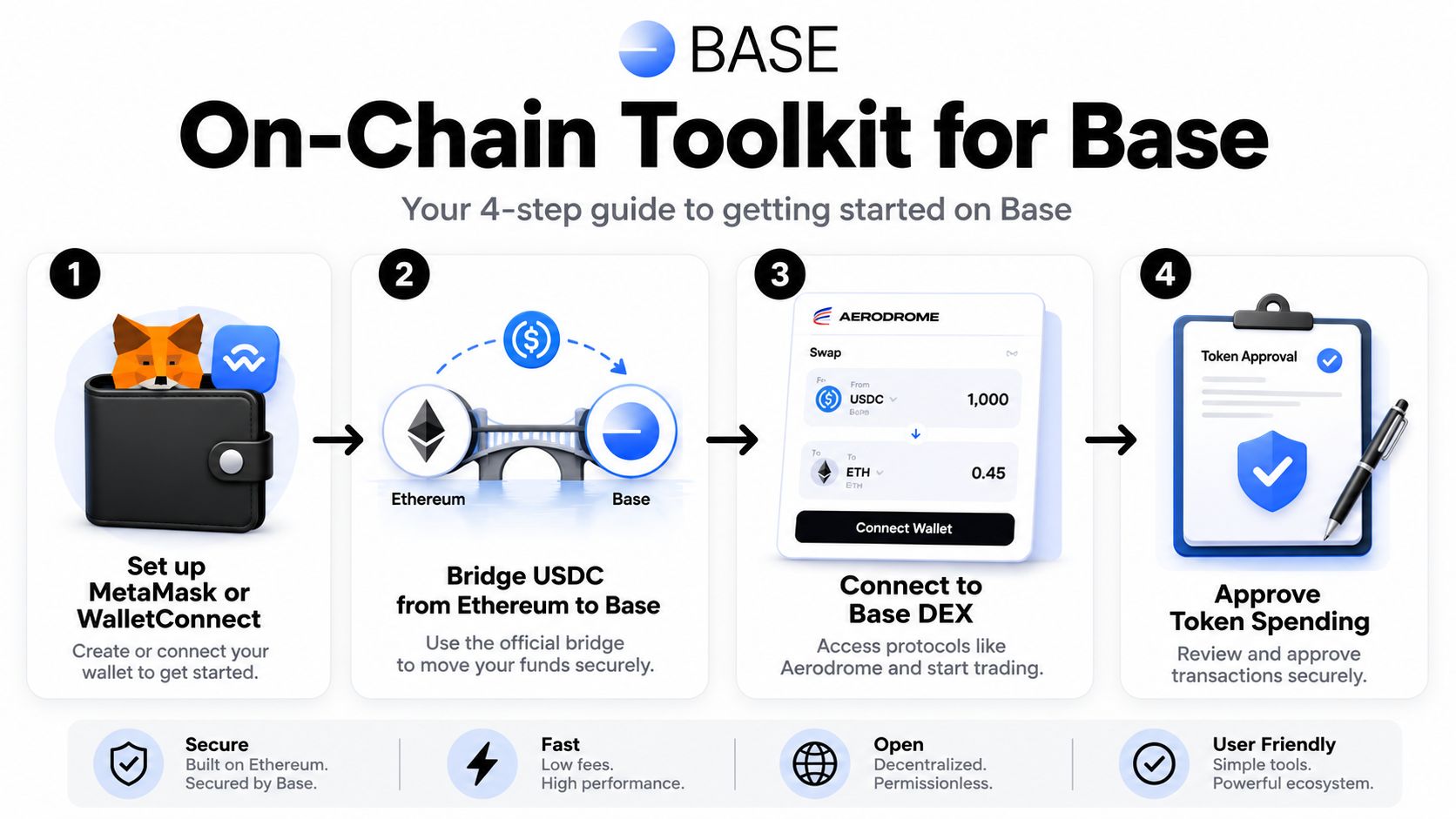
The reason this order matters is operational, not theoretical. A wallet, a bridge, and gas are boring until something breaks, and then they're the difference between a normal withdrawal and a stuck position.
Choosing Your Stablecoins and Farming Venues
A first stablecoin farm on Base goes better when you start with assets people redeem and venues whose return sources you can name without guessing. Stripe's guidance is clear on the asset side, use established fiat-backed stablecoins like USDC and USDT, check audits and reserve reporting, and stay away from opaque or algorithmic structures. That fits Base well, because the goal is usually to avoid operational surprises, not to chase a cleaner theory of decentralization at the expense of custody risk or exit risk.
Stablecoins first, protocols second
USDC is usually the cleanest starting point because it sits in a deep liquidity network and fits naturally into Base-native DeFi flows. DAI can still make sense in some setups, but the more important question is whether the asset is easy to redeem, easy to route, and already understood by the protocol you plan to use. USDT brings deep liquidity too, but transparency preferences differ, so the asset choice should come before any APY comparison.
The venue matters just as much. Lending markets are easier to reason about, the yield source is usually straightforward, and the position is simpler to explain later if you need to audit your own decisions. Stable and stable pairs in liquidity pools can earn trading fees and sometimes extra incentives, but they also add more moving parts, including concentration rules, price-band management, and more active monitoring.
Venue | Typical appeal | Practical trade-off |
|---|---|---|
Lending market | Simplicity and clear interest source | Usually steadier, often less exciting |
Stable liquidity pool | Fee-driven return potential | More active management, more contract surface area |
Rule of thumb: if you can't explain where the return comes from in one sentence, you're probably looking at a farm that is trying to do too much.
For Base, the better first move is usually a widely used stablecoin paired with a high-liquidity venue that shows its mechanics plainly. If a protocol makes the yield source, custody model, and chain visible up front, that is a good sign. If the main pitch is a glossy APY widget, treat it with caution even when the number looks attractive, because headline APY often leaves out fees, slippage, and the time cost of managing the position. A practical place to narrow the choices is a comprehensive Base DeFi app comparison, which helps sort through venue types without making the decision for you.

The best farms are usually boring in the right ways. They use assets people redeem, protocols people can inspect, and accounting that does not require a detective.
Executing and Automating Your Yield Strategy
The manual version is familiar: connect wallet, approve token spending, deposit into a lending pool or liquidity position, then repeat when conditions change. That works, but each extra transaction adds room for error, and each reallocation means more time spent checking rates, fees, and token behavior. On Base, the low-cost environment reduces pain, but it doesn't remove the need to manage the position carefully.
A more modern approach is to use an AI agent that watches the market and handles the allocation logic for you. Yield Seeker is one example, it accepts USDC on Base and uses a personalized AI Agent to monitor opportunities, allocate across DeFi venues, and keep the process readable through a clean dashboard and built-in walkthroughs. The point isn't to remove judgment, it's to remove the repetitive work that makes people procrastinate on otherwise sensible strategies.

A practical way to think about this is the difference between choosing a position once and babysitting it forever. If the platform can automate monitoring and rebalancing, the user still sets the risk tolerance, but the software carries out the boring part.
A common mistake is fixating on the headline APY and ignoring the full cost stack. Coverage often advertises attractive ranges like 10% APY or 12–17% APY, but it rarely breaks out what comes from borrower interest, what comes from incentives, and what disappears after fees, routing, compounding, and exit costs discussion of APY cost stack. That's why the metric is not the displayed rate, it's the realized return after you've paid to move in and out of the farm.
For users who want to compare where opportunity lives before acting, compare odds across platforms is a useful mindset even outside pure arbitrage. You're still comparing spread, friction, and exit quality, just with stablecoins instead of directional bets.
The cleanest execution flow is simple. Deposit once, let the system work, and only intervene when the net return meaningfully improves or the strategy's risk profile changes.
Understanding and Managing DeFi Risks
Stablecoin farms feel calmer than volatile-token loops, but they still carry real failure modes. The three that matter most are smart contract risk, depeg risk, and protocol-specific risk, and none of them disappears just because the asset trades close to a dollar. A position can look steady right up until the contract, the peg, or the protocol's incentives shift under stress.
The risks that actually move money
Smart contract risk is the obvious one in DeFi. If the code is compromised, audited or not, funds can be delayed, trapped, or lost, and the user has very little recourse compared with traditional finance. Audits and heavy usage are worth preferring, but they are a filter, not a guarantee.
Depeg risk is the second issue, and it is more practical than ideological. Stripe's guidance to prefer established fiat-backed stablecoins is useful because it reflects a simple truth, a stablecoin is only as reliable as its backing and redemption behavior. If the asset behind your farm starts trading away from its peg, the yield math stops mattering very quickly.
Protocol risk is the quieter problem. Incentives change, governance parameters move, liquidity dries up, and a position that looked attractive yesterday can become a poor capital sink today. The most actionable risk-management pattern is diversification across 2–3 lower-volatility pools and rotating when the net APY improves, rather than chasing the biggest number on the screen risk-management guidance.
Keep enough gas to exit, keep the position simple enough to explain, and don't let a good APY hide bad liquidity.
A strong farm should also be easy to leave. If exiting requires complex bridging, a narrow liquidity window, or multiple reward conversions, the position deserves extra skepticism. Stability in DeFi is not a promise, it is a stack of small checks that keep one bad assumption from becoming a bad outcome.
Monitoring Performance and Withdrawing Your Funds
The dashboard number is not the same thing as realized earnings. Stablecoin yield is typically lower but more consistent than volatile-token farming, and the range discussed in industry guidance is about 2% to 6% APY for CeFi stablecoin products and 3% to 10% APY for DeFi lending and liquidity strategies stablecoin yield rate guidance. That spread is useful because it sets expectations, but the position still lives or dies on net return after fees, slippage, and any rebalancing you needed along the way.
What to watch while the position is live
Track three things: earned yield, withdrawal friction, and whether the venue still matches your risk tolerance. If the strategy is automated, check whether the agent is reallocating for a good reason or just reacting to short-lived rate noise. If the strategy is manual, don't let curiosity become overtrading.
When it's time to withdraw, test the full path before you need the money urgently. Make sure the venue has no hidden lockup, confirm there's enough ETH on Base for gas, and count the steps from the farm back to your wallet and then back to fiat if you plan to off-ramp. The highest APY means very little if the final exit is slow or expensive.
A clean exit also helps you learn. If the return was lower than expected, the cause is usually visible in one of three places, fees, timing, or strategy churn. If the return held up well, you've got a baseline you can reuse next time instead of guessing.
Stablecoin yield works best when you treat it like managed cash, not a lottery ticket. Use a simple asset, a transparent venue, and a process that lets you leave without drama. If you want an automated way to do that on Base, Yield Seeker gives you an AI-driven path for monitoring, allocating, and keeping stablecoin yield practical instead of manual.