

Think of it like this: you could have a financial advisor for your crypto, working around the clock to find you the best possible returns. That's pretty much what algorithmic yield farming is. It’s software that automatically moves your digital assets between different DeFi protocols to squeeze out the most profit, all without you having to lift a finger.
What Is Algorithmic Yield Farming and How Does It Work?
If you've ever tried manual yield farming, you know it feels like being an old-school farmer. You're constantly checking the soil (protocols), watching the weather (market conditions), and deciding exactly when to plant, water, and harvest each crop by hand. It's a full-on, demanding job that requires you to be glued to your screen, ready to make quick decisions. One wrong move, and your whole harvest is toast. In DeFi terms, that means endless hours staring at dashboards, stressing over gas fees, and manually shifting funds between lending platforms and liquidity pools just to chase the highest APY.
Algorithmic yield farming, on the other hand, is like upgrading to a fully automated, high-tech farm. This system uses sensors, data analytics, and robotics to manage everything for you. It knows precisely which soil (protocol) is the most fertile right now, when to plant your seeds (deposit funds), and exactly when to harvest your earnings (claim rewards) and reinvest them for that sweet, sweet compound growth. It never sleeps, so no opportunity is ever missed.
The Problem It Solves
The big problem algorithmic yield farming cracks is complexity and inefficiency. The DeFi world is a mess of different platforms and moves at a blistering pace. Yield opportunities can pop up and disappear in minutes, and the transaction costs (gas fees) to jump on them can quickly chew through your profits.
Algorithmic yield farming addresses the intense, manual "yield chasing" that defined early DeFi. It replaces constant human intervention with smart contract-based automation that can execute complex strategies far more efficiently than any individual.
This hands-off approach lets regular users tap into sophisticated financial strategies that would be a nightmare to pull off manually. The algorithm is always scanning the market, rebalancing your positions, and auto-compounding your returns, turning a high-stress hustle into a much more passive activity. It’s a game-changer, especially if you don't have the time or the deep technical know-how to manage a DeFi portfolio by hand. To get a better feel for the big ideas here, you can check out our deep dive on the fundamentals of algorithmic trading.
The Shift to Automation
The crypto world really woke up to the need for this kind of automation during the legendary "DeFi Summer" of 2020. This was when we saw the launch of Yearn Finance, a project that basically invented the idea of automated yield optimization. Its "vaults" would algorithmically shuffle user funds between protocols like Aave, Compound, and Curve to snag the highest available returns—which often skyrocketed above 100% APY on stablecoins.
That was the turning point. It proved that automation could not only match but actually beat manual efforts, all while saving users from the mind-numbing grind of tracking dozens of platforms and worrying about risks like impermanent loss. These early platforms paved the way for the sophisticated crypto AI we're seeing today.
To really get a handle on algorithmic yield farming, you have to pop the hood and see what makes these automated systems tick. Think of them as a team of high-performance engines, each with a specific job, all working in concert to crank out returns. It’s these core mechanics that separate simple bots from truly intelligent yield-generating platforms.
This diagram gives you a quick visual of the shift from tedious manual farming to the automated, high-yield world we're talking about.
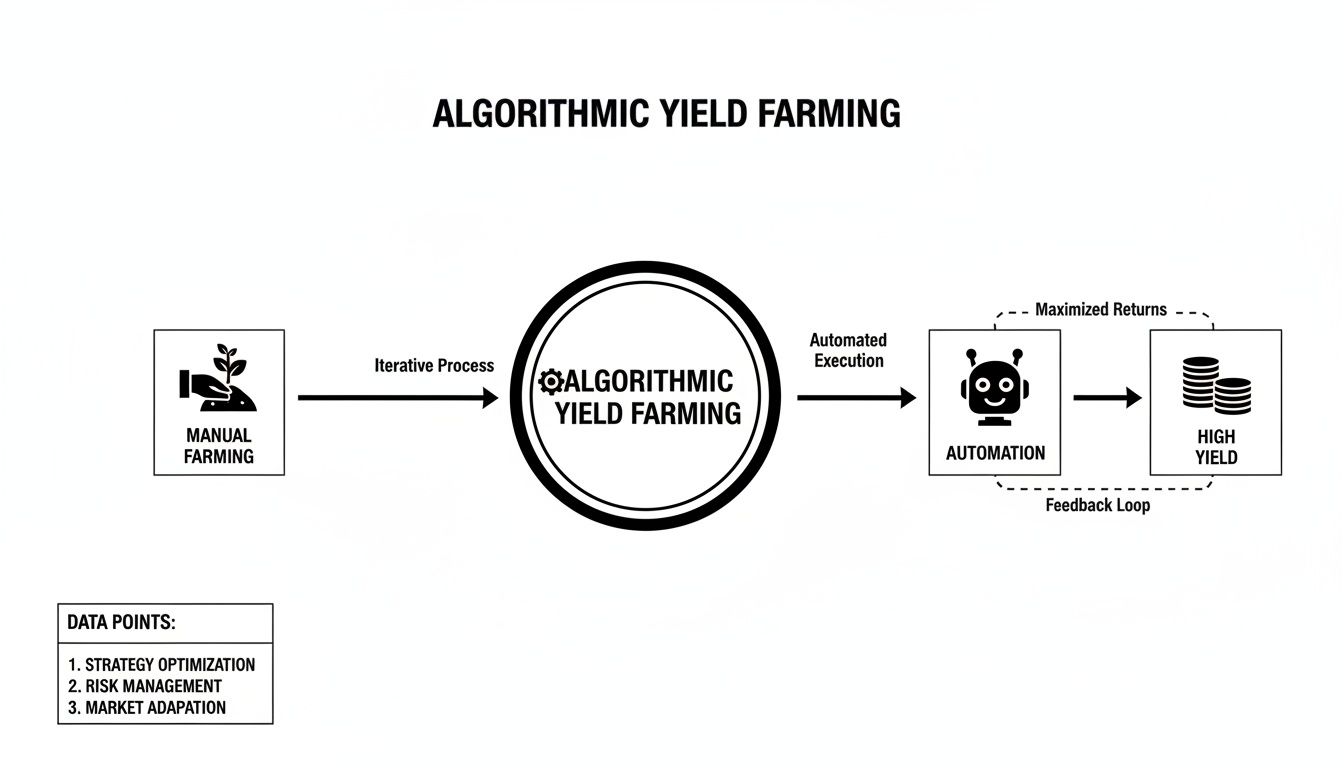
The main takeaway here is simple: algorithms are replacing the time-consuming grunt work to get better, more consistent results.
Automated Rebalancing and Compounding
At its heart, algorithmic yield farming is basically a compounding machine on steroids. Picture a traditional dividend reinvestment plan (DRIP) for stocks, but instead of reinvesting every quarter, these algorithms can harvest your earnings and put them back to work multiple times a day.
Every time a strategy earns rewards—say, from lending interest or trading fees—the smart contract automatically sells those reward tokens and ploughs them right back into your main position. This is called auto-compounding, and it kicks your growth into overdrive without you ever having to lift a finger or sign a transaction. It's a relentless cycle of earning and reinvesting that a human could never keep up with, especially when you factor in gas fees for every move.
Strategy Orchestration and Execution
But it's not just about simple compounding. These algorithms are like master conductors of a financial orchestra. They don't just play one instrument; they intelligently shuffle capital between different DeFi protocols to play the most profitable tune at any given moment. We call this strategy orchestration.
For instance, an algorithm might see that:
Lending USDC on Aave is offering a steady 8% APY because lots of people are borrowing.
Providing liquidity to a USDC/USDT pool on Curve is pulling in 9.5% APY from trading fees.
A newer, riskier strategy is dangling a potential 15% APY.
The algorithm, guided by its programming and risk settings, can then split your funds between these opportunities or even shift your entire stack to the one with the best risk-adjusted return. It’s a dynamic game of cat and mouse, always chasing the best, most sustainable yield across the whole DeFi ecosystem.
This constant optimization is what makes algorithmic yield farming so powerful. The system can make dozens of decisions and transactions in the time it would take a person to analyze just one or two options, ensuring capital is always in the most productive spot.
This approach has been incredibly successful. Since 2020, algorithmic strategies have generated over $10 billion in rewards for users. Platforms like Aave, which algorithmically balance their lending pools, paid out $2.1 billion in fees by 2023 alone, with depositors earning between 5-15% APY on stablecoins like USDC.
Dynamic Liquidity Management
Finally, we have the most advanced feature: dynamic liquidity management. This isn't just about choosing a strategy; it's about actively managing the position within that strategy to boost gains and dodge risks. It's proactive and incredibly fast.
Imagine you're providing liquidity for a DAI/USDC stablecoin pair. If the algorithm picks up on early signals that DAI might be struggling to hold its $1 peg, it can act instantly. It could pull your funds out of the DAI/USDC pool and shift them into a single-asset lending position—like just lending out USDC—to sidestep the risk of impermanent loss entirely. For a deeper dive on this, check out our guide on how automated liquidity management works.
This kind of defensive play happens in seconds, protecting your capital from market shocks that would leave most manual farmers holding the bag.
Understanding the Major Risks in Algorithmic Farming
While the promise of automated returns is pretty compelling, algorithmic yield farming isn't a free lunch. High yields and high risks often go hand-in-hand, and if you want to protect your capital, you need to know what you're getting into. Think of it like a race car driver who needs to know the absolute limits of their car. A smart investor has to understand where things can break, especially in an automated system.
Let's break down the main risks you'll face. I'll use some clear analogies so you can invest with your eyes wide open.
Smart Contract Risk: The Hidden Flaw
First up, and arguably the biggest, is smart contract risk. These contracts are the very foundation of DeFi—they're the automated vaults and engines running every single strategy.
Imagine a state-of-the-art bank vault with incredibly complex locks. It looks impenetrable. But what if there's a tiny, single design flaw that nobody noticed? A clever thief could find that one weakness, bypass everything, and walk away with the contents. A smart contract is just like that. A single error in the code can create a vulnerability for hackers to exploit, potentially draining every last dollar deposited. We've seen billions lost to these kinds of exploits over the years.
This is exactly why professional code audits are a non-negotiable. Any platform worth its salt will have its contracts stress-tested by multiple third-party security firms. It's like hiring several independent teams of master locksmiths to try and crack your vault before you put anything valuable inside.
Impermanent Loss: The Seesaw Effect
Next, we have impermanent loss. This one's a bit tricky and is unique to providing liquidity on decentralized exchanges (DEXs). While it's a known factor in both manual and algorithmic farming, the automation can sometimes hide its effects until it's too late.
Picture two kids of different weights on a seesaw. They represent two different assets in a liquidity pool, like ETH and USDC. To keep the seesaw balanced (maintaining the pool's value ratio), the heavier kid (the more valuable asset) has to sit closer to the middle. Now, imagine one kid's weight suddenly changes—say, the price of ETH skyrockets. The seesaw is going to tilt, hard.
When you provide liquidity, your job is to keep that seesaw balanced. If one asset's price shoots up, the protocol automatically sells some of it for the other asset to rebalance. The result? You end up holding more of the asset that's now worth less and less of the one that's worth more. If you pull your funds out at that point, the total value might be less than if you'd just held onto the two assets separately in your wallet.
Impermanent loss only becomes permanent when you withdraw your funds at a loss. The trading fees you earn are meant to cancel out this risk, but a massive price swing can easily wipe out your earnings and leave you with a net loss.
Oracle and Liquidation Risks
Two other big ones to watch out for are oracle manipulation and liquidation, especially if you're diving into more complex, leveraged strategies.
An oracle is basically a data feed that tells a smart contract what's happening in the real world, like the current price of an asset. If a hacker can corrupt that feed—imagine someone messing with a stock ticker to show a fake price—they can trick the algorithm into making disastrous trades. It might buy an asset at a ridiculously inflated price or sell it for way less than it's actually worth.
Liquidation risk is what happens in leveraged yield farming. It's the crypto version of a margin call. If you borrow money to boost your yield and the value of your collateral drops below a certain point, the protocol will automatically sell your assets to pay back the loan. This almost always results in a significant loss. This is where solid risk management comes in, and you can learn more about how platforms handle this in our guide to on-chain risk management.
These risks are serious, but they aren't unmanageable. The best algorithmic platforms have systems in place to fight back:
Rigorous Audits: Multiple, independent code reviews to catch and fix bugs before they become a problem.
Conservative Strategies: Sticking to battle-tested protocols and avoiding anything too experimental or risky.
Insurance Funds: Some platforms set aside capital to compensate users if an exploit does happen.
Real-Time Monitoring: Using advanced tools to spot weird activity or oracle issues the second they happen.
How AI Is Revolutionizing Algorithmic Yield Farming
If regular algorithmic yield farming is like an automated factory running on a set of instructions, then adding artificial intelligence (AI) is like hiring a brilliant, self-improving CEO to run the whole operation. Basic algorithms just follow "if-then" rules. But AI takes things to another level—it's not just automated anymore; it's genuinely smart and can adapt on the fly. This is a massive leap forward in the hunt for the best possible returns with the least amount of risk.

The real difference-maker is how they handle data. A simple algorithm might move your funds when an APY hits a certain number. An AI, on the other hand, sips from a massive ocean of data to make its moves. We're talking about everything from on-chain transaction volumes and gas fee spikes to social media sentiment and even developer activity on GitHub. By crunching all these different inputs, AI can spot subtle patterns and predict market shifts long before a human ever could.
From Reactive to Predictive Strategy
Your standard algorithm is reactive. It sees something happen, and it reacts. An AI, especially with machine learning, is proactive. It builds models based on what's happened in the past to guess what will happen next. This turns algorithmic yield farming from a simple response system into one that's always looking ahead.
This ability to predict the future unlocks some serious advantages:
Opportunity Discovery: AI can sniff out brand new, high-yield opportunities on emerging protocols or pools that most people would miss, giving it a huge first-mover advantage.
Dynamic Risk Assessment: Instead of just blacklisting risky protocols, an AI can measure risk in real-time. It can predict volatility spikes or a stablecoin de-pegging event before it actually blows up.
Gas Fee Optimization: By analyzing network traffic, an AI can time transactions to hit when gas fees are at their lowest. Over thousands of transactions, this saves a ton of money.
This power to see what's coming is where AI really shines. It allows for strategies that aren't just efficient, but practically psychic.
By sifting through enormous, messy datasets, AI models can find an edge and cut down risk at a speed and scale that's just impossible for human traders or simple rule-based bots. It finds the signal in the noise.
Personalized and Adaptive Risk Management
One of the coolest things AI brings to the table is personalized strategies. Let's be real, not everyone has the same stomach for risk. AI-powered platforms can actually tailor their moves to match your comfort zone.
For example, you could set your profile to "conservative." The AI will then stick to battle-tested protocols like Aave and Curve, focusing on stable, single-digit yields from stablecoins. But if you're feeling a bit more adventurous and select an "aggressive" profile, the AI might dip a small part of your capital into newer, riskier strategies. It'll watch them like a hawk, ready to pull out at the first hint of trouble.
This is worlds away from the one-size-fits-all approach of the early automated systems. The AI acts as your 24/7 early warning system. If it spots weird transactions from a protocol's main wallet or a sudden liquidity drop, it can automatically yank your funds to safety before a full-blown crisis hits. It changes risk management from a static checklist into a dynamic, round-the-clock security operation.
Getting Started Safely: A Step-by-Step Primer
Jumping into algorithmic yield farming can feel like a big leap, but it doesn't have to be intimidating. By following a clear, methodical process, you can go from zero to earning your first yield securely. This primer breaks down the whole journey into simple, actionable steps.
Before you even think about depositing assets into a yield farming protocol, it's absolutely vital you understand the best practices for safely storing your cryptocurrency. Your wallet is the foundation of your security in DeFi. Get this part right first.
Step 1: Set Up Your Web3 Wallet
Think of your Web3 wallet as your digital passport to the world of DeFi. It’s where you'll hold your assets and interact with platforms. For anyone new to this, a browser-based wallet like MetaMask is a fantastic starting point because it’s so widely supported and easy to use.
Here’s how to get it done:
Download and Install: Head over to the official MetaMask website and add the extension to your browser (like Chrome or Brave).
Create Your Wallet: Follow the on-screen prompts to set up a new wallet and create a strong password.
Secure Your Secret Recovery Phrase: This is the most critical step of all. Write down your 12-word secret recovery phrase and store it somewhere safe and offline. Never share this phrase with anyone or save it on your computer where it could get hacked. This phrase is the master key to all your funds.
Step 2: Get Stablecoins on an Efficient Network
Next up, you need the fuel for your yield farming journey: stablecoins. These are cryptocurrencies pegged to a stable asset like the US dollar. USDC is a popular and trusted choice. To keep your costs low, it's smart to operate on an efficient blockchain like Base, which offers fast transactions and minimal fees.
You can get USDC on Base in a couple of ways:
Centralized Exchange: Buy USDC on an exchange like Coinbase and withdraw it directly to your MetaMask wallet on the Base network.
Bridging: If you already have funds on another network (like Ethereum), you can use an official bridge to transfer them over to Base.
Step 3: Choose a Trustworthy Platform and Make Your First Deposit
With your wallet funded, it's time to choose where to put your capital to work. This is where your own research is non-negotiable. Look for platforms with a strong focus on security, transparency, and a clean user experience.
A well-designed platform makes this process feel simple, showing your balance and potential strategies at a glance.

As you can see, a clean dashboard lets you connect your wallet, view your available USDC, and deposit into an AI-managed strategy with just a few clicks. The goal is to remove complexity, not add more of it.
Pre-Flight Safety Checklist Before you deposit a single dollar, run through this quick safety check. Tick every box to make sure you're starting your algorithmic yield farming journey on the right foot.
Check | Why It's Critical |
|---|---|
Verify Security Audits | Confirms the platform's code has been reviewed for vulnerabilities by experts. |
Understand All Fees | Know exactly what percentage is taken for performance or management. |
Confirm No Lockup Periods | Ensures you can withdraw your funds anytime without penalty. |
Review the Team's Background | Look for experienced founders with a public and verifiable track record. |
Start with a Small Amount | Never invest more than you’re willing to lose, especially on your first try. |
By following these steps and making safety your top priority, you can confidently enter the world of automated yield generation. The process is designed to be accessible, letting you put your capital to work without needing to become a full-time DeFi analyst.
Real-World Scenarios Comparing Automated and Manual Farming
Theory is great, but let's be real—seeing how things play out in practice is what really matters. To make the benefits of algorithmic yield farming hit home, let’s walk through a couple of realistic scenarios. We’ll compare the old-school manual approach with an automated one.
Meet our two farmers: Alex, a busy professional who dives into DeFi on the weekends, and Ben, who’s decided to use an algorithmic platform. Both are starting with $10,000 USDC on a low-cost network like Base, hunting for solid stablecoin yields.
Scenario 1: The Busy Professional
Alex is our manual farmer. His Saturdays are dedicated to DeFi. He sinks hours into researching protocols, crunching numbers on APYs across different platforms, and trying to figure out what he'll have left after gas fees. He eventually finds a promising liquidity pool, but that’s just the start.
To actually grow his investment, he has to manually claim his rewards, swap them back to USDC, and then redeposit them. He does this every single week. Over the year, this adds up to 4 hours per week—that's over 200 hours of his life spent managing his portfolio, often stressing about timing his transactions to dodge high gas fees. And because he's only compounding weekly, he's leaving potential gains on the table.
Ben takes a completely different route. He deposits his $10,000 USDC into an AI-powered algorithmic platform. The initial setup takes him about 30 minutes, and after that, his job is pretty much done. The platform's algorithm takes over.
It auto-compounds his earnings several times a day, shifts his funds around to catch the best yields as they pop up, and works 24/7 without him lifting a finger. Ben's time commitment? Maybe 15 minutes a week to glance at his dashboard. The system does all the heavy lifting, turning a weekend chore into a passive investment.
Scenario 2: The DeFi Newcomer
Now let's imagine Chloe, who's just stepping into the world of DeFi. She decides to go it alone, lured by flashy APYs she's seen on social media. In her first month, she gets burned after jumping into a new protocol with unrealistic promises, losing $1,500 when the project rug-pulls.
Shaken but not out, she then tries providing liquidity to a volatile token pair without really understanding impermanent loss. A sudden market swing hits, and she’s down another $800. Her story is a classic—the DeFi learning curve is steep, and the lessons can be expensive.
Contrast that with a newcomer who starts with a trusted algorithmic tool. They're shielded from these common rookie mistakes from day one. A reputable platform does the hard work of vetting protocols, automatically filtering out the unproven or straight-up scammy projects. The strategies are usually more conservative, focusing on established stablecoin pools to sidestep risks like impermanent loss.
By leaning on a vetted algorithmic system, a beginner gets to bypass that painful—and costly—trial-and-error phase. The platform basically acts as a built-in safety net, giving them access to DeFi's upside while protecting them from the most common traps.
The table below really drives the point home by putting some numbers to these scenarios. It shows a simulated outcome for that $10,000 USDC investment over one year.
Illustrative Yearly Returns On a $10,000 USDC Investment
This table compares the potential outcomes for our two farmers, Alex and Ben. It highlights how factors like compounding frequency, gas efficiency, and time commitment can dramatically change the end result.
Approach | Estimated APY | Estimated Gas Fees | Net Return | Time Spent Per Week |
|---|---|---|---|---|
Manual Farmer (Alex) | 10% | $150 | $850 | 4 hours |
Algorithmic Farmer (Ben) | 12% | $50 | $1,150 | 15 minutes |
The numbers don't lie. Ben didn't just earn $300 more thanks to better compounding and smarter strategy; he also clawed back nearly 200 hours of his time. Whether you’re a busy professional or just starting out, algorithmic yield farming offers a path that’s more efficient, less stressful, and often, more profitable.
Your Questions Answered
As you start digging into algorithmic yield farming, you're bound to have some questions. It’s a new space for many. Here, I'll tackle the most common ones I hear, giving you straight-up answers to help you navigate your journey.
Is This Really a "Set-and-Forget" Strategy?
While these platforms handle the heavy lifting, calling it completely "passive" isn't quite right. Think of it more as "low-maintenance." You're still in the driver's seat and always have control over your funds.
The best approach is to check in on your investments from time to time. A quick look at your performance and any platform updates ensures your strategy still fits your goals and what you're comfortable risking.
What Kind of Returns Should I Actually Expect?
Let's be real: the days of crazy, triple-digit APYs on stablecoins are mostly in the rearview mirror. For 2026, a solid, sustainable return from a reputable algorithmic platform is more likely to fall in the 5% to 20% APY range for stablecoins.
A word of caution: if a platform is promising sky-high, guaranteed returns, that’s a massive red flag in DeFi. Those returns always come with a catch, usually in the form of extreme, often hidden, risks. Real yields fluctuate with market activity, like loan demand and trading volumes.
Can I Actually Lose Money Doing This?
Yes, absolutely. Losing your capital is a very real possibility. The biggest threats are smart contract hacks or a major market crash causing significant impermanent loss. Automation helps you avoid silly manual errors, but it can't erase the core technology and market risks that come with DeFi.
This is exactly why picking a platform with a serious security track record is non-negotiable. Here's what I look for:
Multiple professional code audits from well-known security firms.
A focus on risk-averse strategies that put protecting your capital first.
Total transparency on how they make money (fees) and how their strategies are performing.
By sticking with platforms that are obsessed with security, you can seriously cut down your exposure to these risks and make your whole experience a lot safer.
Ready to let AI-driven intelligence put your capital to work? With Yield Seeker, you can start with as little as $10 and have our platform hunt down competitive, risk-aware yields for you. Start earning smarter, not harder. Visit https://yieldseeker.xyz to get started.