
Navigating fragmented DeFi is all about knowing how to strategically move your money between different blockchains and protocols to grab the best risk-adjusted yield. It really comes down to three things: mapping out where the money is, figuring out how to move it cheaply and safely, and dodging the hidden costs that can eat up your profits before you even start.
Why Is Navigating Fragmented DeFi So Hard
Let's be real, decentralized finance isn't one big, happy marketplace. It’s more like a scatter of digital islands—separate blockchains and protocols, each with its own walled-off pool of cash and its own quirky set of rules. This "fragmentation" is the biggest headache for anyone trying to earn a decent yield on their stablecoins.
Imagine you spot a lending pool on Solana offering a juicy 15% APY on USDC. At the same time, your funds are parked on the Base network, pulling in a respectable 8%. That 7% difference seems like a no-brainer, right? But this is exactly where things get complicated.
The Hidden Taxes of a Divided Market
That path from Base to Solana isn't a free highway; it's a toll road filled with hidden costs that can quickly turn a sweet deal sour. These aren't just tiny fees, either. They're real hurdles that need a smart plan to overcome.
Bridging Fees: To get your USDC from Base to Solana, you need a bridge. That bridge is going to take its cut. Depending on which one you use and how busy the networks are, you could be looking at a few bucks or a whole lot more.
Transaction Costs (Gas): You'll pay gas to pull your funds out of the Base protocol, another fee to approve the bridge contract, a fee for the bridge transaction itself, and then another fee to deposit into the new protocol on Solana. Even on so-called "low-cost" chains, these start to stack up.
Slippage: When you're swapping assets or pushing a big chunk of change through a bridge that doesn't have deep liquidity, you'll run into slippage. It means you get a worse price than you expected, acting like an invisible tax on your move.
Think about it: moving $10,000 might rack up $50 in total fees and slippage. Suddenly, that 7% APY advantage you were chasing has to cover that initial $50 hit before you see a single dollar of net profit. If you only planned on keeping your funds in that new pool for a couple of months, those upfront costs could wipe out any extra yield you hoped to gain.
The real secret is that high APYs often exist because of all this inefficiency and friction. That extra yield is basically a reward for anyone who can successfully navigate the maze of costs and risks.
A Market of Silos and Missed Opportunities
All this fragmentation is a huge pain for yield hunters. Stablecoins, the bedrock of any passive income strategy, are spread thin across dozens of blockchains. The DeFi market may have hit a record $237 billion in total value locked (TVL) as of Q3 2025, but this massive pool of capital is anything but unified.
Just look at the numbers. Top protocols like Lido command $34.8 billion (about 14.7% of the total TVL) and Aave holds $20.38 billion. Then you have entire ecosystems like Arbitrum with $10.4 billion and Solana with $8-9 billion carving out their own territories. You can dig into the latest numbers yourself with a look at the current DeFi market size data.
This brings us to a comparison of what you might find across these different ecosystems.
Stablecoin Yields Across Different Blockchain Ecosystems
The table below gives you a rough idea of how different the yield landscape can be from one chain to another. Notice how the highest yields often come with the biggest headaches.
Blockchain | Typical Stablecoin APY Range | Dominant Protocols | Key Challenge |
|---|---|---|---|
Ethereum | 3% - 10% | Aave, Morpho, Ethena | High gas fees can make smaller deposits unprofitable. |
Solana | 8% - 20%+ | Kamino, MarginFi, Solend | Liquidity can be thin, leading to higher slippage on bridges. |
Base | 5% - 15% | Aave, Compound, Morpho | A newer ecosystem, so protocol risk can be higher. |
Arbitrum | 4% - 12% | Aave, Radiant, Pendle | Tons of protocols, making it hard to find the true gems. |
As you can see, simply chasing the highest APY number without considering the context is a recipe for disappointment. The "best" opportunity on paper might be on a smaller, emerging chain you aren't even watching. The time and effort it takes to manually scan forums, track dashboards, and compare dozens of protocols is just massive. And that’s how great opportunities get missed.
Understanding this core problem is the first and most critical step. It shifts your mindset from just chasing flashy APYs to building a smarter, more sustainable strategy for navigating fragmented DeFi. It's all about focusing on your real, take-home returns, not just the big numbers on a screen.
How to Map Liquidity and Bridge Chains Effectively
Your first move in navigating DeFi’s fragmented landscape is to get a clear map of the territory. Think of yourself as an old-world cartographer, charting out the islands of deep stablecoin liquidity and flagging where the best, most sustainable yields are hiding. This goes way beyond just a quick glance at a protocol's Total Value Locked (TVL).
True liquidity analysis means getting your hands dirty. The overall TVL for a decentralized exchange (DEX) might look massive, but the specific stablecoin pair you want to trade could be surprisingly shallow. This is a classic rookie mistake.
A thin pool means you're going to get hit with higher slippage—that annoying difference between the price you expect and the price you actually get. It can take a serious bite out of your capital on both entry and exit. I always drill down into the specific liquidity pool on a DEX analytics site before I even think about committing funds.
Finding Deep Liquidity Pools
To map out liquidity properly, you need the right set of tools. These are your compass and spyglass for spotting where the treasure is buried.
DeFiLlama: This is your home base. Use its "Chains" and "Stablecoins" dashboards to get a bird's-eye view of where capital is flowing.
DEX Screeners: Tools like DEX Screener or DEXTools are non-negotiable for inspecting individual liquidity pools. You're looking for pairs with high volume and deep liquidity relative to the size of your trade.
Protocol-Specific Analytics: Most of the larger protocols have their own detailed analytics pages. These can offer killer insights into pool utilization, historical trading volume, and how concentrated the liquidity providers are.
This whole process is about avoiding the common pitfalls that trip up even seasoned yield farmers. It's easy to see a juicy APY and get tunnel vision, but that's how you lose money before you even start.
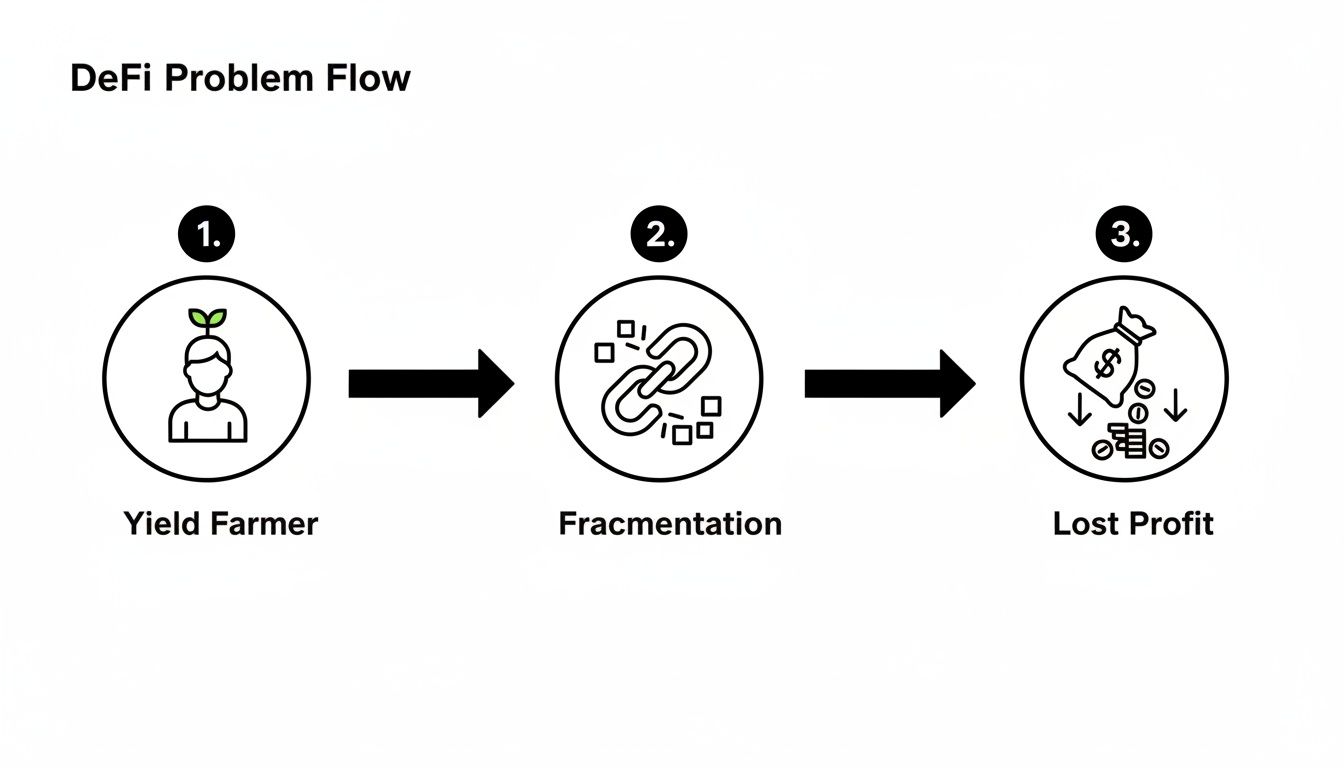
This graphic nails the core challenge: the fragmentation between blockchains creates walls, causing your value to leak out through fees and slippage before it ever reaches the yield opportunity you were chasing.
My personal rule is simple: if my planned deposit or withdrawal will make up more than 1% of a pool's total liquidity, I either find a deeper pool or I split my transaction into smaller chunks over time.
Once you’ve found a promising opportunity on another chain, the next puzzle is getting your funds there without losing your shirt. This is where bridging comes in.
Choosing Your Bridging Solution
Moving funds between blockchain islands is a make-or-break step. Your choice of bridge will have a huge impact on your costs and, more importantly, your security. They are not all created equal.
A native bridge, like the official Arbitrum or Base bridge, is built by the blockchain's own dev team. These are usually the safest bet because you aren't adding any new third-party trust assumptions. The downside? They can sometimes be slower and pricier than the alternatives.
Third-party bridges, like Stargate or Hop Protocol, and bridge aggregators like Bungee or Jumper, offer a ton more flexibility. They connect a much wider array of chains and can sniff out the cheapest or fastest route by sourcing liquidity from multiple places at once. The trade-off is you're introducing another layer of smart contracts, and with it, another layer of potential risk. If you want to dig deeper here, our guide on how TVL tracking signals can reveal protocol health is a great read.
Sometimes, the best "bridge" isn't a bridge at all. For certain transfers, sending your stablecoins to a centralized exchange (CEX), withdrawing them on the destination chain, and then sending them to your wallet can be shockingly cheap and fast. It feels a bit backward in DeFi, I know, but it works. I’ve personally saved over $50 on a single transaction by using a CEX instead of a congested on-chain bridge.
At the end of the day, the goal is to make smart, cost-effective moves that protect your capital. By carefully mapping your route and picking the right vehicle, you make sure your profits aren’t lost in transit.
A monster APY is often just bait on a hook. In the fragmented world of DeFi, the juiciest yields almost always come with the highest, and often hidden, risks. Before you even think about depositing a single dollar into some new protocol, you absolutely need a tough, repeatable way to vet it that goes way beyond surface-level stats.
This is how you learn to spot the sustainable gems and sidestep the ticking time bombs.
Being successful in DeFi isn't about chasing the highest number on a screen. It's about becoming a skilled risk assessor. You have to understand that protocol risk isn't just one thing; it's a mix of technical, economic, and human factors all rolled into one.
Decoding Smart Contract Security
The foundation of any DeFi protocol is its code. A single vulnerability here can mean a total loss of funds, which makes smart contract security your first and most critical checkpoint. A slick website and big promises mean nothing if the code underneath is a house of cards.
Your vetting process should hit three key areas:
Audits: The first thing I look for are audits from reputable firms like Trail of Bits, OpenZeppelin, or Quantstamp. Don't just see the checkmark; find the actual report and read the summary. Were there critical issues? More importantly, did the team fix them? Seeing multiple audits over time is a fantastic sign.
Time on Mainnet: A protocol that’s been running smoothly on mainnet for a year or more, holding real value without getting hacked, is what we call "battle-tested." Time is a brutal but effective auditor. New protocols, even with great audits, simply haven't faced the creativity of real-world attackers.
Bug Bounties: A healthy bug bounty program, especially on a platform like Immunefi, shows the team is serious about security. A bounty of $1 million or more for critical bugs tells you they value security enough to put serious cash on the line.
My personal rule is to never be the first money in. I wait until a protocol has been live for at least three months and has attracted a stable Total Value Locked (TVL) before I even consider it. The opportunity cost of waiting is way lower than the risk of becoming someone else's exit liquidity.
Assessing Economic and Centralization Risks
Even with rock-solid code, a protocol can implode from a bad economic model or too much centralization. These risks are just as critical as the technical ones, but they're the ones people often ignore when they're staring at a crazy APY.
For example, where is that yield really coming from? Is it generated from sustainable protocol fees, like trading or borrowing interest? Or is it just from printing a native governance token and handing it out? That second one is just an inflationary gimmick that almost always ends with the token price crashing to zero, dragging your "great" APY down with it.
To get a clearer picture of these non-technical risks, you need to ask the right questions. For a much deeper dive, you should check out our full guide on how to perform a thorough protocol safety analysis.
Key Risk Indicators to Check
Risk Category | What to Investigate | Where to Look |
|---|---|---|
Economic Risk | Is the yield from real revenue or inflationary token rewards? What's the tokenomics model? | Protocol documentation, tokenomics pages, and community channels (Discord/Telegram). |
De-Pegging Risk | If it's a "synthetic" or "algo" stable, what keeps it pegged? What's the collateral? | The project's official whitepaper and analytics dashboards. |
Centralization Risk | Who has the admin keys? Can a few people just pause contracts or change the rules? | Protocol docs, especially announcements about multi-sig wallets and timelocks. |
TVL Stability | Is the TVL growing steadily, or is it all over the place? Sudden drops can signal a loss of confidence. | DeFiLlama is the absolute best tool for tracking historical TVL. |
Think about the difference between a blue-chip like Aave and some new, unaudited farm-and-dump protocol. Aave generates yield from real borrowing demand, its code has been battle-tested for years, and its governance is decentralized. The new protocol might offer a 500% APY, but it's fueled by printing a worthless token, and the admin keys are held by an anonymous team. One is a foundational asset; the other is a lottery ticket.
Making this vetting process a core part of your strategy is non-negotiable. It helps you look past the hype and make decisions based on a clear-eyed view of the facts. This is the discipline that lets you build a resilient portfolio that can actually weather the market and consistently capture sustainable yield.
Building Your Cross-Chain Stablecoin Strategy

Alright, you've mapped out the DeFi landscape and have a solid process for checking out protocols. Now it's time for the fun part: putting your money to work. This is where theory gets real.
A strong portfolio for navigating fragmented DeFi isn't about chasing one or two crazy high-yield pools. It's about building a balanced, adaptable system that doesn't fall apart when the market gets choppy.
For this, I swear by the core-satellite approach. It’s a classic investment strategy that translates perfectly to stablecoin yield farming, splitting your capital into two buckets to balance safety with growth.
Your core is the bedrock of your portfolio. This is the biggest chunk of your capital—I'm talking 70-80%—and it goes into the most battle-tested, low-risk DeFi protocols. Think of the big names like Aave or Compound, protocols that have been around the block, survived multiple bear markets, and generate yield from real, sustainable demand.
The aim here isn't to hit grand slams. It's about securing a reliable, steady return. The yield might not get your heart racing, but the risk of a catastrophic loss is much, much lower.
Designing Your Core Allocation
Even when you're sticking with the blue-chips, you don't want to put all your eggs in one basket. I spread my core funds across at least two to three different top-tier protocols.
To keep fees from eating my lunch, I usually stick to one or two low-cost, high-liquidity chains like Base or Arbitrum for this part of my portfolio.
Protocol Choice: I only consider protocols with a TVL over $1 billion, a stack of audits, and a track record of more than two years without any major security scares.
Chain Choice: Major Layer 2s or fast Layer 1s are your best bet. You don't want transaction costs eroding your foundational yield.
Yield Source: Make sure the yield is coming from real borrowing demand, not just from inflationary token rewards that will eventually dry up.
This stable core gives you the financial—and psychological—cushion to get a bit more adventurous without risking your entire stack.
Activating Your Satellite Positions
The other 20-30% of your capital is for your satellites. This is your experimental bucket, where you can take some calculated shots.
These are the funds you’ll allocate to newer, higher-risk opportunities you've found and thoroughly vetted. This might be a fresh lending market on an up-and-coming chain or a new liquidity pool offering some juicy trading fees.
The golden rule for satellites is simple: never put in more than you are genuinely okay with losing. This part of your portfolio is for educated risks, not blind bets. If one of your satellites went to zero tomorrow, it shouldn't wreck your overall financial plan.
This structure lets you catch some of the upside from DeFi's constant innovation while keeping your portfolio anchored in proven, reliable protocols. It's a disciplined method that helps you avoid the classic mistake of aping into the latest shiny new thing.
Establishing a Rebalancing Workflow
A strategy is useless if it's static. You need a simple, rules-based system to manage your positions. Making decisions based on emotion or gut feelings is a recipe for disaster. What you need are clear triggers that tell you exactly when to move your capital.
A good rebalancing workflow takes the guesswork out of the equation. Here are a few triggers I personally use to decide when to shift things around:
Yield Threshold: I'll only move funds if I find a new, vetted opportunity offering a sustainable APY that's at least 2% higher than my current position. And that's after factoring in all the bridging and transaction fees.
Risk Score Change: If a protocol I'm in (especially a satellite) has a security issue, a big, sustained drop in TVL, or makes a risky change to its tokenomics, I’m out. I’ll immediately re-evaluate and usually exit the position.
Portfolio Drift: I check my allocations at the end of every month. If a successful satellite position has ballooned—say, it’s now 15% of my total portfolio instead of the original 5%—I'll trim those profits and move them back into my core holdings.
This systematic approach is key to long-term success. It forces you to take profits, cut potential losses before they get out of hand, and stick to your risk plan. It turns the chaotic process of navigating fragmented DeFi into a structured, repeatable discipline.
Let AI Agents Automate Your DeFi Strategy

Let's be honest. Everything we've covered so far—mapping out liquidity, vetting different protocols, and constantly rebalancing funds across chains—is a monumental task. Trying to do it all by hand is basically signing up for a full-time job.
This is where automation comes in and completely changes the game.
The real leap forward in navigating fragmented DeFi isn't about grinding harder; it's about working smarter with AI-powered agents. These platforms are built to do the heavy lifting for you, acting as your own personal DeFi analyst and portfolio manager that never sleeps.
Imagine an AI agent constantly scanning the market. It sifts through thousands of liquidity pools across countless blockchains, checking them against your specific risk settings. When it finds a better opportunity, it can automatically move your capital to capture that higher yield.
The Real Edge of AI Automation
This isn't just about saving time. Automating your strategy gives you a serious, tangible edge that’s almost impossible to replicate manually.
You get your time back: Stop spending hours glued to dashboards and Discord forums. We're talking dozens of hours saved every single month.
It takes emotion out of the equation: The AI sticks to your strategy, no matter what. No fear, no greed, just disciplined execution that avoids those costly impulse decisions.
You catch fleeting opportunities: It can spot and act on those flash-in-the-pan yield opportunities that appear and vanish before a human could even open a new browser tab.
This is how you apply all the solid principles of a DeFi strategy without drowning in the manual labor. It turns a complex, fragmented market into a manageable—and automated—process.
For treasury managers and DeFi professionals, this shift is already happening. AI platforms can take a single USDC deposit on a low-cost chain like Base and have AI agents automatically spread it across a dozen different protocols to get the best risk-adjusted yield. It's a huge evolution from the chaos of 2020's yield farming.
How These AI Platforms Actually Work
These aren't your basic "yield optimizers" that just park your funds in a single vault. We're talking about dynamic, responsive portfolios that adapt to your personal goals.
Take a platform like Yield Seeker. You deposit your stablecoins into one secure smart contract. From there, a clean interface lets you tell your personalized AI agent exactly what your risk tolerance is.
Here’s a glimpse of what that kind of user-friendly interface can look like, designed for total clarity and control.
A dashboard like this gives you an at-a-glance view of your balance, earnings, and where your funds are, cutting through all the usual DeFi complexity.
Once set up, the AI agent gets to work, allocating your capital across a list of pre-vetted protocols. It’s always on the lookout for yield decay, risk spikes, or better opportunities, rebalancing your funds automatically when it makes sense. If you want to get into the nitty-gritty, you can learn more about how to use AI agents in our dedicated guide.
The most powerful part of this tech is that it turns fragmentation from a problem into an advantage. The AI can exploit the exact same inefficiencies and yield gaps between chains and protocols that make manual farming such a headache.
For anyone looking to automate parts of their DeFi strategy, it's also worth understanding how AI chat completion tools work, as they're the brains behind many of these intelligent agent systems.
At the end of the day, these platforms open the door for everyone—from total beginners to teams managing large treasuries—to capture competitive yields without the endless hunt. You keep full control and can withdraw anytime, but you delegate the tedious, 24/7 optimization job to an agent that does it all for you. This is what makes navigating fragmented DeFi not just doable, but profitable and sustainable.
Your Questions About Fragmented DeFi Answered
As you start digging into yield generation across multiple chains and protocols, you'll find the same questions keep popping up. I've heard them all, so let's tackle them head-on with some straight, practical answers to clear up any confusion.
How Do I Know if a High APY Is Worth the Risk?
A sky-high APY isn't an invitation to ape in; it's a signal to do your homework. That juicy number could easily be a red flag in disguise.
First, I always look for recent, reputable smart contract audits. Then I head over to a site like DeFiLlama to analyze the protocol's Total Value Locked (TVL). Is it growing steadily, or is it all over the place? Spikes can be a sign of mercenary capital that will disappear as quickly as it arrived.
Most importantly, you have to figure out where the yield is actually coming from. Is it from sustainable sources like borrowing fees? Or is it just propped up by printing inflationary tokens that are destined to dump?
My personal rule is simple: if I can't explain the yield source in a sentence or two, I treat it as extremely high-risk. I might throw a tiny bit of my "satellite" portfolio at these unproven opportunities, but never my core capital.
What's the Minimum Capital for Multi-Chain Yield Farming?
Honestly, this all boils down to transaction costs. It's a game of efficiency.
On Ethereum mainnet, a few transactions can easily cost you hundreds of dollars in gas. Trying to deploy a small amount of capital is a losing game—the fees will eat up any profit you might have made.
This is exactly why Layer 2s like Base and Arbitrum are such a big deal for navigating fragmented DeFi. On these chains, transactions often cost just pennies, making these strategies accessible to just about everyone, not just the whales.
Low-Cost Chains: You can get started with just a few hundred dollars on chains like Base, Arbitrum, or Solana.
AI-Powered Platforms: Tools built on these low-cost networks are a game-changer. They can efficiently manage even tiny amounts of capital—we're talking $100 or less—across different protocols. That would be completely impossible on more expensive chains.
Ultimately, automation on these affordable chains is what removes the massive barrier to entry that used to define cross-chain farming.
How Often Should I Rebalance My Stablecoin Positions?
The single biggest mistake you can make is over-trading. Chasing every small percentage point will get you eaten alive by gas fees and slippage, absolutely killing your profits. You need a clear, rules-based system.
Don't let FOMO or fear guide your hand. I suggest reviewing your positions on a set schedule—maybe once a month, or after a big market event. Then, define a strict "yield threshold" for when you'll actually move funds.
A good rule of thumb is to only rebalance if a new, fully vetted opportunity offers at least a 2% higher APY after you've factored in all the bridging fees, swap fees, and gas costs. If it's less than that, the effort and risk probably aren't worth the tiny gain.
This is another area where AI-powered automation really shines. These tools can run this exact logic for you 24/7, only making a move when it's provably profitable based on your rules. It's all about acting on logic, not impulse.
Ready to stop hunting and start earning? Yield Seeker uses personalized AI agents to automatically find and manage the best risk-aware stablecoin yields for you. Deposit on Base and let our platform do the heavy lifting. Get started at https://yieldseeker.xyz.