
You open your wallet, check a dashboard, and see the same problem most stablecoin holders face. Rates move fast, protocol risk is hard to compare, and every X thread claims a new “best” opportunity. By the time you verify the smart contracts, bridge route, incentive schedule, and withdrawal conditions, the yield has already changed.
That's where an AI crypto forecast becomes useful. Not as a magic number generator, and not as a promise that a token will hit some exact target on some exact date. Its real value is operational. It helps sort weak signals from useful ones, rank opportunities, and flag when conditions are changing before your capital drifts into a worse setup.
AI forecasting is often associated with Bitcoin calls and altcoin speculation. That's the loud part of the market. The quieter use case is often better for actual portfolio management: forecasting stablecoin yield conditions across fragmented DeFi venues, where the question isn't “Will this coin double?” but “Is this yield likely to persist, compress, or become riskier than it looks?”
Navigating Crypto Volatility with AI Forecasts
Crypto investors don't struggle because information is scarce. They struggle because there's too much of it. Price alerts, on-chain dashboards, influencer threads, Discord rumors, and trading indicators all compete for attention at once.
In that environment, reacting quickly can feel smart while making decisions worse. A proper AI crypto forecast helps by forcing the process back toward evidence. It pulls signals into one place, compares them, and gives you a structured view of trend, risk, and probability.

Why AI forecasting keeps gaining attention
Part of the interest is simple market expansion. The projected market capitalization of crypto AI tokens is $150 billion by the end of 2025, with at least ten new crypto AI protocols expected to exceed $1 billion in circulating market capitalization, according to TrendX's 2025 crypto AI projections.
That doesn't prove every AI product is good. It does show the category isn't fringe anymore.
For investors, the practical question is different from the headline question. It's not “Is AI big?” It's “Can this tool help me make fewer bad decisions?” Often, the answer is yes, but only if you use it as a filter rather than an oracle.
Practical rule: Use AI forecasts to narrow the field first. Make commitment decisions second.
What a useful workflow looks like
A workable process usually looks more like triage than prediction theater:
Scan broad conditions first: Check whether market structure looks stable, stretched, or disorderly.
Compare opportunity types: Separate volatile token trades from cash-like stablecoin strategies.
Review downside before upside: Ask what breaks the thesis before asking how much it might earn.
Keep funds flexible: If a strategy depends on perfect timing, it's usually too fragile.
That last point matters for newer users thinking about portfolio safety more broadly. A grounded primer on whether crypto investing is safe is often more useful than another hot take on price direction.
Noise feels urgent. Risk actually is.
A lot of crypto content trains people to chase movement. Builders and treasury managers usually need the opposite. They need tools that reduce research burden, improve consistency, and help them avoid hidden downside.
That's why the best use of AI forecasts often starts with one simple shift. Stop asking for certainty. Start asking for a cleaner decision environment.
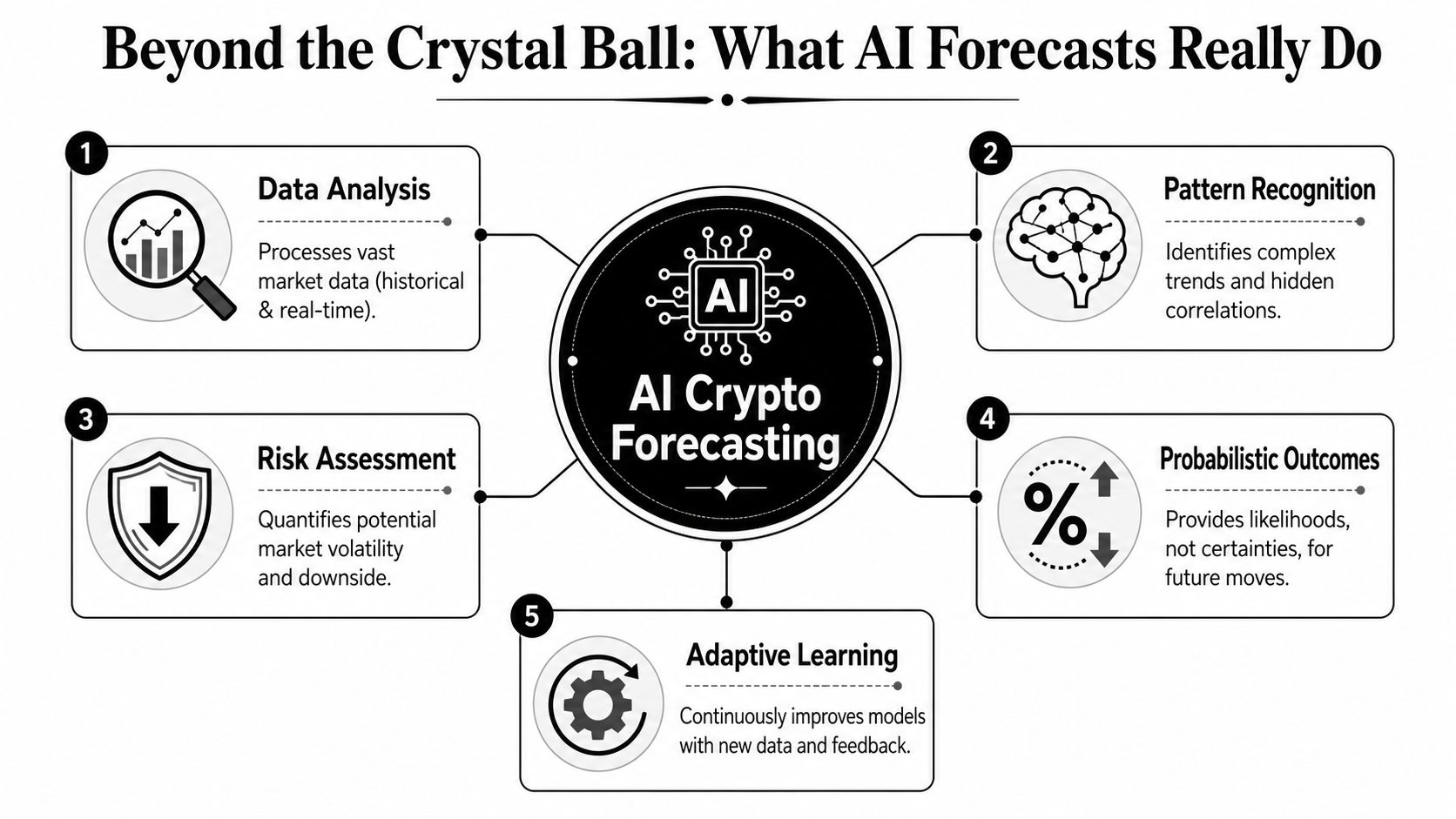
Beyond the Crystal Ball What AI Forecasts Really Do
A good AI crypto forecast works more like a weather report than a prophecy. A weather report doesn't say, “It will rain on your left shoulder at 3:12 PM.” It says conditions are changing, storm probability is rising, and you should plan accordingly.
That's the right mental model for crypto. AI can process more inputs than a human can track manually, but the output is still probabilistic. It's there to improve planning, not eliminate uncertainty.
What the forecast is actually doing
Under the hood, most forecasting tools are trying to answer a few practical questions:
Function | What it means in practice |
|---|---|
Pattern detection | Spotting recurring setups in price, volume, or on-chain behavior |
Regime identification | Distinguishing quiet conditions from unstable ones |
Risk scoring | Estimating whether an opportunity is improving or deteriorating |
Probability framing | Showing scenarios and ranges rather than exact promises |
This is why serious platforms rarely issue cartoonishly precise calls. According to ChangeHero's review of AI crypto prediction methods, legitimate AI systems tend to provide probability ranges, trend analysis, and pattern recognition, not claims like “Bitcoin will hit a specific number by April.”
Price forecasting and yield forecasting are not the same job
This distinction gets missed constantly.
Forecasting the price of a volatile asset is a speculation problem. The model has to deal with narrative shocks, macro shifts, forced liquidations, liquidity gaps, and trader reflexivity. Even when the model is directionally useful, the path can still be chaotic.
Forecasting stablecoin yield is closer to an operations problem. The model asks different questions:
Is protocol usage rising or fading?
Are emissions doing the heavy lifting?
Is liquidity sticky or temporary?
Are fees supporting the rate?
Do withdrawal conditions change the actual attractiveness of the yield?
That makes yield forecasting more practical for many investors. It's less about calling moonshots and more about monitoring changing conditions across many venues at once.
Treat AI like a meteorologist for DeFi. It won't guarantee sunshine. It can tell you when the storm risk is rising.
If you want a parallel lens on how signal systems are used in practice, this guide to AI crypto signals is a useful companion. The key is the same in both cases. A signal is only helpful when you know what decision it supports.
What AI forecasts do badly
They do badly when people ask them for the wrong output. Exact tops, exact bottoms, exact timing. Those are the requests that turn a decision tool into entertainment.
They also struggle when users ignore context. A model can highlight a favorable setup, but it can't decide your liquidity needs, tax constraints, custody preferences, or tolerance for protocol complexity. That part still belongs to the investor.
The Engine Room Models and Data Sources
It is often thought that the model is the magic. Usually, the data pipeline matters more.
A weak model with clean, varied inputs can still be useful. An advanced model fed narrow or stale data will produce polished nonsense. In DeFi, that problem gets worse because the market is fragmented across chains, apps, liquidity layers, and incentive schemes.

The model types matter less than the inputs
You'll hear terms like machine learning, deep learning, time-series models, and reinforcement systems. Those labels matter to builders, but users should care more about coverage and update quality.
A credible forecasting stack usually blends several input classes:
Market structure data: price action, liquidity shifts, and volatility behavior
On-chain signals: wallet flows, protocol usage, transfer patterns, and volume changes
Technical indicators: momentum and confirmation layers
Sentiment and narrative data: social chatter, news flow, and narrative rotation
Protocol-specific mechanics: emissions, fee generation, collateral design, and redemption behavior
When those inputs disagree, the disagreement itself is often the signal. A pool showing strong headline APY but weak stickiness, heavy incentive dependence, and deteriorating usage should be treated very differently from a lower but steadier opportunity supported by actual activity.
Confirmation beats single-indicator confidence
One of the better practical descriptions of current AI forecasting pipelines comes from CoinXSight's 2026 technical analysis guide. It notes that AI-driven crypto forecasting models in 2026 use multi-layer technical analysis pipelines that combine RSI extremes, MACD crossovers, divergence signals, and pattern breakouts into a confidence-weighted signal, and only trades with 3+ independent confirmations, including on-chain volume and market structure, pass final confirmation.
That matters because single-indicator systems fail all the time. RSI alone can stay overbought for long stretches. MACD alone can lag badly. Sentiment alone can chase narratives after the best entry is gone. The edge comes from convergence.
Here's a simple way to understand it:
Input style | Typical weakness |
|---|---|
Price history only | Misses context and hidden structural shifts |
Sentiment only | Overreacts to noise and crowd emotion |
On-chain only | Can lag human narrative changes |
Multi-source system | Harder to build, but better at filtering false confidence |
Data quality is the real bottleneck
Builders know this already. If chain labels are wrong, if protocol data is delayed, or if rewards are counted without adjusting for conditions, the forecast will be skewed before the model even starts reasoning.
That's why broader guidance on improving AI model data quality is relevant here. The lesson applies directly to DeFi. Better forecasts don't start with fancier prompts. They start with cleaner, better-joined, more current inputs.
The fastest way to break an AI crypto forecast is to feed it one clean chart and pretend that chart contains the whole market.
For readers who want the DeFi-specific version of this idea, machine learning in DeFi is worth reviewing. The big takeaway is practical. If a platform can't explain what data it watches, you shouldn't trust its confidence score.
Interpreting Forecasts and Understanding Limitations
You wake up, check a dashboard, and an AI model says ETH is likely up this week. If that signal pushes you to rotate out of a stablecoin position earning solid base yield into a noisy directional trade, the forecast needs a much higher bar than “better than chance.”
That is the core interpretation problem. An AI crypto forecast can be useful and still be too weak to trade blindly.
Accuracy helps, but it does not carry the whole decision
A recent review in MDPI's survey of machine learning methods for cryptocurrency prediction found that reported model performance often improves on random direction calls in controlled settings, but results vary sharply by dataset, time window, and evaluation method. In practice, short-term directional accuracy in crypto is often modest. Even a model that gets direction right more often than wrong can still produce bad trades if entries are late, fees are high, or the move is too small to cover risk.
That is why I treat forecast outputs as one input, not the trade thesis.
Use this filter:
Direction: Is the model only suggesting bias, or is it claiming a specific target?
Time horizon: A 24-hour signal and a 30-day signal should not drive the same action.
Error cost: What happens if the model is wrong once? On a high-stakes trade, one miss can erase several small wins.
Decision fit: Does this forecast help with allocation, timing, or risk reduction? Make it answer one job.
Disagreement between models is useful information
Two reputable models can watch the same market and reach different conclusions because they are built for different failure modes. One may react fast to momentum and get chopped up in reversals. Another may wait for confirmation and miss the first part of the move.
For traders, that disagreement often means uncertainty is high.
For stablecoin allocators, it means something more practical. If models disagree on where risk assets are heading, parking capital in a durable yield source can be the better call than forcing a directional bet. That is one reason I find yield forecasting more useful than headline price forecasting. The question shifts from “Will this token rally?” to “Will this pool still pay enough next week after incentives cool and utilization changes?”
If two credible models disagree sharply, reduce exposure or stay in stablecoins until the setup is clearer.
That mindset also fits the payment and agent side of the market. X402 Foundation's AI payment views are relevant here because automated agents do not just need predictions. They need rules for when not to act.
What AI forecasts do well
AI is good at ranking and monitoring. It can flag when a yield source starts deteriorating, when utilization moves out of its healthy range, or when reward composition shifts from real fees to temporary token emissions.
It is much worse as a substitute for risk judgment.
A practical workflow looks like this:
Use forecasts to compare options, not to create certainty
Rank three stablecoin venues by expected net yield after fees, slippage, and bridge costs.Check whether the yield is structural or promotional
Fee-driven lending demand is different from a seven-day incentive campaign.Set a trigger for review
Recheck if utilization spikes, governance changes collateral rules, or incentives expire.Size for forecast error
A model can be directionally right about yield improving and still miss the drawdown risk from smart contract, oracle, or liquidity issues.
The main limitation is straightforward. Models are usually better at spotting patterns than at understanding regime breaks. A hack, governance vote, exchange listing, or collateral shock can invalidate yesterday's signal fast.
That is why the best use of an AI crypto forecast is operational. Improve allocation decisions. Catch deterioration earlier. Keep stablecoins in places where the yield still makes sense after you account for risk, friction, and the chance that the model is wrong.
From Price Speculation to Smart Stablecoin Yields
Now, the conversation gets more useful.
Most AI crypto forecast content stays stuck on volatile asset prices. Bitcoin target. Ethereum target. Best altcoin setup. It's engaging, but it misses the workflow many real users care about most. They're sitting in stablecoins and trying to earn responsibly without turning yield hunting into a part-time job.
The overlooked forecasting problem
One of the more interesting gaps in current coverage is identified in Bitcoin.com's roundup of AI model predictions. The article notes that the most frequently unaddressed question is how accurate AI models are at predicting stablecoin yields versus volatile asset prices, even while 9 major AI models focus on Bitcoin reclaiming $100K by late 2026.
That gap matters because yield forecasting is a different discipline.
Price forecasts deal with unstable market psychology. Yield forecasts can focus more on mechanics such as:
Protocol demand: Are borrowers, traders, or liquidity users creating sustainable usage?
Reward composition: Is the rate coming from fees, incentives, or a temporary campaign?
Liquidity durability: Does capital stay once incentives cool off?
Risk drift: Are contract changes, governance moves, or collateral shifts making the yield less attractive?
Why stablecoin yield is a better fit for AI
An AI system is particularly good at repetitive monitoring across many changing environments. That's exactly what stablecoin yield management requires.
A human can compare a few pools manually. An AI system can continuously watch a much broader set of conditions and ask the same questions every time:
Question | Why it matters |
|---|---|
Is the yield stable? | High rates that collapse quickly are hard to capture consistently |
What drives the yield? | Fee-backed yield is different from incentive-backed yield |
How fast are conditions changing? | Sudden TVL surges can compress returns |
What are the access costs? | Bridge friction and withdrawal complexity change the real net outcome |
This is less glamorous than price speculation, but it's often more aligned with treasury management and passive income goals.
The next layer is machine-to-machine finance
As more DeFi activity becomes agent-driven, forecasting yield won't just be about human investors comparing dashboards. It will also involve software agents routing capital, evaluating intent-based execution, and reacting to payment standards built for automated systems.
For that reason, X402 Foundation's AI payment views are worth following. They help explain why yield discovery and capital allocation are becoming part of a larger machine-native financial stack.
A stablecoin strategy usually fails for boring reasons, not dramatic ones. The yield decays, the incentives change, the liquidity shifts, or the operational friction eats the edge.
That's why forecasting yield can be more valuable than forecasting hype. It supports a repeatable process. You're not trying to win the loudest market narrative. You're trying to keep capital productive without taking hidden risks for cosmetic APY.
How an AI Agent Automates Your Yield Strategy
The cleanest way to understand this is to think in terms of delegation.
You start with stablecoins. You want them to stay liquid. You don't want to spend your week checking pools, reading governance threads, comparing reward schedules, and deciding whether a yield spike is real or temporary.

What the agent is actually doing
An AI agent for yield strategy isn't “predicting crypto” in the broad, cinematic sense. It's doing portfolio operations continuously.
A practical agent workflow looks something like this:
It monitors stablecoin opportunities across supported DeFi venues.
It evaluates whether the visible yield appears durable or likely to compress.
It compares that opportunity against alternatives on a risk-aware basis.
It reallocates when the relative attractiveness changes.
That's a much better use of AI than asking it for a heroic token call. The investor gets automation where automation helps most: monitoring, comparison, and execution discipline.
Why this model is growing
The bigger trend supports this direction. According to Paul Davies' 2026 review of AI x crypto, AI agents are projected to manage at least 5% of total DeFi value by the end of 2026, representing billions in autonomous capital deployment, and the broader AI Crypto market is forecast to reach $10 billion by then, driven by intent-based execution.
That projection doesn't mean every agent will be good. It does mean autonomous capital management is moving from experiment to real market behavior.
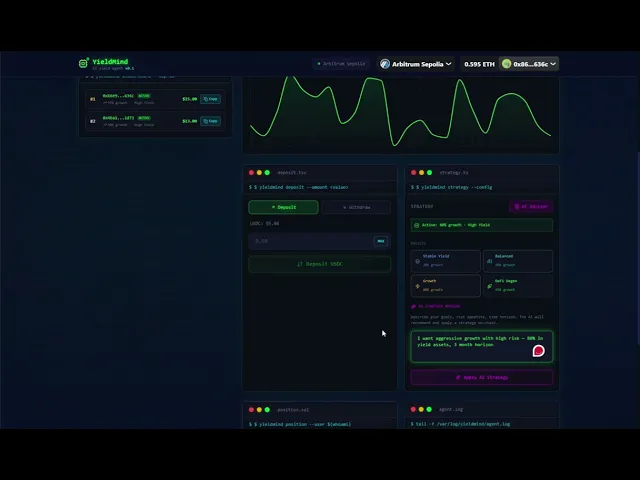
Here's a short product walkthrough that makes the operating model easier to visualize:
What investors should expect from automation
The right expectation isn't perfection. It's reduced burden.
A good AI agent should help with:
Constant monitoring: watching markets you won't track manually
Faster response: adapting when conditions change
Cleaner comparisons: ranking opportunities on more than headline yield
Lower decision fatigue: removing the need to re-underwrite every move from scratch
It should not remove responsibility entirely. You still need to understand custody, chain exposure, protocol risk, and liquidity needs. Automation helps most when the objective is clear. For many stablecoin holders, that objective is straightforward: keep idle capital productive, stay flexible, and avoid chasing unsustainable rates.
If you want that kind of hands-off stablecoin strategy, Yield Seeker is built for it. You can deposit USDC on Base, let a personalized AI Agent monitor and allocate across DeFi opportunities in real time, and keep full flexibility with accessible funds and no lockups.