
The most popular advice about crypto high yield savings is to compare APYs and choose the biggest number. That starts in the wrong place. Before asking what a product might pay, ask what you legally own, who owes you money, and what happens to your claim if the platform, stablecoin issuer, or smart contract fails.
Stablecoins usually don't pay interest just because you hold them. Yield appears when a holder puts them to work through a lending protocol or a centralized crypto platform, where returns change with borrowing demand, available liquidity, incentives, and market conditions. That's a different arrangement from an insured bank deposit, even when both are described as “savings.”
Table of Contents
Why Crypto High Yield Savings Is Not a Bank Account
How Stablecoin Yield Is Actually Generated
Follow the money through the pool
Look beyond the headline APY
CeFi and DeFi Routes to Stablecoin Yield
What Typical Returns Look Like and Why They Move
The Real Risks Behind a High APY
How a local failure can spread
“No lockup” isn't the same as an exit
Regulation, Taxes, and the Claim You Actually Hold
Identify the party and the recovery path
Taxes and reporting
How to Evaluate a Platform or Strategy
Ask what supports the strategy
Practical Next Steps for Earning Yield More Safely
Why Crypto High Yield Savings Is Not a Bank Account
A high APY can look like a better-priced version of a savings account. It isn't. Crypto yield is a variable return from deploying digital assets, not a guaranteed bank deposit rate, and the legal protections and risks can be very different.

Ordinary stablecoins such as USDC or USDT typically don't pay interest on their own. To seek yield, holders can supply them to a lending pool or use a centralized platform that deploys them. Borrowers provide collateral, and depositors may receive interest shaped by how much of the pool is being borrowed, how much liquidity remains, and whether the protocol is offering token incentives. Those rates can change, and incentives can end.
The model grew alongside DeFi lending. BIS-related analysis reports that DeFi lending's total value locked rose from nearly zero at the end of 2020 to approximately $50 billion in early 2022. Yet yield-seeking deployment hasn't meant every stablecoin holder lends: a BIS study covering January 2019 through June 2025 found that the median share of USDC supplied to DeFi lending protocols was 12.8%, compared with 4.1% for USDT (BIS analysis of stablecoins and bank deposits).
That distinction matters when comparing a crypto APY with a bank savings rate. A bank deposit is a claim on a bank, and eligible deposits may receive protection under applicable deposit-insurance rules. A crypto product may expose you to a platform, protocol, stablecoin, collateral, and liquidity risks instead. The rate alone doesn't tell you which party owes you money or how you might recover assets if something breaks.
Start with the claim, not the rate. Find out who holds your assets, how they're used, and what legal position you'd have if that party failed.
How Stablecoin Yield Is Actually Generated
Think of a lending pool as a communal pot. Stablecoin holders supply assets to it; borrowers pay to use some of those assets, usually by providing collateral; and the pool returns a portion of the borrowing income to depositors. The yield comes from lending activity, not from a bank promising a fixed rate.

Follow the money through the pool
If borrowers want more stablecoins while the pool has limited available liquidity, the rate may rise to attract deposits and moderate borrowing. If borrowing demand falls or deposits build up, the rate may decline. Utilization, the share of supplied assets currently borrowed, helps explain that movement, but it's only one part of the picture. Collateral quality, available reserves, incentives, and contract execution also affect what a depositor earns.
A displayed APY can combine two distinct sources:
Base borrowing interest: payments borrowers make for using the pool's assets.
Token incentives: additional rewards that a protocol or platform may offer temporarily.
That second component can make a headline rate look attractive without representing durable lending income. If incentives shrink or disappear, the displayed return can fall even if the underlying pool keeps operating. DeFi lending-pool yields can also evolve largely independently of conventional policy rates, so they may move for reasons a bank deposit rate doesn't (BIS research on DeFi lending and financial stability).
Look beyond the headline APY
Before depositing, check the pool's utilization and reserve liquidity, what collateral borrowers use, and how much you can withdraw under normal conditions. Ask whether a quoted rate includes token rewards and whether those rewards can be sold or redeemed without materially changing their value.
For a plain-language introduction to lending pools and how they fit into DeFi, read this guide to DeFi money markets. The central question is simple: what activity is paying the yield, and could that activity change quickly?
CeFi and DeFi Routes to Stablecoin Yield
Centralized finance, or CeFi, and decentralized finance, or DeFi, offer different ways to pursue stablecoin yield. Neither route removes risk. The difference is where custody and decision-making sit, how much of the underlying activity you can inspect, and what could happen when an intermediary or protocol runs into trouble.
A centralized platform may take custody of your stablecoins and deploy them for you. That can make the experience easier to use, but it creates a counterparty relationship: you need to understand the platform's terms, how it uses customer assets, and what rights you have if it fails. The interface may show a balance without making the underlying loans, counterparties, or withdrawal constraints easy to evaluate.
A DeFi lending protocol generally lets users interact through a wallet and inspect activity on-chain. That visibility comes with more responsibility. You manage wallet access and transactions, pay applicable network costs, and accept smart-contract risk. A protocol's on-chain visibility also doesn't guarantee that you can exit at a preferred time or price.
Factor | Centralized Platform (CeFi) | DeFi Lending Protocol |
|---|---|---|
Custody | The platform may hold or control assets on your behalf. | Users typically interact through their own wallets, though the protocol controls deposited assets according to its code. |
Transparency | Disclosures and account interfaces depend on the provider. | Pool activity and transactions may be inspectable on-chain. |
Failure exposure | Platform failure, asset management, and recovery terms matter. | Contract, collateral, oracle, and protocol liquidity risks matter. |
Withdrawals | The provider's policies and operational capacity can affect access. | Pool liquidity, network conditions, and contract rules can affect access. |
For readers assessing how stablecoins fit into payment and financial infrastructure, BroLabel's overview of stablecoin infrastructure applications offers useful context. It doesn't decide which yield route suits you. That depends on your comfort with custody, technical complexity, and the specific legal claim the product gives you.
What Typical Returns Look Like and Why They Move
There isn't one typical APY that reliably describes crypto savings. A rate can differ from one pool to another, then shift as borrowing demand, available liquidity, or token incentives change. Treat a sudden increase as a reason to investigate what changed, not as proof that the opportunity has become safer or more durable.

An APY can include base interest paid by borrowers, temporary token rewards, or both. Those pieces don't carry the same durability. Base interest depends on lending activity and pool conditions; emissions depend on the incentive program and the value and availability of the reward token. A rate display doesn't tell you how much of the quoted return comes from each source unless the provider explains it.
Crypto yield also responds to the broader interest-rate environment. A Philadelphia Federal Reserve analysis reported that stablecoins grew from approximately $25 billion during the 2021 DeFi summer to nearly $300 billion by 2025, while yield-bearing stablecoins expanded from slightly below $1 billion in 2023 to more than $19 billion by September 2025 (Philadelphia Fed analysis of stablecoins). In the same body of research, a 1-basis-point increase in bank deposit rates over a ten-week period was associated with roughly a 3-percentage-point reduction in stablecoin market-capitalization growth in the baseline estimate; an alternative estimation approach suggested an approximately 9-percentage-point reduction. Those historical findings show that crypto yield demand isn't isolated from conventional rates.
The practical comparison isn't “Which number is largest?” It's what remains after fees, changing rates, and the risks you're accepting. Learn how APY differs from yield before treating a dashboard figure as durable income.
The Real Risks Behind a High APY
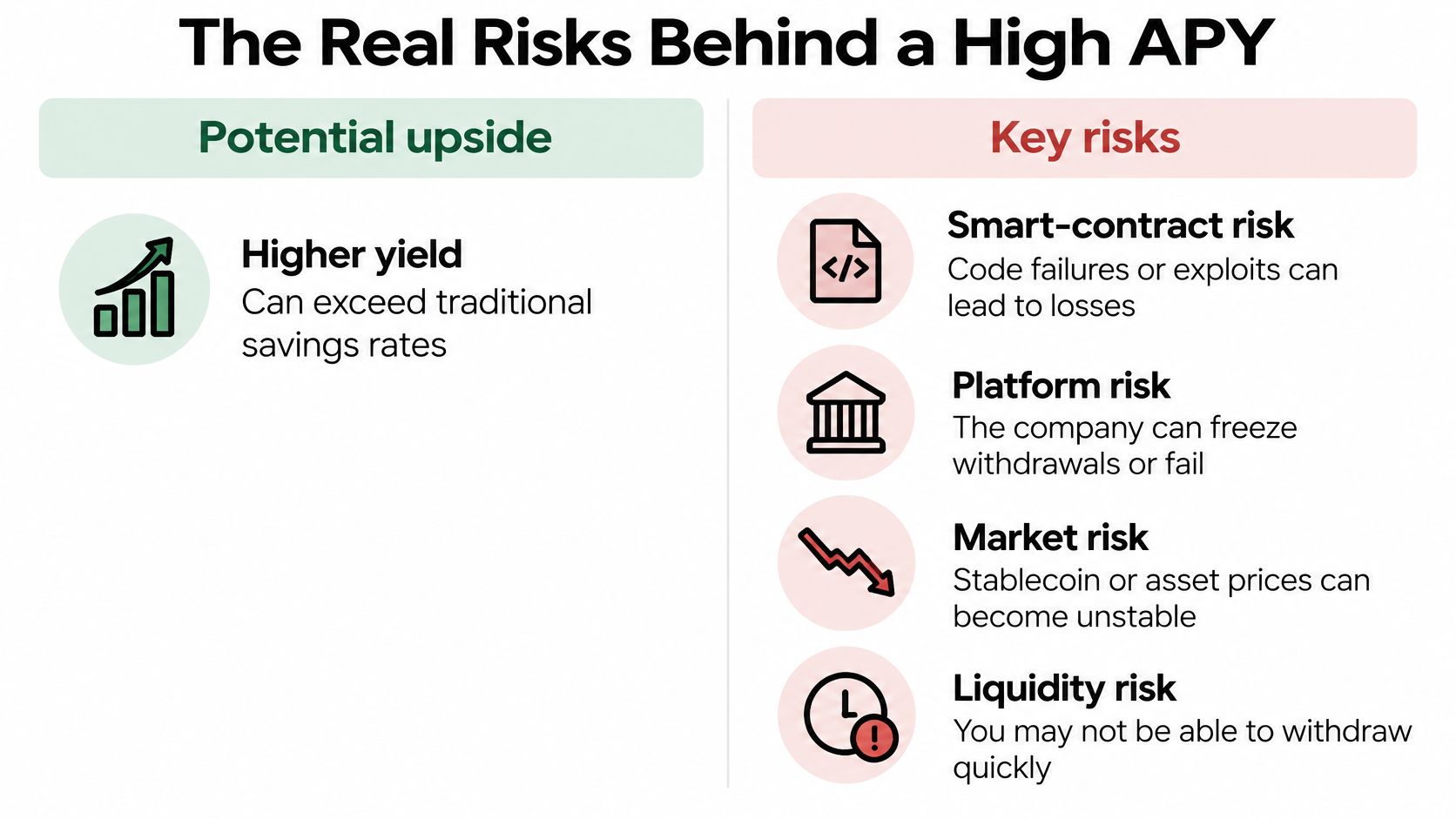
A stablecoin's target price doesn't make a lending strategy safe by itself. Losses can arise from the contract that manages deposits, the platform controlling them, the collateral backing loans, the stablecoin's redemption arrangements, or a failure to withdraw when liquidity tightens.
How a local failure can spread
Smart-contract risks include oracle failures, delayed pricing, flash-loan attacks, reentrancy vulnerabilities, and liquidity shortages. An oracle supplies data a contract uses to make decisions. If that data is faulty or delayed, a contract can act on a misleading price; other weaknesses can enable attackers to manipulate or exploit a protocol. A bug or shortage in one part of a strategy can therefore affect depositors, not just the developers operating the system.
Stablecoin and collateral risk can compound the problem. If a stablecoin deviates from its target, collateral values fall, or borrowers face liquidation, participants may rush to withdraw. That withdrawal pressure can further reduce available liquidity. BIS analysis describes mismatches between the risks of backing assets and the stable value promised to holders, while crypto-collateralized systems can lose overcollateralization during volatility spikes (BIS analysis of DeFi risks).
“No lockup” isn't the same as an exit
Withdrawal capacity has several layers: liquidity in the lending pool, liquidity on any bridge or settlement route, the stablecoin issuer's redemption process, and the interface's ability to process withdrawals. A platform may show funds as accessible during ordinary conditions while network congestion, market impact, contract problems, or a liquidity event delays an exit.
Practical rule: Set exposure limits before depositing. Prefer contracts with a meaningful operating history and clear security information, keep some assets outside any single protocol, and decide in advance what changes in utilization, collateral volatility, or stablecoin pricing would make you reduce exposure.
A higher APY can reflect a temporary burst in borrowing demand or incentives, but it can also accompany weaker liquidity or greater risk. Review counterparty-risk principles for crypto platforms as part of your assessment. Don't treat a token's target price or an “instant withdrawal” label as a guarantee.
Regulation, Taxes, and the Claim You Actually Hold
A crypto yield product can look like a savings account on a screen while giving you a very different legal claim. A bank deposit comes with a defined recovery path: insurance up to a limit and a regulated resolution process if the bank fails. Stablecoin yield products generally lack deposit insurance and equivalent prudential oversight, so if an intermediary collapses you may end up an unsecured creditor in an insolvency queue, depending on the structure and applicable law (BIS overview of regulatory approaches to stablecoin-related yields).
That distinction is the core question. Rate-shopping asks what you can earn; the balance-sheet question asks what you truly hold a claim on, and against whom.
The United States illustrates the gap. The GENIUS Act, enacted in July 2025, created a federal framework for payment-stablecoin issuers and contains a statutory prohibition on those issuers paying interest or yield directly to holders. That prohibition is not yet in effect: it takes force on the earlier of the effective date of implementing federal regulations or a fixed statutory date around 2026 to 2027. Two things follow. First, the yield advertised today comes from platforms and protocols, not from the stablecoin itself. Second, moving money from an insured deposit into stablecoins still means giving up federal deposit-insurance protection, and the new framework does not change that. "It is dollar-pegged" and "it is protected like a bank balance" remain different statements.
Identify the party and the recovery path
Each structure hands you a different claim. With an issuer, ask what backs the stablecoin and how redemption works, since your strongest claim usually runs to the issuer itself. With a centralized lender, ask whether customer assets are segregated, rehypothecated, or pledged, and what the account agreement says happens in insolvency. With a DeFi protocol, your claim may be nothing more than a smart contract's withdrawal function, and code plus on-chain visibility do not guarantee recovery.
"Withdrawable at any time" describes an access model, not an exit guarantee. Ask which party controls withdrawals and what could delay or block them.
Taxes and reporting
Tax treatment varies by jurisdiction and by how you earn and dispose of assets. Yield, rewards, and gains can each fall under different rules, so confirm your position with a qualified professional. For business owners weighing digital-asset activity, crypto tax guidance for small businesses can help frame questions to take to an adviser. You can also review regulatory compliance considerations for crypto yield before committing funds.
How to Evaluate a Platform or Strategy
Evaluate the whole arrangement, not just the advertised rate. Start with custody: do you keep control of the assets, or does a platform take possession? Then trace how the product uses deposits, what parties or protocols it depends on, and what your claim would be if one of those parties failed.
Ask what supports the strategy
Check the contract's operating history and available audit information, but don't treat an audit as a guarantee that code is safe. Review the collateral composition and liquidation rules, the pool's reserve liquidity, and how much of the strategy's return comes from lending interest versus token emissions. Ask whether the provider explains its exposure clearly and whether it relies on bridges, price oracles, or other services that could fail.
Stress-test the exit rather than relying on ordinary-day access. Ask how withdrawals would work if 10%, 25%, or 50% of users tried to leave at the same time. Those are scenarios to ask a provider about, not predictions or performance data. Consider protocol liquidity, any bridge or settlement route, stablecoin redemption, and whether the interface can process withdrawals under stress.
Manual protocol-hopping gives you direct control but requires ongoing research and execution. An aggregator can simplify discovery, though you still need to understand its underlying venues and fees. Automated allocation can reduce the work of tracking pools, but it doesn't remove contract or liquidity risk. Yield Seeker's Vault Agent is live and offers automated USDC allocation across approved lending vaults on Base using user-owned agent wallets. Its yield is variable, and the current page states a 10% fee on yield, not deposits; automation changes how allocation is managed, not the risks of lending.
Before committing, make sure you can answer:
Who holds or controls the assets? Confirm custody and withdrawal authority.
What generates the return? Separate borrowing interest from incentives and understand fees.
What happens under stress? Check liquidity, dependencies, and the provider's withdrawal disclosures.
What's your legal claim? Read the terms for segregation, reuse of assets, insolvency, and recovery.
What will you monitor? Define the conditions that would make you pause or reduce exposure.
For a wider comparison of approaches and trade-offs, explore this crypto yield comparison.
Practical Next Steps for Earning Yield More Safely
Start with a small amount you can afford to expose to smart-contract and platform risk. Read the disclosures, verify how deposits are used, and test a withdrawal under normal conditions before considering whether to add more.
Compare net, risk-adjusted yield, not the highest APY on a dashboard. Keep a portion of your stablecoins outside any single protocol, and revisit your exposure if pool utilization, stablecoin pricing, collateral volatility, or withdrawal conditions change. Rules and simulations can help you understand a strategy, but they can't guarantee its future behavior or your ability to exit during stress.
The useful question isn't which product pays the most. It's what claim you hold, what can fail, and how you'd respond if liquidity disappeared.
Yield Seeker's live Vault Agent allocates USDC across approved lending vaults on Base through user-owned agent wallets, with variable yield and a stated fee on yield rather than deposits. Read the product disclosures and assess whether that approach fits your risk tolerance before you visit Yield Seeker.