

Think of DeFi protocols as a network of highways. To move your money from one destination (like a yield farm) to another, you have to pay a toll. That toll is the gas fee, a variable cost you pay to get anything done on a blockchain like Ethereum or Base.
Gas-efficient allocation is the art of planning your route to pay the fewest tolls possible. It’s about making sure the transaction fees, known as gas, don't eat up all your profits. A great yield strategy can quickly turn into a losing one if the costs get out of hand.
This is a core discipline for anyone serious about earning in DeFi. High gas costs can quietly drain your returns, turning a promising Annual Percentage Yield (APY) into a net loss. This hits investors with smaller amounts of capital the hardest, where a single transaction fee can wipe out a huge chunk of their potential earnings.
Why It's a Foundational Concept
Managing these costs isn't just some technical detail—it's absolutely fundamental to whether you make money or lose it. Every single decision, from the network you choose to how complex your strategy is, directly impacts the fees you pay. This is exactly why platforms are now being built on low-cost networks and designed to batch transactions intelligently.
At its core, gas-efficient allocation ensures that more of your money stays invested and working for you, rather than being spent on transaction fees. It shifts the focus from chasing the highest gross APY to maximizing the net APY that actually lands in your wallet.
For users on platforms like Yield Seeker, this principle is baked right in. The system is engineered to automatically find the cheapest pathways, making every transaction count. This is how you build a sustainable passive income strategy in DeFi without getting bled dry by fees.
You can see how this applies to diversifying your investments in our guide on multi-protocol allocation strategies.
This guide will break down how these costs add up and show you the core techniques used to keep them low, illustrating why modern DeFi platforms are built with gas efficiency as a top priority.
To really get why today's solutions are so good, we have to look back at DeFi's expensive, clunky beginnings. Early protocols on Ethereum were infamous for their crazy high and unpredictable gas fees. This made things like yield farming a game for the whales—only those with serious capital could afford to play without getting wiped out by transaction costs.
For the average person, these fees weren't just a small hassle; they were a brick wall. You could find a killer yield strategy, but one spike in network traffic could eat up all your potential profits. It forced developers to ask a tough question: how can we build a financial system for everyone if only the rich can afford to use it?
The Uniswap Disruption
The hunt for a more gas-efficient allocation model finally led to a massive breakthrough. First-generation decentralized exchanges (DEXs) like Bancor ran on complex smart contracts that guzzled gas for even simple swaps. Then, a new player came along and changed everything with a far more elegant design.
Uniswap launched in late 2018 and didn't take long to show everyone the power of gas optimization. By 2019, it was blowing past older platforms in trading volume, mostly because of its brilliant constant product formula. This simple 50/50 reserve model slashed the gas needed for a trade, making swaps cheaper and opening up DeFi to a much wider audience. For a deeper dive into this history, check out this piece on gas optimization in DeFi on nadcab.com.
The message to the rest of the industry was loud and clear: efficiency isn't just a feature, it's a competitive weapon.
The success of gas-efficient protocols like Uniswap proved that lower transaction costs directly translate to better user experience and greater adoption. It was a pivotal moment that forced the entire DeFi space to prioritize lean, cost-effective design.
Paving the Way for Modern Solutions
This obsession with cutting costs kicked off the next wave of DeFi innovation. The growing pains on Ethereum's mainnet made it painfully obvious that we needed better infrastructure, which led directly to the rise of Layer 2 scaling solutions.
These L2s were built from the ground up to tackle the gas fee problem head-on. If you want to get into the nuts and bolts, you can explore our complete guide on how Layer 2 scaling solutions work.
Platforms like Base, where Yield Seeker runs, exist because of this history. They were born out of the need for a cheaper, faster, and more accessible version of DeFi. By building on top of this next-gen infrastructure, modern platforms can run complex, automated strategies without dumping insane costs on users. This journey, from wasteful beginnings to today's streamlined systems, is exactly why gas-efficient allocation is now a cornerstone of smart DeFi investing, finally opening the door for everyone to participate.
Spotting the Hidden Costs in Yield Farming
When you're hunting for the best returns in yield farming, it's easy to get tunnel vision. That big, juicy APY number grabs all the attention. But lurking just beneath the surface are hidden transaction costs that can quietly—and quickly—drain your profits, turning a promising strategy into a money-losing headache.
Learning to spot these "gas guzzlers" is the first step toward a smarter, more profitable gas-efficient allocation of your funds. Many common actions in DeFi are way more expensive than they first appear, and these aren't just one-off fees. They're recurring costs that stack up, especially if you're actively managing your positions. A small fee, repeated over and over, can easily wipe out your gains.
This chart shows just how wildly gas costs can differ between DeFi protocols, even when you're doing similar things. It really drives home why platform choice matters.
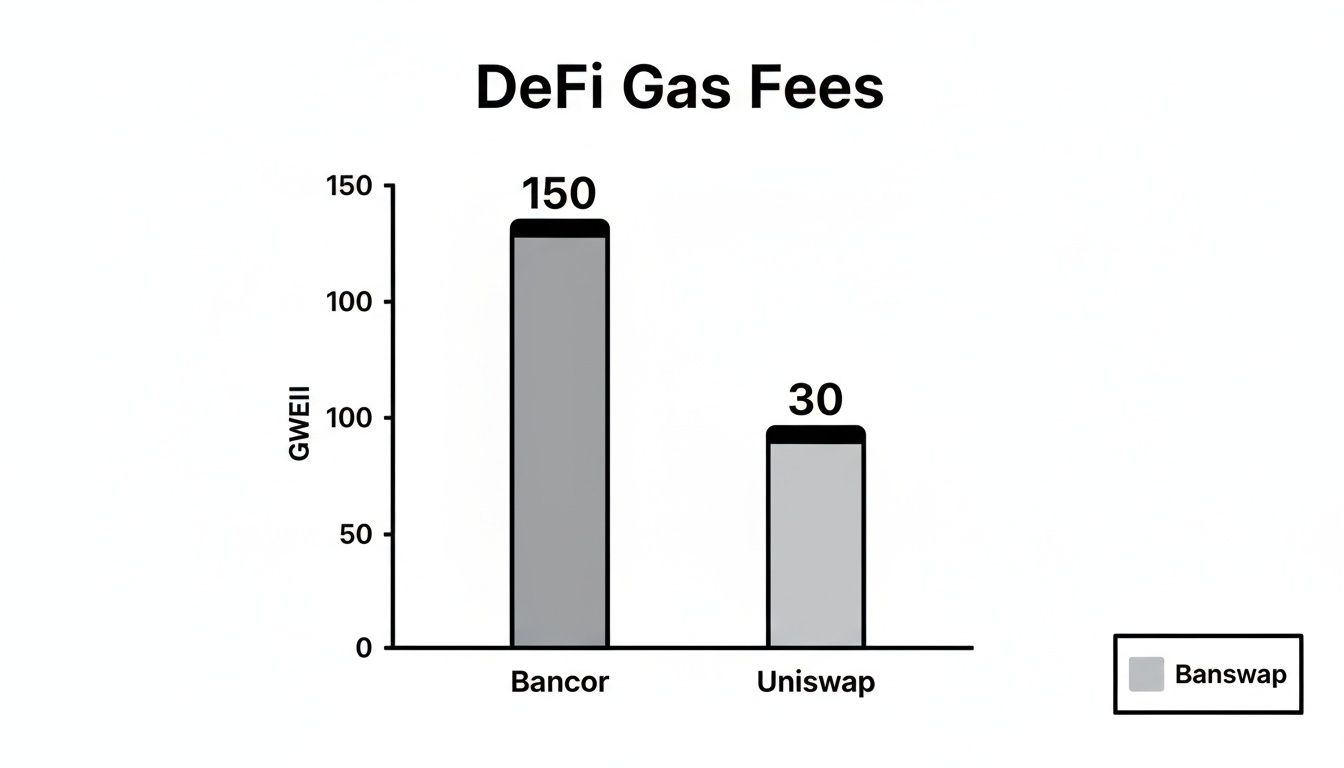
As you can see, platforms built with less efficient smart contracts, like some older versions of Bancor, can cost a fortune to use compared to more modern, optimized protocols like Uniswap.
The Biggest Gas Guzzlers to Avoid
To protect your bottom line, you've got to know where the money is leaking from. A few DeFi actions are notorious for burning through gas.
One of the sneakiest culprits is token approvals. Before you can use a new protocol, you have to give its smart contract permission to interact with your tokens. Every single approval is a separate transaction that costs you gas. It might sound minor, but token approvals have become a massive gas hog, at times responsible for over 3% of Ethereum's daily gas usage. Each approval can set you back 50,000 to 100,000 gas units, making even simple interactions feel expensive. You can dig deeper into these top gas consumers on patentpc.com.
But it doesn't stop there. Other major gas wasters include:
Complex Multi-Step Strategies: Manually moving funds between protocols—a common move called "yield hopping"—is incredibly expensive. Each leg of the journey (swap, deposit, stake) is its own transaction with its own gas fee. A three-step strategy means paying three times, which can quickly make the whole thing unprofitable, especially if you're not working with a huge amount of capital.
Interacting with Inefficient Contracts: Not all smart contracts are built the same. Some are clunky and poorly optimized, requiring more computational work to get the job done. This translates directly to higher gas fees for you. Using one is like driving a gas-guzzling truck when a fuel-efficient car is sitting right there.
Frequent Harvesting or Compounding: This is a classic rookie mistake. If you harvest $5 in yield but pay $3 in gas, you’ve just torched 60% of your earnings. Being disciplined and compounding less frequently is almost always the more profitable path.
Not every transaction costs the same. Some operations are far more computationally intensive than others, and the gas fees reflect that. Here’s a quick look at how different actions stack up.
Comparing Gas Costs of Common DeFi Actions
This table breaks down the typical gas consumption for various transactions, highlighting which ones are the real budget-busters for yield farmers.
DeFi Action | Typical Gas Units | Impact on Your Yield Strategy |
|---|---|---|
Simple ETH/Token Transfer | 21,000 - 40,000 | The baseline cost. Relatively low impact, but frequent transfers add up. |
Token Approval (ERC-20) | 50,000 - 100,000 | A hidden, recurring cost. Interacting with new protocols gets expensive fast. |
Basic Token Swap (DEX) | 100,000 - 200,000 | A significant cost. High-frequency trading or rebalancing can drain profits quickly. |
Add/Remove Liquidity | 150,000 - 300,000 | One of the more expensive actions. Avoid moving liquidity around too often. |
Complex Contract Interaction | 300,000+ | The biggest drain. Strategies involving multiple steps or poorly optimized contracts are extremely costly. |
Understanding this hierarchy is key. Swapping tokens or providing liquidity isn't cheap, but it's the complex, multi-step strategies that can truly wreck your returns if you're not careful.
A high-yield opportunity is only as good as its net return. A strategy that costs a fortune in gas fees is a losing game, no matter how attractive the initial APY seems.
Once you start recognizing these hidden costs, you can make smarter, more deliberate choices. This awareness is the foundation for adopting the advanced, gas-saving techniques that savvy investors and modern platforms use to maximize their real, take-home profits.
Core Strategies for Smarter Gas Management

Okay, so we've identified the hidden costs eating into your yield. Now for the fun part: plugging the leaks.
Achieving gas-efficient allocation isn’t some dark art. It’s about consistently applying a few powerful, foundational strategies. Think of these techniques as minimizing the "shipping and handling" fees of DeFi so your capital can get to work faster and more effectively.
It's a lot like planning a delivery route. A logistics company wouldn't dream of sending out a separate truck for every single package. They group them by destination to make each trip as productive as possible. That’s the exact logic we need for smarter gas management in crypto.
These ideas often echo principles from the business world. For a broader look at this kind of thinking, you might find some useful parallels in mastering resource allocation optimization. Adopting this strategic mindset is the first step to cutting down on waste.
The Power of Batching Transactions
One of the most effective ways to slash gas fees is through transaction batching. This is basically the DeFi equivalent of carpooling.
Instead of firing off dozens of small, individual actions—each with its own separate gas fee—you bundle them into a single, much larger transaction.
Imagine ten different people all want to deposit funds into the same yield protocol. Instead of ten separate deposit transactions racking up ten separate fees, a smart platform can collect all those funds and deposit them in one go. The gas cost for that single, batched transaction is then split among all ten users, bringing the cost per person way down.
This is fundamental to how modern automated platforms operate. By waiting to gather multiple user actions (deposits, withdrawals, rebalances), they can execute them far more cheaply than any individual ever could.
Leveraging Low-Cost Networks
Another cornerstone strategy is simply choosing the right playground.
Performing complex DeFi actions on a congested and expensive network like Ethereum mainnet is like trying to run a delivery service through midtown Manhattan at rush hour. It’s painfully slow and absurdly expensive.
This is precisely why Layer 2 networks like Base are such a game-changer. They’re built to be the express lanes of DeFi, offering transaction fees that often cost just a few cents. Moving your activity to these networks is one of the biggest levers you can pull for a more gas-efficient allocation.
By operating on a low-cost Layer 2, you immediately lower the barrier to profitability. Small, frequent actions that would be financially ruinous on Ethereum become perfectly viable, opening up a much wider range of strategies.
Choosing Efficiently Coded Protocols
Finally, not all smart contracts are created equal. The quality of a protocol’s code has a direct impact on how much gas it guzzles.
Optimized Code: Well-designed protocols use clean, efficient code that minimizes the number of computational steps required, which translates directly to lower fees for you.
Poorly Coded Contracts: On the flip side, clunky and inefficient contracts require more processing power to do the same job, passing those higher costs straight to the user.
Simply choosing protocols known for their engineering excellence is a powerful way to manage costs. It’s why automated platforms like Yield Seeker are so meticulous about vetting partner protocols—they prioritize not just the advertised yield but also the operational efficiency that maximizes your actual, take-home returns.
How Automated Platforms Master Gas Efficiency
Trying to farm yield manually can feel a lot like running a tiny, one-person delivery service. You’re constantly checking routes (the best yield opportunities), paying tolls (gas fees), and trying to pack your own truck (your capital) as efficiently as possible. It's a ton of work for just one person.
This is where automated platforms completely flip the script. Think of them as a massive, AI-powered logistics network for your money.
Yield Seeker puts the principles of gas-efficient allocation on autopilot, but at a massive scale. Instead of you sending out your funds in a single, often expensive transaction, the platform’s AI agents group your deposit with many others. It’s like a carpool for your capital, a strategy known as transaction batching.
By bundling dozens—sometimes even hundreds—of user actions into one optimized transaction, the platform slashes the gas cost for every single person involved. An action that might have cost you a dollar or more on your own suddenly costs a fraction of a cent.
What Happens Behind the Scenes
The best part? This entire process is designed to be invisible to you, yet ruthlessly efficient behind the curtain. When you deposit USDC into Yield Seeker, you aren’t just sending it to a single protocol.
Instead, the platform's smart contracts and AI agents spring into action. They instantly analyze the current gas prices on the Base network, pinpoint the absolute best allocation across our vetted yield sources, and execute the whole strategy in one clean move. For a deeper look at how systems like this refine their processes, check out how to boost efficiency with AI.
All you see is a simple, clean interface where you can watch your earnings grow automatically.
While your dashboard gives you a straightforward view of your balance and returns, the system is constantly working in the background, making sure your capital is always deployed with maximum gas efficiency in mind.
Automated platforms turn gas management from a user's headache into a system's core strength. By pooling resources and actions, they hit a level of efficiency that’s flat-out impossible to achieve on your own, making sure your net returns are as high as they can be.
This hands-off approach makes gas-efficient allocation a built-in feature, not a complex task you need to worry about. It lets you tap into sophisticated, multi-step strategies without ever having to swallow the high transactional cost.
The platform handles all the complexity, leaving you with the one thing that matters: better, more sustainable yield. To learn more about how our system routes your funds, check out our guide on algorithmic yield routing.
Got Questions About Gas?
To wrap things up, let's hit a few of the most common questions that pop up when talking about gas-efficient allocation. These should clear up any lingering thoughts and give you some practical takeaways.
What Is the Single Biggest Gas-Related Mistake to Avoid?
Without a doubt, it's making tons of small, frequent transactions on an expensive network. Think harvesting rewards every single day or shifting tiny amounts of cash between different pools.
Every single one of those actions, no matter how small, costs you a gas fee. It's a classic case of death by a thousand cuts, where your transaction costs can easily eat up—and even exceed—whatever yield you managed to earn. The fix? Batch your transactions, move your strategy to a Layer 2, or let an automated platform like ours handle the heavy lifting for you.
How Do Layer 2 Networks Like Base Help My Strategy?
Layer 2 networks (or L2s) like Base are a total game-changer here. They sit on top of a main blockchain like Ethereum, processing transactions way faster and for a fraction of the cost. They do this by bundling up a whole bunch of transactions and settling them on the main chain as one single event, which slashes the cost for everyone involved.
For anyone trying to be gas-efficient, this is huge. It suddenly makes complex strategies and smaller investment amounts actually profitable because fees drop from dollars to mere pennies.
L2s basically make DeFi economically viable for the average person, not just the whales. Efficiency stops being a luxury and becomes a built-in feature.
Does Gas-Efficient Allocation Mean Sacrificing Security or Yield?
Not if it's done right. The best gas-efficient strategies never compromise on security or yield—those are the top priorities. Smart protocols save on gas through clever code and smart engineering, not by cutting corners where it matters.
Automated platforms use AI to hunt for opportunities that strike the perfect balance: competitive, risk-aware yield on low-cost networks. The whole point is to boost your net returns by cutting out waste, not by taking on sketchy risks.
Ready to stop worrying about gas fees and put your yield strategy on autopilot? With Yield Seeker, our AI agents manage all the complex moves for you, making sure your capital is always deployed as efficiently as possible. It’s time to start earning smarter, not harder.