
Chasing the highest advertised rate is the most popular advice for idle stablecoins, and it's the advice that gets wallets stuck. A rate tells you who's desperate to borrow, not whether your users can get their dollars back this afternoon. If you run a wallet, neobank, or treasury product, that order matters.
To monetize idle USDC responsibly, score exit liquidity first, then allocate only the float that can wait. Spendable cash and yield float aren't the same money, even when they sit in the same address. Treat them as one balance and a busy market will make the distinction for you, at the worst time.
Table of Contents
Why Idle USDC Earns Nothing by Itself
Where the Reserve Income Actually Goes
Compare Yield Paths Before You Allocate
Idle USDC Paths Compared Before You Allocate
Row One Is Not a Failure
Who Pays in a Lending Market
Liquidity Pools Add a Different Payer
What an Automated Allocator Changes
Compare Net, Not Headline
Treat a High USDC Yield as a Warning
What the Episodes Actually Show
Score the Exit State, Not the Percentage
Exit States for USDC Lending Yield
Why Wallets Feel This Harder Than Traders
Where to Look Before Each Deposit
How to Allocate Idle USDC on Base
What to Check After the Deposit
A Fixed Monitoring Cadence
Records, Costs, and Withdrawal Triggers
Decide What Your Wallet Can Still Exit
Why Idle USDC Earns Nothing by Itself
A fully reserved dollar token still pays its holder zero. Say a creator payout address receives USDC on Monday, the user doesn't spend it for three weeks, and the balance looks reassuringly stable the whole time. Stable isn't earning. Nothing arrives because the token held its peg.
Where the Reserve Income Actually Goes
Circle's transparency page states that USDC is backed 1:1 by highly liquid cash and cash-equivalent assets, with reserve holdings equal to or greater than the amount of USDC in circulation. The majority sits in the Circle Reserve Fund, an SEC-registered 2a-7 government money-market fund that may hold cash, short-dated U.S. Treasury securities, and overnight repurchase agreements backed by those securities. The remaining reserves are held primarily as cash at large regulated banks.
That structure supports redemption. It doesn't send Treasury income to a wallet that merely holds the token. Circle also discloses reserve holdings and mint-and-burn activity weekly, with monthly attestations from a Big Four accounting firm, which helps you judge peg quality. It tells you nothing about whether a lending vault will return funds under stress.
Peg quality and yield risk are two separate questions. Answering the first doesn't answer the second.
Monetizing a balance means a separate arrangement, usually lending, and that adds protocol, liquidity, and counterparty risk the peg doesn't remove. Before you compare venues, split every balance into cash needed this week and cash that can sit. Teams that research markets for a living, including readers who cross-check positioning through a HeliosNet market research platform, still have to make that split first. Yields vary and aren't guaranteed, crypto carries risk, and funds can be lost.
Compare Yield Paths Before You Allocate
Score exit liquidity before yield. If a path cannot return the amount you need under busy conditions, its current rate does not make it suitable. Allocate only the float you can leave in place.
Idle USDC Paths Compared Before You Allocate
Path | Who pays | Rate behavior | Exit when markets are busy | Extra risk |
|---|---|---|---|---|
USDC left in the wallet | Nobody; reserves do not pay the holder | None | Immediate at wallet speed | Issuer and redemption risk, not a DeFi protocol |
Supply to a lending market | Borrowers, after any protocol reserve share | Variable with utilization | Can slow or stall when utilization is high | Smart contract, oracle, governance and liquidity risk |
Stablecoin liquidity pool | Swap fees and sometimes token incentives | Variable and incentive-sensitive | Set by pool depth at the moment of exit | Extra contracts and pool or depeg risk |
Yieldseeker on Base | Lending activity through curated vaults; platform costs can reduce net yield | Variable and not guaranteed | Depends on vault liquidity and withdrawal conditions | Vault, strategy and smart-contract risk |
Row One Is Not a Failure
Leaving USDC in a wallet pays nothing, and sometimes that is the right choice. Payroll money, a card float due tonight, or balances spent throughout the day should not depend on a lending market staying liquid. Immediate at wallet speed is a practical benefit.
Plain USDC still carries issuer and redemption considerations, but it adds no smart contract, oracle, or borrower queue between the user and their funds. For money needed the same day, that shorter path may matter more than interest. Zero yield is easier to budget than a withdrawal delay.
Who Pays in a Lending Market
In a lending market, borrowers pay. You supply USDC, borrowers draw against collateral, and interest is distributed to suppliers under the protocol's rules, after any reserve or treasury allocation. If borrowing demand falls, supplier returns usually fall too.
A Federal Reserve note on banks and stablecoins helps frame the additional dependencies: smart contracts, oracles, governance, and liquidity. Compare whether the quoted rate is variable, what asset rewards are paid in, and what withdrawal conditions apply. Check liquidation and emergency mechanisms as well, rather than relying on an APY screenshot.
Today's quote is a spot price for liquidity, not a monthly promise. Supply rates can rise when borrowing demand increases, then drop when borrowers repay or deposits arrive. A budget built around one day's rate can miss its target even when the market behaves as designed.
Liquidity Pools Add a Different Payer
A stablecoin liquidity pool pays from swap fees, sometimes supplemented by token incentives. That changes the source of return, not the need to assess exit conditions.
Your withdrawal depends on pool depth at the time you exit, and the position adds contracts even in a stable-to-stable pair. Incentives also complicate the net calculation: a reward token must be converted before it becomes USDC, and its value may change before then.
Pools may suit teams already equipped to manage positions and assess the contracts. For a consumer wallet whose support staff will answer withdrawal questions, added operational work may not improve the exit options.
What an Automated Allocator Changes
An automated allocator can place funds in lending vaults and adjust positions without requiring manual management. Yieldseeker is an AI stablecoin yield agent that runs on Base. Its AI agent analyzes trusted DeFi protocols and automatically manages capital to pursue sustainable yield. Funds are invested via AI into curated, audited, low-risk vaults, and earnings are reinvested and auto-compounded.
Yieldseeker is non-custodial, so users keep control of their funds. Automation does not remove vault or smart-contract risk, and it cannot guarantee an exit at a preferred time. Before depositing, check the vaults used, their withdrawal conditions, and any platform costs that could reduce net yield. For the mechanics of automated allocation, read about automated USDC yield, then compare crypto yield options before transferring funds.
Compare Net, Not Headline
Apply the same checks to each path:
Quoted rate: Is it variable, and what period does it cover?
Reward asset: Is the return paid in USDC or a token that must be converted?
Costs in and out: How much do gas, bridging, and platform costs reduce the net return?
Exit terms: Are there queues, pauses, or utilization limits on withdrawals?
Failure surface: Which contracts, oracles, and governance bodies can affect the position?
For a small balance, fixed transaction costs take a larger share. Bridging to chase a slightly higher rate can consume weeks of interest before the position earns anything. If the net return only makes sense at a size you cannot allocate, that path does not fit.
Practical rule: If customers may need funds the same day, reject a path whose exit depends on lending-market liquidity, regardless of its displayed rate.
Use the table as a risk screen, not a forecast. No row guarantees an APY or turns USDC into an insured deposit. Price only the paths that pass your exit test.
Treat a High USDC Yield as a Warning
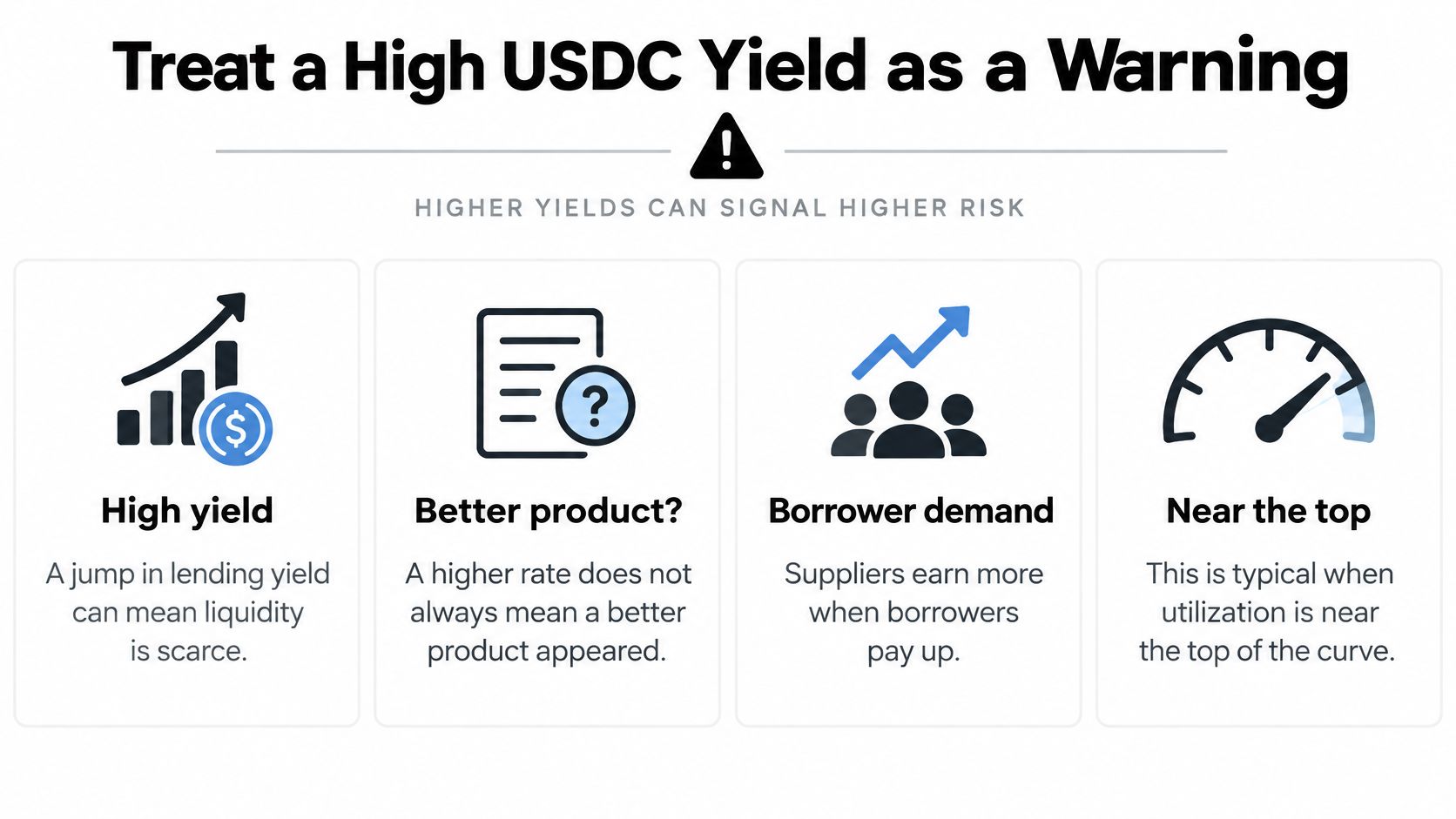
A jump in lending yield usually means liquidity is scarce, not that a better product appeared overnight. Suppliers earn more when borrowers pay up, and borrowers pay up when utilization is near the top of the curve. That is precisely when your exit gets crowded.
The checklist below sums up the pattern to check before you add size.
What the Episodes Actually Show
One comparison in a Panaprium analysis of tokenized treasuries versus DeFi lending reported Aave USDC rates ranging from 2.42% on Arbitrum to 11.94% on Ethereum. The same source describes a liquidity shock that pushed Aave USDC and USDT borrow rates from roughly 3.4% to 14%, with depositor liquidity becoming constrained.
Don't trade off those numbers as live quotes. Use them as a pattern. The market paying the most was the market where heavy borrowing made withdrawals slower or less certain. A wallet that moved user funds toward the biggest print would have bought the tightest exit on offer.
That's the contrarian point most rate tables hide. In lending, price and availability move against each other. When nearly every supplied dollar is borrowed, the remaining available liquidity is thin by definition, so a wave of withdrawals can't all be satisfied until borrowers repay or new suppliers arrive.
Score the Exit State, Not the Percentage
Give every vault one of three labels before money moves. Immediately liquid means deep available cash alongside an ordinary supply rate. Liquid but rate-sensitive means you can leave today, yet the rate should fall once deposits return, so don't budget it forward. Potentially gated means utilization is extreme, or a queue or pause is plausible, and a calm-weather absence of lockup is not a same-hour exit in a rush.
Exit States for USDC Lending Yield
Signal | Exit state | What to do |
|---|---|---|
Ordinary supply rate and deep available liquidity | Immediately liquid | Eligible for yield float |
Elevated rate that would fall if deposits returned | Liquid but rate-sensitive | Keep size small and review often |
Utilization near the top, or talk of a queue or pause | Potentially gated | Do not add; plan an exit |
Sharp rate jump during a market-wide rush | Stress, not a bargain | Downgrade or leave the vault |
Rewards paid in a volatile token | Quoted rate is not USDC in hand | Count only what you can exit as USDC |
An allocator should downgrade or leave a vault that stays in the third state. Adding because the number is large reverses the logic of the signal. The rate is compensating suppliers for exactly the condition that should make a wallet cautious.
Why Wallets Feel This Harder Than Traders
A solo trader can sit up at 3 a.m. and unwind a position by hand. A wallet can't. Your users live in every time zone, they request withdrawals around the clock, and they judge the product on whether the money arrives, not on the rate you earned while it waited.
That operating reality changes what counts as acceptable. A venue that's fine for a monitored personal position can be wrong for thousands of small balances that move unpredictably. Size your exposure to the exit you can honour on a bad hour, not the average hour.
This short walkthrough shows how utilization and withdrawal conditions fit together in practice.
Where to Look Before Each Deposit
Read utilization, available liquidity, and any queue or pause notice on the vault's own page. Check the reserve factor too, since it tells you how much borrower interest the protocol keeps before suppliers see their share. Record that reading in your log with the date, so a later dispute about conditions has evidence attached.
Also check what's being paid. A headline rate blended from base interest plus a volatile reward token isn't comparable to a rate paid in USDC. Count only what you can exit as USDC at the size you hold, after conversion costs, and treat the rest as upside rather than income.
The highest print is a stress signal until the exit column says otherwise.
Wallets that internalize that rule stop asking where the biggest number is. They start asking a better question, which venues still pass when everyone wants out, and that reframing is the core of judging yield on a risk-adjusted basis. Ask it before size goes in, because after size goes in you're negotiating with a queue.
How to Allocate Idle USDC on Base
Follow one sequence so support staff and the user can both say where the dollars went. Skipping steps is how balances end up in venues nobody can explain.
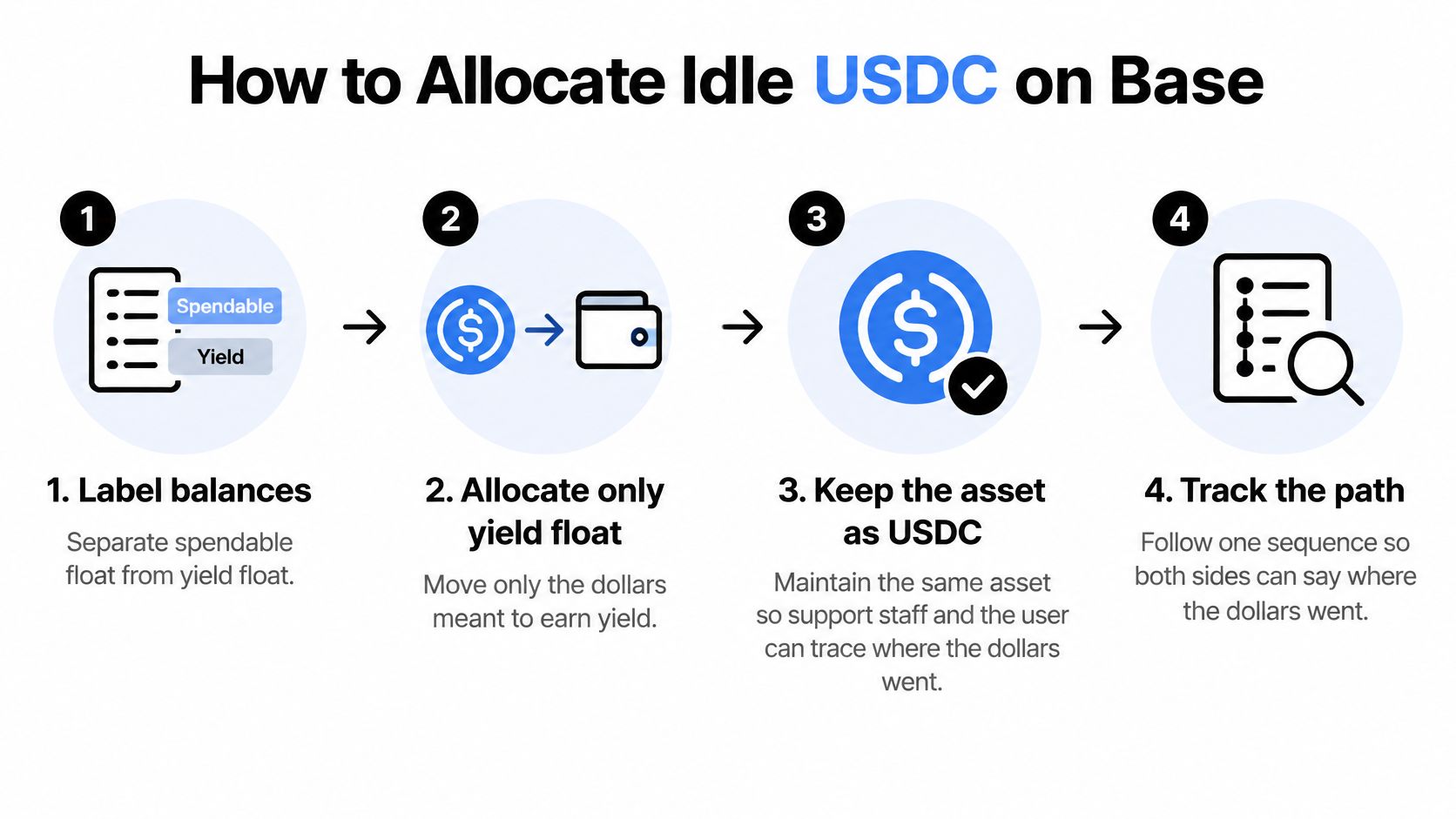
Label the balances: Mark each balance as spendable float or yield float, and allocate only the yield float, because same-day money must stay at wallet speed.
Keep the network boring: Hold the asset as USDC on a network the wallet already supports, which is Base in this setup, so customer funds aren't bridged for a slightly higher quote.
Name the payer: Identify the approved lending vault paying borrower interest, and note on screen that the rate is variable.
Use a user-owned wallet: Open a non-custodial agent wallet the user owns, so ownership of the funds stays with the user throughout.
Embed, don't redirect: If you ship a wallet, neobank, or treasury product, build the flow in with a stablecoin yield API for wallets instead of sending users across extra dashboards.
Allocate within the approved set: Let the Yield Agent allocate across approved lending vaults on Base, as described in this overview of how Base fits the setup, and skip any venue you've scored as potentially gated.
Confirm the fee: Show 10% of yield earned, never a charge on the deposit, before the user confirms.
Test small: Send a small amount, read the activity feed, and confirm the round trip works before adding the rest of the yield float.
Write the withdrawal path: Document how funds come back, who can trigger it, and what happens if a vault is busy, before you scale.
This isn't financial advice, and no sequence locks in a future rate. Crypto carries risk and funds can be lost.
What to Check After the Deposit
Once funds are in, stop hunting new venues and watch the position you already hold. Churn creates gas costs, tax records, and operational confusion, and it rarely improves the net result.

A Fixed Monitoring Cadence
Realized versus quoted: Compare the rate you were shown with the USDC that arrived over the period.
Reward currency: Note whether earnings landed in USDC or another token that still needs converting.
Liquidity readings: Reread utilization and available liquidity, and flag any drift toward the top of the curve.
Protocol events: Note any pause, oracle change, or governance action affecting the vault.
Context helps here. A Circle press release on the 2025 State of the USDC Economy report reported more than $20 trillion in all-time USDC transaction volume by January 2025, including approximately $1 trillion in November 2024 alone. An asset built for that pace of settlement shouldn't sit in a strategy you can't unwind, which is why watching positions with real-time yield monitoring beats a monthly glance at a headline rate.
Records, Costs, and Withdrawal Triggers
Keep a simple log with date, amount in, amount out, venue, and asset received. It's the record you'll need when reviewing the position or answering a user query. Check the rules where you live for how yield and records are treated, for individuals and companies, rather than guessing.
Reinvested earnings only help if they stay in a vault that still passes the exit test. Track gas, avoid unnecessary bridging, and remember more protocols aren't automatically safer, because each added contract is another place funds can be lost. Withdraw when the user needs dollars or when the exit state worsens, not because a chart looks dull. If a vault is tight, wait for liquidity or exit in stages, then hold the result as plain USDC.
Decide What Your Wallet Can Still Exit
Score exit liquidity before yield. Keep USDC needed for near-term spending in the wallet; allocate only the float that can remain invested while a withdrawal is processed. A quoted rate matters less if the funds cannot arrive when the user needs them.
For a wallet, neobank, or treasury product, that means setting allocation limits around withdrawal needs and using only venues already scored as immediately liquid or liquid but rate-sensitive. Yield Seeker runs on Base and uses an AI agent to analyze trusted DeFi protocols and allocate capital to curated, audited, low-risk vaults. It is non-custodial, so users retain control of their funds and can withdraw at any time, with no lockups. The dashboard and activity feed let users track performance.
Before increasing an allocation, test the withdrawal path and check how long funds may take to return. The guide to withdrawing funds from DeFi positions covers the practical steps. Yield is variable, and funds can be lost, so size the position for the possibility that some USDC is unavailable temporarily.
Automation does not replace limits or exit rules. Teams that configure trade mirroring with copyfomo still need to set their own controls in advance. Review the activity feed, confirm the withdrawal path works, and scale only the float the user can afford to leave invested.
Turn idle USDC into variable yield through curated vaults on Base. Visit Yield Seeker to start with a small deposit, track activity, and allocate only the amount that can stay invested.