
At its core, a programmable yield strategy is like a wealth manager for your digital assets that never sleeps. It uses automated, code-based rules to hunt down the best returns for you, 24/7. Instead of you manually moving funds between different DeFi protocols, these systems do all the heavy lifting, making sure your capital is always working as hard as possible.
From Manual Farming To Automated Wealth
Picture your investment portfolio as a high-performance race car. In the early days of Decentralized Finance (DeFi), you had to be the driver—manually shifting gears, constantly checking the gauges, and steering through a chaotic track filled with hundreds of other racers.
This hands-on process, better known as "yield farming," demanded constant attention and a ton of technical know-how just to stay in the game. You were responsible for monitoring interest rates across dozens of platforms, paying gas fees for every single move, and reacting instantly to any market shifts. It was exhausting, to say the least.
Not only was it a grind, but it was also incredibly inefficient. If you missed a crucial update overnight, you could lose out on a massive opportunity or get caught on the wrong side of changing market conditions. The sheer complexity of it all was a huge turn-off for most people.
The Problem of a Fragmented Market
Today's DeFi ecosystem has taken this challenge and magnified it a thousand times over. We're not talking about a handful of opportunities anymore; it's a massive, fragmented universe of options spread across countless platforms and blockchains.
For instance, in late 2025, there were 1,834 different stablecoin yield opportunities scattered across 460 protocols and 101 different chains. Trying to keep track of that manually isn't just difficult—it's basically impossible to do it well and consistently capture the best returns. You can learn more about how AI is tackling this challenge to create always-on yield strategies.
This is the exact problem that programmable yield strategies were built to solve. They represent the next step in the evolution of DeFi, moving from a manual, high-effort chore to a sophisticated, automated system.
Think of it this way: Programmable yield strategies are the self-driving technology for your DeFi investments. You just set the destination—say, "maximize my yield"—and the system navigates the complex, ever-changing market for you, making smart, data-driven decisions in real time.
Before we dig deeper into how these strategies work, let's do a quick comparison of the old, manual approach versus the modern, automated one.
Manual Yield Farming vs Programmable Yield Strategies
Aspect | Manual Yield Farming | Programmable Yield Strategies |
|---|---|---|
Effort | High; requires constant monitoring and manual transactions. | Low; "set-and-forget" after initial setup. |
Decision Making | Emotional and reactive; based on human judgment. | Data-driven and logical; based on predefined code. |
Speed | Slow; limited by human reaction time. | Instant; executes trades in milliseconds. |
Market Coverage | Limited; can only track a few protocols at once. | Comprehensive; scans hundreds of protocols 24/7. |
Efficiency | Inefficient; high gas fees from frequent manual moves. | Optimized; can batch transactions to minimize costs. |
Accessibility | Low; requires deep technical knowledge and time. | High; opens up advanced DeFi to a broader audience. |
This table really highlights the night-and-day difference. What was once a full-time job for DeFi experts is now accessible to anyone, thanks to automation.
The Automated Solution
Programmable yield strategies automate the entire process of finding and capturing the best returns on your crypto. Instead of you being the driver, these systems use smart contracts—code that executes itself—to perform key actions based on rules you've set. This brings a level of efficiency and precision that manual efforts just can't compete with.
Here are some of the key perks of going automated:
24/7 Market Monitoring: The strategy is always on, scanning for better yield opportunities across countless protocols. It doesn't need sleep or coffee breaks.
Speed and Efficiency: It can execute transactions in a split second to capitalize on those fleeting opportunities that a human would almost certainly miss.
Reduced Emotional Decisions: By running on pure logic and data, these strategies get rid of the risk of fear or greed messing with your investment choices.
Lower Transaction Costs: More advanced strategies can bundle transactions together to optimize for gas fees, which saves you a surprising amount of money over time.
Ultimately, this shift from manual farming to automated strategies is making earning in DeFi more accessible, powerful, and a whole lot less stressful for everyone involved.
How Programmable Yield Actually Works
To really get your head around programmable yield, you have to look under the hood at its engine: smart contracts. Forget the traditional legal documents; these are self-executing bits of code living on a blockchain, designed to run automatically when specific conditions are met.
Think of a smart contract like a super-obedient robot that follows your instructions to the letter. You program it with a set of rules, and it will carry them out perfectly every single time, no human needed to push a button. This is the bedrock of all automation in DeFi.
The Role of Smart Contracts and Oracles
A smart contract is a powerhouse, but it's also stuck in its own little world. It only knows what’s happening on its own blockchain. For it to make smart moves based on what's happening in the real world—like current asset prices or interest rates on a different protocol—it needs a secure feed of outside information.
That’s where oracles come into the picture. Oracles are basically secure data messengers that connect the blockchain to the real world. They feed vital off-chain data into the smart contract, letting it react to market shifts in real-time.
Smart Contracts: The "engine" that executes the commands.
Oracles: The "sensors" that feed the engine the data it needs to make decisions.
Without oracles, a programmable yield strategy would be flying completely blind. Put them together, though, and you get a system that can see what the market is doing and act on it instantly. Learning how to automate a trading strategy from start to finish is a great way to see these mechanics in a practical context.
Understanding Triggers and Logic
At its heart, the decision-making process is all about triggers. A trigger is just a specific condition that, once met, tells the smart contract to execute a pre-programmed action. The whole thing runs on simple "if-then" logic.
If a specific event happens, then the smart contract executes a specific task. This pulls emotion and guesswork out of the equation, replacing it with pure, data-driven execution.
This flowchart shows how these strategies take the messy, manual grind of DeFi and turn it into a clean, automated workflow.
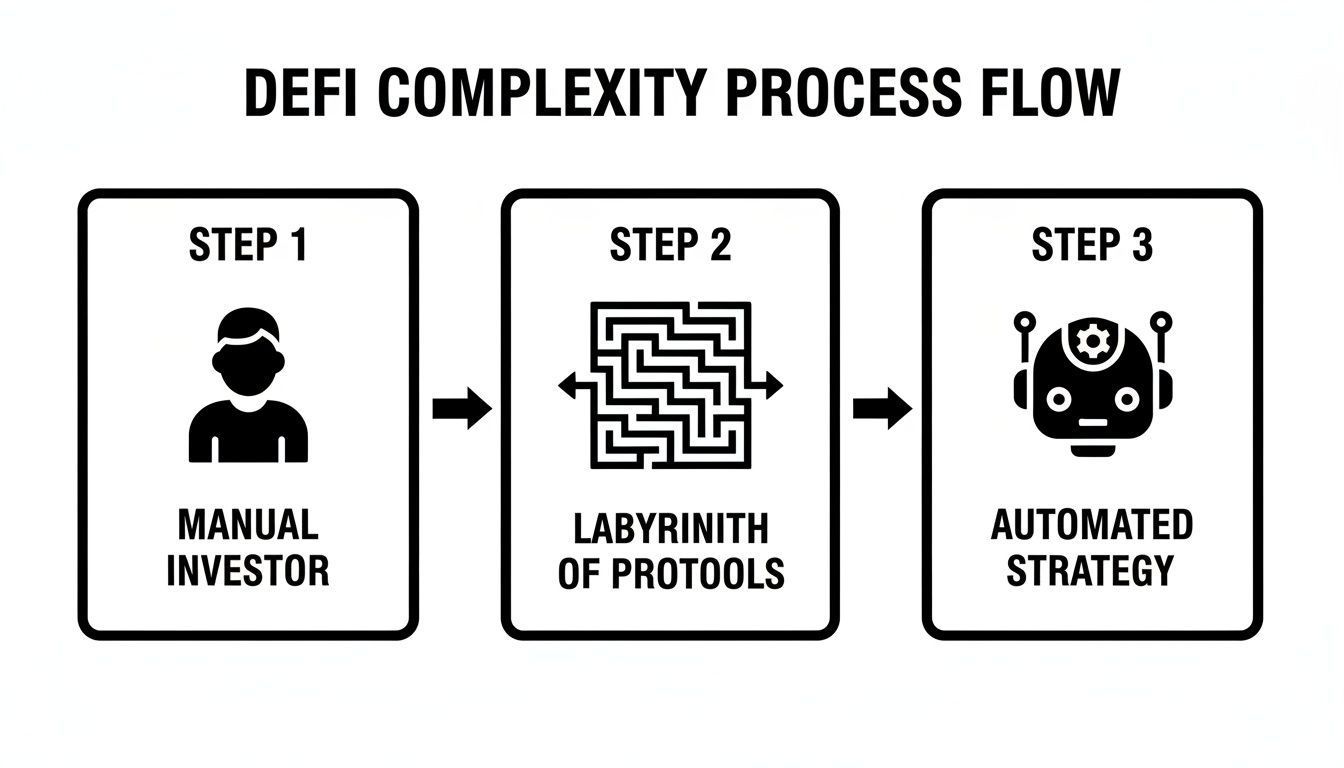
You can see the clear progression from a human investor tangled in a web of choices to an automated system that cuts through the complexity with precision.
Let’s walk through a concrete example of this "if-then" logic. Imagine a strategy built to always keep your funds in the highest-earning stablecoin pool between two different protocols, let's call them Protocol A and Protocol B.
The Trigger Condition (The "If"): The smart contract is constantly watching the Annual Percentage Yield (APY) on both protocols. The trigger is set: if the APY in Protocol B climbs more than 0.5% above the APY in Protocol A, it's time to move. That little buffer makes sure the switch is actually worth the gas fees.
The Automated Action (The "Then"): As soon as that trigger is hit, the smart contract springs into action. It automatically withdraws the stablecoins from Protocol A, bridges them over if needed, and deposits them right into the higher-yield pool on Protocol B.
This all happens on its own, with zero manual input from you. And it doesn't just do it once. The strategy is always on, constantly monitoring for the next opportunity to rebalance based on its programming. This concept of dynamic adjustment is the core of what makes effective algorithmic yield routing so powerful—it ensures your capital is always working as hard as possible.
Not all programmable yield strategies are created equal. Even though they all aim to put your returns on autopilot, they follow different blueprints to get the job done.
Think of it like choosing a car. Some are built for a steady, low-risk cruise down the highway, while others are engineered for high-octane performance—which naturally comes with a bit more risk. Getting a feel for these common patterns is the first step in matching an automated strategy to your own goals and comfort level.
Let's break down three of the most popular patterns you'll find in DeFi.
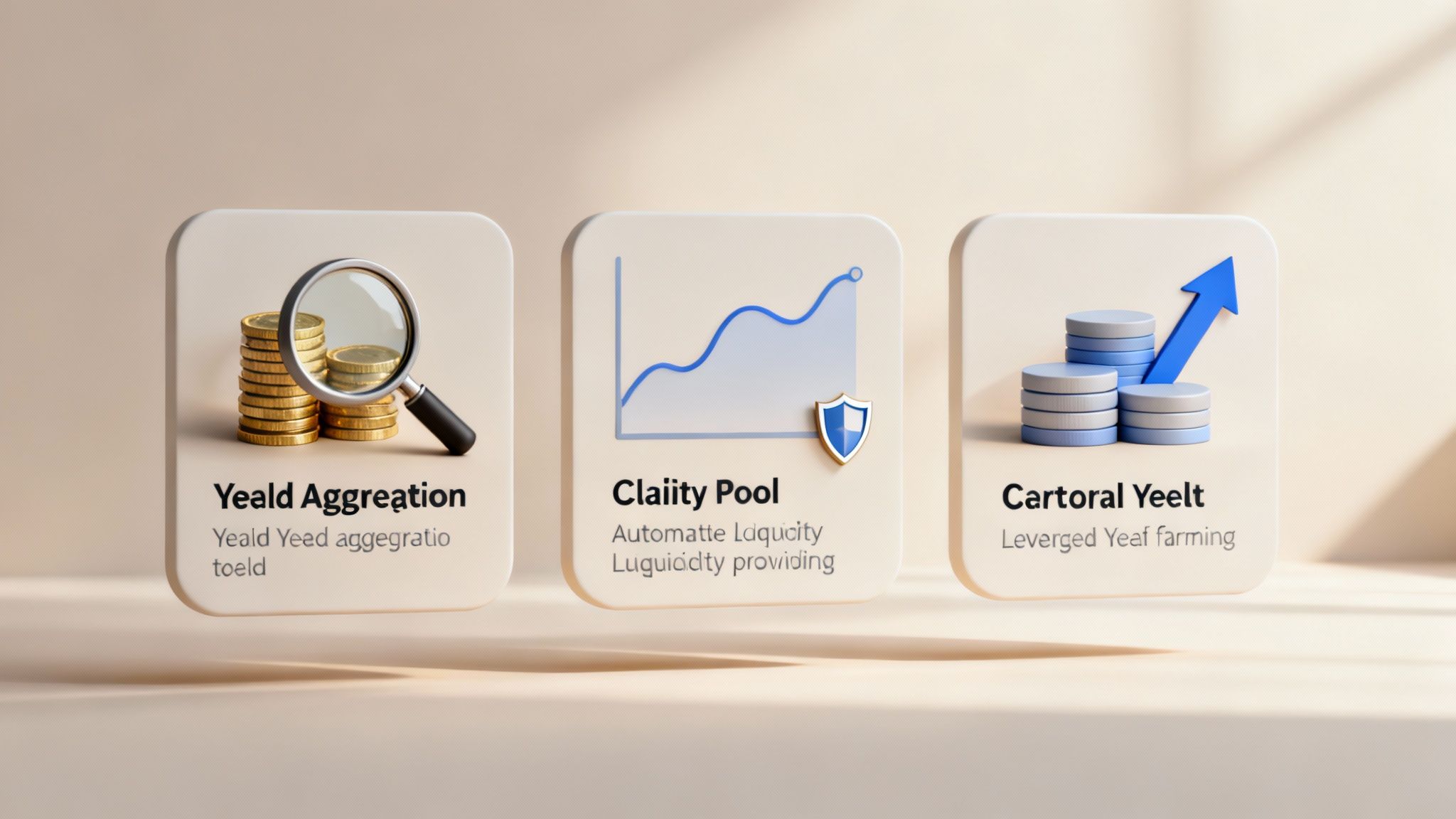
Yield Aggregation: The Automated Yield Hunter
This is the most fundamental pattern out there, and for good reason. Yield aggregation has a simple but powerful job: to automatically sniff out and move your capital to the highest-yielding lending pool it can find anywhere in DeFi.
Imagine a tireless assistant who spends 24/7 scanning hundreds of different high-yield savings accounts, instantly shifting your money to whichever one is offering the best rate at that exact moment. That's a yield aggregator. It completely automates the tedious work of "rate shopping."
How it Works: The strategy is constantly checking the APYs on lending protocols like Aave and Compound. The second it spots a pool with a better risk-adjusted return, it triggers the transactions to move your funds over.
Example in Action: Your stablecoins are parked in Protocol X earning 4.5% APY. The strategy detects that Protocol Y just bumped its rate to 5.2%. It then automatically withdraws from X and deposits into Y to lock in that higher yield, all without you lifting a finger.
Best Suited For: This is the perfect starting point for conservative investors and DeFi newcomers. It sticks to optimizing returns from relatively stable activities like lending, making it the lowest-risk automated strategy around.
Automated Liquidity Provisioning
Moving up a notch in complexity, we have automated liquidity provisioning (LP). This pattern is all about earning trading fees by supplying assets to decentralized exchanges (DEXs) like Uniswap. But it's a lot more involved than just depositing your tokens and hoping for the best.
The big catch with providing liquidity is something called impermanent loss. This is a unique risk where the value of your deposited assets can actually end up being less than if you had just held them, especially if the market prices move around a lot. Automated LP strategies are built specifically to manage this headache.
These strategies are like sophisticated market makers, constantly tweaking the price range of your liquidity position. They aim to scoop up as many trading fees as possible while sidestepping the big price swings that cause impermanent loss.
This turns what could be a passive "set it and forget it" activity into an actively managed one. You can almost think of it like building one of the effective recurring revenue business models for your capital, where the goal is to create a sustained stream of fee income.
Leveraged Yield Farming
For those with a bigger appetite for risk, leveraged yield farming throws gasoline on the fire, offering the potential for seriously amplified returns. This advanced pattern takes your existing yield-bearing assets, uses them as collateral to borrow more funds, and then plows those borrowed funds back into farming to generate even more yield.
It’s the DeFi version of taking out a mortgage to buy a rental property. You use a loan to control a bigger asset, and the income from that asset (rent, or in our case, yield) pays off the loan interest with a nice profit left over for you.
How it Works: A strategy might take $1,000 of your assets and deposit them into a lending protocol. It then uses that as collateral to borrow $700 in stablecoins, which it immediately puts to work in another high-yield pool. Suddenly, you're earning returns on $1,700, not just your original $1,000.
The Amplified Risk: The danger is liquidation. If the value of your collateral dips below a certain point, the protocol can automatically sell it off to repay your debt, which could wipe out a huge chunk of your initial capital.
Best Suited For: Let's be clear: this is strictly for experienced DeFi users who are deeply familiar with borrowing, collateral, and liquidation risk. The rewards can be massive, but the potential for loss is just as big.
Each of these patterns offers a totally different road to automated returns, built for different kinds of investors and financial goals.
Understanding and Managing the Risks
While letting an automated strategy run your portfolio sounds amazing, diving into DeFi without a healthy respect for risk is a recipe for disaster. High returns never come for free; there's always a trade-off. But understanding the risks isn't meant to scare you off—it's about giving you the tools to make smarter, safer decisions with your money.

Think of it like being a pilot. You wouldn't just jump in a cockpit and hope for the best. You'd need to understand turbulence, engine mechanics, and weather patterns. In DeFi, the core risks fall into a few key categories, and each one demands its own set of checks and balances.
Smart Contract Risk
The code is the foundation of everything. Smart contract risk is the chance that a bug, vulnerability, or exploit exists in the code of the protocols you're using. If a hacker finds a flaw, they could potentially drain all the funds locked in that contract. It's a brutal reality of the space.
Even the biggest, most respected protocols aren't completely immune. This is why third-party code audits are an absolute must. An audit is a deep dive by security experts who try their best to break the code and find weaknesses before the bad guys do. Always, always check that the protocols in your strategy have been audited by reputable firms. To get a better handle on this critical layer of defense, it’s worth learning more about the details of smart contract risk scoring and how it helps spot potential red flags.
Protocol and Systemic Market Risk
Beyond the code itself, you have protocol risk. This covers vulnerabilities in the DeFi platforms your strategy relies on. A protocol could get hit with an economic exploit, its governance could be taken over, or it might just have a design flaw that puts your assets in jeopardy.
Then there's the big one: systemic market risk. This is all about the wild volatility of the broader crypto market. A sudden, massive price crash—what some people call a "black swan" event—can create a domino effect. For anyone using leverage, this can trigger a wave of liquidations, where collateral is force-sold to cover debts, leading to huge losses.
A core rule of DeFi risk management is to diversify. I don't just mean across different assets, but across different protocols. Spreading your capital out reduces the damage if any single platform goes down.
To get a grip on these bigger-picture risks, here are a few best practices to live by:
Diversify Across Protocols: Don't put all your eggs in one basket. By using strategies that interact with multiple well-established platforms like Aave, Compound, and Uniswap, you can protect yourself from a single point of failure.
Favor Battle-Tested Platforms: Stick with protocols that have been around the block. If a platform has securely managed billions of dollars through multiple crazy market cycles, that's a pretty strong signal of its resilience.
Use Stablecoins: For many yield strategies, working mostly with stablecoins like USDC dramatically cuts down your exposure to the price swings of ETH or BTC. This helps you focus on the yield itself, not on market speculation.
By combining a sharp eye for smart contract security with smart diversification and a preference for stable assets, you can actively manage the risks that come with the DeFi territory. It’s a proactive approach that lets you tap into the power of programmable yield without gambling away your principal.
How AI Takes Your Strategy to the Next Level
Simple programmable yield strategies, the kind built on basic "if-then" logic, are a massive step up from farming by hand. They automate away the boring stuff and stop you from making emotional, late-night decisions. But what if your strategy could do more than just react to the market? What if it could start to anticipate it?
This is where Artificial Intelligence completely changes the game. AI turns a basic automated script into a dynamic, learning engine. Instead of just following a rigid set of rules, AI-powered systems dive deep into market data, spot complex patterns, and make forecasts to get your capital in the right place before the best opportunities are obvious to everyone else.
It's like the difference between a simple cruise control that just keeps your speed steady and a full self-driving system that sees traffic ahead, reroutes you around a jam, and optimizes the whole trip from start to finish.
From Reactive Rules to Predictive Power
An AI Agent, like the ones that power Yield Seeker, is playing on a totally different field. It doesn't just see that Protocol A's yield is a bit higher than Protocol B's right now. It's constantly crunching thousands of data points across the entire DeFi ecosystem to figure out why and predict what's coming next.
These data points aren't just surface-level APYs. We're talking about:
Liquidity depth in different pools
Borrowing demand and how much is being used
Transaction volumes across various protocols
Historical yield volatility and emerging trends
By processing all this information, an AI can forecast where yields might be heading, spot new high-potential opportunities as they emerge, and even flag protocols that might be getting a bit unstable or risky. This predictive edge is what sets it apart from simpler, rules-based automation.
Making Advanced DeFi Effortless
The real breakthrough with platforms like Yield Seeker is that they make this powerful tech incredibly simple to use. All the heavy lifting—the AI analysis, the forecasting, the execution—happens behind the scenes.
You don't need to be an AI guru or a data scientist. The whole experience is designed to be straightforward.
Simple Deposit: You kick things off by depositing stablecoins like USDC.
AI Takes Over: From there, your personal AI Agent gets to work, handling all the complex allocations and moving your funds across a portfolio of vetted DeFi protocols to hunt for the best risk-adjusted yield.
Track Performance: You can pop in anytime to see how much you've earned and how your capital is performing through a clean, simple dashboard.
Here’s a look at the Yield Seeker dashboard. It’s built to give you a clear, at-a-glance view of how your automated strategy is doing.
This kind of interface cuts through the usual DeFi noise. It just presents the important stuff, like your current balance and total earnings, in a way anyone can understand.
AI-powered strategies solve the biggest headache in DeFi: the need to constantly watch thousands of different markets. By late 2025, stablecoin yields had settled into the mid-single to low-teens APY range, which makes that always-on optimization absolutely essential. Yield Seeker's AI is built for this reality, using machine learning to make 15-20bps forecasts every hour to rebalance USDC in real-time across Base DeFi—from liquidity mining to complex carry loops.
This approach delivers something a human just can't match: 24/7 optimization that is both predictive and relentless. It makes sure your capital is never sitting on the sidelines and is always positioned for the best possible performance.
This blend of AI power and user-friendly design is a perfect fit for a whole range of investors. It gives busy professionals effortless automation, offers a guided entry point for newcomers, and provides superior optimization for crypto veterans. If you want to get into the nitty-gritty of how it all works, our guide on a next-generation yield optimization protocol is a great next step. At the end of the day, AI is making the most powerful parts of programmable finance accessible to everyone.
The Future Is Automated
Decentralized Finance is growing up. The wild, speculative days are fading, replaced by a new focus on stable, sustainable returns. At the heart of this shift are programmable yield strategies, which are bridging the gap between DeFi's raw power and the kind of reliable returns you'd expect from traditional finance.
What was once a playground for hardcore crypto traders is quickly becoming a legitimate alternative to old-school money markets, all built on automation and transparency.
This change is clearest in the DeFi lending world. Thanks to these automated strategies, the sector has ballooned into a $70 billion deposit market as of November 2025. Gone are the crazy 50%+ APY spikes from the 2020 boom; today, average returns have settled around a much more sustainable 3.4% APY. Platforms like Aave and Compound are now generating real revenue from protocol fees, not just temporary incentives, with yields that often track real-world indicators like U.S. Treasury rates. If you want to dive into the data, this report on DeFi's maturation breaks it all down.
Bringing Real-World Assets Onchain
Another massive leap forward is the arrival of Real-World Assets (RWAs) in DeFi. This simply means that automated, onchain strategies can now tap into tangible, off-chain assets like real estate, private credit, or even U.S. Treasury bonds. This is a total game-changer for a few key reasons:
More Stability: RWAs bring in yields that aren’t tied to the crypto market's mood swings, adding a much-needed layer of stability.
Big Money Magnet: Traditional financial institutions get assets they already know and trust. This makes RWAs the perfect on-ramp for bringing institutional capital into DeFi.
Way More Liquidity: We're talking about tokenizing trillions of dollars in real-world value, which could massively expand the entire DeFi ecosystem.
Fusing onchain automation with off-chain value is creating a financial system that’s far more resilient and predictable than ever before.
The big promise here is a future where passive income isn't just a dream—it's programmable, transparent, and open to anyone. It’s a move away from the black-box, centralized systems we're used to and toward an open, automated financial world.
Programmable finance isn't just an upgrade; it's a fundamental change in how we manage and grow our money. These strategies cut through the overwhelming complexity of DeFi, and with AI-driven platforms like Yield Seeker popping up, they're becoming incredibly easy to use.
By automating all the hard work—watching markets, managing risk, and executing trades—these systems are finally delivering on the original promise of DeFi. The future of earning is automated, data-driven, and built right on the blockchain.
Got Questions? We've Got Answers
As you dive into the world of programmable yield, a few questions always pop up. Let's tackle them head-on to give you a clearer picture of what to expect when you put your DeFi strategy on autopilot.
Is This a Good Starting Point for a Beginner?
Absolutely. While any move in DeFi comes with its own set of risks, a solid, AI-driven platform does a ton of the heavy lifting and seriously lowers the barrier to entry for newcomers.
Think about it: instead of spending weeks trying to vet hundreds of different protocols yourself, the platform's AI does that for you, focusing only on audited, reputable options. The key is to pick a non-custodial service—one that never takes ownership of your funds—and prioritizes transparency. This way, you get the benefits of advanced strategies without needing a PhD in crypto to get started.
The best platforms act like a guide. They automate the complicated stuff but keep you in the loop on how your money is working for you. It's about taking the guesswork out, not taking away your control.
So, What Kind of Returns Are We Talking About?
This is the big question, right? Returns will always shift with the market, but the DeFi space has grown up a lot. Gone are the crazy, unsustainable four-digit APYs from a few years ago.
Today, you're typically looking at stablecoin yields somewhere in the 2% to 10% APY range. These aren't speculative numbers; they come from real activity like lending fees. An AI-powered platform is designed to hunt for the top end of that range, constantly shifting your capital to the most profitable—and properly risk-assessed—opportunities as they appear.
Do I Need to Be a Coder to Use This?
Not at all. Building one of these strategies from the ground up is definitely a job for a developer. But using a platform like Yield Seeker is a completely different story. We designed it to be simple enough for anyone to use.
The whole process is dead simple:
Fund Your Agent: You just deposit some stablecoins.
Let the AI Work: The system takes over from there, finding opportunities and rebalancing your funds automatically.
Track Your Earnings: You can watch how you're doing from a clean dashboard. No need to ever touch a smart contract or write a single line of code.
It’s all about making these powerful financial tools accessible to everyone, no matter their technical background. You get all the upside of an advanced strategy without having to become a DeFi expert yourself.
Ready to put your stablecoins to work? With Yield Seeker, you can deploy a personalized AI Agent to find and capture competitive, risk-aware yield across DeFi, all from one simple dashboard. Start earning smarter by creating your account at https://yieldseeker.xyz.