

At its core, smart contract yield automation is a system that autonomously manages and moves your cryptocurrency across different decentralized finance (DeFi) protocols to constantly hunt for the best possible returns. Think of it as a 24/7 financial robot that runs complex yield farming strategies on your behalf, so you don't have to. It's a "set it and forget it" approach to DeFi.
The Autonomous Engine Driving Your Crypto Yield
Imagine you’re trying to find the bank with the highest interest rate for your savings. Now, imagine those rates change every single minute, and there are thousands of "banks" (DeFi protocols) all over the world. This is what manual yield farming feels like—it's a chaotic, time-consuming, and often overwhelming job.
Smart contract yield automation cuts through this chaos. It acts as an autonomous engine, executing pre-programmed strategies to squeeze the most return out of various DeFi activities without you ever having to lift a finger. This is how a high-effort, high-stress task becomes a passive income stream.
The key benefits really boil down to a few simple things:
Effortless Optimization: The system is always on, automatically sniffing out and moving funds to protocols with the highest yields.
Time Savings: Forget about spending endless hours researching, staring at dashboards, and manually executing transactions.
Emotional Detachment: The strategy is hard-coded. This prevents emotional, spur-of-the-moment decisions that are often driven by market panic or hype.
Accessibility: It opens up advanced, high-yield strategies to everyone, not just DeFi wizards with deep technical know-how.
From Manual Hassle to Automated Returns
If you were doing this manually, you'd be constantly researching lending protocols, analyzing liquidity pool rewards, and re-evaluating your positions. Every move costs gas fees, introduces a chance for error, and adds the stress of trying to time the market perfectly. To get a sense of the sheer scale of the ecosystem where this all happens, take a look at these DeFi statistics.
Smart contract automation takes care of that entire workflow. It’s like having a brilliant, tireless financial advisor who is programmed to do one thing and one thing only: find the best possible risk-adjusted yield for your assets. This is precisely what makes a sophisticated yield optimization protocol so powerful.
The real magic of this technology is its ability to compound earnings efficiently. By automatically reinvesting profits, it can accelerate wealth generation far beyond what most manual strategies could ever hope to achieve.
This kind of automation is a huge reason why the smart contracts market is growing so rapidly. Projections show the market jumping from USD 3.39 billion in 2026 to an incredible USD 16.31 billion by 2034. This growth is fueled by the raw efficiency of automated systems that dramatically cut down on human error and manual work.
How Automation Protocols Generate Yield
So, what actually happens to your funds after you deposit them? Let's trace the journey. The moment you commit your stablecoins to an automation platform, a specialized smart contract takes over. Think of this smart contract as a tireless, expert portfolio manager and the entire DeFi ecosystem as its market.
This manager has direct access to a whole universe of powerful financial tools, often called DeFi primitives. These are the fundamental building blocks—like Lego bricks—that can be combined to build sophisticated and highly effective yield strategies. The smart contract doesn't just pick one and stick with it; it intelligently mixes and matches them to find the best possible returns.
The whole point of smart contract yield automation is to manage these components for you, 24/7. It handles all the nitty-gritty details: complex transactions, constant market monitoring, and shifting conditions that would be exhausting for a human to track.
The Core DeFi Ingredients for Yield
An automation protocol’s main job is to put your capital to work. To do this, it taps into the foundational pillars of decentralized finance. These "DeFi primitives" are the engine rooms where yield is actually created.
Let's break down these core building blocks.
DeFi Primitive | How It Generates Yield | Example Protocols |
|---|---|---|
Lending Protocols | By supplying assets to a money market, you earn interest paid by borrowers. The contract hunts for the best rates. | |
Liquidity Pools | By providing assets to a decentralized exchange (DEX), you earn a share of trading fees from every swap. | |
Staking/Farming | By "staking" assets or LP tokens, you earn protocol-native reward tokens on top of other yield sources. | Varies by protocol |
Essentially, the automation platform acts as your agent, navigating these different venues to find the best risk-adjusted return at any given moment.
The diagram below gives you a clear picture of just how different this is from trying to do it all yourself.
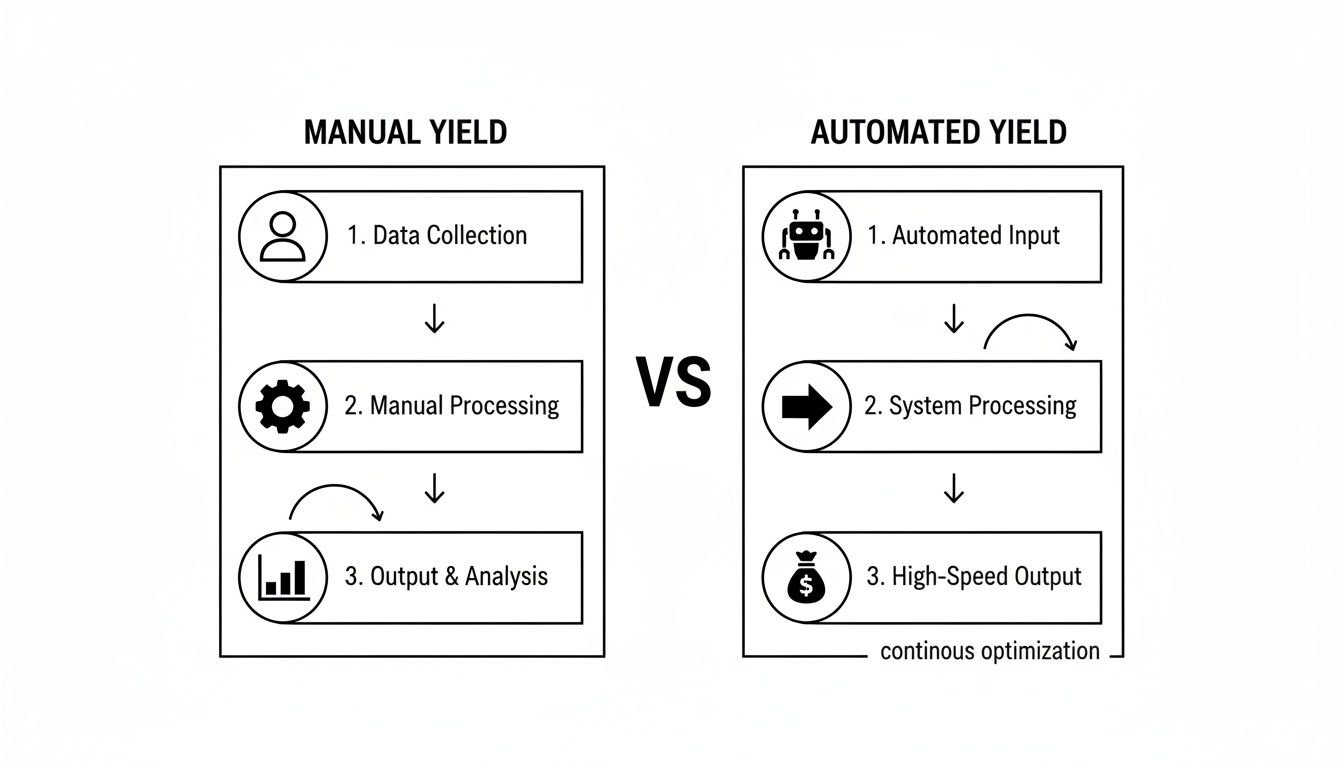
As you can see, automation turns a complicated, research-heavy process into a single, straightforward action. This not only saves a huge amount of time but also minimizes the chances of making a costly mistake.
The Automated Workflow in Action
Once your stablecoins are in, the platform’s smart contract begins a nonstop cycle of optimization. This is far more active than just a simple "deposit and forget" approach.
The real power of automation lies not just in finding yield, but in its relentless process of harvesting, compounding, and rebalancing. It’s an active management system designed to maximize growth over time.
This continuous cycle is what separates decent returns from great ones. The system is built to be completely autonomous, freeing you from the day-to-day grind of managing a DeFi portfolio.
Harvesting Profits and Compounding Growth
Yield in DeFi doesn't just magically appear in your wallet. It accumulates within different protocols as interest, trading fees, or reward tokens. The automation contract is programmed to "harvest" these earnings on a regular basis.
But it doesn't just let those profits sit idle. The contract immediately puts them back to work, using the harvested gains to acquire more of the underlying yield-bearing asset. This is compounding in its purest form, and it's the engine of exponential growth. Your future earnings are generated from a constantly growing capital base.
This cycle runs around the clock. The contract also rebalances your position, shifting capital between different strategies as market conditions change. If lending rates on Aave suddenly become more attractive, it might move funds there. If a new liquidity pool on Curve offers a better deal, it can reallocate to seize that opportunity. This dynamic management ensures your funds are always positioned to generate yield as safely and efficiently as possible.
Common Strategies for Automated Stablecoin Yield
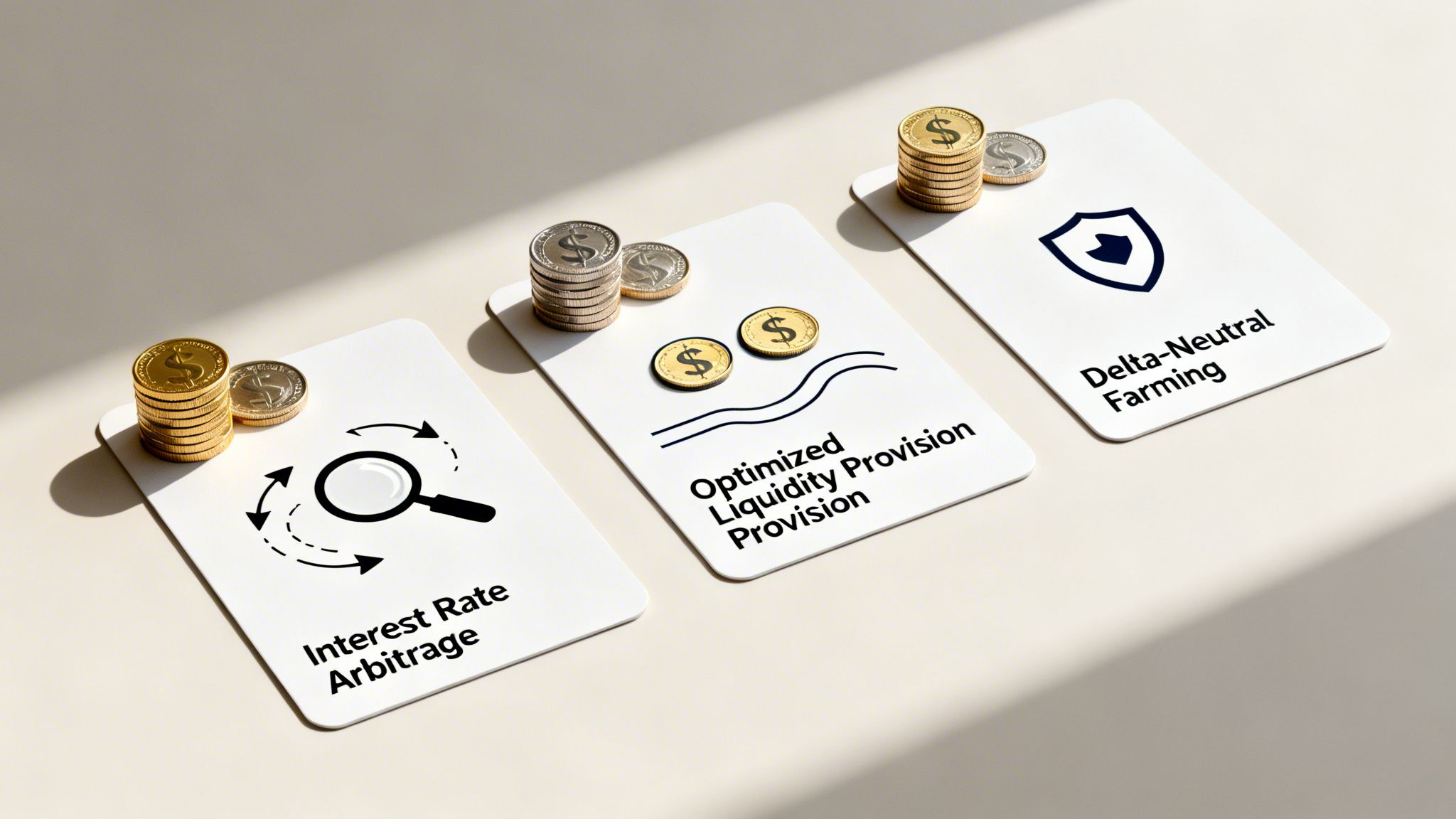
Not all automation is created equal. Under the hood, smart contract yield automation platforms are running specific playbooks—or strategies—to put stablecoins like USDC and USDT to work. These approaches can vary wildly in their complexity, risk profile, and, of course, their potential returns.
Think of these strategies as different investment philosophies that have been coded into an autonomous system. Some play it safe, focusing on preserving your capital above all else. Others are built to be more aggressive, chasing higher yields where they can find them. Once you understand these core approaches, you'll have a much clearer picture of what’s actually happening with your funds.
Let's pull back the curtain on some of the most common strategies you'll find in the world of automated DeFi yield.
Strategy 1: Interest Rate Arbitrage
This is one of the most straightforward and intuitive strategies out there. The goal is simple: always be earning the highest available lending rate. The smart contract basically becomes a relentless rate-shopper, constantly scanning different lending markets across the DeFi ecosystem.
For instance, imagine Protocol A is offering a 4.5% APY on USDC, while Protocol B is paying 5.1%. The automation contract will immediately shuttle the funds from A to B to capture that better rate. If Protocol C pops up an hour later with 5.3%, the contract will pack up and move the funds all over again.
How it works: Continuously monitors lending rates on tried-and-true protocols like Aave and Compound.
Action: Withdraws capital from lower-yield platforms and deposits it into higher-yield ones.
Goal: Maximize yield from fluctuating interest rates with minimal fuss.
This approach is popular because it’s relatively low-risk. It primarily sticks to well-established, over-collateralized lending protocols. The biggest challenge is simply managing gas fees to make sure the cost of rebalancing doesn’t chew up all the profits.
Strategy 2: Optimized Liquidity Provision
Another core strategy revolves around providing liquidity to decentralized exchanges (DEXs). When you supply a pair of assets—like USDC and USDT—to a liquidity pool, you earn a cut of the trading fees every time someone swaps between those tokens.
An automation contract takes this concept and puts it on steroids. It doesn't just park your funds in one pool and call it a day; it actively seeks out the most profitable and stable pools available. It’s constantly analyzing factors like trading volume, fee rewards, and the potential for impermanent loss to find the best risk-adjusted return.
By focusing on stablecoin-to-stablecoin pairs (e.g., USDC/DAI), these automated strategies can collect robust trading fees while significantly minimizing the risk of impermanent loss, which is a major concern when dealing with volatile assets.
The contract might also shift liquidity between different DEXs, like Curve or Uniswap, depending on which one is offering a better deal at any given moment. You can learn more about how to evaluate different smart yield strategies in our detailed guide.
Strategy 3: Advanced Delta-Neutral Farming
This is where smart contract yield automation really flexes its muscles, running complex plays that would be a nightmare to manage by hand. A delta-neutral strategy is designed to generate a profit no matter which way the market is heading.
So, how does it pull that off? The smart contract builds a perfectly balanced position using a combination of different DeFi tools. A classic example looks something like this:
Borrow: It takes out a loan for a volatile asset, like ETH.
Farm: It uses that borrowed ETH to provide liquidity somewhere else, earning high farming rewards.
Hedge: At the same time, it opens a short position on ETH on a perpetuals exchange.
The whole idea is that the profit from the juicy farming rewards and the funding rates on the short position will be greater than the cost of borrowing. Because the long exposure from farming and the short position effectively cancel each other out, the strategy's value is shielded from ETH's price swings. It becomes "delta-neutral." This allows the contract to safely farm the high yields often found in volatile asset pairs without putting your stablecoin principal at risk.
A Sober Look at the Risks of Automated Yield
The promise of smart contract yield automation is incredibly appealing—set it, forget it, and watch your assets grow. But it's vital to remember that "automated" never means "risk-free." The slick user interfaces of these platforms can easily hide the complex and sometimes fragile machinery working underneath.
Think of it like a high-performance race car. It's a marvel of engineering designed for speed and efficiency, but you wouldn't get behind the wheel without understanding how it handles and what could go wrong. In DeFi, you're the driver. Your first job is to do a full safety inspection before you even turn the key.
Let's pull back the curtain and look at the real hazards you need to be aware of. By understanding these risk categories, you'll be able to ask the right questions and tell the difference between a secure, well-built platform and one that’s an accident waiting to happen.
Smart Contract Risk: Is the Code Solid?
Every DeFi protocol is built on code, and that code is law. Smart contract risk is the ever-present danger that this code has a hidden bug, a logical flaw, or a vulnerability that a hacker can exploit to steal funds.
This is the most fundamental risk in the space and, unfortunately, the cause of many of the biggest DeFi disasters. A single error in a smart contract can be like leaving the vault door wide open. No matter how brilliant the strategy is, if the code isn't secure, nothing else matters.
So, how can you gauge the safety of the code?
Check for Audits: Reputable projects don't just say their code is safe; they prove it. They hire multiple, well-respected security firms to conduct deep audits of their smart contracts. Always look for these audit reports and make sure they are publicly available.
Time Is a Test: A platform that has been running smoothly for a significant period without any incidents is a great sign. The longer a contract has been live with a large amount of value locked, the more "battle-tested" it becomes, as it has likely weathered many attempts by hackers to find a flaw.
Protocol Risk: What Is It Built On?
Automated yield platforms are rarely built in isolation. They are master integrators, plugging into various other DeFi protocols—lending markets, liquidity pools, and decentralized exchanges—to execute their strategies. Protocol risk is the danger that one of these underlying "money legos" fails.
Even if the automation platform itself has flawless, perfectly audited code, it's still exposed to the risks of every single protocol it interacts with. If it deposits your funds into a lending pool that gets hacked, your money is gone.
A yield platform is only as strong as its weakest link. Its overall security depends entirely on the resilience of the foundational protocols it chooses to build upon.
This is where diversification becomes a key safety feature. A smart aggregator won't put all its users' funds into one or two protocols. Instead, it will spread capital across a carefully vetted portfolio of established, time-tested platforms to minimize the fallout if one of them fails.
Oracle Risk: Can You Trust the Data?
DeFi doesn't exist in a bubble; it needs reliable information from the outside world, especially asset prices. Oracles are the data messengers that feed this information to smart contracts. Oracle risk is the chance that these messengers get corrupted, delivering manipulated, delayed, or just flat-out wrong data.
Imagine a strategy that rebalances based on the price of ETH. If an attacker can trick the oracle into briefly reporting a wildly inaccurate price, they could trigger the protocol to make a catastrophic trade, leading to huge losses.
A well-designed platform will use robust oracle solutions like Chainlink, which aggregate prices from dozens of independent sources. This decentralization makes them incredibly difficult to manipulate. When you're checking out a platform, always ask where it gets its price data. It’s a critical security detail that often gets overlooked.
Before depositing funds into any yield automation platform, it's crucial to run through your own safety check. You are your own best line of defense, and asking a few pointed questions can help you steer clear of poorly constructed or outright dangerous protocols.
The checklist below provides a simple framework for evaluating potential risks. Think of it as your pre-flight inspection before committing your capital.
Yield Automation Risk Assessment Checklist
Risk Category | Key Question to Ask | What to Look For (Green Flags) |
|---|---|---|
Smart Contract Risk | Has the code been professionally audited by reputable firms? | Multiple, public audit reports from well-known security companies. |
Protocol Risk | Does the platform rely on a single underlying protocol or diversify? | Strategy spreads funds across several established, battle-tested protocols. |
Oracle Risk | How does the platform get its price data? | Use of robust, decentralized oracles like Chainlink that aggregate many data sources. |
Counterparty Risk | Who holds the keys? Is there a multisig or a single admin? | Control is decentralized through a DAO or a multisig with reputable, independent signers. |
Liquidity Risk | Could a "bank run" on an underlying protocol trap my funds? | The platform uses deep, highly liquid pools on major protocols. |
Liquidation Risk | If the strategy uses leverage, how is liquidation risk managed? | Clear documentation on loan-to-value (LTV) limits and automated monitoring/rebalancing. |
Team & Transparency | Is the team public, and do they communicate openly? | Doxxed (publicly known) team, active community channels (Discord, Twitter), clear docs. |
By systematically going through these questions, you move from being a passive user to an informed investor. A platform that can provide clear, confident answers to these points is one that takes security and user protection seriously. If the answers are vague or missing, that's a major red flag.
The Future of AI-Powered Yield Automation

If today’s smart contract automation is like a diligent robo-advisor, meticulously following a script, then the next generation is a full-blown hedge fund manager. This isn’t just a small step forward; it’s a complete shift from rigid, “if-then” logic to dynamic, data-driven decisions. The future of yield farming isn't about automating tasks—it's about embedding intelligence into the process.
With artificial intelligence, DeFi gets smarter, safer, and a whole lot more efficient. Instead of just reacting to what the market is doing right now, AI models can comb through massive datasets to predict what’s coming next and make moves ahead of time. This is the moment smart contract yield automation stops being a passive tool and becomes an active, intelligent agent working for you.
Beyond Fixed Rules Toward Predictive Intelligence
The real game-changer here is the ability to learn and adapt. A standard automation script might be told to move funds if Protocol A’s APY beats Protocol B’s by 2%. An AI-powered system, on the other hand, digs much deeper.
It can analyze on-chain data to forecast which lending markets are about to heat up, positioning capital before the rates jump. This predictive skill is what truly sets AI-driven strategies apart. To get a feel for the underlying tech, checking out some of the best AI workflow automation tools can offer some great context.
AI is already making smart contract yield automation much safer and more effective. By 2026, we’re expecting automated security audits to cut manual review times by 70-80% and real-time monitoring to catch oddities like gas spikes or strange transaction patterns. This is huge for platforms that constantly shift capital to chase the best returns, where AI-powered timing can add an extra 2-5% to APYs. Given that 61.6% of teams are still stuck with partial automation, AI is becoming the clear path forward.
A Vigilant Guard for Your Digital Assets
One of the most powerful uses for AI in DeFi is beefing up security and managing risk. The DeFi space is wild, and threats pop up out of nowhere. An AI agent is like having a 24/7 guard watching over your funds.
AI doesn't just execute a strategy; it protects it. By continuously monitoring for anomalies and modeling potential risks, it can identify threats before they result in a loss of funds, transforming security from a reactive checklist into a proactive defense system.
Think about it: an AI could detect an unusual number of withdrawals from a protocol you're using—a classic sign of a bank run or an exploit. Before things get messy, it can automatically pull your capital and move it to a safer, pre-approved alternative. Trying to do that manually is next to impossible.
The Rise of Personalized Financial Agents
This evolution directly tackles two of DeFi's biggest headaches: complexity and risk. It's opening the door to a future where intelligent, personalized agents manage your capital with an incredible degree of precision. These aren't generic, one-size-fits-all bots; they're systems that can learn and adapt to your specific risk tolerance and financial goals.
This shift is set to make high-level financial management accessible to everyone. You can get a closer look at this idea and learn more about how to use AI agents to automate your own strategies. Ultimately, we're moving toward a system that feels less like using a piece of software and more like handing your portfolio over to a trusted, super-smart financial partner.
How to Get Started with Automated Yield
Alright, let's move from theory to practice. Now that you have a solid grasp of the strategies and risks involved in smart contract yield automation, it's time to take your first steps. Don't worry, the process is simpler than you might think, and we'll approach it in a way that builds confidence from the ground up.
The idea isn't to jump in headfirst. Instead, we’ll use a simple, three-step approach that prioritizes safety, learning, and getting some real, hands-on experience. This way, your first foray into automated DeFi is a positive one that sets the stage for future success.
Step 1: Choose a Trustworthy Platform
This is your most critical decision. Pull out that risk assessment checklist we went through earlier and put it to work. A solid platform will be upfront about its security audits, transparent about the protocols it plugs into, and have a clear operational history.
Look for good documentation and see if they have an active community. A project that communicates openly and has a verifiable track record is always the way to go. Take your time here—your peace of mind is worth it.
Step 2: Make Your First Deposit
Once you’ve found a platform you feel good about, it's time to get your feet wet. The golden rule is to start small. Seriously, only deposit an amount you are completely comfortable experimenting with, even if it feels tiny. The goal right now isn't to hit a home run on returns; it's to get familiar with how everything works.
This first deposit is your chance to click around the user interface, see the transaction flow in action, and get a feel for the platform's rhythm without putting significant capital at risk. Think of it as a low-stakes test drive.
By starting with a small, manageable amount, you transform your first deposit from a risky investment into a valuable learning experience. This builds hands-on confidence, which is far more important than any initial yield.
Step 3: Monitor and Learn
With your funds deposited, your final task is simply to observe. Pop into the platform’s dashboard every now and then to see how your balance is ticking up. Most will offer analytics showing which strategies your funds are in and how they’re performing.
This is your opportunity to connect all the concepts we've talked about with real-world results. Watching your passive income grow, even by a little, is the best way to truly understand the power of automation firsthand. As you get more comfortable, you can then decide if and when you want to add more to your position.
Got Questions? We've Got Answers
Diving into automated yield farming can feel like a lot at first. That's totally normal. Here, we'll walk through some of the most common questions people have, clearing things up so you can move forward with confidence.
Is This Really Safe if I'm New to DeFi?
For newcomers, a well-vetted automation platform is often a much safer bet than trying to go it alone. Manual yield farming is full of complex transactions and potential pitfalls. Good platforms shield you from that complexity, which drastically cuts down on the risk of simple user error—something that trips up even experienced users sometimes.
That said, safety isn't a given. It's on you to pick a platform with a solid track record, transparent practices, and multiple public audits from reputable security firms. A smart way to start? Begin with a small amount you're comfortable with. Think of it as your "learning capital" while you get a feel for how everything works.
What Kind of Returns Should I Actually Expect?
Returns, usually displayed as an Annual Percentage Yield (APY), are never static. They ebb and flow with the market and the specific strategies in play. For stablecoins, it's pretty common to see APYs fluctuate anywhere from 5% to over 20%, but remember, these numbers are not guarantees.
Be extremely wary of any platform promising impossibly high or, worse, fixed returns. That's a massive red flag and often points to a high-risk or unsustainable setup. A legitimate platform shows you its performance history, warts and all—it doesn't make promises it can't keep.
The whole point of a good automation system is to find the sweet spot: capturing solid, risk-adjusted returns by intelligently moving to where the real opportunities are.
Can I Get My Money Out Whenever I Want?
With any top-tier platform, the answer should be an emphatic "yes." The gold standard here is non-custodial management with no lock-up periods. This is a critical design choice that means the platform never actually takes ownership of your funds—you always hold the keys.
This ensures you can pull your funds out whenever you want, directly back to your own wallet. The only thing you'll have to cover are the standard network transaction fees (gas), which is a normal part of using any blockchain.
How Do Taxes Work on These Earnings?
Yep, you'll need to think about taxes. In most countries, the earnings from yield farming are treated as taxable income, similar to earning interest from a bank account. The specifics on how to report it and what you owe will really depend on your local tax laws.
The best practice is to keep detailed records of all your transactions. The good news is that many platforms are now integrating with crypto tax software, which makes this a whole lot easier. Still, we always suggest chatting with a qualified tax professional to make sure you're doing everything by the book.
Ready to stop chasing yield and let an intelligent agent handle the heavy lifting? With Yield Seeker, you can deposit stablecoins and let a personalized AI find and manage the best risk-aware returns for you. Start earning smarter today.