

If you've spent any time in DeFi, you know the drill. You hunt for the best yields, move your stablecoins around, and try to stay one step ahead of a market that never sleeps. It's a full-time job. But what if it didn't have to be?
What Is a Stablecoin Strategy Engine?
Imagine hiring a hyper-intelligent financial analyst who works for you 24/7, never gets tired, and is solely focused on maximizing your stablecoin returns. That, in a nutshell, is a stablecoin strategy engine. It's an automated system designed to take the relentless manual work and guesswork out of DeFi yield farming.
Instead of you spending hours buried in spreadsheets and Telegram channels chasing the highest APYs, an engine uses powerful algorithms to constantly scan the entire DeFi landscape. It pinpoints the most attractive opportunities and executes the trades for you, striking a careful balance between chasing returns and managing risk.
The Grind of Manual Yield Farming
Let's be real: managing a stablecoin portfolio by hand is a grind. The market is a chaotic, round-the-clock beast, and yields can shift in the blink of an eye. This creates some serious headaches for anyone trying to do it themselves:
Information Overload: There are hundreds of protocols scattered across dozens of blockchains. Trying to keep track of it all is a recipe for burnout.
Gas Fees Galore: Chasing the hottest new farm often means moving funds frequently. Those transaction costs add up, and they can seriously eat into your profits.
The Risk of "Fat-Fingering" It: One misplaced decimal or a rushed transaction in the middle of the night can lead to painful, irreversible losses. We've all been there.
Emotional Rollercoaster: FOMO and FUD are powerful forces. They can push you into making reactive, emotional decisions instead of calm, calculated ones.
A stablecoin strategy engine is built from the ground up to solve these exact problems. It replaces human effort and emotional bias with automated, data-driven execution.
The table below breaks down just how different the experience is.
Manual Yield Farming vs Stablecoin Strategy Engine
Feature | Manual Yield Farming | Stablecoin Strategy Engine |
|---|---|---|
Time Commitment | High (daily monitoring required) | Low (set it and forget it) |
Decision-Making | Manual, often emotional | Automated, data-driven AI |
Opportunity Discovery | Limited to what you can research | Scans hundreds of protocols 24/7 |
Execution Speed | Slow, limited by human reaction time | Instant, algorithmic execution |
Transaction Costs | Can be high due to frequent rebalancing | Optimized to minimize gas fees |
Risk of Error | High (human error, missed opportunities) | Low (removes manual mistakes) |
Complexity | Requires deep DeFi expertise | Simple, user-friendly interface |
As you can see, it's not just a minor upgrade—it's a fundamentally different approach to generating yield.
The Automated Solution
Think of an engine as your personal, AI-powered portfolio manager. It plugs into the DeFi ecosystem and drinks from a firehose of real-time data to inform its every move. It's less of a simple tool and more of an autonomous agent with one mission: grow your capital.
The core idea is simple: let technology do the heavy lifting. The engine handles the complex, repetitive tasks of yield optimization so you can focus on the bigger picture. It doesn't just find a good yield; it finds the best risk-adjusted yield available in the market at any given moment.
Platforms like Yield Seeker are making this technology accessible to everyone. You can start with a small amount of capital and let the platform's AI agents go to work, finding and capitalizing on competitive yields automatically.
This is all built on the unshakeable demand for dollar-pegged assets. The stablecoin market cap was a resilient $307.152 billion as of early February 2026, which shows just how foundational these assets are to DeFi. You can read more about the stablecoin market's strength on Binance Square. This deep liquidity and constant demand provide the perfect playground for automated systems to operate.
This kind of technology is a huge leap forward from the first generation of yield aggregators. While an aggregator might just auto-compound your rewards within a single, static strategy, a true stablecoin strategy engine is far more dynamic. It reallocates your entire capital base between completely different types of strategies—like lending, providing liquidity to AMMs, or even arbitrage—to make sure your funds are always in the most optimal position for the current market conditions.
For a deeper dive into the mechanics of how this works, check out our guide on what a yield optimization protocol is.
How a Strategy Engine Actually Works
To really get what a stablecoin strategy engine does, you have to look under the hood. It’s not some magic black box; it’s a finely tuned system with different parts all working in sync, kind of like an automated financial analyst that never sleeps. It has its eyes and ears, a brain, hands, and even a guardian angel.
The whole process boils down to three simple steps: scan for opportunities, analyze the data, and execute the best move.
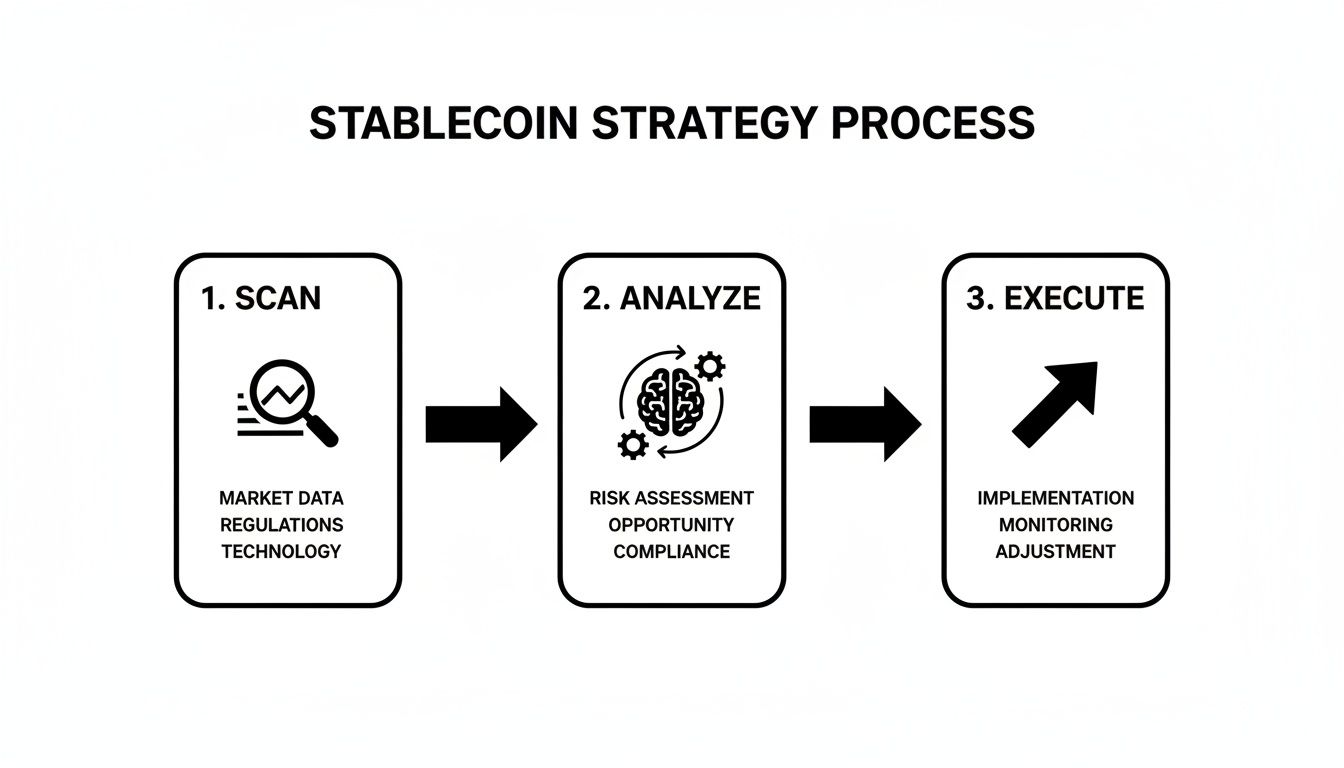
This constant loop—scan, analyze, execute—is what lets the engine react to the market in real-time. Your capital is never sitting still; it's always being put to work in the most efficient way possible.
The Data Input Layer
It all starts with data. A lot of data. This is the job of the Data Input Layer, which acts as the system’s eyes and ears. It’s constantly plugged into the DeFi ecosystem, pulling in a massive stream of on-chain information.
And we’re not just talking about the headline APY numbers you see on the front page of a protocol. The engine digs much deeper to get the full story, grabbing dozens of data points like:
Yield Metrics: What are the current and historical APYs from lending protocols, liquidity pools, and staking?
Liquidity Data: How much money is in a pool (Total Value Locked, or TVL)? Can it handle big trades without tanking the price?
Transaction Costs: What are the real-time gas fees? There’s no point in a high-yield strategy if gas costs eat up all the profits.
Protocol Risk Scores: What are security auditors saying? Is there insurance available? The engine is looking for any red flags.
Think of this layer as the intelligence-gathering unit, collecting all the raw info needed to make smart, informed decisions.
The AI Decisioning Core
Next up is the AI Decisioning Core—the brain of the whole operation. This is where all that raw data gets crunched and turned into an actual strategy. Machine learning models chew through the information, spotting patterns, predicting where yields might be heading, and finding opportunities that match your risk tolerance.
This "brain" isn't just a simple calculator chasing the biggest APY. It’s running complex models to figure out the true risk-adjusted return for every potential move.
For instance, it might look at a flashy 25% APY on a new, unaudited protocol and decide it's not worth the risk. Instead, it might opt for a much safer 6% APY on a battle-tested protocol like Aave. If you want to see how other automated platforms are built, you can check out general explainers like how Mintline's platform works to get a feel for the architecture.
The Execution Layer
Once the AI brain has a plan, the Execution Layer steps in to get it done. These are the engine’s "hands," tasked with carrying out the strategy on-chain. This layer is all code, interacting directly with DeFi smart contracts to perform every necessary action.
That could mean a few different things:
Depositing USDC into a lending protocol.
Pairing up assets to provide liquidity to an automated market maker (AMM).
Bridging funds to another blockchain to snag a better yield over there.
This layer moves with a speed and precision no human could ever hope to match, always optimizing for the lowest gas fees and avoiding slippage. That raw efficiency is a huge reason why an automated approach almost always beats managing things by hand. We dive deeper into this in our guide to https://www.yieldseeker.xyz/blog/algorithmic-yield-routing.
The Risk Management Framework
Watching over everything is the Risk Management Framework. This is your capital's "guardian angel," providing a constant layer of protection. It’s basically a set of automated tripwires and safety protocols designed to handle the wild west of DeFi.
A key function of this framework is constant monitoring. If a protocol's TVL suddenly drops or on-chain data suggests a potential vulnerability, the system can be programmed to automatically withdraw funds to safety, long before a human might even notice a problem.
This framework also handles the initial vetting process, making sure the engine only ever interacts with audited, reputable platforms in the first place. It’s a combination of proactive security and reactive defense that makes automated yield farming not just profitable, but sustainable over the long haul.
Common Automated Stablecoin Strategies
A stablecoin strategy engine is only as good as the playbook it can run. The tech is cool, but the real magic is how the engine puts your capital to work. These automated strategies are built to hunt for yield across the entire DeFi ecosystem, constantly shifting based on live data to squeeze out the best returns while keeping risk in check.
Think of it like having a whole toolkit of advanced investment strategies at your disposal. But instead of you having to manually pick the right tool for the job, the engine flawlessly switches between them—or even uses several at once—to stay ahead of the market.
Let's break down the most common moves these engines make.
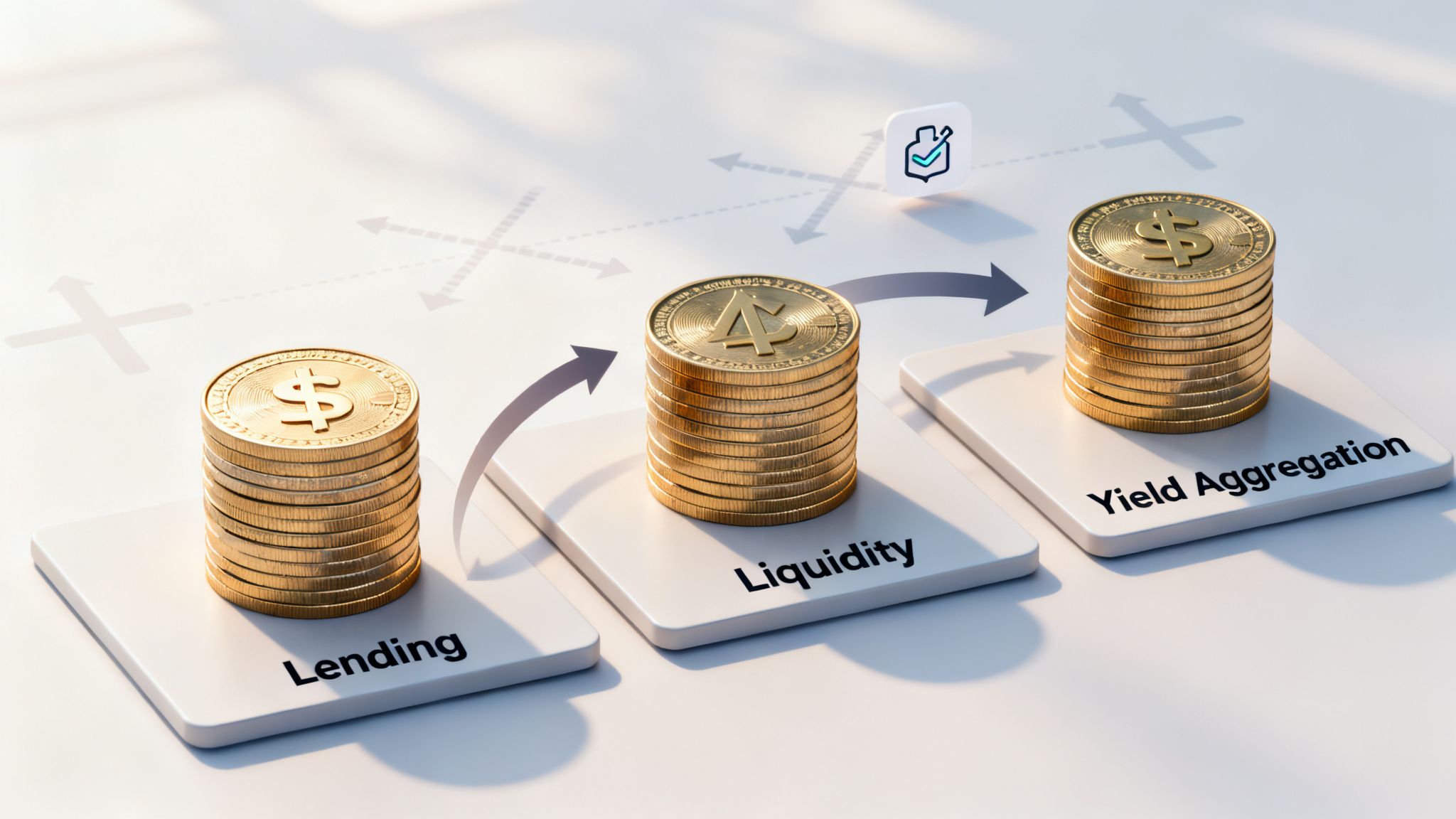
Dynamic Lending and Borrowing
This is the bread and butter for most engines and the easiest concept to grasp. In DeFi, you can earn interest by lending your stablecoins to protocols like Aave or Compound, where other people borrow them. The interest rates, or APYs, on these platforms aren’t set in stone; they bounce around constantly based on supply and demand.
The engine essentially becomes a professional "rate chaser" on your behalf. It keeps a constant eye on lending rates across multiple, trusted protocols.
If Aave is offering 6.5% APY on USDC and Compound is at 6.2%, your funds go to Aave. Simple.
But if market conditions change and Compound’s rate suddenly spikes to 7.1%, the engine instantly moves your capital over to capture that higher yield. It even calculates transaction costs to make sure the switch is actually profitable.
This constant shuffling ensures your stablecoins are always parked in the highest-earning spot available in top-tier lending markets, without you lifting a finger.
A strategy engine doesn't just find a good rate; it finds the best available rate at any given moment and acts on it instantly. This completely removes the need for manual monitoring and the FOMO of missing out on short-lived yield spikes.
Intelligent Liquidity Provisioning
Another core DeFi money-maker is providing liquidity to Automated Market Makers (AMMs) like Uniswap or Curve. You deposit a pair of assets—often two different stablecoins, like USDC and DAI—into a "liquidity pool" and earn a slice of the trading fees every time someone swaps between them.
While this sounds great, it carries a unique risk called impermanent loss. This is where a smart engine really proves its worth by actively managing that risk.
Optimal Pool Selection: The AI sifts through data on trading volume, pool depth, and fee structures to pinpoint the most profitable and stable pools to enter.
Concentrated Liquidity Management: On newer AMMs like Uniswap V3, the engine can manage your liquidity within tight price ranges. This is a game-changer for maximizing fee generation while minimizing your exposure to price swings.
Risk Monitoring: The system is always on alert, watching for signs of pool imbalance or other risks. If conditions turn sour, it can pull your liquidity out before any significant damage is done.
This turns liquidity provisioning from a passive, set-and-pray activity into a actively managed and optimized income stream. If you want to dive deeper into the basics, checking out stablecoin yield farming is a great start.
Automated Yield Aggregation and Compounding
Yield aggregators, like the well-known Yearn Finance, are protocols designed to automatically compound your earnings. Instead of you having to manually claim rewards and redeposit them (and paying gas fees each time), these platforms do it all for you in a super-efficient way.
A stablecoin strategy engine adds another layer of intelligence on top of this. It doesn't just use these aggregators; it decides which aggregator is offering the best risk-adjusted return at any given moment.
Your funds might be in a Yearn vault one week, but if another aggregator's strategy starts outperforming it, the engine will shift your capital over. It’s a meta-level of optimization, ensuring your money is always benefiting from the most powerful and efficient compounding machine in DeFi.
Who Actually Uses a Strategy Engine?
It’s easy to think a stablecoin strategy engine is some complex piece of kit built only for crypto whales or full-time traders glued to their screens. But that’s a huge misconception. The real power of these engines lies in their flexibility, opening up sophisticated DeFi strategies to a surprisingly broad audience, each with their own goals.
This isn't about high-frequency trading bots. It’s about making capital work smarter for everyone.
From absolute beginners just dipping their toes into decentralized finance to entire organizations managing hefty treasuries, automated engines are leveling the playing field. They tackle the universal headaches: not enough time, too much information, and the steep cost of a single manual mistake.
Let's break down who benefits the most.
The Ambitious DeFi Beginner
For anyone new to the space, DeFi can feel like trying to drink from a firehose. The sheer number of protocols, the confusing jargon, and the hidden risks are massive barriers. A strategy engine essentially acts as your experienced guide, handling all the messy complexity behind the scenes.
Instead of needing a deep understanding of liquidity provisioning or impermanent loss, a beginner can just deposit funds and let the AI get to work. Platforms like Yield Seeker offer a clean dashboard that shows your earnings, transforming what was once an intimidating process into a simple, passive income stream. It empowers people to tap into DeFi's potential without needing a Ph.D. in tokenomics.
The Busy Professional
Plenty of professionals are drawn to crypto but simply don't have the time to actively manage a portfolio. Their days are packed with meetings, deadlines, and real-world responsibilities, leaving no bandwidth for constantly monitoring APYs and shuffling funds around.
This is where the "set-and-forget" power of a strategy engine truly shines. A busy doctor, lawyer, or software engineer can allocate a portion of their capital and trust the engine to optimize it 24/7. It’s a powerful way to put their money to work in the background, generating yield while they focus on what they do best.
The engine becomes a tireless financial employee, automating the tactical, moment-to-moment decisions of yield farming. This frees up the user's most valuable asset—their time—to focus on high-level strategic financial planning.
The Web3 Treasury Manager
DAOs, crypto startups, and other Web3 organizations often hold a big chunk of their reserves in stablecoins. Letting that capital sit idle is a huge missed opportunity, but actively managing it is a full-time job that comes with serious operational risk.
A strategy engine provides a professional-grade solution for treasury management. It allows a DAO or startup to generate a steady, low-risk yield on its operational runway, helping to offset burn and extend its longevity. The recent explosion in stablecoin adoption makes this crystal clear; with volumes hitting $46 trillion last year, these assets are now a core part of financial operations. This growth is exactly what fuels the demand for AI-driven engines that offer transparent, risk-managed yield for treasuries.
The Experienced DeFi Power User
Even the most seasoned DeFi veterans can benefit from smart automation. Professionals in demanding crypto trader roles know their expertise is best spent on big-picture strategy, not repetitive manual tasks.
An engine automates all the tactical grunt work they’d otherwise do by hand—like rebalancing across lending protocols or managing concentrated liquidity positions. The efficiency gain is massive. It frees up their mental energy to research new protocols, spot emerging market trends, and make bigger, more impactful decisions, leaving the daily grind to the algorithm.
Understanding the Risks and Rewards
Let's be real: no investment is a guaranteed win, and that's especially true in the wild world of automated DeFi. A stablecoin strategy engine can definitely open the door to some powerful returns, but you have to walk in with your eyes wide open, fully aware of both the rewards and the risks. The goal isn't to blindly trust an algorithm; it's to understand the trade-offs it's making for you.

This means you need a solid framework for judging any automated platform. We'll break down the key performance numbers that actually matter and the hidden dangers you need to watch out for. Only then can you make confident decisions about where you put your money.
Decoding the Real Rewards
It's way too easy to get mesmerized by the huge, flashy Annual Percentage Yield (APY) numbers that DeFi protocols love to advertise. A smart stablecoin strategy engine, however, looks right past those vanity metrics to calculate what actually hits your bottom line.
Here’s what you should really be looking at:
Net APY: This is the money you actually keep after all fees are taken out. It accounts for platform fees, transaction costs, and anything else, giving you the true picture of your earnings.
Risk-Adjusted Returns: A sky-high yield is worthless if it comes with a terrifying amount of risk. This metric weighs the potential return against the danger involved, always favoring safer, sustainable yields over a risky gamble.
Performance vs. Benchmarks: A good engine should consistently do better than simple "set-it-and-forget-it" strategies, like just parking your stablecoins in a top lending protocol like Aave. This comparison shows you the real value the automation is adding.
The real prize of a stablecoin strategy engine isn't just a bigger APY. It's getting a better risk-adjusted return with almost zero effort, freeing up your time and mental space while your capital works smarter for you.
Confronting the Inherent Risks
Getting a handle on the potential downsides is every bit as important as chasing the rewards. The DeFi space is still young and messy, which means certain risks are always part of the game. A top-tier engine can't make these risks disappear, but it can—and should—work tirelessly to minimize them.
The sheer scale of the stablecoin ecosystem shows you what's at stake. In 2025, transaction volumes blew past a mind-boggling $33 trillion, a 72% jump from the year before. This shows just how vital these assets have become. Platforms like Yield Seeker operate right in the middle of this high-stakes environment, which makes managing risk their number one job. You can dig into more of these stablecoin statistics at Stablecoin Insider.
Key Risks to Understand
When you're using any DeFi product, including an automated engine, you need to be aware of three main types of risk.
Smart Contract Risk: Every single DeFi protocol runs on smart contracts—basically just code on the blockchain. If there's a bug or a vulnerability in that code, it could be exploited, and funds could be lost. The best engines fight this by only interacting with heavily audited, battle-tested protocols that have a long and proven security track record.
De-Peg Risk: A stablecoin is only as good as its peg to an asset like the U.S. dollar. In moments of extreme market chaos, a stablecoin can lose that peg and trade for less than $1. To protect against this, top engines diversify across multiple, high-quality stablecoins (like USDC and USDT) so they aren't overly exposed to any single one.
Systemic and Market Risk: This is the big-picture stuff—things like insane network congestion that sends gas fees to the moon, or a major protocol collapsing and causing a domino effect across the market. An engine's constant on-chain monitoring and automated triggers are your best defense here, allowing it to quickly pull funds from dangerous situations like an early warning system.
Frequently Asked Questions
Jumping into automated finance is exciting, but it's natural to have questions. A good stablecoin strategy engine should be completely transparent, and getting solid answers is the only way to make a smart decision. Here, we'll tackle the most common questions we hear about security, costs, control, and how this all fits into the bigger DeFi picture.
The idea is to give you straight-up answers that cover the practical details, so you can feel confident before putting any of your capital to work.
How Does a Strategy Engine Keep My Funds Safe?
Security isn't just a single feature; it's a whole system of layers designed to protect your assets from every angle. Any top-tier engine puts safety above everything else, and that starts with the DeFi protocols they even consider working with.
Protocol Vetting: First off, they only connect with heavily audited, battle-tested DeFi protocols. We're talking about projects with a long, reliable track record. New or unaudited platforms are a no-go, no matter how juicy their advertised APYs look.
Continuous Monitoring: The system is constantly watching on-chain data for anything that looks out of place. This could be a sudden nosedive in a protocol's liquidity or weird transaction patterns that might signal a risk.
Automated Safeguards: If a potential risk pops up, many engines have automatic triggers that can instantly pull funds out of a questionable protocol. They move the assets to safety before a bad situation gets worse.
But here’s the most important part: your funds are almost always held in non-custodial smart contracts. This is a massive security feature. It means only you, with your private key, can authorize a complete withdrawal from the platform. The engine can shift funds between approved strategies, but it can never just take off with them.
What Are the Typical Fees Involved?
The fee structure for a stablecoin strategy engine is usually designed to be simple and align the platform's success with yours. Instead of hitting you with upfront access fees, most run on a performance-based model.
This means the platform takes a small slice of the yield it generates for you, which typically lands somewhere between 10% to 20%. It’s a powerful model because it means the platform is laser-focused on performing well—they only make money when you make money.
You generally won't find deposit or withdrawal fees. It's worth remembering, though, that you are still on the hook for the blockchain's network transaction costs (gas fees) for any on-chain moves.
Can I Withdraw My Funds at Any Time?
Yes, absolutely. One of the biggest perks of using a stablecoin strategy engine is liquidity. Your funds aren't locked up like they might be in a traditional bank CD or some DeFi staking protocols that demand a long commitment.
You can start a withdrawal whenever you want. The engine is built to automatically pull your capital from the various positions it’s managing across DeFi and send it straight back to your wallet. This flexibility means you're always in control and can get to your funds when you need them.
How Is This Different From a Yield Aggregator?
This is a fantastic question because people mix these two up all the time. While both a strategy engine and a yield aggregator want to boost your returns, a strategy engine is playing a much more dynamic and intelligent game.
A standard yield aggregator, like Yearn Finance, mostly focuses on auto-compounding rewards inside a single, pre-set strategy. For instance, it takes the rewards you earn from a liquidity pool and automatically plows them back into that same pool to maximize your compounding. It's a great tool, but it's pretty static.
A stablecoin strategy engine is more like an active portfolio manager. It doesn’t just stick to one thing; it actively rebalances your entire capital base between completely different types of strategies.
For example, the AI might decide that current market conditions are better for lending. It could then pull your funds out of a liquidity position on Curve and shift them into a lending spot on Aave to chase a better risk-adjusted return. This active, cross-strategy management based on real-time market data is the key difference that sets an engine apart.
Ready to put your stablecoins to work without the manual grind? Yield Seeker offers an AI-powered platform that finds competitive, risk-aware yields for you. Deposit as little as $10 and let your personalized AI Agent handle the rest. Start earning smarter today at Yield Seeker.