

Stablecoins are sold as the safe, boring corner of the crypto market, but don’t let the calm exterior fool you. Underneath, there's a tangled mess of risks that can trip up even experienced investors.
Getting your head around these risks isn't just about dodging a complete wipeout; it’s about making smart choices to protect your hard-earned capital. This guide is your map through the danger zone.
Why Understanding Stablecoin Risks Matters Now
I like to think of stablecoins as different kinds of money changers. Some are like the transparent teller at a high-street bank, swapping your dollars one-for-one with reserves you can actually verify. Others are more like a shady dealer in a back alley, making big promises with very questionable backing. As the DeFi market continues to mature in 2026, knowing who you're dealing with is everything.
The appeal is obvious, right? You get the price stability of good old-fashioned money combined with the speed and borderless nature of crypto. It's a powerful mix, making stables the foundation for everything from trading to stablecoin investing for yield. But that convenience can hide some serious weak spots.
The Core Dangers to Watch For
To get started, it helps to put the threats into a few main buckets. Most of the problems you'll run into stem from one of these potential points of failure:
Depegging Risk: This is the big one. It's the risk that a stablecoin breaks its 1:1 promise, dropping below its dollar value.
Reserve Failure: The issuer’s piggy bank might not be as full as they claim. The risk is that their assets aren't there, are poorly managed, or can't be sold fast enough to pay everyone back in a "bank run."
Regulatory Shifts: The classic wild card. A sudden government crackdown could freeze assets, make a stablecoin illegal to use, or shut down an issuer overnight.
The entire stablecoin market is incredibly lopsided. US dollar-pegged tokens now make up over 99% of the total market capitalization. This means a single major failure could send shockwaves through the whole crypto ecosystem.
Think of this as setting the stage. We’re about to pull each of these concepts apart, piece by piece, using real-world examples to show you exactly what to look for.
As we go, we'll dissect each risk, look at meltdowns from the past, and give you a simple framework for making safer choices. The goal is to arm you with the confidence to tell the difference between a solid financial tool and a disaster waiting to happen.
Deconstructing the Core Stablecoin Risks
Before you can safely earn yield on stablecoins, you have to know what can go wrong. While they’re often sold as a simple bridge to the dollar, the truth is they are complex financial machines with plenty of moving parts—and several ways to break.
I find it helps to break the dangers down into four main buckets. Each one is a different kind of problem, and you need to look at a stablecoin through a different lens to spot them.
This graphic gives you a quick visual on the difference between the main types. You can see right away that some are built like a fortress while others are more like a house of cards.
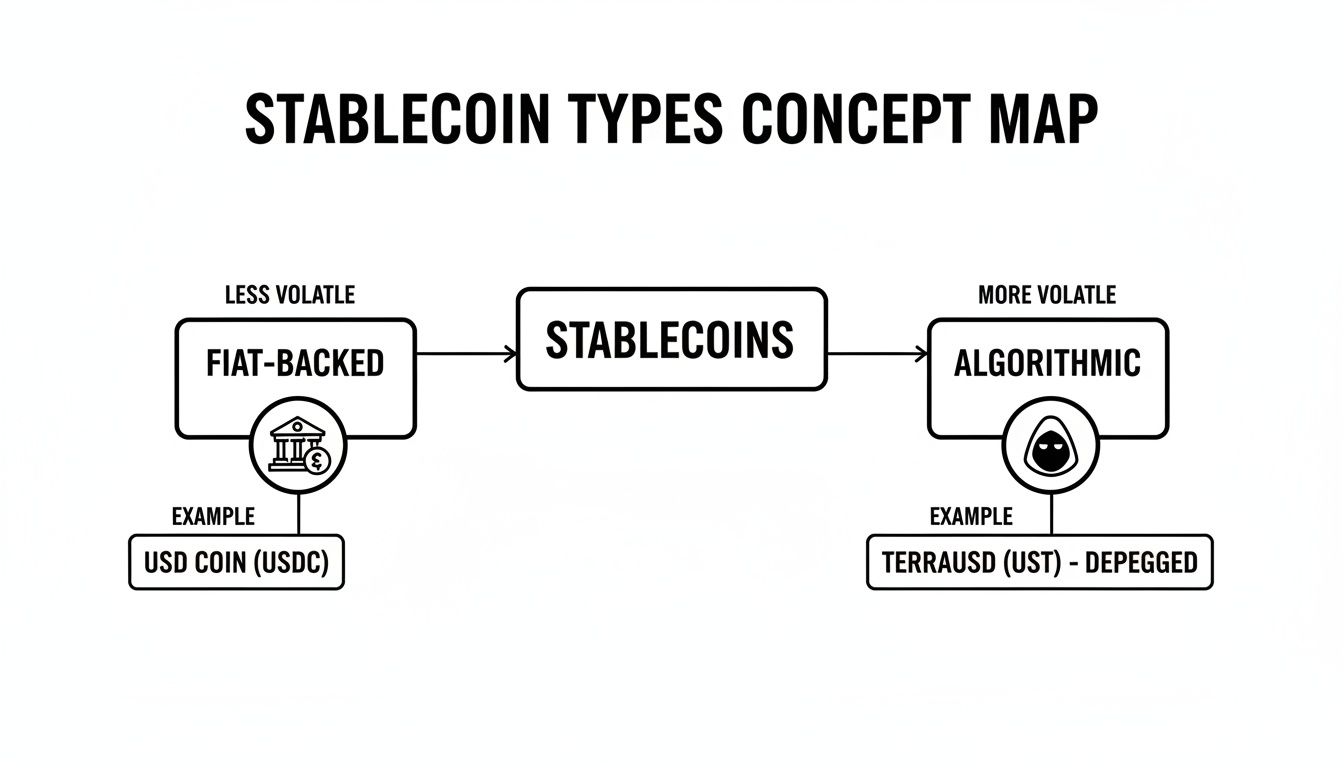
As you can tell, not all stablecoins are created equal.
Peg Risk: When The Anchor Drags
First up, the most obvious danger: peg risk. This is the risk that a stablecoin simply fails to hold its 1:1 value with its pegged asset, which is almost always the U.S. dollar.
Imagine you have a casino chip that's supposed to be redeemable for exactly $1. Peg risk is what happens when you go to cash out, but the cashier says they can only give you $0.80 for it. That's a de-peg.
This can happen for a few key reasons:
Panic selling kicks in and everyone rushes for the exits at once.
The assets backing the stablecoin suddenly drop in value.
The code meant to stabilize the price (especially for algorithmic types) just breaks under pressure.
A tiny, temporary dip below $1 isn’t the end of the world. But a sustained de-peg usually signals a much deeper problem.
Counterparty Risk: The Vault Is Emptier Than You Think
Next is counterparty risk. This one is all about the issuer—the company or DAO that mints the stablecoin and is supposed to be managing the reserves. You are placing your trust in them to actually hold the collateral that backs every single token.
Think of it as the risk that your bank manager is either shady or just bad at their job. The issuer might mismanage the funds, gamble on risky investments that go south, or simply be unable to handle a flood of redemptions in a crisis.
This is where the classic "bank run" scenario comes into play. If too many people try to cash out their stablecoins for dollars at the same time and the issuer can't pay up, confidence shatters, the peg breaks, and the whole system can implode.
This is why transparency is everything. An issuer that provides regular, detailed, and third-party-audited reports on its reserves is taking this risk seriously. Vague promises or a history of run-ins with regulators are massive red flags. And always remember to consider the reality of cryptocurrency fraud, which absolutely extends to issuers misrepresenting their reserves.
Smart Contract Risk: A Flaw In The Code
Even with a solid peg and a trustworthy issuer, you’re still exposed to smart contract risk. This is a huge one, especially if you’re using your stablecoins in DeFi. Stablecoins are built on code, and that code controls everything.
This is like owning a high-tech vault with a bug in its digital lock. If a hacker finds that vulnerability, they could potentially drain the funds, freeze assets, or mess with the entire system.
And it’s not just the stablecoin’s own code you have to worry about. Every single DeFi protocol you deposit your stables into—lending platforms, DEXs, yield farms—has its own smart contracts. A bug in any one of them can lead to a total loss of your funds, even if the stablecoin itself is perfectly safe.
Regulatory Risk: The Rules Suddenly Change
Finally, there’s regulatory risk. This is the wild card of government intervention. Since stablecoins sit at the crossroads of traditional finance and crypto, they are a huge target for regulators.
It’s like owning a plot of land and the government suddenly changes the zoning laws, making it worthless overnight. That’s regulatory risk in a nutshell.
Here’s what that could look like:
Frozen Assets: A government could force an issuer like Circle (USDC) to blacklist certain wallet addresses, freezing the funds inside.
New Rules: New laws could demand stricter reserve requirements, potentially putting some issuers out of business.
Outright Bans: A country might decide to ban a specific stablecoin, crushing its value and usability in that region.
This risk is highest for centralized, fiat-backed stables, since the companies behind them are registered entities and easy for governments to lean on.
Key Stablecoin Risks at a Glance
To tie it all together, here's a quick cheat sheet that summarizes the four horsemen of stablecoin risk. It’s a good way to quickly frame how you should think about a stablecoin’s potential weak points.
Risk Type | What It Is | Common Cause | Threat Level |
|---|---|---|---|
Peg Risk | The stablecoin loses its 1:1 value (e.g., drops to $0.95). | Mass sell-offs, reserve issues, broken algorithms | High |
Counterparty Risk | The issuer fails to honor redemptions or mismanages reserve assets. | Lack of transparency, fraud, poor management | High |
Smart Contract Risk | A vulnerability in the code is exploited, leading to theft or loss of funds. | Bugs, hacks, or exploits in DeFi protocols | Medium-High |
Regulatory Risk | A government action negatively impacts the stablecoin's operation or value. | New laws, asset freezes, or outright bans | Medium |
Keeping these four risks in mind is the first step. Next, we’ll look at how to actually spot these dangers in the wild before they become a problem for your portfolio.
Learning from Crypto's Costliest Mistakes

Talking about risk in theory is one thing, but nothing hits home like watching billions of dollars vanish in a matter of days. To really get why understanding stablecoin risks is so crucial, you have to look back at the real-world blow-ups.
These stories aren't just for scaring people. They're a playbook for what to watch out for—how flimsy designs, hidden problems, and pure market panic can create the perfect storm.
The Algorithmic De-Peg: TerraUSD's Death Spiral
The most notorious collapse, of course, was TerraUSD (UST). Unlike stablecoins backed by cash or bonds, UST was an algorithmic stablecoin. It was designed to hold its $1 peg using a clever, but ultimately brittle, balancing act with its sister token, LUNA.
Imagine a seesaw. If UST’s price fell below $1, the system let users "burn" UST to "mint" an equivalent $1 worth of LUNA. This was supposed to drive UST's price back up. If UST went over $1, it worked the other way around.
This mechanism held up, right until it didn't. In May 2022, a few massive withdrawals started to test the peg, and as UST wobbled, panic took over.
This kicked off a "death spiral." The more UST’s price dropped, the more LUNA was minted to defend the peg. This insane inflation crashed LUNA's price, which shattered all confidence and caused even more people to dump UST. That, in turn, minted even more worthless LUNA.
The aftermath was an absolute catastrophe. TerraUSD, once a major player with a market cap over $18 billion, completely imploded. The collapse vaporized nearly $40 billion from its ecosystem. As this detailed analysis of the stablecoin landscape shows, by May 13, 2022, UST was trading at just $0.30, and over 200,000 investor wallets were wiped out.
The Terra/LUNA crash became crypto’s "Lehman Brothers moment." It proved that an algorithmic stablecoin is only as stable as the market’s belief in it—a foundation that turned out to be built on sand.
Even Fiat-Backed Giants Can Stumble
While algorithmic models have their own special kind of fragility, even the big fiat-backed stablecoins aren't bulletproof. We’ve seen them lose their footing, proving that even a 1:1 backing with real assets can't always save you from market stress.
Just look at Tether (USDT), the biggest stablecoin out there. It has de-pegged temporarily multiple times, usually triggered by widespread market fear or fresh doubts about the quality of its reserves.
For example, when the market gets really choppy, traders often scramble out of USDT and into what they see as safer bets, like USDC. This wave of selling can swamp the market makers, pushing USDT’s price down to $0.98 or even lower on some exchanges.
These events teach a couple of critical lessons:
Perception is reality. In a panic, what the market believes about an issuer's reserves matters just as much as what's actually in the bank.
Liquidity is king. If an issuer can't handle a sudden rush of redemptions, fear will drag the price down, no matter how good the balance sheet looks on paper.
Sure, these de-pegs were short-lived and USDT always found its way back to a dollar, but they're a sharp reminder. No stablecoin is a "set it and forget it" asset. Even the titans can wobble, which makes constant monitoring and a solid understanding of stablecoin risks non-negotiable for anyone in this space.
The Hidden Risks of Transparency and Centralization
After the chaos of algorithmic stablecoins blowing up, it's easy to see why so many people have run to the perceived safety of fiat-collateralized tokens. The logic feels solid, right? If there’s a real dollar sitting in a bank for every digital dollar out there, what could possibly go wrong?
Well, that line of thinking skips over two massive, intertwined risks with centralized stablecoins: transparency and censorship.
The promise of a 1:1 backing is only as good as the proof. When an issuer tells you their reserves are solid, that’s one thing. When they show you, that's something else entirely. This is where you run into the huge difference between a flimsy "attestation" and a proper, independent financial audit.
An attestation is often just a snapshot in time. It might confirm the issuer has enough assets on a specific day, but it rarely dives into the quality or liquidity of those assets.
Think of it this way: an attestation is like a builder showing you a bank statement from last Tuesday to prove they have the cash to finish your house. A full audit is like your accountant going through all their books, verifying every dollar, and making sure they can actually access the money when they need it. One gives you a vague sense of security; the other gives you real confidence.
The Problem of Opaque Reserves
No stablecoin has lived under a bigger shadow of this risk than Tether (USDT). For years, its market dominance has been dogged by questions about what really backs it. These aren't just minor worries from crypto nerds; these transparency gaps have led to major run-ins with regulators.
The situation blew up in 2021 when Tether settled with the U.S. Commodity Futures Trading Commission (CFTC) for a cool $41 million over misleading claims. They had consistently said every USDT was backed 1:1 by U.S. dollars. But the investigation found that at times, only 27.6% of its reserves were actual cash. The rest was a murky mix of commercial paper, loans, and other investments. This analysis of the shifting stablecoin market highlights just how wide the gap was between their marketing and reality.
The lesson here is simple but critical: you have to demand proof you can actually verify. Blind faith in an issuer's word is a bet you don't want to make.
Comparing USDT vs. USDC Transparency and Reserves
To really grasp this, it helps to put the two biggest players, USDT and USDC, side-by-side. They both aim for a $1 peg, but their approach to transparency and what's in their treasury couldn't be more different.
Feature | Tether (USDT) | USD Coin (USDC) |
|---|---|---|
Reserve Composition | A mix of cash, U.S. Treasury Bills, money market funds, and historically, riskier assets like commercial paper. | Primarily backed by cash and short-term U.S. government obligations (Treasury Bills). Disclosed monthly. |
Audit/Attestation | Provides monthly "attestations" from accounting firms, but not full, detailed audits. | Provides monthly attestations from a top accounting firm (Grant Thornton LLP). Historically clearer composition. |
Historical Transparency | Faced regulatory action (e.g., CFTC settlement) for misrepresenting its reserves. | Generally more transparent, though like any centralized entity, it relies on trust in its reporting and auditors. |
As you can see, USDC has generally taken a more conservative and transparent path. Tether has improved over the years, but its history serves as a permanent reminder to always check the fine print.
The Other Side of the Coin: Censorship Risk
If a lack of transparency is one side of the centralization coin, the other is its exact opposite: the absolute power to control and freeze your funds.
Centralized issuers like Circle (the company behind USDC) are registered financial businesses. That’s great for regulatory compliance, but it also means they have to follow government orders. And that includes freezing assets.
This isn’t some far-off, theoretical risk. It’s already happened.
Following the U.S. Treasury's sanctioning of Tornado Cash in 2022, Circle instantly froze over 75,000 USDC sitting in wallets linked to the service. While they were legally obligated to do it, the move sent a shockwave through DeFi. It was a cold, hard reminder that your "decentralized" money could be switched off by a central party.
This leaves you with a fundamental trade-off. The same centralized structure that allows for audited reserves and regulatory peace of mind also gives the issuer—and by extension, governments—a kill switch on your money.
What Questions You Must Ask
So, you're at a crossroads. When you pick a stablecoin, you have to weigh the risk of shady reserves against the risk of censorship. To make a smart choice, you need to ask some tough questions before you put your capital on the line:
What truly backs this coin? Forget the marketing slogans. Dig into the reserve reports. Is it mostly cash and U.S. Treasuries, or is it filled with riskier corporate debt?
How is the backing proven? Are they publishing monthly attestations or full-blown audits from a big-name firm? More detail and more frequency are always better.
Who can control my funds? Find out the issuer's legal home base. Do they have the technical power to blacklist a wallet and freeze assets? If the answer is yes, you are taking on censorship risk, plain and simple.
At the end of the day, there’s no such thing as a perfectly safe, risk-free stablecoin. Your job is to peel back the layers, understand these hidden trade-offs, and pick the one with a risk profile you can live with.
A Practical Framework for Assessing Stablecoin Risk

Knowing the theory behind why stablecoins fail is one thing, but it’s pretty useless if you don’t have a practical game plan. To get a real handle on understanding stablecoin risks, you need a solid method to vet them yourself. This isn't about being a passive user; it's about becoming an informed investor who can spot red flags and protect their capital.
Think of it like being a detective. Your job is to pull together clues from different places to build a full picture of a stablecoin’s health. A single piece of evidence won’t cut it—you have to connect the dots between the quality of its reserves, its real-time behavior on the market, and the security of the protocols you use.
Investigate the Issuer's Reserves
First things first, you need to dig into the issuer’s own transparency reports. Don’t just look at the headline number. The devil is always in the details of what’s actually backing the coin.
Look for high-quality, liquid assets. U.S. Treasury Bills are the gold standard here. They’re safe and can be sold in a heartbeat. Cash and reverse repurchase agreements are also top-tier collateral.
Be wary of vague categories. If you see terms like "other investments" or "corporate bonds" without a clear breakdown, that’s a red flag. Those buckets can hide all sorts of riskier assets. The more specific, the better.
Check the frequency and source. Monthly attestations from a reputable accounting firm like Grant Thornton are a great sign. Annual reports or, even worse, self-reported data don't give you nearly the same level of confidence.
Monitor Real-Time On-Chain Health
Next, take your investigation on-chain. This is where the rubber meets the road, showing you how the stablecoin is actually behaving in the wild, far away from any polished reports. Public dashboards on platforms like Dune Analytics are your best friend for this.
There are two key metrics you’ll want to keep an eye on:
Peg Stability: Track the stablecoin's price against peers like USDC or DAI. A healthy stablecoin should trade in a tight band right around $1.00. If you see it consistently dipping below $0.995, that’s a clear warning sign of stress.
Liquidity: Check how deep the liquidity pools are on major DEXs like Curve or Uniswap. If liquidity is thin, even a moderately large sale could knock the stablecoin off its peg and trigger a death spiral.
A stablecoin’s health isn't just about its reserves; it's about the market's confidence in those reserves. On-chain data is your direct window into that confidence, showing you how traders are voting with their money in real time.
Vet the DeFi Protocol Itself
Even the safest stablecoin in the world won’t save you if you deposit it into a sketchy DeFi protocol. Before you put your funds anywhere, you have to do your homework on the platform itself. We have detailed guides on this, like our breakdown on protocol safety analysis, but the core checklist is pretty straightforward.
Look at the protocol’s history, its security audits from well-known firms, and the track record of the team behind it. A protocol that’s been running for years without a major incident and has multiple audits is a much safer bet than some new, unaudited project promising you the moon.
Finally, the most powerful tool in your risk management toolkit is simple: diversification. Never, ever put all your eggs in one basket—not in a single stablecoin and not in a single DeFi protocol. By spreading your capital across a few different high-quality stables and battle-tested platforms, you protect yourself from a single point of failure, whether that's an issuer collapsing or a protocol getting hacked. It's a disciplined approach, but it's fundamental to staying safe and profitable long-term.
Automating Your Safety with Intelligent Tools
After walking through all the manual work it takes to properly vet stablecoins and DeFi protocols, one thing becomes crystal clear: staying safe is a full-time job. This need for constant vigilance is exactly why the smartest platforms are now using automation to do the heavy lifting, giving you a serious layer of defense without eating up all your time.
A platform like Yield Seeker, which is driven by AI, is built from the ground up to tackle the core problems of understanding stablecoin risks. It takes a safety-first approach by design, starting with the assets it chooses to handle. By sticking exclusively to fully-reserved stablecoins like USDC on secure, low-cost networks, it immediately sidesteps the most dangerous peg and counterparty risks.
Proactive Defense Against Threats
The real magic, though, is in its continuous, automated monitoring. Instead of you having to manually sift through audits and track a protocol’s health day-to-day, its AI engine does it for you. This system is designed to spot the early warning signs of a smart contract bug or any weird market behavior long before it becomes a real problem.
The big idea here is to flip security from being reactive to proactive. By spotting potential threats before they blow up, an intelligent system can automatically pull your funds out of a risky protocol, acting like a digital bodyguard for your capital.
This automated defense is a game-changer, especially when it comes to protecting against tricky technical failures. You can dive deeper into how this all works in our guide on advanced smart contract monitoring.
For the people Yield Seeker is built for—busy professionals and folks new to DeFi—this automation is everything. The platform's focus on no-lockup USDC strategies on the Base network isn't an accident. USDC has a strong institutional backing, representing 24.42% of the stablecoin market with a value of $75.61B, which gives you strong assurances you can get your money back when you need it. You can discover more insights about stablecoin market growth at Market.us.
At the end of the day, automating your safety isn't just a sales pitch; it's the logical next move for anyone serious about investing in this space. As you weigh these methods, specialized AI legal software can also offer invaluable help in making sense of the complex rules around stablecoins. For those who value both their time and their security, using intelligent tools is simply the most effective way to chase yield in DeFi.
Common Questions About Stablecoin Safety
Once you get a handle on the big-picture risks, a bunch of practical questions always pop up. It's one thing to know the theory, but another to feel confident putting your capital to work.
Let's cut through the noise and answer some of the most common questions I hear.
Is Any Stablecoin 100% Risk-Free?
Nope. Not a single one.
The goal isn’t to chase some mythical, "zero-risk" asset that doesn't exist. It's about understanding the trade-offs, picking a stablecoin with a risk profile you can live with, and managing your exposure from there.
Even the biggest, most trusted stablecoins have counterparty risk (the issuer could go bust) and regulatory risk (a government could change the rules overnight). You’re always making a choice, so it’s crucial to understand what you’re signing up for.
How Can I Track a Stablecoin's Peg in Real Time?
For a quick glance, data aggregators like CoinGecko or CoinMarketCap are your best friends. They’ll show you the stablecoin’s price against the U.S. dollar at a high level.
But if you want to see what’s happening on the ground, second by second, you need to go to a decentralized exchange (DEX) like Uniswap or an aggregator like 1inch. There you can see the live trading price against other stables like USDC, which is often where the first signs of trouble appear.
A consistent depeg of more than 1% is a massive red flag. Fleeting, tiny fluctuations are just market noise, but a sustained dip means something is seriously wrong and you need to pay attention immediately.
What Happens If a DeFi Protocol Gets Hacked?
If the protocol holding your stables gets hacked, your funds could be gone. For good. That's the brutal reality of smart contract risk.
Sure, some protocols have insurance funds or treasuries to try and make users whole, but it's never a guarantee. The payout might be slow, partial, or never come at all. This is why you absolutely must:
Stick to Battle-Tested Protocols: Only use platforms that are well-established and have gone through multiple security audits from reputable firms. Don't be the guinea pig for a new, unaudited protocol.
Don't Put All Your Eggs in One Basket: Spread your capital across different protocols. Even the one that seems the safest could have a vulnerability no one has found yet.
Do AI-Powered Platforms Eliminate All Investment Risks?
Look, a sophisticated AI platform can be a game-changer. It can automate the painstaking research, monitor for threats 24/7, and keep you in high-quality, audited opportunities. It dramatically cuts down on risk.
But it doesn't make risk disappear entirely. It's a tool for mitigation, not elimination.
Think of it like an expert co-pilot. They can navigate through storms, manage the engines, and handle emergencies far better than you could alone, making the journey incredibly safe. But you’re still in a plane, and some risks—like a sudden, system-wide event—are outside anyone's control. An AI platform manages the risks it can control, but it can’t insulate you from the entire crypto ecosystem.
Ready to earn smarter, safer yield without the full-time research? Yield Seeker uses AI to automate risk management and find competitive returns on your stablecoins. Get started in minutes.